Since
it’s unclear when Ancient Rome died, as we don’t know whether he personifies
the Byzantine empire or not, it’s hard to say how Italy’s life was afterwards.
As for your second point: that
seems about right. Basically, in very generic terms, the Treaty of Verdun (843)
broke up the Carolingian empire.
When Louis the Pious died – son
of Charlemagne – his sons began fighting for his inheritance. One son, Charles
the Bald received the Kingdom of the West Franks (France). Louis the
German received the East Franks (Germany),
and Lothair – who kept the title of Holy Roman Emperor – gained the middle
strip which included the Papal States (part of Italy) and Lorraine (part of France).
In short, it created rough boundaries that would later develop into France and
Germany, but not quite Italy yet, as it still consisted of several smaller
states at the time.
Let’s tie this back to Hetalia.
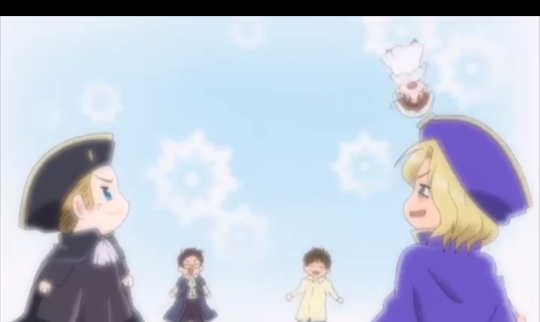
I’m pretty sure the scene you’re referring to is when Austria, Spain, Holy
Rome, and France are kicking around Chibitalia (and Romano) like they’re soccer
balls, right? This can be seen as the brothers fighting for inheritance/
dominance over the land, despite none of them receiving Venice right away,
which I’ll get into in a second. I should also mention why Spain and Austria were
there: Spain was part of the house of Hapsburg, and Austria pretty much
controlled the Holy Roman empire.
Anyways,
Venice (Italy Veneziano) was a politically independent state at the time of the
treaty. Eventually, Austria succeeded in acquiring Chibitalia. Holy Rome’s
obsession with Chibitalia has a lot to do with the fact that despite
controlling Italian territory, Venice wasn’t under his jurisdiction until
Austria assumed control over Chibitalia.
Thank you for sharing your
thoughts 🙂 Given the history, your theory is very well
supported. I definitely believe it!

 Ellawritesficssometimes