

Marriage with the nations is a lot different than
traditional, primarily Western notions of it. It arises more out of a sense of
political duty, an arranged alliance or
partnership, and sometimes it just so happens that a romance forms between
the two countries involved.
Typically, what I’ve seen is that marriage at its core in
the series involves two countries merging together, either into a co-state empire,
a co-state kingdom, or a separate sovereign nation with distinct ethnic groups
and cultures. There aren’t any ceremonies, but rather, it entails a mutual dependence
and relative respect between two political entities.
That said, it’s important to mention that two countries joining
together via annexation does not fit into this marriage equation. There’s a
difference between being conquered and subordinated and forming a mutual
union. On the other hand, that doesn’t go to say that there’s perfect equality or
power balances in marriages between nations; Austria’s control over Hungary is
a perfect example of that.
All right. Let’s go over some examples of marriages, shall
we?
Austria’s character is known for his quirky tendency to
solve his problems through marriage.

First, there was arguably his early ties with Switzerland. I’m
counting this as a marriage mainly because it involves the use of the word
partnership and honeymoon (albeit jokingly).

Notice how as soon as one tries to control the other, the partnership ends. While Switzerland does
reveal some fondness over his early memories spent with Austria, there’s
nothing particularly romantic about it, especially given the fact that they
were young children at the time. Again, marriage for them is essentially the
joining together of nations.
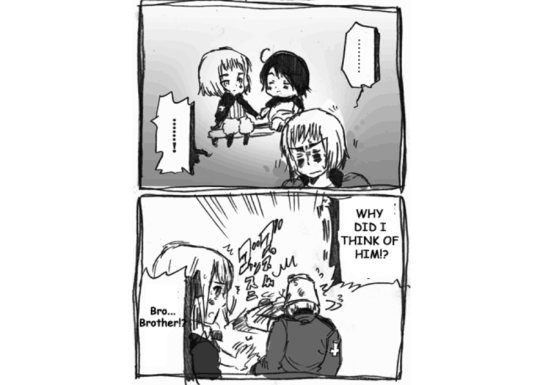
Next, Austria marries Spain via the Hapsburgs Monarchy.
Here, you actually see a hint that Spain harboured romantic feelings for
Austria during the Austrian Wars of Succession. It was a political merger
that likely later involved the development of some intimacy between the two.
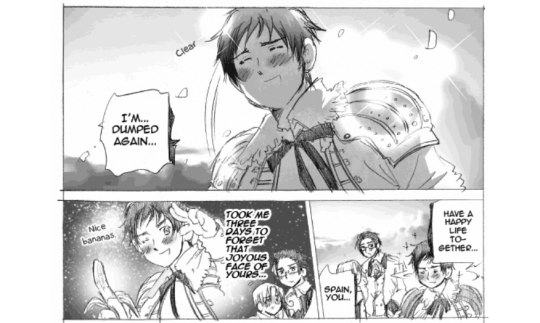

Then, you have Hungary. After the dissolution of the Austro-Hungarian
empire, it’s very heavily hinted that Austria still bears feelings for Hungary.
In Buon San Valentino, Hungary receives roses from an anonymous man that’s
conveniently described as having glasses and one hair sticking up.

On the other hand, there are marriages that involve little
or no romance at all. Take Czechoslovakia for example, two countries united by a
hyphen. Yes, that’s an actual joke in the series.
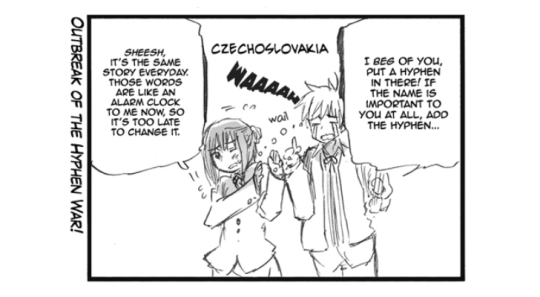
Still, what’s interesting is that when Bulgaria talks about
their separation in terms of a divorce, they’re quick to deny the claim, mainly
because of the romantic connotation marriage carries.
How I interpret this is that the two may have developed
feelings, but never told each other.
Bulgaria bringing up the topic of marriage in a casual political
sense merely may have caused them to get defensive because of these unvoiced feelings.
This isn’t confirmed, so don’t take it at canon value.

I know I’m repeating this, but it’s important that I make
this as clear as possible:
Marriage = a merger between two countries.
I say this because I’m going to apply these rules to Belarus
and Russia. Belarus wants to marry Russia and loves him to the point of obsession.
She’s even forgotten her own language at one point in favour of learning Russian.

But, does it ever say that Belarus loves Russia in a
romantic way?
No.
What it does say is that she wants to “become one” with him.
Sounds like a merger if you ask me.
When Belarus says marriage, she wants their countries to
join together. There’s nothing romantic about it, so hopefully this stops
people from misinterpreting their relationship.

In summary, marriage between the nations seems to involve a political
merger between two countries (partnership, co-ruled kingdom/empire). It can have
a romantic element to it, but this isn’t always the case.

 Ellawritesficssometimes