
This post will use attachment
theory to analyze Russia’s attachment style – how he forms relationships with
others – in adulthood. Unlike the case of Romano’s characterization [x], where
you can argue that attachment theory is actually used, this post applies
attachment theory to Russia for the sake of amusement. Although, things
strangely make a lot more sense when you look at him from this
perspective.
What is attachment theory?:

Attachment theory focuses
on the relationship between a child and their caregiver. Central to the theory
is the concept of needs. A child relies on their caregiver to protect them,
provide for them, and care for them. If all these needs are consistently met,
the child develops a healthy attachment to their parents. This healthy attachment style positively
affects both the child’s personality and their capability to establish and
maintain healthy relationships as they grow older.
However, if needs are not met at all, or are sometimes met and
at other times are not, this inconsistency causes the child to develop unhealthy attachment styles. As
such, they develop unhealthy personalities and form unhealthy relationships
with others.
The Ainsworth experiment was where this theory
originated. To test the attachment styles between toddlers and their
caregivers, they would put them in a room together at first. After a while, the
parent would leave and the child would be left on their own. Then, a stranger
would be introduced to the room and leave after the toddler had a chance to react.
The last part of the experiment analyzed the toddler’s reaction once they were
reunited with their parents again.
Being in a “strange situation” – a foreign room, absence of a
parent, and meeting a stranger [danger] – created a lot of
stress in the child. Since children seek protection from their caregivers, this
stress and fear would typically cause the child to become upset and seek
reassurance from their caregiver. It’s a survival instinct that innately kicks
in.
Those with a secure [healthy] attachment style would
cry or be upset for a bit but would be easily calmed once their caregiver
soothed them. The healthiness of this attachment style means that the child
knows that the parent is there for them – they can be relied on to satisfy
their needs.

While there are several
different unhealthy attachment styles, only one is important for this
post. An organized/ unresolved categorization is where Russia fits best. A
child with this attachment type functions better when their parent isn’t
around.
This is typically seen in
children who are abused and view their parent (s) as a source of fear. The
parent’s care is inconsistent in that they provide for the child and the child
attaches themself to them out of an instinct to survive; however, the abuse also
makes the parent the enemy. In the strange situation experiment, these children
would often approach their parent with hesitation or be paralyzed with
fear.
As adults, their attachment
system is subtle and needs to be activated. If they’ve had past traumas, such
as abuse, then they become disorganized. This often involves dissociation and
slipping in and out of consciousness. So long as they have trauma(s), they’ll
be disorganized. Sometimes, they’ll act in ways that are completely dependent
on others (activation), and at other times, they’ll be completely detached – perhaps from
reality.


What’s Russia’s attachment style?:
Russia’s organized/
unresolved attachment style, for the most part, stems from his relationship
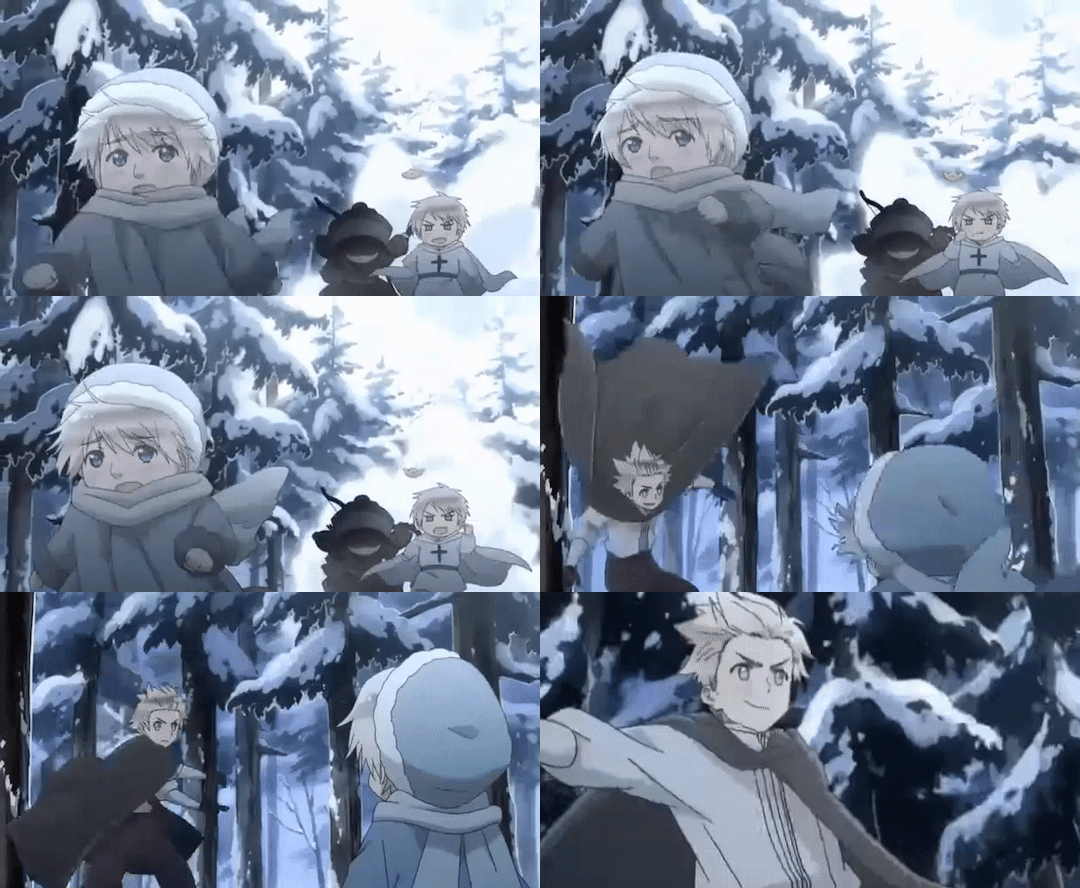
with General Winter, who acted as his parent figure. The inconsistency of
General Winter’s care for Russia is seen in how he protected Russia from
invaders and yet attacks (abuses) Russia on an annual basis [x].


It’s far
from a healthy relationship. Not to mention that General Winter wasn’t always
able to protect Russia from countries who were accustomed to colder climates,
thus adding to the inconsistency of care that Russia received.


On the other hand, General
Winter wasn’t the only one who altered Russia’s conception of what a normal
human relationship is like. Having been conquered over and over again, in this
case by the Tatars, Russia normalized unequal power in a relationship.
This is why I believe that he
rejected becoming Lithuania’s friend when they first meet as children. They
didn’t have enough “power.” Notice how Russia’s environment has completely
misconstrued how he associates and attaches himself to others. What you’ll see
is that just like General Winter, Russia will repeat this abuse once he assumes
a position of power over others.


Point is, with a character
like Russia, there is no right and wrong. He’s not evil, and he’s not good. He
can’t have morals if he doesn’t realize that what he’s doing is wrong,
especially if it’s all he’s ever learned.
As such, Russia’s
understanding of friendship is warped. He believes that everyone is his friend,
including General Winter, his abuser.

A good example of this would
be when Lithuania points out to Russia that he shouldn’t really consider the
Allies to be his friends, given how they’re all ruled by self-interest. Russia
becomes dejected at this; he truly thought that they were his friends.


Russia’s Trauma:
We also know that given
Russia’s particularly rough and bloody history, he’s carried a lot of trauma.
Ex: A happy New Year’s for him
was not freezing to death [x].


Ex: He’s had several dramatic
shifts in government [x].


Ex: His bosses have tortured him. In this example, they ask him to stop a tank with his body.


Ex: During the Stalinization
era, he’s tasked with building a canal with no food or adequate clothing while
his boss – presumably Stalin – eats in front of him and wears a parka [x].

As mentioned above, because
Russia was subjected to so much violence, it’s been normalized for him. While
this is obviously wrong, violence is how Russia’s learned to solve his
problems [x].

Although, this isn’t canon,
Russia’s heart falling out – to me – acts as a metaphor for the fact that he’s
never learned what love is, let alone experienced it. Yes, he has his sisters,
but they couldn’t always be around for him.

Russia’s Dissociation:
There are several instances
in the manga where Russia dissociates to cope with a stressful situation.
A common coping mechanism for Russia is to
imagine being in a warm place, a long-time wish of his [x].


He also appears to
disassociate when he’s threatened with punishment if he doesn’t build a steam
engine [x].

In response to Latvia’s
trembling, Russia starts shaking him around and then snaps his neck –
presumably killing Latvia temporarily. Notice how Russia doesn’t even realize
the scope of what he did [x].


Activation:
While Russia is childish –
and therefore arguably detached from reality – there are moments where his
attachment system gets hyperactivated. His
childhood trauma is kicked into overdrive, and he becomes…terrifying.
Ex: When Lithuania outsources
himself to America after WW1, Russia isn’t exactly keen to see the latter off [x].

Ex: He’s commonly spotted
hugging and squeezing Soviet countries from behind to communicate his
possession over them/ desire to possess them.


Ex: He asks Moldova to call
him older brother [x].

Ex: In the present, Russia
wonders whether the ex-Soviet countries consider him as a friend.

Obviously, given the physical
abuse they were subjected to, they’re not very keen to be close to Russia. At
the same time, they also appear to realize that how Russia experiences his
reality and relationships isn’t normal. Again, he doesn’t realize that what he
did was wrong.
Just to put things into perspective, from a criminal law point
of view, Russia probably wouldn’t be convicted for his abuse, given that he
lacks the mental capacity – mens rea – to fully understand what he did.
In sum, Russia’s not an inherently
evil figure that maliciously inflicts abuse onto others. Instead, he’s a character
who has experienced his fair share of evil, and because it’s all he knows, he
inflicts this same evil on others. Of course, none of this pardons or justifies
his past actions, but hopefully it gives perspective into why he acts the way
that he does.


 Ellawritesficssometimes