

What this post aims to
do is examine the ways in which the nations are impacted by the chronicity of
the wars they’ve endured as well as the coping mechanisms that they employ to bear
these hardships. Aside from the predictability of physical pain and illness,
there is a disturbing sense of normalization and domesticity in how the nations
negotiate their lifestyles in war. It’s
maladaptive.
That said, let’s go over
some examples.
Physical Pain and Illness:
The most obvious impact
of war and political struggles—both
domestic and international—is the physical strain that it puts on a nation’s body.
Ex: During the Second World War, Germany and Italy are both taken as
prisoners of war. Germany compares the pain of torture to a mosquito bite, as
his daily life is far more painful.

Ex: England falls ill on several occasions following major political conflicts
(e.g., the American Revolution, the Napoleonic Wars, World War II) [x].

Ex: China complains of body aches, stemming from political infighting
in his country [x] [x].


Sense of Helplessness:
Of course, smaller
powers are rendered vulnerable and pliable to the discretion of larger powers.
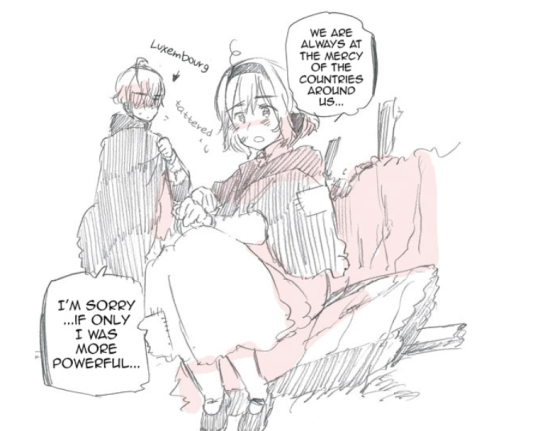
Ex: Belgium and Luxembourg discuss their inability to protect themselves
during both World Wars [x].
Ex: The conditions that Russian soldiers experienced were so bad that
Russia becomes ecstatic when Germany takes him as a prisoner of war. He
compares the German POW camps to heaven.


Ex: England’s normalized being captured by
the Axis and pre-preemptively brought a spare change of clothes [x].


Suspicion and Hostility:
War is a breeding ground
for distrust and betrayal. As such, the nations must always be ready to fight
for their lives, even in seemingly innocuous circumstances.
Ex: When the two first
meet in World War I, Germany second guesses himself several times on whether
Italy poses a threat to him.


Ex: Russia shares his tea
ration with England. While skeptical at first, England accepts. The sweetness
of the tea initially causes England to conclude that Russia poisoned him. What
matters here is the fact that England rationalized this outcome as a legitimate
possibility…[x].


Domesticity, Normalization, and Adaptation:

As horrible and gruesome
as war may be, there are still moments where the nations are able to enjoy
themselves and share a good laugh. The problem, then, is that having had
experienced countless wars, the nations bring the domestic into the world of
war—i.e., war becomes their home and the private
and public sphere divide becomes muddled.
Ex: England drinks tea in
the middle of the battlefield. Trivial as this may appear, on a latent level,
he’s attempting to include a routine and sense of normalcy in an environment
that is otherwise chaotic and unpredictable.

Ex: After infiltrating
America’s war camp, Prussia teases Germany for his impression of an American.


Ex:Having just occupied
Rome, America asks the terrified Italy Brothers if they could make him
authentic Italian cuisine [x].
The casualness in the way
America speaks is disturbing considering that from his perspective, taking over
another country is normal. It’s not
something that should produce fear but rather should be accepted as is. He
doesn’t consider the Italy Brothers to be his personal enemies. The personal is not political in this case.

Relief:
The best nations that
illustrate the burdens of war are those who have passed on. Rome and Germania
visit Earth together and upon reflecting on their lives, they reach a similar
conclusion: death gave them a sense of liberation.
They’re no
longer bound by their bosses’ orders and aren’t forced to participate in wars
they have no interest in being involved in [x].


 Ellawritesficssometimes