I honestly find it so
rude when people leaving the fandom say that it’s dead. As long as there’s
people still in it and content is being created, there’s no basis for that
claim.
How I see it is that
you should join a fandom because you enjoy
it, not whether a ton of people enjoy it.
Ever notice
how in the strips there’s slivers here and there that make mention of Japan’s clairvoyance
abilities?
What I find
to be pretty fascinating is that this lesser-known side of Japan has subsequently
been built on from way early in the series. Not only that, but you can still
find hints of it in the more recent strips.
What is clairvoyance?
Basically, clairvoyance
is ESP (extra-sensory perception). The context here has more to do with mind-reading
and being able to establish mental contact with the other nations.
In the
Meiji Era, despite the fact that his people’s belief in the supernatural was
declining as a result of Westernization–hence the loss of his ability to see youkai and kappa spirits–interest in the occult and clairvoyance was still very
much a thing.
It would
follow, then, that Japan’s clairvoyance abilities were still able to be tapped
into.
Bonus
points to Hima for having Japan break the fourth wall and read his mind.
That said,
there’s substantial hints that Japan had been using these mind-reading powers well
before he had made contact with the West, spanning into his time spent in
isolation.
The most
concrete example of this is when Chibitalia has a strange dream that involves
him encountering some kind of divine being.
Chibitalia
is then led by the being to Japan. Note that this takes place well before the
two ‘first’ meet to form the Tripartite pact in WW2.
We get further
confirmation that Japan has secretly been reading the minds of the other nations
in Chapter 16 of World Stars. There, Italy expresses confusion at how little
Japan speaks. Japan is quick to ease this concern.
Essentially,
Japan has gotten so used to mentally communicating with those whom he reads the
minds of that he’s forgotten how to speak.
Now, this
gets even more interesting when you consider the potential this ability has in
being used as a plot device. It could reveal a whole lot of secrets about what
some of the other nations are hiding.
I would especially
be interested to see if we can get a little more insight into Italy’s thoughts/
feelings on his childhood, since he hardly ever acknowledges it during adulthood.
The
problem, however, is that the one time we get to see what Japan reads from
Italy’s mind– admittedly, with mind-reading binoculars that he invented– he
doesn’t believe what he sees.
I honestly
don’t blame him, though. That’s not the Italy we’re used to seeing, so it would
be hard to imagine him as anything else.
Still, the
more I think about it, the more I wonder:
Regardless
if Japan doesn’t believe what he’s read from Italy’s mind, doesn’t it seem highly
plausible that he’s come across Italy’s childhood memories before?
If so, has
he indirectly found out what really happened to Holy Rome?
It’s nice to think about, but given how
considerate of a person Japan is, if he did know, I don’t think he would be one to reveal
this secret.
While that’s true, I’ve always liked this moment here.
Right as they’re preparing for war, Italy secretly panics (if you look closely, you can see that he’s crying, but he does well to mask it ) and makes Germany promise him that he’ll take care of himself.
They switch roles for once and Italy becomes the ‘Commander.’
I do, yes! How about I talk about his clairvoyance abilities?
What I especially love is that Hima has been consistent in
portraying this. You can find Easter Eggs of this ability in some of the
earliest strips.
Post coming up soon!
I’ve seen this question enough times where I think it’s
important to differentiate between a few things.
Misconception #1: That nations are a reflection of their governments.
This couldn’t be the more opposite. Countless times
throughout the series, the nations have been shown to do things against their
will. Right from the get-go, this rule is established in chapter 1 of World Stars.
The nations may not agree with their bosses, but they
nonetheless accept their fate, resign, and obligately listen and do what they’re
told–not that it makes it right, nor am I justifying it.
Likewise, the nations represent their people. Yes, they’re
political in the sense that they’re forced to work for their governments, but
it’s important to remember that they’re cultural and historical
personifications.
They don’t represent the government. The nations represent
their people in whole; the government is only a small part of that.
In other words, likewise to the stereotypes they embody, the
nations are a symbol of their people’s cultural identity.
Think of it this way: when you identify yourself with a
national identity, is it predicated on the negative actions of your government?
No.
Then why apply the same faulty logic to the nations?
What the government does is not a reflection of that
nation’s culture. That said, it wouldn’t make sense to attribute the actions of
a political minority onto a cultural personification that represents the
majority. Not to mention that again, the nations are often forced to follow
their bosses’ orders.
Misconception #2:
Political Enemies = Personal Enemies
Remember that the nations themselves are people too.
Regardless of the wartime alliances they get involved in, they’re more often
than not able to transcend over them. While war may impact how they formally relate
to each other, it doesn’t impact the past that they’ve shared and experienced
together (spanning across decades, centuries, and sometimes even millennia).
So, while they may be enemies during war, when fighting
isn’t necessary, the nations will still interact and see each other as friends
above all else. Political relations between national leaders is more orientated
in the present, whereas due to long-established and developed relationships, the nations are more influenced by the past. However, that doesn’t mean that they hold grudges either. It just means that they have more to consider.
Like I said above, the nations are humans too. Yes, their
countries may not have had/have the best relations, but that doesn’t
automatically mean that the respective personifications won’t get along either.
The best example of this is how Russia and America interact
with each other, especially in modern
times. They may not be the best of friends, but they still share a considerably
familiar and comfortable relationship.
Young Germany: How was I born?
Prussia: AAAAAAAAHHHHHHHHHHH I SAVED YOU AS HOLY ROME
BUT THEN YOU BECAME AN AMNESIAC LALALALALALALA
*Holds up Young Germany by the armpits, Lion King style*
I think it’s very
interesting, mainly because it confirms earlier conceptualizations of
nationhood!
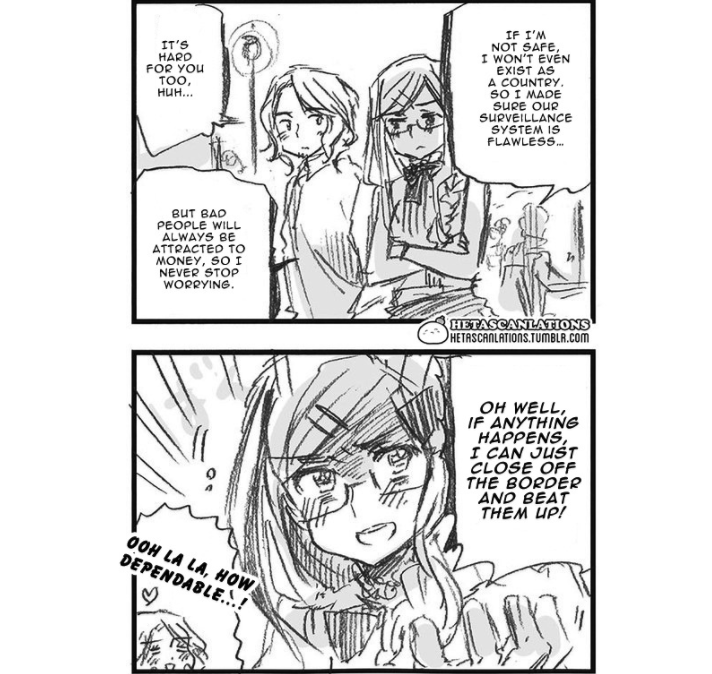
Since Monaco isn’t a big
country and has a small population, they mainly rely on tourists to sustain
themselves.
However, because the
country is resort and luxury-based (i.e casinos, hotels), it doesn’t attract a
ton of people, as not many people can afford going there.
Instead, it attracts for
the most part richer classes, both good and bad. What Monaco and France are
discussing here with regards to public safety is that the corrupt rich people Monaco’s
attractions bring in threaten the possibility of other people wanting to visit
her country.
When she says that she
won’t exist if she’s not safe, she’s basically saying that she’s nothing
without people visiting her. Likewise, because she doesn’t have a large
population, her existence is heavily dependent on tourists.
So, it would follow that
Monaco needs to dispose of the dangerous classes by getting rid of them,
therefore upping her country’s safety and making it a more desirable place to
travel to.
This strip echoes what
we saw back in chapter 307, where France confirms that their nationhood derives
from their citizens.
In sum…
A nation is nothing
without their people. But, because Monaco is tourist-based, they comprise a big
part of her population, albeit temporarily.
She “doesn’t stop
worrying” because if corrupt tourists with money keep visiting her, it can act
as a disincentive for other tourists to visit.
There’s also an issue
with expensiveness that she has to tackle if she’s to attract more kinds of
people to her country.




 Ellawritesficssometimes