You’re very welcome. I
would like to point out that both nations you mentioned are not always cheerful
or empty-headed. They can actually be quite threatening and terrifying (especially Russia).
While
they don’t remember everything in vivid detail, they still carry their dark
pasts with them. It affects their
personality, and these temperaments show up when you least expect it.
Thank you! I’d highly recommend reading as much of the manga as you can. It’s rich and full of depth. The problem is that people often mistake the anime as an accurate portrayal of the material. It’s not!!!! That’s why I have to do these characterization posts…
The characters are all complex and multi-dimensional. The fact that I can love a dislikeable character reveals so much brilliance on the part of Hima’s characterization.
I’ll start this by doing a brief summary of what I’ve already theorized on the topic before adding my recent addition to it.
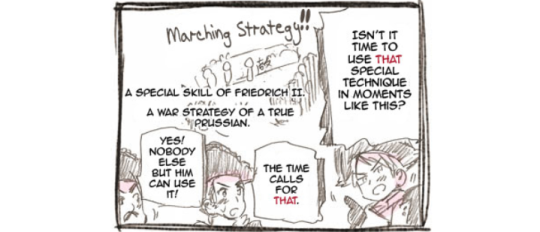
Prussia and Fritz’s flute playing, along with the motif of
marching forward and national consolidation in a military context, also bears
extreme significance when you connect it to some of the underlying themes
running through Germany and Prussia’s current relationship.
The flute is symbolically important in that it’s often
depicted as an instrument used by the Gods. It’s used to channel their voices.
For instance, Ancient Egyptians believed that it channeled the voice of Isis,
the Goddess of life and magic. She was also known for her healing spells, those
of which cured the sick and brought the dead back to life.
In Greek mythology the flute is associated with Pan, God of
the wild. He is also associated with the shepherd, whose primary duty is to
tend to their flock of sheep by bringing them together.
Now, the flute was first used by Fritz in a marching song
intended to instill a sense of consolidation and strength among his troops.
Taken symbolically, Fritz, as the shepherd, used the flute to bring his flock of
troops together.
I’ve also theorized before that Prussia, who adored Fritz
and therefore likely adopted the flute-playing from the latter, also took on the
role of the shepherd when he united the flock of fragmented German
states to form one sovereign nation – the German Confederation. It was a
military march that culminated in unification.
With that said, this theory will be making the assertion
that Prussia has chosen his next successor to undertake the role of the
shepherd – Germany.
The strip “Private Flute Concert” is essential to this
theory in that it gives us some of the biggest hints of connections
between Germany and Holy Rome. Evidence of this symbolic divine reference can be found
when Prussia talks about the “sacred journey of the flute.”
As designated by the title, Prussia gives Germany a private
flute concert.
Notice how as Prussia plays, he has a flashback to another private concert he had… with his little brother no less.
There, a sick
and bed-ridden Holy Rome expresses surprise at Prussia’s ability to play the
instrument. What’s important here is that Holy Rome refers to Prussia as a “war-maniac.”
The connection surfaces once Prussia halts playing and removes himself from the flashback. Germany expresses surprise at Prussia’s ability to
play, and Prussia echoes his previous conversation with Holy Rome by likewise referring
to himself as a “war-maniac” in his defense of this ability.
So, why is it that I think Germany is the next shepherd to
be?
For one thing, in another chapter that echoes Prussia’s
flashback, Prussia reads Grimm Fairy Tales to a dying Holy Rome.
Another connection emerges when you notice that one of the
illustrators was named Ludwig Grimm, who also
just so happened to play the flute. Once again, notice the flute’s herding
properties; in this case, Ludwig Grimm’s flute causes a flock of pigeons to come
together.
Perhaps this is why Germany’s human name is Ludwig. What if
it was Prussia who gave it to him, either as a tribute to his predecessor, or as a tribute to his forgotten past? [I lean more towards the latter]
While Holy Rome himself was not good at drawing and was more erratic and impulsive in temperament, we know that
Germany has a more structured and composed personality. He would therefore be more adamant
on practicing and perfecting this skill. Here, he’s shown to have considerable artistic competency when
he draws Italy.
That said, it’s also important to mention that this personality
difference between Holy Rome and Germany is accounted for and justified in
chapter 1 of World Stars. When a personification gains a new title, it’s
possible for them to acquire a new personality.
Since Holy Rome is seen to exist well after his
dissolution, it’s not farfetched to assume that he never actually died. A
theory on that [here]. In fact, given how much evidence there is that Germany
is suffering from amnesia [theory here], these two arcs seem to form yet another
connection whereby Hima’s implying at the possibility of him being Holy Rome.
All right. With all that said, let’s tie this together.
Prussia is no more in modern times, and so is East Germany, albeit formally. [It’s heavily and painfully obvious that he’s East Germany, but I have yet to
see him explicitly be referred to as this].
Here’s one example of how obvious, yet indirect the hints of Prussia being East Germany are:
“We have to get rid of the “wall in our hearts”, so that the country can get better and the progress will be naturally more effective!
When the Ostalgie level gets higher, Russia imposes himself on my big brother. [ T/N: Ostalgie is a combination of Ost (East) and Nostalgie] ”
Nonetheless, in the same concert strip, we also know that Prussia doesn’t
heal as fast as he should after being bitten by Germany’s dog. On top of that, he lies to Germany about when he acquired the injury. It would follow,
then, that perhaps Prussia’s immortality is waning.
However, this shouldn’t cause us any panic, since we know that
it’s possible for personifications to live on and become state representatives
after losing their nationhood:
“Usually, when the culture or the country’s personality dies/disappears, the country would gradually disappear or entrust him/herself to the country that takes over him/her.
There are also cases that him/her is not a country but continues to live leisurely as a representative of a region.”
[Source: It’s a treasure box of countries.]
It’s these particular panels that are of interest to
me.
That’s right. Prussia’s pushing for Germany to take up
playing the flute. Situating this in its symbolic context, doesn’t it seem that
Prussia is asking for Germany to heal his newfound mortal weakness?
The country was consolidated by a march that Prussia led. Now that the country is consolidated again after the fall of the
Berlin Wall, his reason of being [a personification] is no more.
It’s Germany who now leads the figurative march in running
their country. There’s also the fact that Germany has a character song titled “Vorwärts Marsch!”Translation: Forward March!
If Germany’s marching forward
in running an already consolidated nation, he leaves Prussia behind. There’s
not much use for the latter now.
How I interpret this is that
by giving Germany the flute, Prussia is recognizing that 1) his time has
passed or 2) he’s relying on Germany to help fix/heal his broken immortality.
Prussia gave life to Germany, but what about vice-versa?
One, I don’t appreciate your tone. I’ve already said before that my word isn’t law. This is a place for discussion, not me indoctrinating or forcing my outlook onto others. You guys are my check and balance, and in no way are you obligated to agree with me.
Two, calling someone an uncle is not mutually exclusive from being a father figure. They can go together.
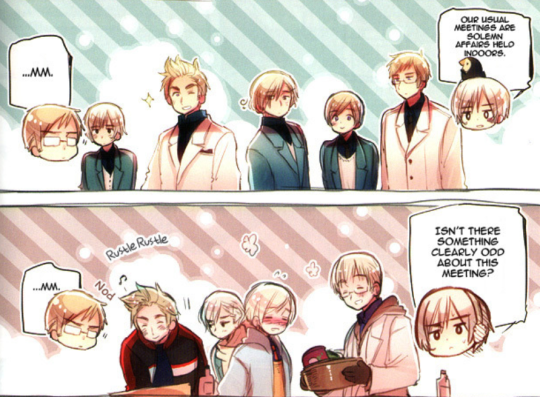
My justification is that all the other Nordics are waiting for Santa Claus and Finland to appear. Ladonia generically refers to them as Uncles.
Denmark comments that any kid would refer to them as an uncle. Ladonia later refers to them as Swe’s friends. I think this correction and differentiation on Ladonia’s part is him being embarrassed by Iceland’s initial confusion at the label of being called an uncle.
Considering how Ladonia first uses uncles generically as they all wait, which happens to include Sweden, this is why I believe that he grouped them together to fall in line with how he perceives his relationship with Sweden. Like you said, Sweden acts as a father figure to Ladonia, but given how much pride Ladonia takes in his independence, I don’t think he sees him this way.
Further, what differentiates Sealand and Sweden’s more explicit parent-child relationship is that Sweden actually adopts Sealand, not to mention the fact that Sealand isn’t autonomously recognized.
[Side note: I know who you are :O …You asked me this first off anon???]
Just kidding, welcome back! I hope I can continue to show you just how brilliant of a series this is.
Misconception: He’s
emotionless.
Reality: He’s
expressive through non-expressiveness.
Ex: A smile for
him isn’t expressed as obviously as it is for some of the other characters.
Still, that doesn’t negate the fact that he has feelings. I mean really now.
Misconception: He’s
humourless.
Reality: He has
an implicitly “evil” and “mischievous” side. In other words, he’s often
playful, albeit subtly.
Ex: He’s the one
to come up with France’s punishment after the 2007 April Fools’ Event. This entails
getting France to praise everything about England’s culture for a whole day.
Ex: When at war
with each other, he was glad to have a legitimate reason to punch Denmark.
Ex: He goes along
with the Nordics’ plan to host a secret birthday party for Iceland.
Again, the
humour is subtle as he wordlessly teases Iceland and makes light out of the
latter’s confusion over them meeting outside.
Misconception: He’s
intimidating inside and out.
Reality: His
external appearance is intimidating, but he’s tender and sweet on the inside.
Ex: During the
stereotypical café arc, Sweden’s customer is initially terrified of him.
Nonetheless, Sweden gives away the meal for free.
Ex: He acts as a
parent to Sealand.
Ex: Ladonia
refers to him [and the other Nordics] as an Uncle.
Ex: He’s good at sewing + uses this skill to adjust smaller clothes for Finland.
Misconception:
SuFin is canon.
Reality: Sweden
has confirmed feelings for Finland, but Finland doesn’t reciprocate.
In a lost 2007 blog post, Hima confirmed that Sweden has
homosexual feelings for Finland and only acts this way towards Finland. [That’s
literally what the translation says].
Ex: Finland has
repeatedly denied being Sweden’s “wife.”
Nonetheless, the two do share a close relationship, enough for Finland to refer to Sweden as “Swe.”
Ex: The two spend
their New Years’ Eve together in 2009.
Ex: This one-sidedness
is seen as early as when they were first colonizing America. Finland spots
America in the wild, and Sweden proposes the option of them having kids.
Bonus facts:
It’s left unclear as to whether Sweden can see magical
creatures.
He and Denmark used to hate each other, but have recently
calmed down in their temperaments. Of course, this is to be expected from their present welfare
and collectively-oriented nations.
Regardless, the two still tease each other in
the present time.
[Denmark and Finland are imitating Sweden here.]
All in all, a somewhat mysterious, yet thoroughly entertaining character.











 Ellawritesficssometimes