100% agreed. It’s the subtle humour that’s often the funniest.
May I point out that back when they didn’t get along and fought wars with each other, Sweden was “glad to have a legitimate reason” to punch Denmark.

100% agreed. It’s the subtle humour that’s often the funniest.
May I point out that back when they didn’t get along and fought wars with each other, Sweden was “glad to have a legitimate reason” to punch Denmark.
This was asked a while back 😅

Okay, Sweden it is today!
I just want to point out that these characterization posts aren’t analyses or theories. I’m simply presenting canon material.
It’s unfortunate and a bit tedious, but I have to play catch up for others by clarifying common misconceptions. Only then will I be able to get into the really deep and long theories that I have in store for later 😉
Post coming up tonight!


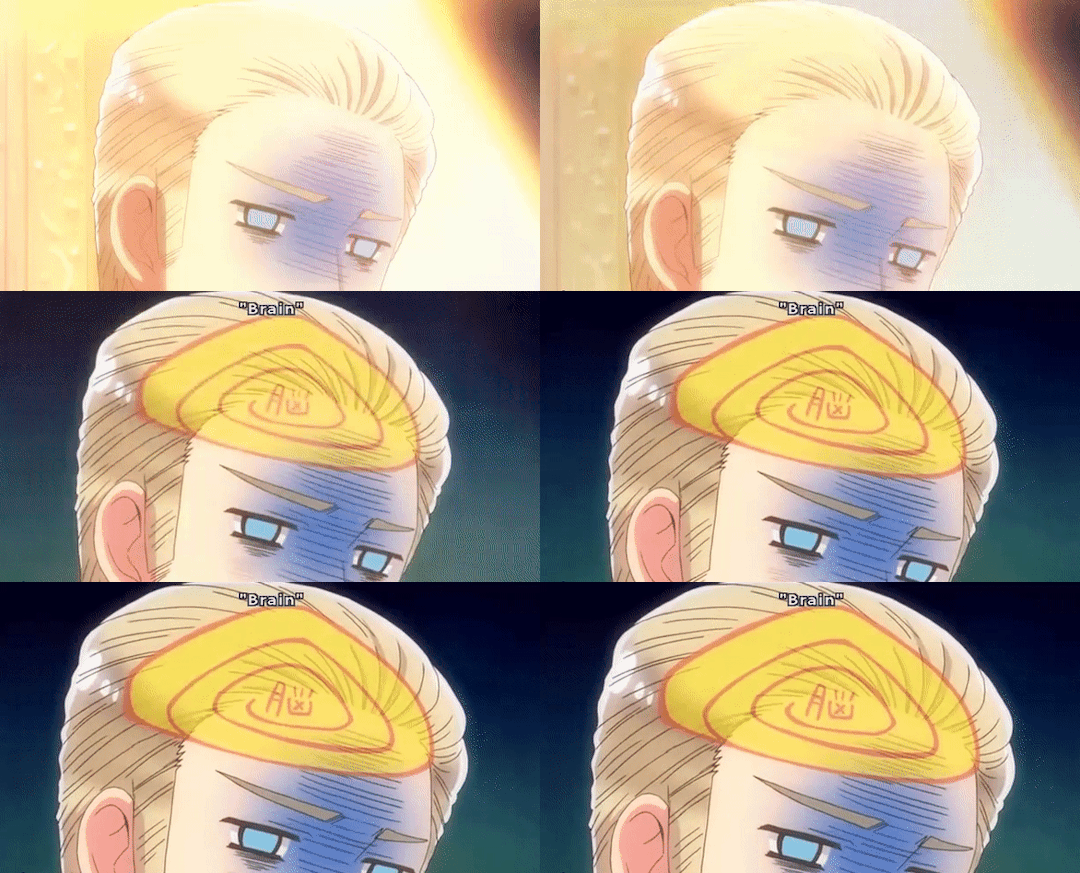
Before I start, it’s important to lay out some ground rules.
Thanks to Finland we know that the nations aren’t that
different from humans with regards to their physical strength and anatomy (with
the exceptions of Russia and America who are exceptionally strong).

The point in this is that the “not-so-different from a human
rule” pertains to their basic physiological structure. On the other hand, there
are immortal perks of nationhood, such as being impervious to experiencing the fatality of illnesses. They still can
fall ill, though. This happens when they’re….
1) Suffering from political instability.
2) They’re experiencing an economic recession.
3) There’s a rampant illness in their population (i.e Romano’s
Chorea).
With that said, we know that the nations are stronger than
normal humans regardless. They don’t age as fast, and as such, their memories
don’t deteriorate at nearly the same rate.
What this post will explore are the different examples where
nations have been shown to have gaps in their memories.

The thesis I’m putting forward includes a variety of
reasons to account for this:
One, older nations such as Japan and China have even larger gaps
in their memories as a result of their physical bodies aging. They’re therefore
unable to recall memories as fast as younger nations [This in part goes with my
third argument].
Two, the influence of their citizens pertaining to whether
or not the nations can see and therefore remember the existence of magical creatures.
Three, the nations simply aren’t able to remember
everything; it would be impossible.
And four, some
nations actively repress bad memories to minimize the anxiety and trauma they
previously experienced.
Without further ado, let’s go over some of these examples.
As stated above, the nations’ chronological age, while
influenced by their economic and political affluence, also seems to be affected
in part by how long they’ve lived (I.e. Both Japan and China refer to
themselves as old men.)
If Japan is shown to have higher blood pressure levels and hip pains as a
result of his old age, then it wouldn’t be too farfetched to assume that his
memory wouldn’t be as up to par as it would be in comparison to a nation younger
than him. Put another way, his age would cause him to have greater slips in his
memory.
It’s the body that’s old, despite not looking like it.


Ex: He’s unable
to remember who Lithuania is, and almost mistakes the latter to be Livonia.

Ex: While looking
through an album of him and Pochi throughout different periods, Japan
mistakenly recalls the chronology of them.

Likewise, China’s also referred to as an old man.

Ex: He admits to
being forgetful.

We’ve also seen the impact on how a population’s belief in
magical creatures respectively influences whether or not the nation will be
able to see them.
Ex: During the
Meiji Era, England could see the kappa and youkai spirits, meanwhile Japan couldn’t
as a result of his people no longer believing in them as strongly.

However, just as a nation can forget about magical
creatures, they can also re-remember them if popular culture strongly believes
in them again – presumably it would have to go past folklore superstitions.
While enjoying Japan’s hot springs, the two talk about
folklore.

Notice how Italy spots a strange creature beginning to approach them.
Although it’s not shown, the discussion of the topic could possibly mean that
Japan [and not just Italy] is also able to see the creature.

There’s also an exact replica of this hot spring scene
dating back to when they first met during WW2. I don’t think Hima did this for
no reason:


As Russia darkly puts it, perhaps it’s a good thing that the
nations don’t remember everything.

When Lithuania and Germany allegedly meet for the first time
during WW2, Lithuania expresses relief over Germany not remembering him. It’s
noted that Lithuania once beat-up one of Germany’s family members. This is
possibly a reference to when Prussia became a lackey to Poland under the
Lithuanian and Polish Commonwealth.

This is highly indicative of Germany existing well before
his ‘birth’ in 1871 given that Lithuania is fearful of being remembered and/or triggering
Germany’s memory. If anything, Lithuania’s fear of this points further in the
direction of Germany suffering from amnesia.
Why else is there a childhood version of Germany/Holy Rome pushing to be acknowledged in older strips? I’ve theorized before that this is
simply a part of his unconscious mind trying to get him to remember about his
forgotten childhood.

Or why is it that he’s seen to confusedly hold up Chibitalia in another strip?
“It’s me.” Jogging his memory much?

Similarly, Italy also dreams of a childhood version of
himself pushing to be acknowledged by him, only for Italy to refuse in doing so. Like
Germany, it seems that Italy has actively striven to forget his childhood.

Lastly, the most obvious hint of repressed childhood
memories is found in Buon San Valentino, where Germany appears to recall fuzzy
images of Chibitalia.


Prussia is the one to confirm this rule, considering that he’s
taken to recording every experience as a method in circumventing the inability
to recall them. It’s simply a matter of jogging his memory.

In sum, while the nation’s memories are limited, there are
different factors and contexts that account for this phenomenon. Age, trauma,
civilian belief, and limited physiological brain capacity seem to be the most
common reasons in accounting for this.

Friend: Hey, remember when you
–
Me: *already begins cringing*


It’s interesting that you brought this up, because I’ve actually developed a mini-theory about it!!
[All of this is making the assumption
that Germany is Holy Rome]
However, we only know that Germany
has a thing for maid dresses. Here, Prussia is reading an entry from Germany’s diary.


Germany’s embarrassed reaction when he finds out that Prussia has read this is a dead giveaway.

What I’ve seen other people validly speculate about,
and what I also believe could be true is that this might be Germany
subconsciously [indirectly] remembering Chibitalia.
This would fall consistent with how he appears to recall fuzzy memories of Chibitalia in Buon San Valentino.

Now, while the subject of a school
uniform is not quite the same as a maid’s uniform, it’s the fact that they’re similar
enough. In that case, perhaps France is inadvertently trying to jog Germany’s memory
in getting him to remember that he’s Holy Rome.

This would explain why France asks
Germany to come over “discreetly” – in a hush-hush manner. Perhaps this is
because the other nations have an unwritten but nonetheless agreed on pact to
not mention Germany’s past.

Ex: We’ve seen England grow uncomfortable
upon recalling a memory of Holy Rome, Lithuania is relieved when Germany doesn’t
remember him when they first meet, Japan notices that Prussia doesn’t tell
Germany everything about his past.
Also, notice how Germany is wearing a cloak…. another tribute to Holy Rome?


All righty! As stated in canon, the nations aren’t able to remember everything.
Tonight’s post will go through several examples of this (both old and new), including the different justifications and reasoning used.
Coming up soon!


Surprise bitch. We’re still thriving.
[The amount of people I do this to is honestly hilarious.]
I think that has more to do with a misinterpretation of his
character, given that we don’t canonically see him in any romantic
relationships. A misconception for me is when people flip canon facts 🙂
However, both canon pieces of
information that you provided are extremely relevant and I cannot stress them enough
if you ever intend to characterize Prussia in a fanwork.
Just wanted to point out that while they did indeed form a
union and are historically tied that way, Hima hasn’t gone that route, nor has
he characterized them in that close of a way. There’s very little canon
information provided about them; that’s an assumption
on your part, even if it is founded in historical fact.
Given that the character note is from as early as Volume 2,
and in pretty much all the events you can find Prussia lamenting about his loneliness, I don’t think Prussia thinks/thought of their relationship as all
that important or close.
Likewise, while this does conflict with other canon
material, Prussia is said to have started out as the Margraviate of Brandenburg in “Lichtenstein’s Journal of Swiss
Dopiness.” He was later absorbed into the Teutonic Knights. Meanwhile, other
canon material (such as the Volume 2 character note) conflicts with this. There’s
also the fact that Brandenburg is a separate character.
“
Prussia, too, began as the Margraviate of Brandenburg intended to buffer Slavic expansion, and later incorporated the territory of the Teutonic Knights.”

Either way, it doesn’t seem like Hima has placed much
emphasis on Brandenburg. Again, given how lonely Prussia is for having not been
in a close relationship [of any kind], I’m sticking with the Volume 2 character note until it’s
stated otherwise in canon. There’s really no point disputing over small
historical facts when we’re dealing with loosely fictional characters.


Misconception: He’s
lazy and unmotivated
Reality: He’s extremely
strict, neat, and places great importance in his appearance. Nonetheless, on
occasion, he has been shown to grow bored easily when faced with the prospect of
work.
Ex: He trained America and his military during the American
Revolution.

Ex: He keeps his clothes spick and span.

Ex: He gets bored and sneezes when he’s given a book on how
to socialize with people.

Misconception: He’s
full of himself, so he doesn’t need anyone.
Reality: He’s
painfully lonely.
Ex: He never
married.


As such, he’s brought to tears when he sees Austria and
Hungary as a couple on Christmas.


He unconvincingly rationalizes to himself that he’s happy to
be alone.


This is repeated in his character song Mein Gott!, where he claims
that “Being alone is too much fun.”
Ex:
He misses Frederick II, and hasn’t found someone to fulfill this strong [but nonetheless implicit] desire for companionship.
It’s even said that he grows
depressed at the mere mention of Fritz. Ironic considering that he has a picture
of him on his nightstand.

Notice how Prussia also calls
on Fritz during Valentine’s Day, and once again attempts to convince himself
that he’s happy to be single.


Misconception: He’s overly-confident.
Reality:
Prussia’s narcissistic, but this stems from being extremely insecure about
himself.
He’s always trying to gain
power for self-reassuring purposes. This reassurance acts to discount his
insecurities over being weak. His use of the word awesome, then, is more
defensive and reparative than it is an exercise of confidence.
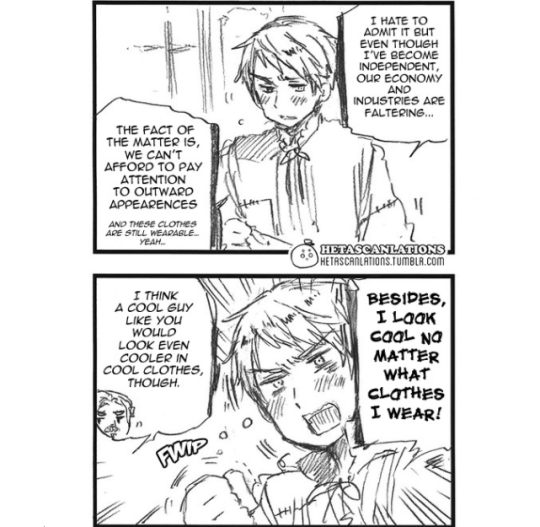
Ex: He associates fancy
clothes with strength + brags to bolster and reinforce confidence within himself.

Before his country grew in
strength, notice how he falsely tries to convince himself that his clothes are
still cool, despite them being worn down. The important difference is that he
doesn’t make use of the word awesome. This a time where his confidence and
morale is low. Awesome for him is equated with strength.
Bonus Facts:
He’s noted to feel like an enclave as opposed to an actual
nation.
He’s an incredible older brother:
Ex:
He reads Fairy Tales to a dying Holy Rome, and is revealed to be heartbroken
after the Napoleonic Wars.


Ex: He immediately
steps in to protect young Germany when he’s born.

Ex: He’s very supportive
and encouraging of Germany, despite teasing him a lot.

To be honest, given all this, I find it redundant for
Prussia to refer to himself as awesome.

 Ellawritesficssometimes