I agree, that scene
where Italy’s catapulted into the air by a faulty car seat does reveal a bit of
naivety on Germany’s part.
On the other hand, Germany’s
young age is mentioned several times in the manga. There’s also the fact that the scene above took place during WW2. Germany would have learned a lot more since then.
There’s no definitive answer, but I have picked up on a few relatively consistent rules. It’s often a combination of these factors.
It’s
still very messy, though, as Hima doesn’t spoonfeed us the information!
1) Sovereignty,
autonomy, or political independence. (varies depending on if you’re
recognized as a nation-state, are a dominion, are under colonial rule, are a
self-regulating micro-nation…etc.)
2) Economic
stability, growth, and self-sufficiency. (i.e. whether your economy is
doing poorly, is stagflated, isn’t growing much, ability to produce your own
goods and commerce…etc.)
3) A
well-developed culture and history
4) A
significant body of people + a stable, functioning government.
Hetalia has often been mischaracterized as something that
promotes and glorifies violence. Why? Because the initial setting takes place
in World War 2. Somehow that automatically equates to said negative image.
To that, I say this. There’s a difference between situating
a historical context and using explicit insignia to support an abhorrent
ideology. You never see the latter portrayal in the series.
While I disagree with a lot of Hima’s early characterizations and miscalculated jokes, his depiction of
fascism, communism, and war is something that I’ve always respected. It’s done
tastefully (with comical hyperbolic elements, of course), and does anything but
promote violence.
That said, it’s also important to mention that the
insensitive war jokes used in the dub are completely irrelevant to the messages
of peace and solidarity that Hima incorporates into his work. That’s the result
of other people interpreting the series and making it their own, only to botch
it entirely.
Regardless of the fact that war’s going on, Hima makes an effort
to showcase the triumph of humane and compassionate qualities in the nations.
Yes, they ‘hate’ and wage wars against each other – not having much of a choice over the matter,
mind you – but this rivalry doesn’t hold them hostage, nor does it dictate how
they interact with each other.
Conflict doesn’t dehumanize the nations; they don’t become
ruthless killing machines without a semblance of remorse or empathy. Just like
enemy soldiers called ceasefires on Christmas and occasionally organized sports
events, the nations for the most part
engage in similar civilities.
Again, it’s the conflict that’s brutal, not the nations
themselves. In fact, they have some of their admirable, most striking moments during war.
When America occupies Rome, he treats both Italies as if
they were his friends. Romano’s clearly terrified, but America breaks the ice
by politely asking them if they could make him authentic Italian food. That’s
hardly something you would see with individuals who regard each other as
enemies.
You also see nations from different alliances casually
hanging out during war, almost as if there wasn’t one going on at all. Remember
that they’ve fought each other so many times that they’ve likely matured past
being pent up on rivalries, as long as interacting with enemy nations doesn’t
go against their people’s well-being.
As they share and try each other’s rations, familiarity
appears to triumph over hostility.
There’s a clear reason why the series’ main theme is “Draw a
circle, that’s the Earth,” rather than, “Draw a border, that’s my country.”
It’s to bring the world together, not tear it apart.
England: You don’t know anything about world geography, do
you?
America: Not sure what you mean. Could you be more pacific?
Norway is perhaps one of the most misinterpreted characters,
so I thought I would flesh out the other, lesser-known sides of him. He
actually has a pretty wonderful personality, possessing several unique oddities
and quirks that make Nordic-centred strips a pleasure to read.
Misconception:
Norway’s emotionless.
Norway’s far from cold and emotionless. If anything, he’s a
bit spacey and pensive, which can sometimes give off the impression of indifference. Other countries have made
note of this, claiming that Norway “thinks from an entirely different dimension.”
Remember that Norway is able to see and communicate with
magical creatures, including England’s. It’s not so much that he’s detached
from emotions, but that he’s occasionally detached from the real world given
how mundane, trivial, and boring it can be.
Misconception: He’s
not close with the other Nordics
While Norway may make passive-sarcastic remarks or even
blunt quips towards the other Nordic countries, he cares about them deeply.
It’s not obvious because he’s a very timid character and doesn’t necessarily
express this affection in an open manner.
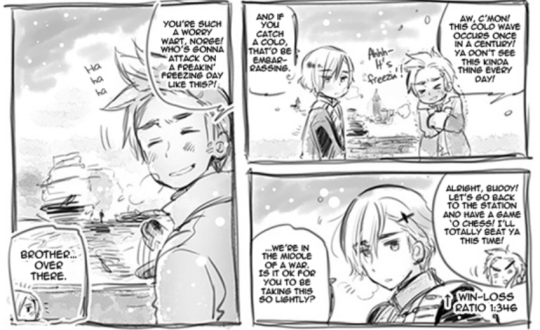
After showing concern for Denmark’s health, Denmark refers
to Norway as a worry wart.
Norway is also noted to stick his nose into Iceland’s business a lot.
Notice the use of words. While bugging Iceland may be a bonus for Norway, who
does in fact enjoy teasing Iceland, there’s a clear emotional investment to
look after his little brother’s well-being.
Misconception: He
doesn’t have a sense of humour.
Norway has a great and subtle sense of humour, albeit odd.
He and Iceland refer to each other as punks (totally adorable).
When Iceland has trouble getting his goods noticed on the
market, the other Nordics develop a plan to help the former out. During their
brainstorming, Norway jokes and says that he’ll dance as part of the process.
Misconception: He’s
mean
Norway has a gentle and shy way of showing his kindness that
is often overlooked.
Back to the idea of him poking his nose into Iceland’s
business, Iceland secretly doesn’t mind Norway’s interference. There’s nothing
but good intentions on Norway’s part, as he’s always looking after Iceland’s
best interest.
Speaking of which, remember that time when Norway didn’t
know what present to buy for Iceland?
Norway sends Iceland a link while they’re both outside a
present shop and gives Iceland the option to choose what he wants. Iceland gets
flustered and tells Norway that anything will do.
Sweet, thoughtful, sarcastic, and subtle, that’s just how Norway (t)rolls.
[Anon is talking about one of Russia’s character songs]
There’s plenty of strips that reveal how miserable and
lonely winter makes Russia. A recurring theme with him is that he either wishes
or dreams to be in a place with warmer weather (I think this is a reference to the
early days of Russia, where he likely personified the Kievan Rus, a region with
a far milder climate).
But, if I had to guess, this strip bears the strongest
connection. A dark theme running throughout the song involves Russia crossing
through a snowstorm in search for signs of life.
Just let that sink in. If Russia’s happy that he survived
the winter, doesn’t that imply that he’s frozen to death before?




 Ellawritesficssometimes