image
image

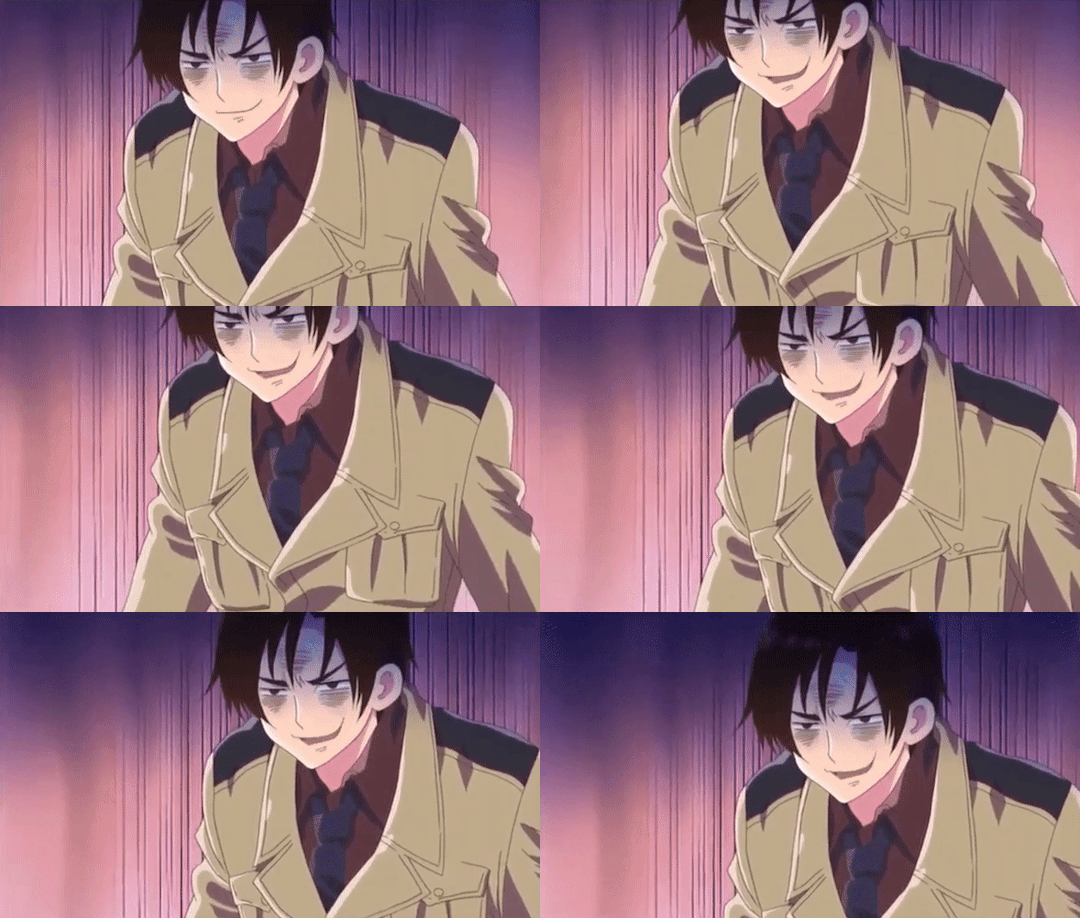
While characterizations depicting
Romano as an easily irritated and rude person isn’t in whole inaccurate, it’s
nonetheless one-sided and uncontextualized. By that I mean that this type of
characterization erases the fact that Romano’s incredibly sensitive from a lifetime
full of pestering insecurities and fears. He’s bottled up a lot of these
emotions and lashes out as a result. Likewise, it also erases Romano’s loyalty
in spite of his poor way of expressing it.

Let’s unpack what I mean by this.

For one thing, it’s canon that Romano is an even bigger
crybaby than Veneziano.

Source: Volume 2.

image
image

A lot of this stems from feelings of resentment and
inadequacy that he developed as a child. Rome spent the majority of his time
rearing and caring for Veneziano.

Source: Hetarchive, Chibitalia.

image

Consequently, Romano develops an inferiority complex and
feels inadequate compared to Veneziano.

Source: Boss Spain’s Control of Southern Italy pt 2.

image

What doesn’t help is that Romano placed second again when
invading countries preferred Veneziano over him.

For example, Spain initially wanted to trade Romano for
Veneziano, as Romano’s manners and housekeeping skills weren’t nearly up to
par. 

Source: Hetarchive, Boss Spain’s Control of Southern Italy pt 1.

image
image

It sounds horrible, but we do get a touching scene where Spain eventually reconciles
with Romano, learning to accept and love him for who he is.

Source: Boss Spain Doesn’t Understand.

The two meet each other halfway and develop a strong bond in
which they genuinely enjoy living together.

image
image

That bond is abruptly cut during Italian Unification, where Veneziano
and Romano are forced together after centuries of separation in which they
rarely saw each other.

image
image

Sources: Hetascanlations, World Stars Chapter 20 & 73.

Since Romano still had unresolved feelings towards Veneziano,
the two didn’t exactly get along. As such, Romano opts to move to America
instead to look for work. The immigrant life was a scary and unfamiliar terrain
for Romano to traverse. To cope with this, he calls the first person who’s ever
felt familiar and homely to him: Spain.

Source: Hetascanlations, World Stars Chapter 73.

image

Point is, even though Romano doesn’t show it, he’s very
sensitive and shows it in ways that aren’t the most obvious.

While I initially rubbed this off as trivial, there are
scenes during WW2 that are particularly important in showcasing Romano’s
vulnerability.

Ex: He cries during the infamous failed mustache incident with Germany.

Source: Volume 1. 

image

Ex: He cries and hides behind Germany from France – note that
this is likely indicative of the fact that Romano is reliving the childhood fear
of being conquered and attacked.

Source: Volume 1. 

image

Other examples of vulnerability would include him being
sensitive about his height and crying into tears of joy when Grandpa Rome
visits him from heaven.

Lastly, it’s also important to recognize that while Romano
may be rude, even to people he cares about, he’s loyal.

Ex: During the immigrant period of his life, he cheered on
America when the latter surpassed England in industrial production.

Source: Hetascanlations, World Stars Chapter 70.

image

Ex: While too shy to do this upfront, Romano looks out for
Veneziano in WW2 by remaining skeptical towards Germany, questioning him about
his intentions.

Source: Volume 1.

image

Ex: Romano tries to save Spain from illness during an
economic recession, which forces him to come into conflict with the mafia, who he’s
normally terrified of.

Source: Hetarchive, In just two minutes you can grasp the exterior of the European economy.

image
image

All in all, it would be unfair to say that Romano’s a prick
without contextualizing this within a broader understanding of him employing a
tough exterior to hide a more sensitive than normal interior.

image

I like Romano because of his character development. I know he’s
not a great person, but he does have a big heart and feels more deeply than
most people. He’s also very loyal, even to Veneziano who he’s not on the best
terms with.

Post coming up tonight!

image
image

Thank you. It’s my pleasure ❤ I’m always happy when people can take something from my posts. 

image

I’m an indecisive person with diverse interests. Criminology is multi-disciplinary, including disciplines like sociology, feminism, biology, psychology, etc. It’s also diverse in the sense that you can do a lot with the degree afterwards. 

image

LOL. Mathew’s blond with green/blue eyes. He doesn’t play hockey but he drives a truck, goes hunting, smokes a lot, wears plaid and timberland boots, lives in the country, and has a Quebecois accent. 

Nothing’s official yet but it does look like we’re heading in that direction. I wouldn’t have told you guys otherwise 🙂

Q & A

image

Do you think that their canon heights are
meaningful in anyway at all (besides being shorter/younger to represent how
developed they are)? They seem inconsistent throughout the series when compared
to each other *during “adulthood”

I’ve done a few posts on
this. It first has to do with economic and political developments. Only then is
the average demographic height taken into consideration [x] [x]. 


How do you think
the countries view humans? as temporary pawns? good? bad? indifferent?

It’s definitely not
as radical and dramatic as you’re framing it.

These posts discuss what you’re talking about. To boil
it down, the nations don’t view humans as pawns but rather they serve their
bosses to the very letter. For other humans, they tend to keep their distance.
When a human spends too much time around a nation, their perception of time
gets so warped that they become insane. I also want to point out that the nations are
very friendly with humans. It’s their people, after all [x] [x] [x]

image

Last year, my
history teacher mentioned something about a theory that America gets its
greatness from its German roots and recently I realized that America embodies a
lot of the traits an Anglo-Saxon warrior is supposed to have in order to become
famous and, therefore, immoral. I’m sure this is just some stupid coincidence
but I was wondering what you think of it

I’m living for the enthusiasm but I think you’re
overthinking it. The stereotype model is based on sociological perceptions. In
other words, America embodies the generalization of what the world perceives Americans
to be. The stereotypical American is the blond-haired blue-eyed golden boy
whose prevailing belief in justice makes them the ‘super-hero’ of the world. Most people wouldn’t know about the Anglo-Saxon warrior.

Side note: I shouldn’t have to mention this, but
stereotypes are not the Truth (capital T) but a truth (a different construction
of reality).

Source: Hetascanlations, World Stars Chapter 23.

image

A lot of people seem to think Germany has
aspergers or some form of autism, any thoughts on that?

Personally, I don’t
think he has autism. My biases from therapeutic training sees someone who has repressed
certain emotions/ memories and is socially inept as a result of his chaotic
childhood. Post here [x]. 

However, that does not
mean you can’t interpret him that way! You can use a lot of Germany’s behaviours
and other idiosyncrasies to make a convincing characterization as someone who’s a high-functioning autistic.


If Hima is on a
hiatus, he might be going somewhere too, I guess. Does he have an active blog
now? I wonder if he uploads some pics. I noticed some pics on his
not-active-anymore blog but those were veeery old. What do you think?

Himaruya does have a
history of travelling during breaks. He doesn’t have an active blog, but
Hetarchive posts English translations of his WordPress blog. The posts aren’t old, though???

Holy Rome Talk

image

First, I just want to thank you both for participating. I really
appreciate it 😀

image

My theory accounts
for this:

1)   
The nations are
cultural personifications

Usually, when the culture or the country’s personality dies/ disappears, the country would gradually disappear or entrust him/ herself to the country that takes over him/ her.

There are also cases that him/her is not a country but continues to live leisurely as a representative of a region.

Source: Hetarchive, It’s a Treasure Box of
Countries.

The nations are cultural personifications. They
exist when people unite under a common cultural identity. As such, this may
account for the reasons why there are separate personifications for Ancient Egypt
and Greece and Ancient Greece and Greece etc. However, I do agree that the
rules of this are arbitrary and inconsistent if you look at nations like China
and Japan, who don’t have ancient counterparts. Which brings me to my next
point:

2)   
The nations are
described as “strange beings.”

image
image

Because of this, not everything that happens can be explained with an ascribed logic. It’s canon for nations to arbitrarily last
for as short as a few days to 1000s of years. Nations can also keep living and
change their titles over time. For example: Hungary was originally born as an equestrian
tribe and Prussia was originally born as a catholic order.

Therefore, it’s not an easy fix because no rules
were broken.

Source: Hetascanlations, World Stars
Chapter 1 + Hetarchive, Notes & Etc + Volume 2 Character profiles.

On the other hand, given that World Stars is
recent, the “easy fix” argument can still be countered. Himaruya’s been hinting
of the Holy Rome = Germany connection since the first original web chapters
(2006).

See: Hetare 4, Pact of Steel + Hetare 5, Lietuvis.

image

My theory also
accounts for this:

1)      France never killed
Holy Rome in the deleted strip.

He only notified Italy that Holy Rome had died.

image

Source: Hetarchive, Holy
Rome is no more

2)      Cultural personifications
x 2

I’m going to sum up my main points, as I’ve already
written and explained this in greater detail:

  • Basically, because the nations are cultural personifications, the switch
    from Germany to Holy Rome didn’t consist of a significant change in culture.
    They both represented the German people. Germany represented the consolidated nation
    of the previous sovereign states that Holy Rome represented.
  • Holy Rome didn’t die right away after his dissolution–this ties in
    with the fact that as long as the culture exists, the personification won’t die
    right away. 
image

Source: Hetarchive, It’s
a treasure box of countries + Hetascanlations, World Stars Chapter 187.

  • Holy Rome became sick because of fragmentation
    and disunity but nonetheless existed because of the culture. This is consistent
    with the rule where nations get sick if their economy or political situation
    isn’t stable

Source: Hetarchive, In
just two minutes you can grasp the exterior of the European Economy.

image
image
  • This then escalated to him being on his deathbed after dissolution. On
    top of the culture still existing, it’s still possible for personifications not
    to die even after their culture/ personality (essence) disappears 

Source: Hetarchive, It’s a Treasure Box of Countries.

  • The switch from Germany to Holy Rome is consistent with the rule of
    personifications being able to change titles.

Linking them again: 

(All posts can be found in my directory).

Holy Rome theory posts: [x] [x] [x] [x] [x] [x] [x].

Prussia theory posts: [x] [x] [x] [x].

Nationhood posts: [x] [x].

What affects a nation’s health?: [x].