EDITED. (I made a small mistake and looked back in my notes.)
I say 2010-2011 in terms of
canon because the Christmas 2010 Event and the 2011 April Fools Event was the last that we saw of the ‘attacking’ stripping trope. In Christmas 2011, France even makes a shocked remark about
how the tradition was broken. I.e.., as you already know, he used to stalk
other nations, embarrass them…and was basically just unwanted in every aspect. I
hadn’t gotten into the fandom in 2012, so I wouldn’t know. I had just gotten
into the manga.
I agree to a certain
extent. I actually prefer World Stars and later volumes. Not that some of the older
strips didn’t make me laugh either. They were just as funny when they weren’t
using inappropriate shock humour, but I found that the dialogue improved a lot
over the years.
Same. There are some chapters
in World Stars that make me wonder if Himaruya felt pressured to create
something (anything) to meet his deadlines and ended up sacrificing quality in the process . Call me
crazy, but three panels of trivia without a real narrative, purpose, or
punchline doesn’t hit the spot.
OH yeah. That strip is
just…WTF. Way way waaaaay too far. There’s nothing remotely funny about it, and I don’t know how anyone could ever think that it would be.
Why is Iceland’s childhood the same as my dating life?
“
He wanted more people to be interested in him so he tried to send out letters but he couldn’t see anything particularly good about himself, so he mostly gave up,” [x].
‘But big brother don’t you always say you don’t
want to see me at all?’this. I do wonder if Himaruya will ever make Romano
realize the weight of his words. I’m sure deep down he doesn’t mean any harm
with them,but they surely leave a scar.
I think that’s
the whole point. Romano doesn’t realize the impact of how mean and vicious he
can be to Veneziano. Veneziano’s also a very sensitive person, so it doesn’t
help. Everyone has their limits
The fact that Romano’s shocked by this is most
telling for me [x].
Countries such as England, Spain, Netherlands,
Portugal, America, and France did overseas trading but weren’t pirates.
While there is a fan request where Himaruya depicts
England and Spain as pirates for fun, it’s important to remember the negative
implications of the word [x].
Ex: France knew the
real Captain Hook and warns Seychelles of him [x].
On the other hand, there is one strip that depicts
an unknown African nation as a pirate (in this case, they actually personified
a band of pirates in the region) [x].
I’ve done a post on religion if you’d like to check
it out. It’s listed in my directory under Characterization in Hetalia [x].
The basic gist is that religion and the belief in
God still remains because there is an actual God in Hetalia. Whether they have faith in God depends on the individual and what they’ve experienced.
Well, all episodes are based on the comics!
Right now, the first thing that comes to mind is America and Canada’s series of
arcs in world stars.
(He doesn’t have a rifle as a child in the growth spurt strip: “England dreaming of long days passed, Vol 3).
There is this panel of child America gripping onto a rifle, though [x].
I’m just
going to start by saying that I don’t make any canon conclusions without basing
it on something in the manga/ character notes provided. As such, what you
mention would fall under headcanon territory.
The part about America clutching guns is
depicted in canon but the leap to him viewing guns as a safety net and this
being reflected in his gun culture today doesn’t draw on canon material. For
me, a conclusion has to tie two or more pieces of canon material together rather than
using one piece to make a speculation where there aren’t any definitive links.
I know this model is nitpicky, but I’m very
stringent when it comes to forming and supporting an argument ^^
However, your headcanon wouldn’t be entirely
impossible. It actually draws on a similar structure in logic to what we’ve
seen with America before!
Ex: America’s tendency to mass produce is a
reflection of the trauma he experienced as a child in that he didn’t possess
many belongings.
So, it’s not impossible, but the link hasn’t
been made in canon yet.
I wanted to ask about Belarus. Does she have an
outdated personality like France? Should I consider her old appearance as
inaccurate?
I’ve said this before, but very
little is known about Belarus. She’s a bit of an anomaly, so I’m not inclined
to form a solid opinion on her.
Most of the canon information about
her personality is from an untranslated PC game that Himaruya created and posted
on his blog. As for any changes? She appears in a few non-linear strips and the
first three printed volumes but makes a marginal appearance in World Stars.
Where we do see her more often is in
the Holiday Events (e.g. in Halloween 2011 and Halloween 2013-2014 you get
larger glimpses than in the Christmas Holiday Events where she also appears).
Judging by her character there,
she’s still obsessed with Russia and has violent/ impulsive tendencies, yet
she’s also calm and almost…regal at other moments [x]. However, it’s nowhere near
to the same extent as some of the borderline insane information given from the
PC game.
(She mistakes Taiwan’s greeting as normal lol).
I’d prefer to have a recent arc of
chapters/ strip deliberately focusing on her before I assess what aspects of
her characterization have remained and/or if it hasn’t changed at all.
Since Mochis are versions of the countries they
represent, does that mean that America’s strange dad complex can be backed up
by the weird lettuce-daddy Mochi comic strips? Cause Lol, I hope so.
I really wanted to
say no to this but knowing Himaruya, that literally might be a factoring
reason lmao. Although you have to remember that this lettuce also once wanted to
take over the world, only to be eaten by Canadamochi [x].
Okay so this has been in my mind for a while. I
was reading over some chapters from the manga to establish notes for myself and
came across the terms ‘junior’ and ‘senior’ used. Specifically in the It’s a
Treasure Box Full of Countries and Ch. 201. I was wondering if it’s meant to be
out of age establishment (Hutt River calls Wy, Molossia, and Sealand juniors
and himself Wy’s senior) or ranks (Australia calls himself Canada’s senior but
could also mean age… )? What are your thoughts?
Most of the time it has to do with
chronological age.
Then again, you also have South
Korea asking Japan and China (who in the
series are older than him) to call him older brother [x].
I saw something saying that romano has more
arabic(?) blood than italy, that’s why he’s darker than him (hair, skin, etc)
but I wasn’t sure if it was someones headcanon or canon
It’s considered to be canon by most
since his hair still remains darker than Veneziano’s. It’s listed in his Hetarchive
article [x]. Some LJ posts also link to Japanese fans who have saved old trivia
information that Himaruya later deleted from his blog.
By the way, in one of your posts, you mentioned
that “in WW2 when he’s occupied by the Nazi regime, England takes France
into his home”. Can you show me which strip that’s in? (I can’t find
it…) Thanks!
It’s from Volume 5: “Liberté, Égalité, Fraternité and…”
Thank you, that’s so nice of you to
say!!
I don’t want to speak out of turn because
neither are my countries, but there is a wide range of skin colors in Spain
like you mentioned. There’s the inaccurate stereotype that all people from Spain, Portugal, and Southern Italy are tanned,
which is probably the primary reason for their portrayal in canon.
As for fanon? I don’t know… your
opinion is your opinion. I don’t want to be dragged into dictating how others
should feel. It leads to a slippery slope where right and wrong become
discrete, erasing the room for grey areas and discussion.
It’s an interesting double-standard
when you look at it objectively. If fans get mad at other creators for white-washing
characters like Seychelles, should the same logic apply to characters who are
made to be darker?
Himaruya didn’t create the AU. He
created illustrations in the artbook and fans made something out of it.
People are capable of learning from
their mistakes. Progress is impeded when others can’t recognize that. Even from
just two years ago, I look back and cringe at some of the jokes I made.
I’ve always interpreted it as Italy teasing Germany. Italy’s admitted to Germany in Buon San Valentino that his first love was a boy.
The strip you’re talking about is from Chapter 4 of World Stars [x].
Interpersonal
relationships:
Their perception of time is different, which makes it
difficult for them to establish close relationships with their citizens.
Ex: Canada spent
an entire weekend staring at Kumajiro’s eyelashes without realizing it [x].
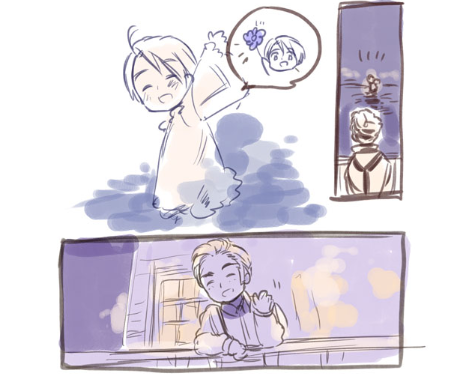
Ex: Young America
befriends Davie, and the two spend their time searching for a blue flower. America
leaves and goes, finding Davie as a young adult and again as an old man with grandchildren.
Since time runs differently for nations, it’s dangerous for
humans to be close to them for too long. Himaruya cites that because time is so
warped for the nations, a human wouldn’t be able to be around one for so long
without losing their mind. Essentially,
the nations’ immortality would rub off on these humans but at a grave cost [x].
Ex: England was
careful not to spend too much time with Howard. Nonetheless, in a blog post, Himaruya claimed that it’s possible that Howard may have retained his youth and lived longer than the average
human [x].
On the other hand, the nations’ immortality can rub off onto their pets without any consequences. Animals don’t possess the same cognitive
skills to comprehend time the same way as a human can. If an animal remains as
a nation’s companion, they’ll age so long as they’re constantly with each
other. Should the pet not be around their nation, they would resume aging [x].
Lastly, another factor to consider is that the nations are
too preoccupied with “diplomatic talks, fights, and being commanded around by
their bosses.” This makes it even more difficult for them to form external personal relationships,
although there are instances where the nation forms strong relationships with their
bosses [x].
Status and Class:
I’ve talked about this before, but the nations aren’t celebrities
warranting high-end protection with limitless wealth.
Instead, they’re treated casually as if they’re any other
citizen.
“Yeah, that’s him. Go, see him
for yourself,” [x].
The nations aren’t inherently wealthy either. Their wealth
and well-being depends on their economy (primarily their GDP).
Ex: France experiences an economic crisis and his wallet
runs dry [x].
In terms of housing, Himaruya’s said that the homes the
nations live in change depending on the era.
Ex: America first lived in a log cabin, then an “austere
English-style building in the suburbs, and now lives in an apartment building
near New York. Meanwhile, Italy’s lived in the same house and has remodeled it
over the years [x].
Ex: The American trait of living lavishly is reflected in
America’s present “luxurious” style of life. Using Italy again, he can’t afford
his electricity bill because he spends all his money on clothes instead [x][x].
Ex: During “periods of peace” (I’m guessing the original
question was referring to eras without political conflict), Japan is said to be
“a young man leading an ordinary life with a strangely high rank that nobody questions
(i.e., for someone so youthful, he’s doing pretty well for himself) [x].
As mentioned in previous posts, we already know that the nations
are subordinates to their heads of state. Said control is very extensive [x] [x].
Ex: England’s boss once limited his consumption of alcohol
and sweets [x] [x].
Work:
The nations all work for their bosses and attend meetings
(e.g., world meetings, EU meetings) [x][x].
Some nations even go to school for post-secondary education.
The type of work depends on their national industries.
Ex: America has done a hair iron commercial before [x].







 Ellawritesficssometimes