It’s gotten to the point where I don’t even know if these fics are satire or not.
I don’t tend to do headcanons
here because I worry that people will confuse them as canon. One of these days
I’ll create a personal blog for something like that. Thank you for your
interest!
I took some quizzes and
it switches from Ravenclaw to Slytherin.
I’ve considered that,
yes! I’ve always wanted to write out my main theory that Holy Rome never died.
Please note that it’s
not canon!
Both.
I drink my coffee black
and my tea (chai green or chai black) plain as well.
I strictly base my
opinions on the information presented in the manga [x].
From what we’ve seen,
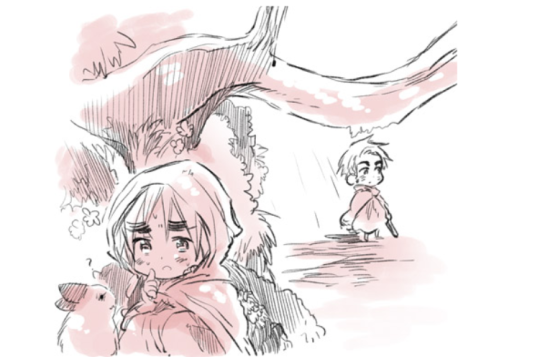
Norway can see and communicate with fairies (including England’s fairy friends), and Iceland can see these creatures but chooses not to let people
know this to avoid being seen as childish and weird [x].
There’s no indication
that they can perform magic, unlike Romania and England who are in the magic
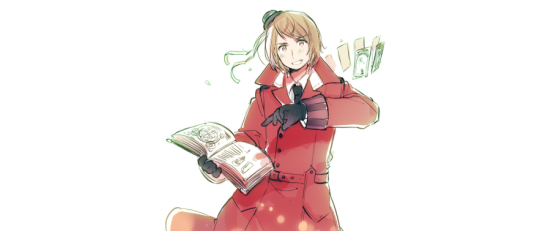
club in the Gakuen AU and are depicted with spell/fortune books in other blog updates [x] [x]
Given the legends, it’s
possible that Himaruya will decide to give them the ability to cast spells, but for now,
no. That doesn’t mean you can’t headcanon this, though!
Russia and America are distinctly
singled out as the strongest as the nations, but Germany is noted to possess
significant strength and muscles too [x].
This doesn’t go to say that
Germany wasn’t strong enough to defeat America or Russia in different battles (obviously), but
Himaruya has been consistent in elevating Russia and America’s strength above
other nations [x].
Not 100% sure, but
Himaruya has cited Osprey’s publishing work as his main source for military
uniforms [x]. If you would like more insight into the resources he uses, you can
skim through Bamboo Thicket. He lists dozens of the books that he uses as
history sources.
Side note: If
anyone’s ever wondering why some of the facts on the Roman emperors are a bit
off from mainstream understandings, Himaruya is really into new theories about
them that contradict traditional historical narratives.
Speaking of ancients, am I the only who thinks
it’s weird that Korea’s portrayed to be so young? I think the theory is because
of the division of Korea, but it kinda irks me when fans make him out to be
this immature little perv (I know Hima wrote him as such but still) because
Korea has almost 2000 years of culture and history; the fact that he’s seen as
“younger” than Japan is kinda wild too considering the south half of the
peninsula was the one to filter tech from China to the island.
No, I get that. Those choices were made in poor taste.
However, there’s also the possibility that Korea is second generation,
just like Egypt and Greece are with their ancient counterparts. It really
depends, because you also have Japan, China, and Turkey who don’t have ancient
counterparts,
Just laying out the possibility, but it’s important to note
that this hasn’t been confirmed.
Ok so I’m not sure
if America’s glasses are fake or real because I remember I was reading the
manga and he was talking to Canada and said “I tried wearing glasses how do
they look” (chapter 207)so that had to be around 1845 or early 1846 so if his
glasses are real glasses I guess he would start to need them as Texas became
more powerful. The stronger Texas is the worse America’s vision is and the more
he relies on his glasses.
He got them in an
unspecified period after his independence. However, given that they represent
Texas, I’m fairly certain it’s 1845 [x].
In consistency with the
rules from chapter 1 of world stars, France and England note that America’s
personality changed after he gained them (*title changes) [x].
They’re not real glasses,
though. In addition to representing land, they serve the purpose of a superhero
trope (e.g., Clark Kent taking off his glasses and becoming Superman) [x] [x].
They can eat, but I don’t recall them every being shown to
have any teeth…or any internal organs for that matter…[x] [x]
Isn’t it super sad that almost the whole fandom forgets about
the fact that Italy is really good with clothing and fashion but wears big,
silly t-shirts instead?
I mean, France of all people pretty much states that Italy
isn’t very good at fashion [x].
Then again, I don’t think Himaruya can make up his mind on
what Italy’s sense of fashion is given how contradictory pieces of canon
information are.
Ex: Italy can’t pay his electric bill because he’s spending
too much on clothes + his dressed-up cosplay ventures [x][x]
If there is a significant demographic shift in
a country (ex. if a minority group shifts to become the majority), will the
personification’s appearance and/or behavior also change? P.S.: Your content is
always awesome! I love your stuff, keep up the good work and thank you!
Thank you!
The nation’s appearances
first and foremost are based on stereotypes. Even if a minority becomes a
majority, more emphasis is placed on how the country is known to the world.
However, internal demographic traits and political, social, and economic
developments can affect the nation’s health, behaviours, and personalities [x].
Try to bear with me while I ask this, I’m not the
greatest with words so the phrasing might not come out right. Um, this has
confused me, unification is like a marriage, right? Okay, so wouldn’t they be cheating
on their spouse if their dates other nations. And what would of happened to two
married nations of other suddenly married another nations. Wouldn’t break and
upset their people, wouldn’t that cause trouble… And if they represent the
same country how’d that work. I’m sorry, very confused.
Even though the words
are used interchangeably, unification
is more often used in reference to the formation of one country (i.e., states,
territories coming together; German Unification, Italian Unification), whereas
marriage involves the union and/ orpartnership between two countries.
Unions don’t necessarily have
romantic overtones either [x].
I was just wondering, do you think the
england’s personality is at all influenced by the germanic stereotype? some
consider him part of the germanic family (historically england has strong
germanic influences + he has blond hair where the rest of his family seem to be
brunettes and redheads) and he’s definitely bad at showing his emotions, or do
you think these stereotypes only apply to actual german-speaking countries?
Probably not. He may not
be good at conveying himself, but unlike the Germanics, England is volatilely
expressive. He’s not stoic but rather extremely hot-tempered, sensitive, and
impulsive [x].
On the other hand, there
has been some Germanic influence depicted, albeit minimal. From what I can
recall, there is one panel depicting the Danish Conquest of England [x].
Thank you, same to you :D.
I know that Austria spent part of his life in his
wheelchair [x], and that Romano had chorea when he was younger (Vol 1).
No lol. Basically, I have preferences for certain ships, meaning that I already ship them, but if a dynamic is written well, I’ll still read it/ consume the content. I’m not very picky.
Why
Hetalia isn’t racist + why it doesn’t promote Japanese imperialism/nationalism
Before I start, it’s important to get a few points out of the
way given that many of the misinformed critiques of Hetalia have been made by
people who haven’t read the original source material (i.e., the manga).
There’s a difference between historical
situation and promoting a horrid ideology. Just because a series depicts war
and Nazis doesn’t mean that they’re inherently glorified. Of most importance is
that Hetalia promotes peace and reconciliation in spite of depicting war.
The wars that are depicted are general and the atrocities
are deliberately glossed over. This is necessary because Hetalia is comedic in
nature.
Hetalia is based on stereotypes, good or bad.
While some of the jokes are admittedly offensive, no nation is singled out nor
are any specific nations made to be superior in comparison to others. Every
character is made fun of for their stereotypes. Its humour isn’t meant for everyone.
Hetalia is satire. It mocks war and nationalist
sentiments rather than promoting it.
The dub is not canon. That includes many of the
insensitive jokes that Funimation scripted.
The anime itself is unrepresentative of the
manga. It can only cover so much material. Don’t judge a manga by its anime
just the same as you wouldn’t judge a book by its cover.
It’s also important to note that Seychelles has
always been dark-skinned in the manga, unlike in the anime where she was drawn
as pale-skinned. However, I do concede that even in the manga, her skin should
be darker [x].
Since I’ve already created many posts on this subject, here
are some resources corroborating the above points: [x] [x][x][x] [x].
In addition, I’ve also found a scholarly article in a
university publication that does a fantastic job of not only dismantling many
of the misconceptions about Hetalia but also many of the baseless critiques
that have been aimed toward it:
It’s a fair, level-headed piece that uses original source material to prove that
Hetalia mocks and undermines sentiments of Japanese imperialism and nationalism
while also demonstrating that it takes a definitive anti-war stance.
What I particularly like about it is that it
acknowledges that some of Himaruya’s early choices were made in poor taste but
is still able to substantiate the stance that this insensitivity isn’t
supportive of racist sentiments.
It also shows artwork/content that glorifies
Japanese imperialism and nationalism and then compares it to Hetalia.
Overall, it’s very well-written, sourced, and informed. Below
will be a list of important quotes that I took from the article. I highly
encourage for people to read the whole thing, as it breaks down a good amount of examples from both the manga and anime [x].The article can be found through Google Scholar.
Source:
Sands, A. T. (2013).
Belittling japanese nationalism in hetalia: axis powers. Humanities and Social Sciences Review, 2(3), 125-144.
Quotes:
“Hetalia does not
portray violence or accurate portrayals of history; Hetalia is a collection of
gags mocking militarism and stereotypes,” (125).
“Hetalia condenses
history for comical effect but retains an anti-war sentiment by belittling
wartime axis beliefs…In Hetalia, each character’s nation is targeted for
ridicule through its stereotypes, and I argue the stereotypes are not intended
to create a sense of racial inferiority,” (126).
“A close examination of
plot, character development and imagery reveals a subtle disdain for
nationalism, which purposes racism and false history,” (126).
“Manga and anime can be
a good outlet for nationalists to use, but it can also be a tool to combat
nationalism,” (128).
“For every Hetalia fan,
there is another furious anime blogger appalled by it. As the battle over
Hetalia’s purpose rages in anime and manga circles, academia has of yet not
entered the discussion with earnest,” (129).
“Hetalia does gloss over
almost all of the war, especially the darker parts of the war, but if you watch
the whole show, it is easy to realize the show is not about WWII,” (129).
“Korea as an ‘other’ in Hetalia is not nearly as
physiologically different from his Japanese counter part… Although Korea is not
portrayed physically inferior to the Japanese, critics argue his immature personality
and actions are racist. Himaruya’s choice to make Korea an immature teenager
rather than an adult may not have been the most sensible of choices, but it was
also necessary for him to create jokes tailored to Japanese stereotypes of
Koreans, which he could then subvert…On some levels, the jokes are insensitive,
and they are not politically correct,” (130).
The author also goes
on to mention how inappropriate and weird some of the “sexually charged” jokes
were, starting from page 131.
“In Hetalia, every nation has its moments when its actions
are designed to make people laugh at it, and Japan is no exception. Rather than
idolizing Japan, Hetalia’s representation of Japan is a socially awkward,
emotionally repressed, and sometimes obsequious character to be laughed at. He
is neither the proud solider in Sensoron nor the charismatic scholar of
Kenkanryu…
If Japan’s character had been a fearless soldier immune to
cultural gaffes, I would argue Hetalia would be purporting an idealized notion
of the “self” in order to promote nationalism. Himaruya’s version of Japan,
however, could not be farther from an “idealized self,” nor does he try to
blatantly dichotomize or attack a perceived “other,” (132).
“Hetalia does have politically incorrect and at times
racially insensitive caricatures. Gag comedy is based on jesting stereotypes
and thus has to have some degree of politically incorrect imagery and character
personalities. Neither in the original web comics nor in the anime version that
followed it did Hetalia attempt to isolate Japan as the dignified “self” people
should idolize. The “others” are often portrayed at the butt of the jokes, but
each nation also has its turn to be the dominant character, even at the expense
of Japan’s pride. Critics can dislike Hetalia for being tactless at times, but
I argue their accusations of supporting malicious racism are based on curt
examinations of the show, which do an injustice to Himaruya’s true intentions,”
(133).
“Hetalia’s critics decry it for more than just its perceived
racist notions; they also denounce it for its interpretation of WWII and other
historical events, which lack acknowledgement for grievances against Japan.
Gag-comedy constrains Himaruya to a small amount of time to touch on important
historical events, such as China’s discovery of Japan, Russo-Japanese War, and
WWII amongst others. The time constraints naturally appear as historical omission
for the sake of defending the nations; however, Hetalia does not attempt to
omit history to protect Japan’s pride, but rather it condenses history for
comical effect,” (133).
“By mocking the tools and ideas of war and degrading it into
a minute-long gag, Himaruya expresses his contempt for war and the foolishness
of man to pursue it, thus creating an anti-war message rather than glorifying
the imperial state as Kobayashi did,” (135).
Page 136: a good
example of how the Axis were anything but glorified, season 1 episode 18.
“Himaruya may have glossed over the atrocities of war, but
he did not glorify Japan,” (136).
“I believe that in season 4 episode 26, the final three
fragments before the credits represent Himaruya’s sincere belief in the need
for reconciliation amongst East Asian nations and Japan…Japan informs the viewer
he wanted to wait until the last to show his final technique, and in a close up
of Japan’s emotional face he proclaims, ‘But if you’re serious, I’ll get
serious, too! My final secret technique: Expression of Regret!’…
“The simplicity of the idea that peace could be solved by a
pair of underpants is the joke’s punchline, but I believe, underneath the surface,
it represents a metaphor that the path to peace and reconciliation in East Asia
is far simpler than assumed. For Japan, the path is regret,” (136-137).
“Himaruya is trying to make a comedy out of history. Hetalia
does omit many historical facts, but it was never trying to be a serious
historical discussion. When Hetalia condenses history for comical effect, the
imagery and dialogue indicate the scene is solely a gag. Himaruya’s metaphors
and cinematography suggest he views war as senseless. Rather than supporting right
wing nationalism, Hetalia appears to be a satirical anti-war anime,” (137).
Conclusion:
With all that in mind, Hetalia may have had its faults—and
still does to a far lesser extent—but
it has never advocated for war, racism, or nationalist and imperialist drives.
If anything, interpretations of the series have caused the exact division that
Himaruya’s writings have long been opposed to.
Thank you for tackling the subject with such an in-depth informative post, your effort is truly appreciated!
And I would also like to add, since the original question mentioned it, that, as an Italian, I never found the jokes at Italy’s expenses offensive. Are they an accurate representation of how WW2 went for Italy? No, they aren’t. But, as Ella has already specified above, Hetalia isn’t meant to be an accurate representation, it’s a satire. Those jokes and heavily exaggerated stereotypes would be offensive only if they were proposed as an accurate representation of Italian people – that, again, is not something that happens in Hetalia. If people cannot recognize the difference between a satire and informational material, it’s on them, it’s by no means a legitimate reason to attack the author (or other people who genuinely like the series, for that matter).
Honestly, I actually found the depiction of Italy’s action in WW2 absolutely hilarious because I have a sense of humour and I can recognize the irony in some situations (actually, there was a running joke among my classmates that the Italians were instrumental in the defeat of Germany for how much we hindered them as incompetent allies, and that was long before I knew about Hetalia. I think I can claim the same for them, as they never mentioned Hetalia – besides, it was never dubbed or aired on a mainstream channel, so them not having heard of it isn’t unlikely). Obviously, I cannot have the presumption of talking for every Italian, but nobody I’ve ever mentioned Hetalia to ever found it offensive.









 Ellawritesficssometimes