Below will be a list of parallels between America and Russia
that I think would benefit any RusAme writer should they wish to incorporate
them into their works. While in canon there is minimal romantic substantiation,
this post merely aims to provide writers with tools that highlight the similar chemistries
and complexes that America and Russia both experience. In no way is this
forcing the ship onto anyone either.
Child Imagery:
America:
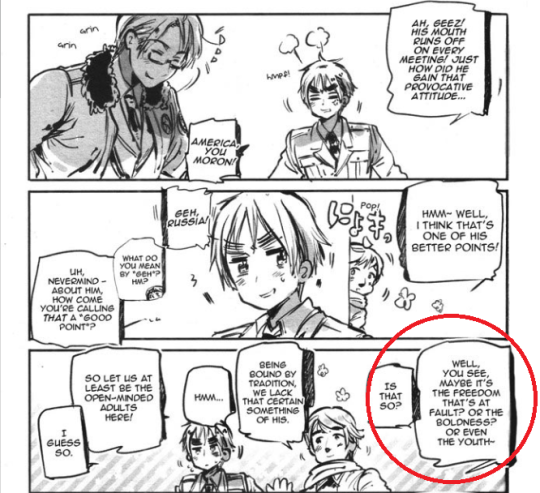
Both are equated to children, albeit in different aspects.
America is seen as young, brash, and inexperienced by older
nations [x] [x].
Ex: He categorizes the world into good guys and bad guys.
Russia:
Meanwhile, having been abused and traumatized in his
childhood, Russia later inflicts this same abuse onto others as an adult. He’s
described as child-like and is respectively noted to be unaware of his cruelty [x].
Point is, Russia isn’t cognitively aware of all this. I should also warn that
this abuse isn’t something that should be romanticized.
Instead, a more appropriate linkage would be the similar childish
perception of the world that he has.
Ex: He thinks that everyone he meets is his friend.
Ex: He naively believes that the Allies are his friends.
Lithuania has to point out to him that self-interest will always come first in
politics.
Weight Issues:
Both are insecure about their weight and physique [x] [x][x] [x].
At one point his only friends were Japan and England.
He struggled to make friends and was fully aware of the fact
that he wasn’t viewed in high regard by other nations [x].
Russia:
He’s had trouble making friends his whole life.
People outside of Hetalia:
Russia and America must hate each other!
Hetalia
fan: Actually, while existing
to represent their people—NOT their
governments—personifications are also individual human beings
with their own free will (who would have guessed).
Of course, it is important to
recognize that some shipping dynamics for various historical, ethnic,
religious, or political reasons are not appropriate and are too sensitive of a circumstance
to fictionalize.
In other words, USE DISCRETION.
Nonetheless, nations have the
capacity to separate themselves from their politics and personally be friends
with each other. Instead of pushing for division and hostility like many of its
critics do, Hetalia emphasizes comraderie and friendship.
This is something that I always emphasize: use discretion.
When it comes to older portrayals and newer ones, the rule of thumb that I use is piecing together what aspects of the characterization have remained and which haven’t. What is it that remains true to the character?
Ex: Is France still an aggressive, deplorable pervert? No.
You don’t ignore the insensitivity and inappropriate shock humour used in the past completely but rather you acknowledge that Himaruya has grown past this and has evolved as a creator.
If you’re asking about hints, that requires a lot more time and thought. However, there are some similarities between them that I can briefly go over. In my opinion, it makes for excellent shipping material.
For starters, they’re both incredibly insecure individuals. They want to make friends but have trouble doing so, and don’t always recognize that what they’re doing is wrong.
Ex: America being nosy and poking into everyone’s business, and Russia’s cruel treatment of other nations under his rule.
Personally, what I would use as a good focal point for conflict is the fact that they both think everyone hates them:
That’s a very good point! I never realize it before! Cool 🙂
Some additions for the anon.
Some common grounds I see similar from both of them is how they’re double-faced / hiding their true feelings/loneliness behind their smiles / their childish like attitude towards other nations.
As for historical side, though it’s not really emphasized much on hetalia, Himaruya did make a revolutionary war strip featuring APH Russia in it. And though it’s such a small panel for him in it, it represents how they started out even before APH America became a nation; APH Russia was one of nations who supported him in revolutionary war.
Also at American Civil War era, Russia also was one of few nations who supported the Union (though idk if Himaruya ever focused on it and made it official strip). And Russia’s support at Civil War era even discussed among historians to be one of factors that made France and Great Britain reluctant to support Confederate and this, making it possible for Union to win the Civil War. (for the history lovers, you could check it here http://www.voltairenet.org/article169488.htmlhttp://www.voltairenet.org/article169488.html)
So what makes this angsty for this pairing is that, their bilateral relationship started out really great in imperial russian era, until russian revolution started and changed Russia to USSR. Just imagine how their hundreds years of warm friendship suddenly turnt 180 degree in just few years. And basically made them act passive aggressive like this most of the time on Himaruya’s strip:
I think it’s canon that despite their passive aggressive bickering, APH Russia still wants to become friend with APH America. Like we could see here in this official strip where APH Russia imagines if every nations turns to children (including APH America here), there would be no conflict of interests and they could become friend.
While idk if APH America also feels the same way towards APH Russia, I think his nonchalantness in butting his way to APH Russia’s business just like how he acts towards other nations despite their long history of passive aggressiveness in hetalia universe is also kind of a hint that APH America also still wants to be friend with APH Russia.
There’s also that one scene in APH Paint it white where APH America went straight to APH Russia for his “sidekick” and not to other nations.
Idk, I might be biased since I’m a RusAme fan and all but I think those hints based on how they interacted with each other in canon shows that they actually want to be friends with each other despite their passive aggressiveness in canon.
And knowing how they actually started out great as friends in Imperial Russian era like how I explained above, I think it’s kind of bittersweet and shows how friendship in Hetalia universe is kind of fragile and depends on the “interest” each nation has. How hundreds of years wonderful bilateral relationship between USA and Imperial Russian Era could decay so quickly in just few years after Russia changed his boss and become USSR. Maybe that could be the “angsty” aspect that anon search for in canon, idk.
Bravo to anyone who reads this long post until the end btw, you guys rock 🙂
-You’re not being rude,
so don’t worry about that. I appreciate that you’ve gone through the lengths to
inquire about the reasons. Not many people are capable of this, unfortunately
🙂
-I’m a multi-shipper, so
it’s not like I only ship them together. (Mainly saying this for those who see this
post).
-In general: Not
everyone has to have a reason for their ship other than simply liking it. They
shouldn’t feel obligated to justify it either.
-It’s a misconception
that Russia and America don’t get along [x]. During the Cold War, their relationship
was a myriad of passive-aggressiveness [x] and yes, dick jokes [x]. Presently, the
two get along really well. Although, the passive-aggressiveness remains.
-I don’t want to
persuade anyone to ship RusAme. They can see the information and decide for
themselves. I’ll just point toward some neat parallels between them that would
form the grounds for effective fic writing.
“The second one from top is without a doubt a tsundere. Third one has the most cunning aura.”
Scottland’s appearance is auditory in “The Battle for America” but he does make one [x].
Himaruya also toys with Scotland’s design in this post [x], but nothing is made official. Given the eyebrows, chances are that those are them, but it still remains that it’s not canon unless explicitly stated otherwise by Himaruya.
What this post intends to do is use Horney’s theory of
personality to analyze why Germany’s strive for perfection and productivity
comes at the cost of compromising his true self and confidence.
Tyranny of the Shoulds:
The tyranny of the shoulds is a term that Horney coined to
explain the occurrence in which someone’s idealized self-image replaces their genuine
self-confidence. What the person strives to be and appears to others acts as
their confidence, whereas they don’t feel confident in who they truly are,
ultimately forcing them to continually put up the former front of
superficiality. An extreme form of this would be the person developing feelings
of shame and disgrace toward their real self.
Put another way, the real self (who you are) is replaced by
how one should be. For example:
“One should always be productive.”
“One should always be punctual.”
“One should never give up.”
“One should be in control of one’s feelings.”
“One should schedule one’s day to maximize utmost
efficiency.”
Sound familiar? It should, because these are the shoulds
Germany is ruled by.
This neurotic compulsion to strive to be someone you’re not
eventually leads to the person internalizing this ideal, albeit unrealistic,
sense of self. The consequence of surrendering your real self compromises the
person’s chances of achieving personal growth and happiness. They’re never
happy with themselves and only focus
on how they present themselves to others.
How does this relate to Germany?
In Germany’s case, he puts up a front of competence, order,
and productivity. He shoulders a lot of pressure to hold up the EU and has
internalized this responsibility to look after other member-states [x].
His work self has become his primary identity…his master
status.
Of course, this doesn’t mean that he’s incapable of unwinding. He’s very favourable of vacations [x].
Nonetheless, there’s no doubt that he’s a workaholic [x].
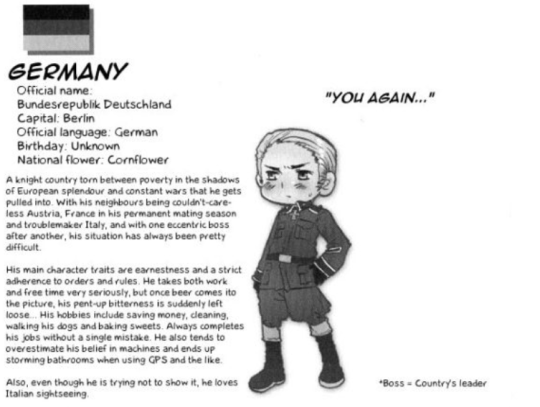
Ex: Several character notes identity him as bearing an
overly serious and compulsive personality type.
Ex: He has a whole character song dedicated to schedules, punctuality,
and routine. Public appearances are an indication of self-worth to him [x] [x]
Consequences:
Because Germany identifies with his work self, he’s
internalized repressing his emotions to the point that when he does experience
them (e.g., embarrassment, happiness), he becomes incompetent and lacks
confidence in himself.
Ex: He’s not used to being praised for his abilities outside
of work life. In this case, he doesn’t know how to react when Italy commends
him for his drawing skills [x].
Ex: He’s well-known for his inability to smile [x].
Ex: When it comes to interpersonal life, Germany is clueless
and has to rely on manuals (e.g., dating advice, teaching him how to smile). He
doesn’t need manuals for matters like business or economics due to familiarity
and experience, but when it comes to socializing he sheds this cloak of
competence and becomes dysfunctional without them [x].
There are also instances where Germany’s work self overrides
others’ impression of him, even when he attempts to be personal and social.
In sum, I’d like to end this with a passage from his
character song “Einsamkeit” that best exemplifies how his work self has
compromised who he truly is. He’s essentially alienated himself despite frequently being surrounded by other nations for his work [x].
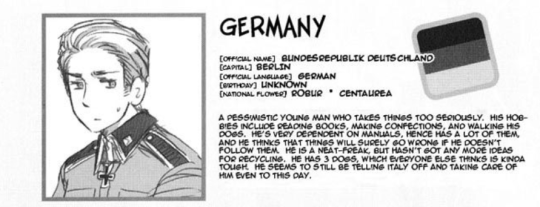
The side of him that likes romance novels, dogs, and confectionary is completely overlooked.
I’m always said to be scowling,
But my smiling face hasn’t been erased
You may think I’m frightening,
But it’s only because I’m straining to laugh














 Ellawritesficssometimes