Me: I need more school friends.
Also me:

Me: I need more school friends.
Also me:
Probably Lithuania. The degree to which he’s been ruled over after his empire was dissolved vastly affected his view of the world [x].

Volume 1, Go Sealand!

Volume 5, Together with Russia.


1) When other content creators
act as if there’s an invisible barrier between them and their followers,
especially in the comment section. It’s really not that hard to type in a
simple thank you to a kind comment/ reply to a message to say thank you.
Of course, it’s sometimes
impossible to check every comment
once time has passed, but I reply to those that I see. The comment section
should be a forum for engagement, not some classist-esque way for creators to
use their followers as a status shield and respective excuse to ignore them.
It’s something I’ve always
disapproved of and have unfortunately encountered in this fandom when I first
started out.
2) People not reading ask
guidelines before sending in an ask.
This isn’t really a pet peeve but it makes me feel bad
when I see this: Please don’t
apologize if you send in an ask. You’re not bothering/ annoying me. Thank you
for your engagement 😀
Totally agreed!
1) The Anglo-Japanese Alliance
between two lonely people [x]–
Japan reassuring England
that he wishes to form an alliance with him, not Russia.
+
England not knowing
how to react to someone legitimately wanting to be his friend, as this takes
place during the Splendid Isolation period.


England teaching Japan English despite having no idea what he’s doing.

2) World stars chapter 68– [x].
Japan teaching England Japanese ceramic art and design.


3)
World Stars chapter 142
–[x].
England sending Japan a custom postcard in reciprocation after learning that the latter had appealed to aspects of his culture.


4)
World Stars chapter 133–[x].
England inviting Japan to the opening of his maid cafe.


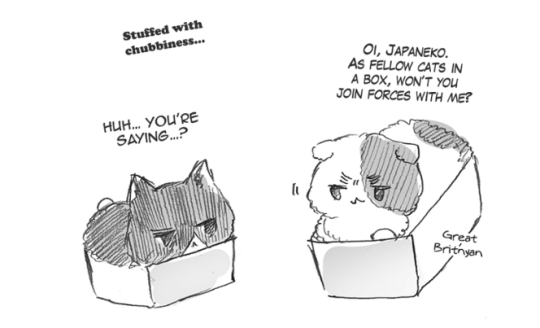
In the Nekotalia AU,
Himaruya uses boxes as a metaphor to illustrate Japan’s and England’s
historical political isolation [x].


Yes, very much so. It’s the same problem that I have with the anime industry in general. They have a tendency to sexualize young school children so that it’s deliberately marketed at adult audiences too.
Ex: Latvia and Estonia were originally characterized as 15 and 17 respectively. They shouldn’t have been incorporated into the fanservice waiter series that Himaruya posted on his blog.

Fighting for petty reasons to their own
detriment despite also caring and holding a deep respect for each other [x].


What this post aims to do is capture England and France’s
relationship at its most basic core. Contrary to popular opinion, France and
England don’t hate each other. There is a discrepancy in what they say and what
they do and feel, and that’s a critical point to understand when examining
their dynamic. What best exemplifies this is a character note from Volume 1.
England is stated to have an “inseparable fight-friendship”
with France. In other words, the whole purpose of their relationship is
predicated on irony. The two ‘despise’ each other due to political ties and
personal disputes, while at the same time, they’ll also find themselves
inexplicably gravitating toward the other. Point is, even when they were
enemies, having grown up together, the two still hold a degree of familiarity that
has made them inseparable, regardless if they’re allies or enemies.
That said, I’ve organized their relationship into three main
themes. Let’s tie this back to the strips.
Of course, I have to begin with what they’re most known for:
fighting and bickering.
The two grew up as rivals and continue to be rivals in
adulthood. Remember that there’s a difference between being a rival and an
enemy. Historically, France and England bounced back and forth between being enemies
or not but always remained as rivals [x].


When they were younger, the comic gag was that France
desired to conquer England, whom he viewed as “uncute.”
While France did tease England for his hair and fashion, I
don’t think he realizes the extent that this has on England’s self-esteem.
England’s pride is too great to admit that France’s words affected how he
viewed himself, so it wasn’t exactly a topic that they brought up and discussed
openly [x].

Ex: England privately reflects on his lacking sense of refinement
after France mocks his sense of style.

Nonetheless, in the same strip, France still takes the time
to cut England’s hair, let alone compliment him, and reserves a matching clothing
piece for England to wear.


We also know that during the Norman Conquest, England became
a subordinate to France.
Ex: England isn’t willing to admit to young America that
France used to cook for him during this period [x].

Another example that illustrates their rivalry well is how
France sided against England in the Revolution [x] [x].


What I take away from this is the differentiation between
the influence that politics has in the present experience of relationships
between nations versus the accumulation of history and experiences that affect
their personal relationships.
That brings me to my next theme.
As mentioned, while England and France fight and bicker
frequently, enemies or not, they would still be considered to be each other’s
right-hand man. Their history together runs deep. The opposite’s presence is
something that has always been a constant in their life. It’s for this reason
that I believe they always find themselves drawn to the other in a variety of
circumstances.
Ex: In WW2 when he’s occupied by the Nazi regime, England
takes France into his home.

Ex: When he opens a maid café, England has no qualms in
proudly declaring the cook of the establishment to be French [x].

Ex: In Volume 6, we see France reprimanding and confronting
England on how poorly he raised America.

Lastly, it’s no question that France and England declaring
that they hate each other is a misnomer. The discrepancies in their words and
their actions speak enough volumes to this.
Ex: When they thought the world was going to end in the year
1000, England decides to grant France’s wish and pretends to be conquered by
the latter.

Ex: In the middle of a brawl, France compliments the
material of England’s outfit, and, in return, England offers France a 20%
discount for the same material [x].

Ex: France plans to sightsee in England and asks England for
any hotel recommendations. While verbally refusing to give France the
recommendations, England still emails them to France [x].

Ex: In the well-known “Dream United Kingdom” strip, France
proposes to England after the Suez Canal Crisis wreaked havoc on their
economies. The intention was to establish a union between the UK and France [x].

What’s always interested me is that even though England was
vehemently opposed to marrying France, his reason for not doing so wasn’t an
outright rejection. Instead, he claims that he didn’t want to marry France for
the lame reason of ameliorating their financial circumstances.
In sum, while France and England may be rivals and
extensively get on each other’s nerves, to only look at them in this light
would be to wrongly stereotype their relationship. The two have an interwoven
complex of friendship and rivalry; both components are necessary if their
dynamic is to be looked at in whole.

“This just in! The French Revolution!
France is forced to wear unaristocratic clothing and dresses
like a commoner!”
England: Aw, pity. Alexa, play despacito.

 Ellawritesficssometimes