Usually I’m very stringent with what I eat because if I don’t eat healthy it makes working out absolutely AWFUL. You have no energy. On the other hand, these kids were selling icecream on my street, and I have a complex where I can’t say no to people. I knew if I left the treats in the freezer my Dad would eat them and break his diet. Eating them all was my only solution.
Translation: I’m a mental case.
Oh oof. I just had to google what 7/11 was :O
In previous posts, I’ve touched on the notion that pets in
Hetalia often function as a mouthpiece for their respective nation. Put another
way, while they are separate physical beings, symbolically they serve to
represent the psyches of their owners (i.e., their thoughts, feelings, and
emotions) [x].
Thus far, I’ve picked up on three consistent themes.
1)
They tell the nation something they need to hear.
2)
They speak what the nation doesn’t dare to say
out loud.
3) In conjunction to #2, they often reveal what the nation is
feeling.
That said, let’s tie this back to the strips.
America:
The best example where America’s pets mirror his feelings is
their fondness of Lithuania.
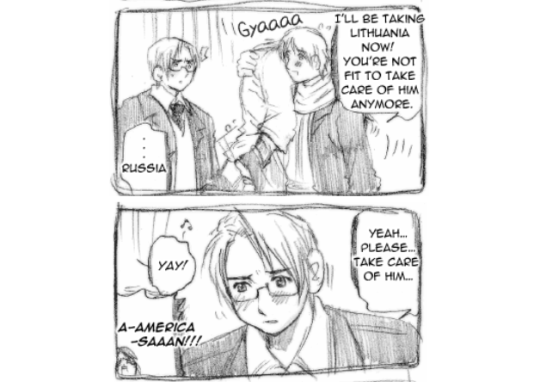
America becomes disheartened when he can’t afford for Lithuania
to live with him anymore [x].
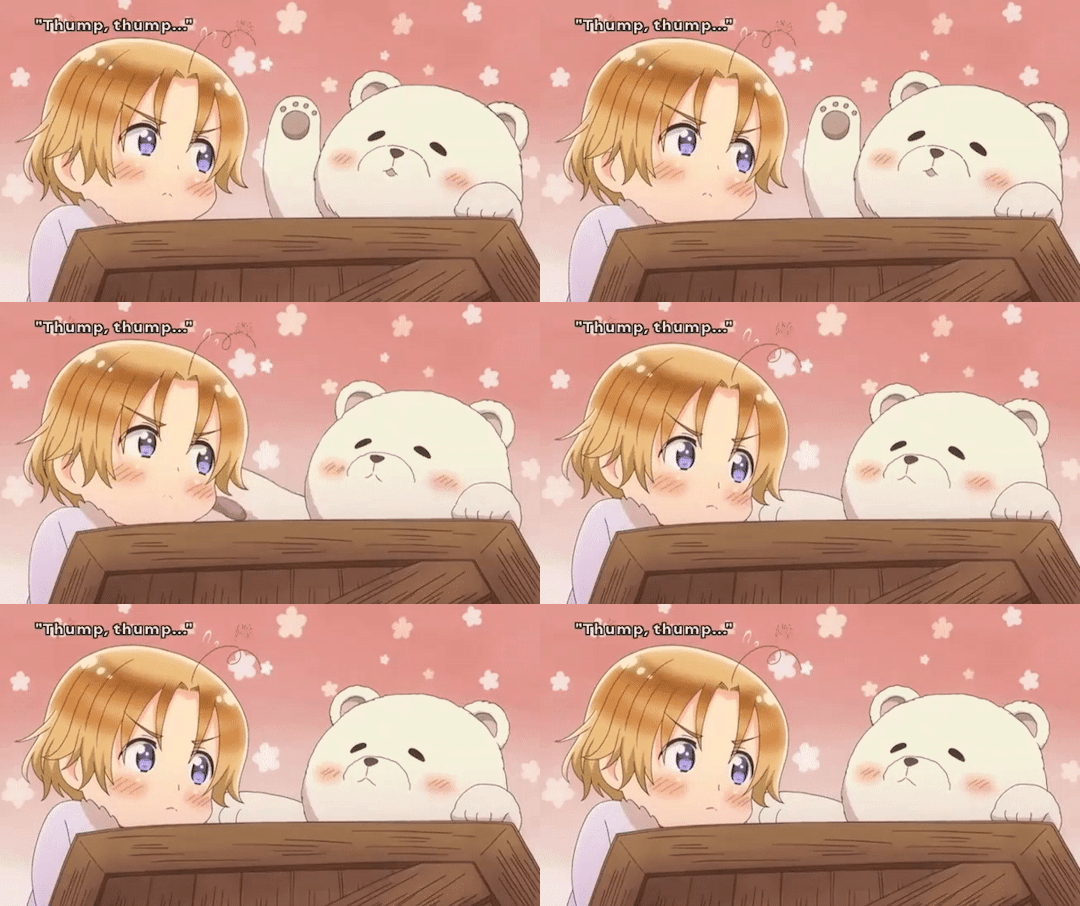
However, in earlier strips, we learn that America’s pets
hold a similar affection for Lithuania [x].
Canada:
Before, I’ve speculated that Kumajiro represents Canada’s
psyche.
The focal point of Canada’s characterization is his struggle
to form a stable and memorable identity and overcome his invisibility. As such,
neither Canada nor Kumajiro getting each other’s names correctly figuratively reflects
how Canada still hasn’t figured out who he is.
Hence, Kumajiro’s infamous “Who are you?” catchphrase has another
level of depth to it [x]. He’s not just asking Canada who he is [as in his name]
but also who Canada stands to represent as a person and a nation. His identity and
self-concept is something that he continues to negotiate and work his way
around.
Some other examples would be…
Canada is too shy to ask England to have lunch with him.
Kumajiro then reassures Canada that it’s okay to be more demanding and urges
him to speak up for what he wants.
In the aftermath of the American Revolution, England diverts
most of his attention toward America. Kumajiro uses stuffed animals to convey Canada’s feelings. The puppet story depicts how Canada feels
neglected and excluded [x].
“I think the well-behaved baby bear should be loved more,
but what do you think, whoever you are over there?”
England:
England becomes dismayed after watching a fantasy movie and
laments over his desire to live in such a world. His magical friends don’t hesitate
to give him a required dose of reality [x].
Iceland:
Mr. Puffin acts as both a mentor and mouthpiece for Iceland.
He’s able to see right through Iceland and recognize what he’s truly
feeling. In this case, he’s aware of how lonely Iceland is [x].
On the other hand, when he first meets baby Iceland, he comforts
him. At the time, Iceland was still figuring out his existence and questioned
why ‘no other guys like him’ existed. Mr. Puffin assures him that other
nations do exist, just in far geographic proximity [x].
He also teaches Iceland knowledge about the world from his
travels [x].
Me every time I eat something I know I shouldn’t have
He can see and communicate with supernatural beings with his barrette but hasn’t been shown to be capable of using magic (e.g., he’s not part of the magic club in the World Academy AU). [x].
So far, it’s only England and his three older brothers and Romania whose magic-performing abilities have been confirmed.
It might be. While America did get a unicorn for his bicentennial as a gift from England, it’s unclear if the one he encounters near a forest is the same one [x].




 Ellawritesficssometimes