Thank you! I’ve done two
mischaracterization-ish posts on him before. [x][x]
This was before the mischaracterization series was a thing. I can
always do a more formal mischaracterization post on him later, given that I
have plenty of requests for it 🙂
I’d really like to show
off how sweet and cute he is, though. He literally warms my heart.
Quick evidence on Spain coming up tonight!
[Also, I apologize. Regardless if I code a read more into longer posts, they disappear after a while. Tumblr is still broken :/]
Note: This post will
use Swiss psychologist Kubler-Ross’s model of grief to analyze how Prussia has
come to terms with his death/ potential [future unconfirmed] death.
Kübler-Ross’ Model:
Having worked with terminally-ill patients, Kübler-Ross
recognized universal themes in which people passed on. There were certain
phases that her patients experienced before dying. While the model isn’t
successive in that patients don’t have to experience one phase in order to
experience the next and that some patients don’t necessarily experience all
stages, these themes were a common phenomenon that she observed. It’s not
measurable and empirically supported, but it does provide a good description of
the phenomenon.
The stages, which can be experienced several times
throughout the dying process are: Denial
and isolation, anger, bargaining, depression, and acceptance.
Denial is pretty
self-explanatory. The person refuses to accept the reality that they’re dying
and will usually avoid talking about it all together. Mostly, there is a
partial acceptance of their death (e.g., recognizing their fatal diagnosed
illness). It’s very rare where the person will maintain a consistent denial
until death. This stage is ultimately characterized by numbness and stoicism.
What’s isolating is that the person refuses to accept any other reality but
the one they’ve constructed.
Anger is also
fairly explanatory. Once the denial
can’t be maintained and upon recognizing their lack of control over the
situation, the person gets angry and resentful. This entails displacing their
anger and projecting it onto everything around them, including their family
members.
Bargaining is a sort of middle ground. If they’ve
consistently denied their death and are still angry at everyone and everything,
including God, they will attempt to bargain with their fate. The lack of
control renders them childlike in that they’ll wish for a postponement of their
death with the implicit promise that they won’t ask for anything else.
Ex: “Just let me
live past one last Christmas. That’s all I ask.”
Depression is seen as a necessary phase if the person is to
die peacefully and with a state of acceptance. Rather than trying to cheer the
person up, Kubler-Ross recommends encouraging the person to accept their
sorrow.
Acceptance includes neither an angry or depressed state.
Nonetheless, it shouldn’t be mistaken for happiness. They may not even feel
anything. This final stage typically involves the person withdrawing into themselves.
They don’t want too many visitors and are more contingent on their family
members presence as their support rather than verbal communication.
That said, the best example where I 100% believe Himaruya
has used this model is with Prussia. Regardless of what he personifies/
personified, it can’t be denied that Prussia has become weaker and may or may
not fade away.
In my interpretation, his character song, Mein Gott!, is an exemplification of
Prussia’s unwilling confrontation with the possibility of his death. He goes
through all stages with the exception of anger. Just like the model, Prussia
flips through the stages in a non-linear manner and experiences them several
times throughout the song [x].
Denial:
“Someone is calling,
I’m being called
Alright, leave it to me; let’s go
More! More!
To the east and to the west
I’ll keep running”
He hears the call of death but
runs away from it.
“The awesome me’s the most supreme! The
strongest!
The one who gets the last laugh, yeah!
Is the awesome me, of course!
Danke!
The best! The most fearsome!
You guys can praise me
I’ll show you my massive dream
A succession of victories for sure!
…
All of the maps will someday be in these hands…
I’ll laugh as I run through
That’s right, it’s not because I’m weak
It’s because I’m too strong”
He hasn’t come to terms with
the fact that he’s not the political superpower he used to be. Instead, he
deflects by boasting about his strength in a hypermasculine way.
Ex: Prussia flat-out lies to Germany when the latter
recognizes that his bite wound has taken an abnormal amount of time to heal…for
a nation, that is.
The isolation pertains more to how Prussia himself feels alone.
Ex: When asked why Prussia is so alone, Himaruya answers
that it’s because of the “pitiful state of an enclave he’s in,” [x].
Enclave has two distinct meanings. In this case, I interpret
it as Prussia feeling different and excluded from other nations whose
immortality still remains.
Definition: ENCLAVE, a place
or group that is different in character from those surrounding it.
“Danke!
Everyone! Come here!
Let’s exchange email addresses?
Being alone is too much fun
Everything will be in these hands! Just you
wait!”
Bargaining:
“Mein Gott!
In a pinch! Punch!
Sometimes even a warrior starts shaking
(…I’ll leave things at this point)
A reverse in the situation, I’m going to be
hasty!”
(Beobachten Sie es bitte,
Fritz Vater) x 3
(Watch over me please, Father
Fritz)”
Here, it’s evident that Prussia desires to reverse
his weakened state. He bargains with fate by asking Fritz, his father figure,
to watch over him.
Ex: Prussia has a picture of Fritz on
his night table. It gives him a sense of security, insulating him from his fear
of dying.
Depression:
“Hey
little bird chirp for my sake
It will heal me; niyo niyo!”
Prussia actively recognizes
that he’s been weakened. His sorrow is displaced to his bird, whom he hopes
will cheer him up.
“This is bad, a panda that
will bring happiness
I won’t be fooled.”
In the 2009 April Fools’
Event, China gives Prussia a panda with the promise that it’ll bring him
happiness.
Acceptance:
“Alone in my room
I’ll write it today too
A memorial of the awesome me
More! More!”
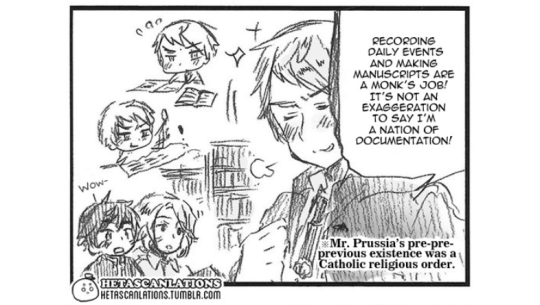
We all know that Prussia’s
been writing diaries since he was little. It’s the mention of a memorial that
signifies his acceptance of death.
There’s also the recognition
that Germany is his successor.
Ex: When asked if Prussia will
disappear, Himaruya doesn’t rule out the possibility [x].
That said, it still amazes me
how people still conceive Hetalia as thoughtless, random, and simple. With the
large volumes of intertexts and historical and theoretical references woven
into the series, it’s anything but.
*Has no books*
The meme collection on my phone:
YES LOL [x]. There are a ton of other interactions that substantiate this btw.
Definitely! Prussia by far is the most obvious.
On the other hand, Rome does experience some of this
in the strip “Grandpa Rome’s Visit Home.” There are also bits of the theory
expressed in how he once tied up God to visit his grandsons and occasionally visits
them in their dreams.
To me, Prussia’s character song Mein Gott! is a song that
involves him confronting each stage of death. Post coming up tonight!
Yes, I’m in Criminology! I’m in my fourth year and graduate in April 🙂 Thank you so much! I also find it pretty neat that I found another crim student here. All the best!
Widely underestimated and forgotten moment in the manga:
Even though it would benefit him economically and
politically, America nonetheless pushes for Canada to gain his independence [x].
He even went so far as to ask for England’s permission
before visiting Canada at his house.
“Once you’re
independent, we can be close again without worrying about England anymore,
right?”
*At America’s Independence Day party*
England: There’snowhere for me to sit. All the seats are taken.
America: Oops, my bad.
America: Here you go.
Here’s just a list of
terms that have a completely different meaning in the manga. This is aside from
their literal denotation.
Being Bullied:
When a nation is referred
to as a bully and/or is bullied, this refers to them being conquered or sought after
by more powerful nations.
Ex: Both Italy brothers being conquered after Rome’s death [x].
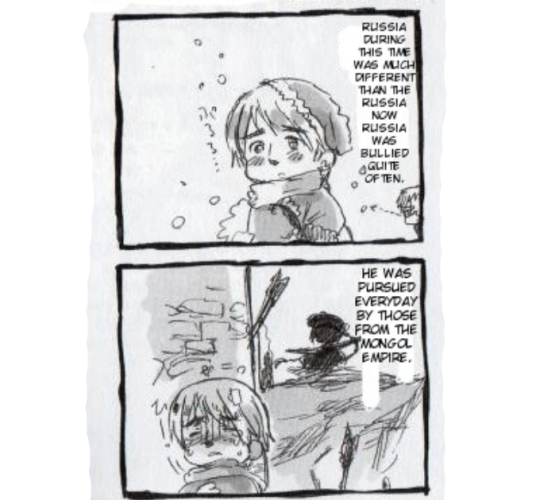
Ex: Russia being ‘picked on’ by Mongolia, Denmark, Sweden, and Prussia.
While it is possible for
nations to become students and attain degrees, the term “honour student” is
used in reference to how well a country succeeds politically or economically.
Ex: Italy’s referred to as an honour student in the EU [x].
Ex: Seychelles, being among the wealthiest African nations, is referred to
as an honour student.
House:
House refers to the
actual country itself.
“My house [country] is
known for…”
Ex: Italy expressing confusion at the foods that tourist destinations in
his country try to pass off as authentic Italian cuisine [x].
Being the antisocial member of your family and leaving your
room like






 Ellawritesficssometimes