“Have you done a characterization post on England
yet? I feel like he’s often represented to be either way crueler or way more
timid/uke-ish than he actually is ripperoni”
I’m going to save England’s strength for another post, considering how perplexing his characterization is regarding that, but I can definitely do a characterization post on him.
I’ve discussed his character in full several other times, so this will just be quick and dirty evidence should you ever need it! These will be the most common misconceptions I’ve noticed.
Post coming up tonight!
Why not both?
Obligatory adult reprimand: Do your homework first!
4) The earthy smell immediately after it rains (not the worm smell because ew).
5) Writing, like 10% of the time.
I know it may seem random at times, but there is a
consistent logic running through the manga that explains why some nations live
on despite ceasing to exist politically. The reason that this causes a lot of
confusion among fans is because of how loosely the word nation is defined in
Hetalia.
Nation doesn’t strictly mean an autonomous and politically
recognized sovereign state. Instead, personifications exist as representations
of a group of people and their culture, hence explaining their wide diversity
(e.g., kingdoms, religious orders, micronations, city-states, provinces, etc.)
Remember that the modern nation-state is a recent phenomenon. Humans organized
themselves far differently in the past. Larger post on that here [x].
In “It’s a Treasure Box of Countries”, it’s confirmed that
the nations are cultural and citizen-oriented personifications. Two things can
happen when a nation dies.
1) They gradually fade when their people’s culture
or identity (personality) disappears.
“Usually, when the culture of the country’s personality
dies/ disappears, the country would gradually disappear or entrust him/herself
to the country that takes over him/ her.
2) The ex-nation becomes a state representative.
“Regardless if their people’s culture and
personality disappears, the personification can still live on as a state
representative.”
There are two points to take away from this. One, the
nations don’t cease to exist because of political recognition. First and
foremost, they exist for their people and their culture. Two, nations don’t
necessarily die right away, or at all if they decide not to.
Ex: In World Stars, France reaffirms again that the nations exist because of their people.
That said, let’s go through some examples.
Poland and Lithuania:
After the third partition of their empire, it wasn’t just
Poland that ceased to exist on the political map.
Lithuania did as well. Nonetheless, as Lithuanians and Poles were absorbed by
Russia, Prussia, and Austria, thus ending their political identity, their
cultural identities remained in tact. Lithuanians and Poles didn’t disappear; their states did.
It’s for this reason on top of the fact that nations gradually
disappear that Poland and Lithuania are revealed to have lived during this era.
Poland made friends with Italy and bonded over their desire for independence.
Meanwhile, Lithuania became a servant to Russia.
Holy Rome:
Holy Rome didn’t die right away despite being dissolved,
once more demonstrating the gradual pace of how and when a nation fades.
Whether he’s East Germany or not, it’s clear that Prussia is
losing his immortality.
Ex: When Germany’s dog bites him, Prussia takes longer to
heal from a wound.
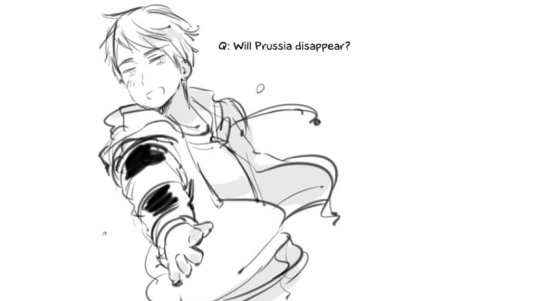
When asked on whether Prussia will disappear, Himaruya doesn’t rule this out as a
possibility [x].
In sum, it’s important to note that the nations don’t exist
for political reasons. If they die, it’s because their people no longer
identify under a common identity, or their culture disappears. This death doesn’t
occur immediately and is a gradual process. On the other hand, personifications
can still choose to exist even without a group of people and culture to
represent.
However, I haven’t discussed Poland’s partitions and how it’s portrayed in the manga, so I’ll draw up a quick guide on that. The logic still stands.
Post on what causes the nations to fade coming up tonight!
Hetarchive appears to be relocating strips to a newer page. The posts scheduled for tonight are postponed. I needed a specific panel from a non-linear strip that hasn’t been uploaded yet. Either way, I want to thank them for their hard work!
One thing I’ve noticed is that fans approach and analyze
relationships between the nations from a human perspective. The problem with
this is that it doesn’t capture the elasticity and interchangeability of
titles of beings who are immortal– not mortal– go through. In other words,
aside from direct biological relations which don’t change, you can’t apply
words of human organization to immortal beings who routinely change how and who
they relate to.
For example, just because a nation lives with another
nation, doesn’t automatically make them family. In the case of a nation, they
don’t live with other nation(s) by choice but rather circumstance. Often
enough, it was the product of being conquered.
Some nations living together will choose to identify as a family,
as their bond as a unit most closely resembles one. Nonetheless, these
families, or households rather, are temporary.
Ex: Hungary refers to Holy Roman Empire’s household as a
family [x].
Ex: Having lived with France in Rome’s household
for some time, young Italy referred to France as big brother.
Out of respect, some nations will continue to refer to the
other nations they lived with as an older brother. In Japanese, “onii-chan” is
a term coined out of affection and adoration for a figure. It doesn’t mean
older brother in a blood sense.
Ex: France claims to be the older brother figure of the
world. Meanwhile, only Italy and Monaco choose to refer to him with this title
of affection [x]. Again, not to be mistaken with a relation.
A nation can be a guardian for several centuries and later
evolve into a companion, friend and/or mentor figure.
This is best seen with America and Canada, biological
brothers who temporarily held a family unit with their colonizers. Although,
they didn’t physically live together, settling for occasional visits instead.
For one thing, it’s important to distinguish the fact that biological relations are inherently sensed by the nations.
There’s a difference between Iceland, who senses Norway to
be his brother from birth [as does Norway]… [x].
…and England and France, who make America and Canada their
family [x].
Ex: America doesn’t inherently sense a brother among his
colonizers, Finland, France, and England.
Instead, they fight over who will assume the role of
America’s brother [x].
As mentioned, it’s difficult to apply human words for
relationships to capture relationships between immortal beings. It doesn’t
quite fit. Think of it this way: The nations have unique experiences that we as
humans will never have. So, why are we using words that describe our
experiences to describe theirs?
Respectively, England has trouble deciding what America
should call him.
Again, notice America’s choice of the word onii-chan.
Titles like guardian and older brother, two very different
terms, are loosely thrown around. Of course, older brothers can be guardians, but you’ll see what I mean by this muddled distinction in a moment.
It’s hard to make sense of a relationship
using words that don’t describe but instead confine and water down the
complexity of the colony-colonizer and simultaneous guardian-adoptive
relationship they’ve established.
This uncertainty and fumbling to find words that best
describe their relationship is seen again when America declares his
independence. Even he doesn’t know if what they had entailed a parent-child or
sibling relationship [x].
Nonetheless, he cuts off these ties and no longer views
England as this type of figure for him.
The point I want to emphasize is that due to political
circumstances, the nations’ relationships with each other are dynamic. It’s not
as rigid as human forms of organization; therefore, it doesn’t make sense to
approach these family-like dynamics from a human perspective. It’s like
comparing apples and oranges.
Lastly, to avoid falling into a trap of reasoning, there’s a
stark difference between conquering/ colonizing a nation and living together and
willfully forming a union [economic or political] and living together.
Ex: Switzerland adopted Liechtenstein into his household and
the two consider each other to be siblings. Because this is how they presently
identify and relate to each other, they are siblings.
France and England: We’re
good, responsible parents.




 Ellawritesficssometimes