Me: I should start waking up earlier.
*Goes to bed at 4:00 AM, sleeps through five alarms, and wakes up at 4:00 PM*
Also me: Unbelievable.

Me: I should start waking up earlier.
*Goes to bed at 4:00 AM, sleeps through five alarms, and wakes up at 4:00 PM*
Also me: Unbelievable.
I believe most of it has to do with Gakuen Hetalia. Fangirls got jealous – don’t ask– and hated Seychelles because she was the main character in the dating simulation with other male nations.
I don’t know how anyone could hate her, though. She’s always smiling.


Sure thing, and hell yes, she’s so underappreciated. She’s a big sweetheart. Unfortunately, people tend to dislike her because ‘she gets in the way’ of ships…just like any other female nation.
Characterization post on Seychelles coming up tonight!


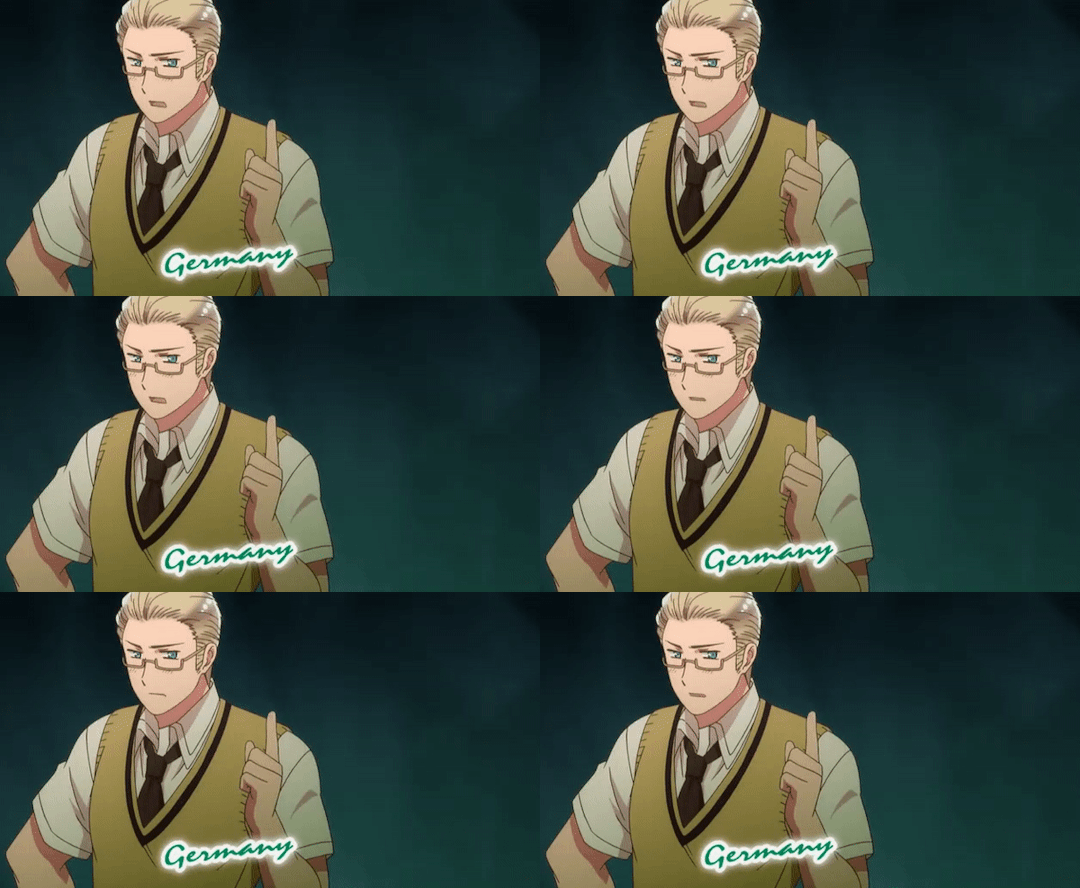
The purpose of this post will be to clarify much of the
confusion that has been generated by changes made in the anime concerning Germany’s
birth.
In the anime, what you’ll see is that the process of Germany’s
birth is depicted as a clear result of the German states huddling [combining]
together to form one state.
Meanwhile, in the manga, the process of Germany’s birth isn’t actually shown – all that’s
revealed is the end result. It’s left vague and open-ended, perhaps for the
purpose of giving Himaruya leeway to later confirm that Holy Rome is, in fact,
Germany.
That said, let’s go over the strips that cover Germany’s
birth.
In this chapter, a meeting for all German states is held [x].
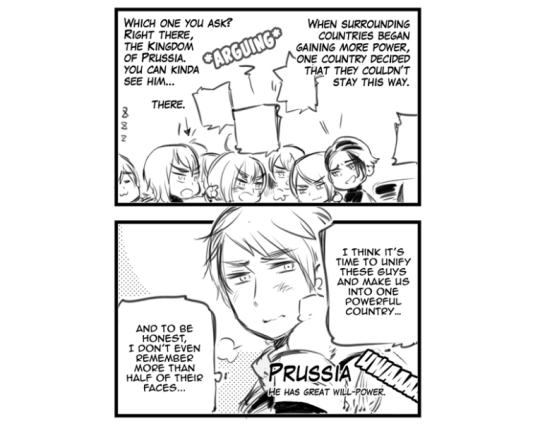
Prussia’s suggestion of merging into one sovereign state is received
well.


Admittedly, before the German states are able to form
Germany, they’re excited about “the birth of their new baby brother.” I’ll get back to this in a minute, hold on.

Austria stops the process and claims that he’ll assume
responsibility over Germany once he’s born.

Prussia kicks out Austria from the German Confederation.

What’s critical is that when Germany is born, the previous
process in which the German states were to huddle together to form him isn’t
shown.
Instead, the strip skips straight to Germany being born.

My explanation:
I’ve done a full post on this [x], but it’s important that I
go over this again before comparing it to other strips.
The reason that I believe the German states aren’t depicted
to be huddling together, only to step back and reveal a new personification –
as shown in the anime – is because the personification already existed.
Holy Rome hid in Prussia’s house after his dissolution
He
didn’t die right away.

On top of that, we know that Holy Rome became sick as a
result of the fragmentation and lack of unity in his empire. This illness only
became worse once he was dissolved.

I
believe the reason that Germany was born as a young child is because he changed titles. The existing body panel is meant to be taken literally in
this sense. The personification was already alive – but not well.
Note: I also recognize that baby nations canonically wear nightgowns. As I’ll reveal below, I believe Germany was wearing a nightgown for an entirely different reason.

As stated in chapter 1 of World Stars, it’s completely
possible for nations to change titles and assume new personalities.

Since your
personality is very much driven by life experiences and memories from them, to have a new
personality inevitably means that you’ve obtained new memories.
Or, in Holy Rome’s case, for him to assume a different personality
as Germany would mean that he’d have to completely forget about his past life. Otherwise,
these past memories would influence his personality.
So, maybe Germany’s an amnesiac Holy Rome then…is there any
evidence of that?
Yes.
In the same strip, Prussia reminding Germany that he can
call him big brother several hundred times can easily be interpreted as him attempting to trigger the newly-born Germany’s memories of being Holy
Rome.

As such, the fact that Germany emerges wearing a nightgown,
as a child, can likewise be interpreted as an amnesiac Holy Rome – who also
conveniently wore a nightgown in his later days – stepping off his deathbed for the first time. In
other words, German Unification fixed Holy Rome’s health, the only problem
being that he’s lost all of his previous memories.
Ex: Holy Rome, sick in bed as Prussia reads him fairy tales.

Ex: An edited comparison of Germany and Holy Rome, both of whom are wearing nightgowns. They also look exactly alike.
Left – Germany, Chapter 12 of World Stars, Right – Holy Rome, Chapter 187 of World Stars.

Lastly, this would explain one German state’s sobbing
reaction to Germany being born.

This is all behind the scenes speculation, but I believe
what happened is that when the German states initially agreed to form into one
country prior to Austria’s interruption, they believed that Holy Rome was dead.
Remember that Holy Rome was hiding in Prussia’s house. That’s why they thought
they would be gaining a new younger brother.
The reason that the process of Germany’s birth was skipped
the second time around is, again, because the personification (Holy Rome) that
represented them already existed.
This panel, then, can be interpreted as one of Germany’s
older brothers realizing that Holy Rome hadn’t in fact died and had been alive the whole time.
Timeline wise, this was made before World Stars. Nonetheless, here too, the process of Germany’s birth isn’t depicted [x]. All we see is the end result.

This is a redrawn and reprinted version of Comic Birz
Episode 11. It’s especially important because it’s what the anime adapts, as World Stars hadn’t yet come out at the time.
Notice again how the process of Germany’s birth isn’t
depicted. It doesn’t show the German states huddling together.

I think you already know what I’m getting at here.


Unlike the strips listed above, Germany’s birth in the anime
is drastically different. It actually shows Germany’s birth process.
Episode 5 of World Twinkle animates this, adopting the strip
from Volume 6.
I cannot stress this enough: The German States huddling
together and later stepping back to reveal a young Germany is not canon.

With all that in mind, I can see how easy it would be to
assume that Holy Rome and Germany are separate persons just by basing opinions off the anime. While the connection between them isn’t confirmed in canon,
however, the manga leaves things far more open-ended.
Germany: It’s finally time to come to terms with my sexuality.
Also Germany:

I’m currently working on a mega post that compares literally every example of the parallels between them (e.g., dialogue, expressions, replicated scenes).
For now, this is what I find to be the most interesting.
We know that pets in canon live longer if they’re around a nation, as the latter’s immortality rubs off on them, right? [x]
Well, doesn’t Holy Rome’s dog look a lot like Berlitz?


VS


I don’t recall Wy being involved. I think this is the strip
you’re talking about [x].
Australia did ‘research’ on Japanese people. This entails
watching a clip from Naruto – a joke, obviously.



Note: This is a
guide. It’s not meant to cover an exhaustive list of all relevant examples in the manga. If I did that, this post could
easily be a novel.
Before I get into the direct blood relations of the
characters, this guide aims to chart out and differentiate between the different
types of relationships that we see in the manga.
Biological siblings, obviously, means that the nations in question
are blood-related.
Ex: America and Canada.

Ex: Greece and Egypt and their moms, Ancient Greece and
Ancient Egypt.


The best example of a biological relation is that of Norway and
Iceland’s.
Iceland had no native people. Since it was Norwegians alone
who first settled on the island, the two are directly related [x].
Iceland innately senses Norway when he’s first born.
Norway
also senses Iceland.


Likewise, DNA testing – in this case, a land excavation – is
done to confirm their biological relation.


Now, let’s do a comparison.
When America’s born, he doesn’t sense a biological brother
among the countries colonizing him. The reason for this is that he’s referred
to as an ingredient, meaning that not only were there native tribes living on
the land he represented but that America existed as a mix of several European
cultures [x].
The point to differentiate here is that America doesn’t have
a direct biological relation to these colonizing countries due to the large
volume of them.
Instead, what you’ll see is that the colonizing countries
fight over assuming the role/ title of being America’s big brother, or
onii-chan.


Continuing from America’s example, after he chooses England
over France, he asks England if he can refer to him as onii-chan – ‘Big Brother.’
As stated in the translator’s note, onii-chan can be used as
an expression of adoration and endearment. Put another way, ‘big brother’ here
has an entirely different cultural connotation. It’s a brother-figure relationship
and isn’t meant to be taken literally.


Not to mention the fact that England initially rejects the
label of onii-chan, claiming that “just ‘England’ is fine.’” The reason England
is hesitant to accept the label stems from the horrible relationship he has
with his own older brothers.


France is another example where the term Big Brother is used affectionately.
Ex: He claims to be the Big Brother of the world.

Ex: He’s described as a Big Brother-type.

Ex: The first thing that he does when he meets Lisa, Jeanne
d’Arc’s reincarnate, is introduce himself as Big Brother.

Ex: The reason that Italy refers to France as Big Brother is simply because they grew up in Rome’s house together for some time.


This title of endearment is confirmed in one of Hima’s blog
posts, where he clarifies that Italy and Monaco both call – as in refer – to France as Big Brother [x].
More examples of France’s use of the title ‘Big Brother’ can
be found here [x].
One last example of this is that of Netherlands, Belgium,
and Luxembourg.
Netherlands and Belgium are biological siblings. Meanwhile,
Luxembourg refers to Netherlands, France, Spain, and Belgium as Big Brother and Big Sister respectively [x].
While the translation is noted to be rough, the distinction
is nonetheless made very clear.

A full post on this can be found here [x].
All that needs to be known is that when two nations
willingly unite – not to be confused with being conquered/ annexed – the personifications
involved are considered to be married.
Austria is notorious for this, being noted to have solved
all his problems in the past through marriage (e.g., the Austro-Swiss
partnership, The Hapsburg Monarchy, the Austro-Hungarian Empire).

In the manga, sharing similar ancestors doesn’t make the
nations involved biologically related. In this case, I’m talking about cultural
influence.
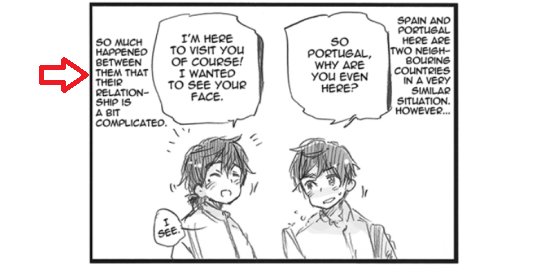
Ex: Spain and Portugal. (Chapters 77-79 of World Stars).
Both are noted to share a similar ancestry. As such,
Seychelles can’t tell which one is Portugal when she has a letter to deliver to
him.


Given the context in which the topic of their physical resemblance and relationship is discussed, if they were siblings, France would have attributed the reason for their likeness to this. He doesn’t.
Not once is a relation ever confirmed except for the fact that they’re neighbors.
Point is, it’s the similar ancestry that causes them to look alike.
+

+

Ex: Romania and the Italy Brothers [x].
While Romania may have inherited much of Rome’s culture, he’s
not related to the Italy brothers.


This brings me to my next point.
While cultural influence often affects the physical
and personality traits of nations, it doesn’t make them biologically related.
Ex: Seychelles was originally designed to have one thick
eyebrow and one thin one to represent French and English influence.

Ex: As an amalgamation of several cultures, America
resembles bits of Finland, France, and England.

Ex: France’s influence prevents America, Canada, and
Seychelles from inheriting England’s bushy eyebrows [x].

Ex: Young Canada inherits France’s hair due to his
influence. This is before England had assumed control over him.

When a country is conquered and their conqueror is on the
same continent, the conquered personification lives with the conquering personification.
Ex: France, Holy Rome, and Chibitalia living in Rome’s house (panel used above).
Ex: Chibitalia and Hungary living in Holy Rome’s house. Despite the rough start, they become so close that they refer to each other as family.


Ex: Romano, Netherlands, and Belgium living in Spain’s house.
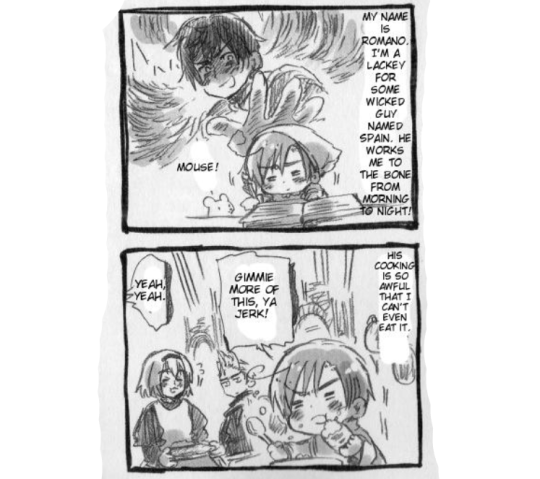
In modern times, we still see this occur, albeit it’s a bit
different.
The Chinese provinces +
Macau and Hong Kong (under a one country two systems principle) all
live in China’s household.


*Note – I made up the labels of house and household system
to better clarify and more easily distinguish between the two different living circumstances.
In canon, ‘House’ and ‘Household’ are terms used loosely and interchangeably in the translations.
The household system is separate from the house system in
that because the colonies are on separate continents, they’re part of a
household. In other words, they’re together and considered to be a unit despite
not living with the ruling nation.
Ex: England visits America, but America doesn’t live with
him in England.

Ex: England hosts a household meeting, requiring the colonies to travel [x]. (America is already independent here, by the way. He’s not part of the household.)
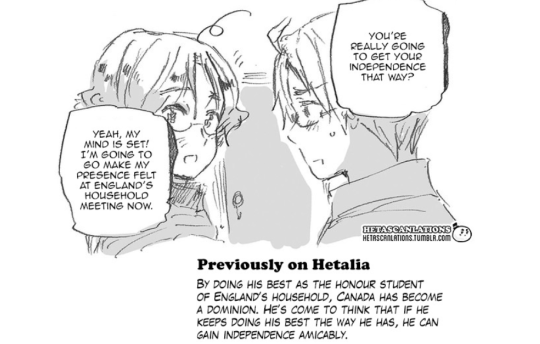
Ex: Likewise, England has holiday houses in Hong Kong and
India, as alluded to in one of his character songs [x].
“
Curry, Chinese cuisine, my holiday houses’ meals.”
Ex: Hong Kong, who used to live with China and referred to him
in a more intimate way [x], changed after he became an English colony.
When he becomes Chinese territory again, he refers to China
as teacher/ Mr., seeing him more as a mentor.


What I want to stress here is how fluid interpersonal relationships
between nations are in Hetalia. They’ve lived for centuries; how they view and
interact with each other changes with time. Their relationships – aside from
biological relations – aren’t as static as human patterns of organization.

*on the phone*
America: Happy Father’s Day!
England: Wow, I’m impressed! This was really thoughtful of
you.
America: Dang, wrong number…I meant to call France.
England: *calls France*

The comic gag is that it’s attributed to French and English influence.


 Ellawritesficssometimes