China is strong, no question there. The only thing that I
have to point out is that because he’s 4000 years old, his physical body has
aged. He can’t maintain the same strength or endurance as would younger nations
like America.
Anyways, I think it would be really interesting to explore
China’s strength in all facets. Post coming up tonight!
Nationhood:
To understand why micronations and provinces/ states
–aside from the country they’re part of– exist, it’s important to understand
how broadly nationhood is defined in the manga. Nationhood and the respective immortality it
brings is not exclusively given to formally recognized nations. In fact, the
modern nation today is a fairly recent method of human organization. Humans
used to organize themselves far differently, ranging from city-states, clans,
tribes, empires, kingdoms, etc..
I say this only because the personifications exist
as reflections of their people, regardless of how they organize themselves.
What’s important is that they all share a common identity. As such, nation in
the manga doesn’t strictly apply to the sovereign countries that exist today.
Ex: Prussia and the Knights Templar represented
Catholic Religious Orders.
As reflections of people located within a specific
geographic region of a larger country, territories, provinces, states, and
prefectures are also personified.
Ex: In one
post, Hima created a dialogue with several American states. While this is a
hypothetical scenario, as they haven’t been canonically personified, it’s the
possibility of their existence that matters.
Ex: China’s provinces are personified.
Please note that all examples of intra-state
personifications can be found by searching up the “states and provinces tag” on
the English translation of Hima’s blog, Bamboo Thicket [x].
Put another way, personifications exist because
they represent a culture and a personality. How I interpret personality is that
it’s a reference to evidence/ remnants of the personification’s existence, such
as historical artifacts or architecture.
If no one remembers or cares about the
personification, then their existence is threatened. The same goes for culture.
Without a culture, the personification can’t exist [x]:
“Usually, when the culture or
the country’s personality dies/disappears, the country would gradually
disappear or entrust him/herself to the country that takes over him/her.”
With all this in mind, it should be noted that not
everything about the nations’ existence is logical.
Ex: In the first chapter of world stars, they’re
described as odd and strange beings.
That said, what this post will explore is the
abnormalities of the micronations’ existence. While not everything can’t be
explained, there is some logic to it that I’d like to run through.
Let’s go through some examples.
The Republic of Niko Niko:
Niko Niko is easily the most abnormal micronation.
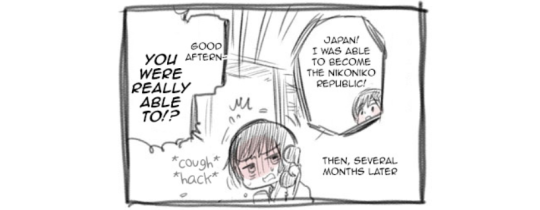
He’s a human who attained micronation status, representing a section of a city in the Fukushima prefecture.
He had previously told Japan that he planned to become a micronation, but the latter didn’t believe him.
Japan’s reaction to Niko Niko becoming immortal attests to the fact that this isn’t a typical case of nationhood.
How Niko Niko experiences nationhood, such as
having his health and well-being be based on his economic performance and
halting aging all together, is normal. What’s abnormal, or rather, “irregular”
is how Niko Niko was able to attain nationhood.
Likewise, Niko Niko
gives up his nationhood and becomes a normal Japanese citizen again. He also
resumes aging and is able to have a son.
It’s noted in another strip that in
contrast to Niko Niko, it would be more difficult for a regular nation to
become a human [x] – which is possible in canon, by the way, post on that here [x].
Sealand:
Sealand is also noted to
be abnormal, regardless of the fact that he’s not officially recognized.
For one thing, his body
(geographic landmass) is small. This causes other nations to have concern over
Sealand’s ambitions to become a formal nation, as it would be too hard on his
body and heart.
Seborga:
Seborga is interesting
because he used to be an independent nation, became a part of Italy, and then
later declared independence again despite still living as an Italian.
His experience of
nationhood confirms my “organization” argument. Before, Italy used to be composed
of several independent city-states.
Those were the ‘nations’ of the time, given how vastly different they
were and how people organized and identified themselves.
If that’s the case, then
I wouldn’t be surprised to see Genoa still existing in the present, albeit this
not being confirmed in canon. Point is, the Genoan identity and culture are
still prevalent enough today to warrant his existence.
Ladonia:
Ladonia is an internet
personification. Notice again that it’s how people organize themselves, not the
officiality of the title the matters in prompting the personification’s
existence.
Wy and Age:
One last abnormality
about the micronations that differentiates them from traditional [formal]
nations is their age.
Traditional nations are
usually born as babies, with the exception of Germany.
Meanwhile, micronations
vary in age.
Ex: Wy emerges as an older child.
There’s really no
explanation for this. The micronations are supposed to be strange and irregular
as we’ve seen from the above reactions toward Sealand and Niko Niko.
In sum, while many
things about the micronations are inexplicable, there is a consistent logic to
their existence in that they represent an organization, culture, and
personality of people. Nationhood applies to all personifications – it’s not
the title of the region that matters but instead the title in which citizens
identify themselves.
As stated by Hima, each nation has a male and female
version [x].
If you search up the nyotalia tag on Bamboo thicket, you’ll
find that there are several reverse male and female designs for each nation.
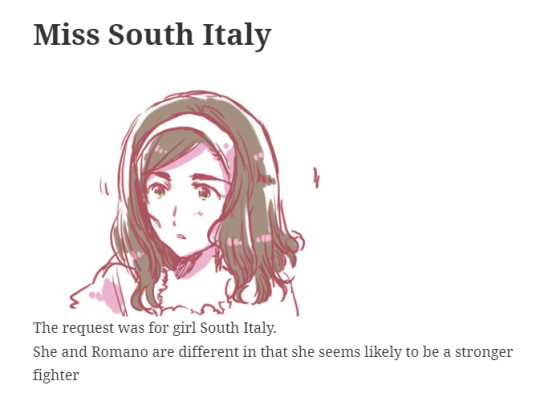
Likewise, some nyotalia versions, such as fem! Italy and fem! Romano [x] are even
given character notes about their personalities.
It’s, uh, complicated. The micronations are both similar and vastly different from ‘regular’ nations. While I’ve touched on this before, there’s lots more that I didn’t and would like to discuss!
Guide on the micronations coming up tonight!
Just found out that I secured a student placement with the RCMP! I’ll be out celebrating tonight. Posts will resume tomorrow
Thank you, and anyone in their right mind would prefer the manga over the
anime 😀
I don’t know, I have very mixed feelings about a potential seventh
season. On one hand, I recognize that a new season will help boost the morale of
creators in the fandom.
On the other hand, like you mentioned, popularity isn’t key.
The biggest problem is our reputation as both a fanbase and from the series in its
earliest depictions. What doesn’t help is the absolutely atrocious dubbed lines that Funimation has pulled
off, leading to an even worse reputation for Hetalia.
If there were to be a seventh season, there would be many
things that if I could, I would change in a heartbeat.
1) Better
strip selection. The strips selected for animation are unrepresentative of
the series and only portray the stock qualities of the characters. This, unfortunately, leads to misconceptions where fans take the anime as canon fact. Even
the oldest of strips have moments of profundity.
Instead, what I would like to see is the more serious and
complicated matters depicted in the anime. But, for that to happen…
2) The
episodes need to be longer. Ten minutes, fifteen minutes; I don’t care. You
can hardly tackle any content and do a good job of it in a 3-4 minute timespan. Most of the episodes are so jumbled, rushed, and incoherent that it
has little to no impact.
Instead of silly comic gags all the time, balance it with
the serious – don’t negate the latter altogether. There’s a reason why people
don’t take Hetalia seriously. They base their opinion on the anime and not the
manga.
3) Stop
marketing Hetalia as something only for kids.Rebrand!
Rebrand! Rebrand! Taking the above examples together, I truly do believe
that if the Hetalia anime switched gears and changed their target audience, it
would bring in a lot more people.
Just to give an example, the
nations have been marketed as “Global buddies!!!!”
Much of Hima’s hard work and creative genius is ignored due
to fans being put-off by the anime. The Hetalia anime, if done right, could be very
impactful in whole, as opposed to having occasional moments that addressed deeper
subject matter.
This post will use
Adlerian theory to examine England’s personality. What I’ll elaborate on is how
he suffers from both an inferiority and superiority complex.
What’s an Inferiority Complex?
An inferiority complex
is a “condition that develops when a person is unable to compensate for normal
inferiority.” These individuals typically possess poor opinions of themselves
and feel helpless/ unable to cope with the demands of life.
In other words, these
individuals cannot accept that it’s a given that other people will be better
than them, either in a given task or life in general. If they come second to
someone, they take it personally and neurotically believe that it’s reflective
of their self-worth.
There are three
potential sources in childhood that can lead to the development of an
inferiority complex. For the purposes of this post, we only need to know about
neglect, which England experienced.
Neglect in childhood – from this psychological framework – entails
the child being met with an indifferent/ hostile attitude by their parents/
parent figures. As such, the children can develop feelings of worthlessness,
anger, and view others with distrust.
England’s Inferiority Complex:
France and England’s
older brothers – Scotland, Wales, and Northern Ireland – step in as England’s
parent figures.
Ex: Since England’s
older brothers would hex and degrade him any time he got near, this satisfies
the indifferent and hostile attitude requirement.
The cycle continues when England, having developed a poor sense of self-worth from the above rejection by his siblings, doubts whether he’ll be able to act as a proper older brother figure to America.
Notice how he cries as
he recalls these unpleasant memories from his childhood. Initially, he doesn’t
even want America to refer to him as onii-chan, but rather, just “England.”
Likewise, France’s
constant insults toward England, while intended to be teasing, is taken to
heart by the latter. He truly believes France when he says that he’s
“unrefined”, as in being behind on fashion trends.
Ex: France mocks
England’s hair for being outdated and ‘unrefined.’
Ex: England’s later
shown to be depressed over France’s comments and becomes insecure about his hairstyle and his failed attempts to change it.
Ex: England’s worry over
being unrefined is overcompensated for when he spies on France to get ahead of
fashion trends.
This way, his early-bird
conformity prevents him from being subjected to France’s comments. While he may
deny it, England does care about France’s opinion of him. He’s not as confident
as he tries to play himself off.
Ex: England undermines
France by vowing to have the latter become his vassal.
The feelings of
worthlessness that England attained is most seen in how self-deprecating he is.
Overall, he’s an extremely critical person, of both others and himself.
Ex: He’s recently noted
to have become more critical of himself than others.
The helplessness that
England experiences stems from his loneliness. He turns to the world of fantasy
(his magical friends) and fiction because it’s a more ideal and less painful
world.
The reason for this is
that he’s said to have trouble expressing himself. He often rubs people the
wrong way and isolates himself as a result. The irony is that England knows
that others misunderstand him, but doesn’t do anything about it. Instead, he makes self-deprecating jokes about himself [x].
What’s a Superiority Complex?:
A superiority complex is
a “condition that develops when a person overcompensates for normal
inferiority.” These individuals can be vain, boastful, self-centered, and tend
to degrade others.
England’s Superiority Complex:
From England’s
inferiority complex, we know that he grew insecure about being weak and
unrefined.
In return, he
overcompensated by striving to be the best, most powerful nation.
Ex: England boasts about
his empire.
Even more interesting is
that after America surpasses him as a stronger world power, England attempts to
gain back this strength through physical training.
What’s important is that
he feels slighted by his inferiority and engages in a vain attempt to secure
his status once more, albeit failing.
As mentioned, England is
a very critical person.
Ex: He leaves scathing remarks on America’s movies.
Ex: He picks apart at everything America says during world meetings – most
of it is ridiculous anyway.
Ex: He and France have consistently insulted and bickered with each other
for centuries.
Point is, the insults
and criticisms are reflective of his own insecurities. Insecure people will
often degrade others in order to feel better about themselves.
In conclusion, while
England may be a bitter and pessimistic person, especially in the years
following the American Revolution [x], it’s imperative to realize that he’s just as
critical of himself.
The best thing about his
character is his uncertainty. He flips from being kind and sweet when he’s
feeling secure of himself to rude and bitter when he’s insecure. Lately,
however, this critical nature has become increasingly internalized…
America: Wanna hear some gossip?
England: No. Unlike you, I have other adult things to worry
about.
There are too many moments, but this one comes to mind [x].
England draws a portrait for Japan when the latter sends him a Christmas card. He wants to reciprocate by appealing to Japan’s culture. It’s a wonderful example of how thoughtful, sweet, and considerate he can be, even if the end result isn’t quite perfect.








 Ellawritesficssometimes