I have two moods, there’s no in between


When England is depicted as a hateful character. He’s bitter, insecure, and resentful, but he’s never motivated by hate.
Don’t get me wrong either. He can be cruel. But, he can also be extremely thoughtful, considerate, and sensitive.


All right, yeah. While this isn’t a novel theory or anything, I still think it’s important to point out that very few nations actually hate each other. Yes, there are periods where they do, but it’s not a deep-set hatred. I can only think of one example where it’s true hatred, and it’s only one-sided.
This isn’t strictly intended for ships, but it can certainly be used as a reference if you want to prove that the relationship dynamic is possible. I’ll touch on this later, but I want to reiterate again that the nations are cultural, not political representations.
Post coming up tonight.


The nations are two-fold representations. By that I mean
that they have a literal body and a figurative body.
Bear with me, things get a bit tricky, but I’ll break it
down to the best of my ability.
Basically, the figurative body is what influences the nation’s
physical body.
The figurative body
is composed of two parts.
1) There’s the geography
of the nation. The landmass is sometimes referred to as their body or house,
despite the real physical one that they possess.
The geography can influence both the physical appearance and
personality of the personification.
Ex: Since Sealand’s geographic body is small, so is his physical
one.


Ex: Iceland’s contrasting volcanic and freezing temperatures respectively
causes him to have a hot and cold side.


2) There’s the personality
of a nation. The personality of a nation (not to be confused with the
personification’s personality) is defined in terms of culture in the manga [x]
If the culture is well-developed
and thriving, then the personification will also thrive and be able to grow; to
age. However, if the culture is repressed, then the personification’s growth
will also be stunted.
The reason I’m outlining this is essentially to show how
geography/climate and historical events are reflected in the personifications’
appearances and personalities. Information on the impact that this has on their
health can be found here [x] [x]
What this post will focus on, however, is why some nations
have scars and either suffer from or are affected with other physical symptoms.
Let’s go over some examples.
Before dying, Rome was noted to have many wounds and scars –
a physical reflection of the turmoil his people suffered from.

We know from his time spent in the USSR that Lithuania acquired
several scars on his back. The military repression of several revolts and the
banning of diverse cultural practices in favor of an atheist state very likely
had a role in causing these scars to appear.

Latvia’s case is similar to Lithuania’s. While we don’t know
if he has any scars, we know that Russia pushing down onto his head ultimately
stunted his growth. How I interpret this is that it’s a metaphor for political repression.

Put another way, Russian control stunted Latvia’s growth,
which, in turn, was reflected in the personification’s physical body.

It’s hinted that China gained scars after being betrayed by
Japan in WW2. It’s both a literal and symbolic stab to the back.


Each time America engages in reckless financial activities,
a new wrinkle develops on Germany’s forehead.


Estonia’s quest to become a Nordic causes Finland’s back to
be itchy whenever he’s talked about.

Bonus cases that aren’t so clear…
When he’s not wearing a scarf, Russia is shown to be wearing
bandages around his neck.

An unknown event caused him to develop a scar on his
forehead.


Canada, honey, I know you have emotional issues, but what the fuck.

England hands down. He has the immune system of a fruit fly.


These are all excellent questions!
Although Pearl Harbour isn’t covered, there is documentation of the nations getting scars from wars and political repression.
As for natural disasters? While they haven’t been shown to get scars from them, the nations’ personalities are sometimes based on their climate and geography. Iceland is a good example of that. He has a “hot side” of his personality to account for volcanic eruptions/hot springs.
Guide coming up tonight!


Before I start, it’s important to go over and situate a few
things. The nations’ immortality is more of a curse than it is a blessing.
They’ve experienced countless wars, plagues, political strife, and have even
died, only to be regenerated.
Now, unlike humans who have been blindsided with the rough
backhand of fate, the nations are forced to relive these pains over and over
again. It would be enough to drive a normal person mad.
In other words, their immortality was a prison that kept them
locked into a systemic cycle of bloodshed. What adds to this prison imagery is
that they’re obligated to listen to their bosses and fight in wars that they don’t
necessarily want to participate in.

Nowadays, this prison more has to do with loneliness. They
still follow their bosses’ orders, but the restrictions on their freedom are
not nearly as pervasive.
Ex: England’s sweet and alcohol intake is regulated by his
boss.

Regardless, Germania and Ancient Rome best exemplify how
their freedom was gained not by their immortality, but rather, the loss of it.
They were “liberated” from their bosses and war upon dying.

France is another good example of this. He gives better
insight into how heartless history can be in tossing peoples’ lives around. When
he first sees Lisa, Jeanne d’Arc’s reincarnate, he believed that God was
playing a cruel trick on him. On its own, this already proves how betrayed and
hurt France felt after her death.

Nonetheless, France still keeps his faith and believes that
humans who have had rough past lives will be reborn into happier ones. He
doesn’t have this privilege.

The purpose of this post will be to illustrate how the
nations’ immortality has historically caused them to live through many
traumatic events. It would follow, then, that being reared in such unhealthy
environments would cause some of them to develop PTSD.
In fact, there is a mounting pile of canon evidence that
depicts the nations having discomforting flashbacks, severe anxiety, and
nightmares. That said, let’s go over some examples.
When his settlers moved inland, America didn’t have many
belongings to his name. England ponders why America produces things in mass and
comes to the realization that America’s overconsumption of goods likely stems
from this impoverished period of his life.

Note the use of the word traumatized.


Lithuania has a flashback to when he and the other Baltic
States declared their independence from the USSR. He then experiences another
flashback, where Russia squeezes his shoulder – it’s used as a metaphor to
represent political repression.

Lithuania is so immersed in this second flashback that he
begins squeezing Estonia’s and Latvia’s shoulders without realizing it.

One of his character notes also mentions that he’s been rebilitating after his time spent in the USSR.

England doubts his capacity to care for young America. The
stress of this new responsibility causes him to have a flashback of his older
brothers sending him hexes.

It’s noted that England once suffered from 100 years of heartbreak, presumably a reference to the American Revolution.
This is a theory of mine, as it isn’t confirmed in canon, but given that England coughs up blood and gets ill on the fourth of July, I think that it is meant to symbolize how he still hasn’t recovered emotionally from America’s independence. In other words, each year, England’s heart is both literally and figuratively ripped open on the inside.

While this example is a more subtle depiction of trauma, it’s
not surprising.
Although this isn’t covered in the strips, following WW2, Japan
would have become America’s underling. As such, the atrocities committed by the
atomic bombs would have made him visibly more compliant to America’s demands,
regardless if he agreed or not.
This is seen in a world meeting where Japan unanimously agrees
with America’s ridiculous global warming plan. Switzerland even calls out Japan
for not voicing his true opinion.

Switzerland’s mercenary past still haunts him. Lichtenstein
perceptively reads into this as she asks him why they’re working to boost her income through tourism.

Italy’s perhaps one of the most anxiety-ridden characters in
the series.
Ex: He worries that Germany hates him and has nightmares
about this. His greatest fear is being left behind to fend for himself.

This insecurity leads him to make Germany reaffirm to him several times that he’s not actually hated.


Ex: Italy has nightmares where a childhood version of himself
presses to be acknowledged.

The dream ends with Italy screaming and refusing to
acknowledge the child. To me, and as I’ve theorized in the past, I read this as
Italy repressing parts of his childhood to minimize and forget about the trauma
that he experienced. The child is merely a representation of his unconscious
mind.

Germany also has a childhood version of himself pressing to
be acknowledged. Of course, this is running on the assumption that he’s
actually Holy Rome and has forgotten about his childhood.

Similarly, he’s once depicted to be holding Chibitalia,
looking visibly confused.
“It’s me.”

Again, how I see this is that perhaps Germany is repressing
aspects of his childhood. In that case, Chibitalia is an unconscious
representation of these memories attempting to pierce through to his conscious
mind.
All in all, given how long the nations have lived, it’s not
novel to assume that they’re still traumatized by things that have happened to
them in the past.
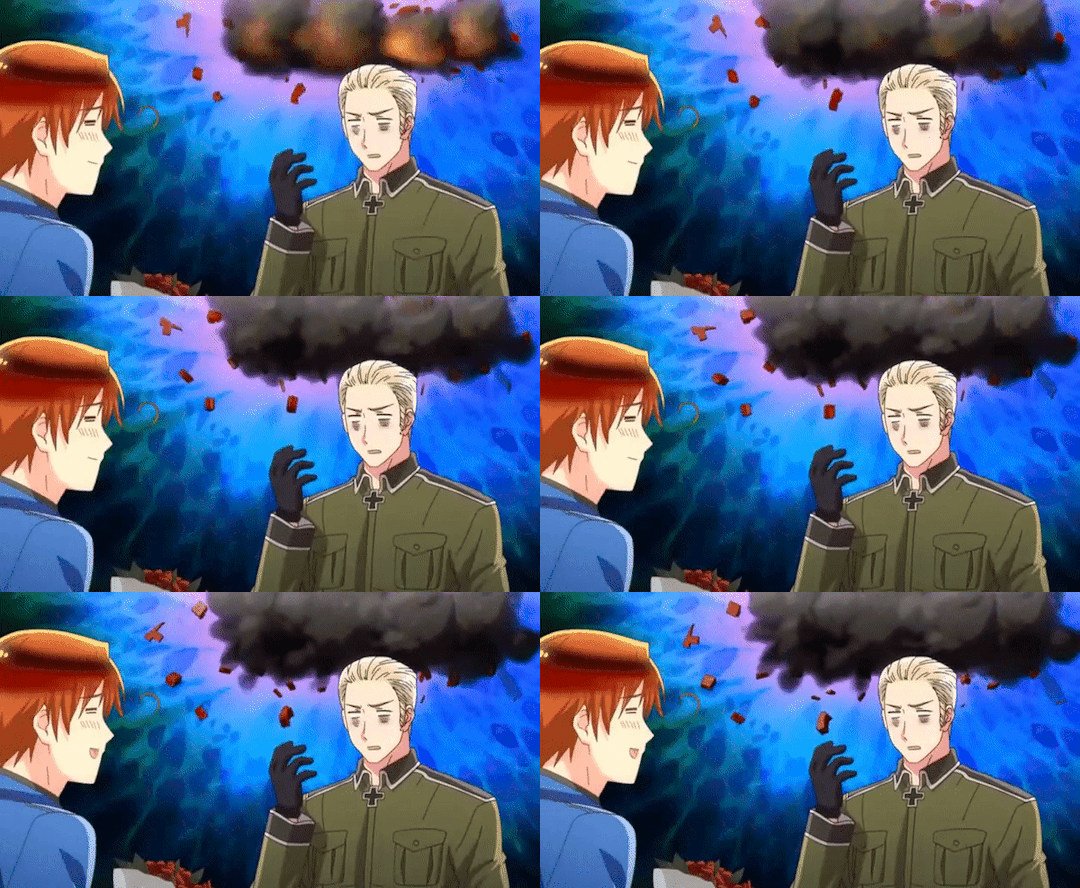
*is swamped in work*
Parent: No excuses. You’re going to have to make time for it.
Me: YoU’RE RigHT. Let me just –

 Ellawritesficssometimes