
Lithuania acted more as the maid. Romano cooked for America [x].

It might be. While America did get a unicorn for his bicentennial as a gift from England, it’s unclear if the one he encounters near a forest is the same one [x].


What this post will
explore is how, despite his independence, America is still equated to a child
by England. I will also touch on how America fights against this image and
overcompensates by attempting to discard any association of his childhood with
England.
As designated by the title,
America’s independence didn’t stop England from infantilizing him. Instead,
what you’ll see is that in light of losing his responsibility of guardianship,
England turns to criticizing everything America does and often meddles in his
affairs. Unconsciously, he’s unwilling to relinquish the authority that he had
over America.
Of course, America is
chronologically young in comparison to other nations, but there is still
something distinct in the way that England fusses over everything the former
does. It’s similar to an estranged parent that hasn’t come to terms with the fact
that they’ve lost control over their adult child.
Some examples of England’s
meddling would be…
Ex: England is caught
meddling in America’s political affairs during the latter’s Civil War [x].

Ex: England conveniently
shows up when America attempts to establish a trading agreement with Japan [x].


Ex: When Lithuania moves
in with America to pursue work, England immediately turns up. He wants to know
how Lithuania is being treated.
Translation: he wants to know what’s going on in
America’s life but is too prideful to admit it [x].

Some examples of his critical,
often condescending, attitude toward America would be…
Ex: When America arrives
at the African Warfront in WW2, England is dismayed over having to “babysit.”

In the same strip, he has
an entire dream sequence where he worries about America injuring himself.

Ex: He hypocritically
reprimands America for running his mouth during a world meeting despite having
a foul mouth himself.

Ex: He bashes America’s
[admittedly childish] world defense plan, referring to him as a “spoiled child” [x].


America’s hero complex,
in large, is an expression of his autonomy, his ability to succeed, and the
ability to assume the responsibility of making choices for both himself and
others. The only problem is that any reminder of his past with England doesn’t
reconcile with this new image of himself.
It’s for this reason that
I believe America suppresses any hint of his childhood with England. In other
words, it works against the mature, capable person that he’s constructed
himself to be.
Ex: England falls asleep
during a world meeting. It’s only until England starts murmuring his dream out
loud that America wakes him up. To be fair, it would be mortifying to have your
past bedwetting habit revealed.

Ex: America drinks
coffee out of spite. Drinking tea would be an acknowledgment of his past as a
subordinate. It’s a childish way of him wanting to differentiate himself from
England [x].

Ex: Lithuania finds the
toy soldiers that England gave to America when he was younger. *In arrives
England for a surprise visit* America becomes distressed and tells
Lithuania to hide the toy soldiers [x].

In sum, even though
America formally gained his independence from England, both struggled to readjust
and form new images of themselves in the aftermath.

*has a bad day*
Brain: It’s fine. Just escape into the world of fantasy.
Me: Fiction doesn’t solve everything!
Also me:


Exactly. While he was rude before, stemming from his
unresolved feelings over the revolution, it’s evolved to constructive criticism.
It happens so often that America’s willing to allow England to critique him.
Their relationship really has come a long way! [x].


You’re right on the money with that! On top of that, England very much infantilizes America and still conceives of him as a child, as do much of the other nations. Post coming up tonight!

Do you think America trusts his own gov?
currently only 18% of the us trusts the gov and the rest doesn’t. I’m not really
sure if they’ve gone over that in hetalia, the only time I can actually think
of one time were america was unsure(??) of his gov, is that one ep where he
finds Tony but his boss or gov tells him that he can’t tell anybody and that it
didn’t happen. Maybe I haven’t found anything yet or I’m just looking too deep
but yeah I was kinda wondering that.
It’s not clear on
whether he trusts them or not, not that he really has a choice on obeying them anyway. Nations are
forced to comply with their bosses’ orders regardless of their own will/
opinion over the matter [x].

You’re talking about the
Roswell incident where he was deliberately lied to about the UFO by his boss
(the president) and was instead told that it was a weather balloon. (Source: Assault☆The neighbor’s Roswell Incident.)

Because
that’s one of the minimal scenes where we see him interacting with his boss
(another example would be in the “Black Ships have sailed” strip), there isn’t
enough information to form a solid conclusion on what you’re asking.
@amuamoami asked: Are
there any other african (black) characters in hetalia besides Seychelles? The
only issue i have with hetalia is that I dont see much color diversity.
There
is color diversity (e.g., Ecuador, the Asian nations, Spain, and Portugal— not to be confused with race, which doesn’t exist in Hetalia).
Cameroon is the only other official black character with a full
design [x].

There’s an unconfirmed female who may or may not be an African nation that visits Seychelles in Volume 6 (most people speculate that it’s Madagascar due
to the use of third person in one panel).

Lastly, there were some “chibi head”
illustrations that appeared in Gauken Hetalia [x].
I understand your sentiment. On the other
hand, Himaruya does have a habit of travelling to countries before he creates a
character for them. There’s also the whole matter of how messy and complicated
it would be to try to depict the subject of colonialism intersected with race.
It would be pretty unavoidable if he were to create these characters.
What are your personal opinions on Czechia and Slovakia?
They’re some of my favourite characters!
They’re hilarious
together! I love them! Taken out of context, this scene is even funnier for
some reason [x].


There isn’t much to base
my opinion on, unfortunately. There are very few interactions between them.
Ex: They have tea
together [x].

Ex: India comes to
England’s aid after the American Revolution and heals the latter [x].

Do you have any particular mischaracterizations of Hetalia
characters that you absolutely hate? This can also include falsely portrayed
relationships and such.
Hate is a strong word, but I definitely get irritated.
People’s inability to reconcile the idea that
deleted material is deleted material and that the shock “perverted” humour used
in the past by Himaruya, while incomprehensible, is no longer incorporated in
the series. France, in particular, would be a prime example of this.
Even though it would benefit him economically and
politically, America nonetheless pushes for Canada to gain his independence [x].
He even went so far as to ask for England’s permission
before visiting Canada at his house.
“Once you’re
independent, we can be close again without worrying about England anymore,
right?”

*At America’s Independence Day party*
England: There’s nowhere for me to sit. All the seats are taken.
America: Oops, my bad.

America: Here you go.


In light of
Canada day, I think it’s about time that I dedicated a full character analysis
to him. What I aim to do is disprove any claims that Himaruya has made Canada
into a flat, two-dimensional character. It’s quite the contrary.
Canada’s
well-known for his invisibility and the overused jokes that accompany this
characterization. However, to say that this is all that defines Canada is to
overlook the amazing depth that this invisibility has on his personality.

While it’s
easy to look at Canada as the nation that’s ignored during meetings, what this
post will explore is the ways in which Canada’s character is far more fleshed
out than what is popularly conceived in fanon.
From birth,
Canada was objectified by European colonizers for his abundance of resources [x].


After
England fights France to assume control over Canada, Canada mistakenly assumes
that England is the first nation to actually look at him as a person and not
merely as an asset.

In reality, England was staring at Canada’s hair, which he
had inherited due to French influence.

When told
that England will become his family, Canada is ecstatic. He had grown
accustomed to being valued for his resources rather than as a living being. Already,
we begin to see how Canada’s worth is not attributed to his person—who he
is.

The
importance of this scene will be critical to understanding why Canada suffers
from such poor self-esteem in his adulthood.
The main
complex that Canada suffers from is that he lacked a solid identity and
conception of himself. Being surrounded by greater, more politically and
economically relevant powers when he was younger can mainly be attributed to
this.
Canada’s
self-esteem was contrived in relation to those around him. He felt inferior,
and these feelings later became entrenched in how he views himself.
Ex: Canada
grew up alongside America, who excelled and aged at a much faster rate [x].

Ex: England
devoted a lot of his attention toward America, leading Canada to feel neglected
and excluded [x].

Living in
America’s shadow consequently caused Canada to believe that he wasn’t worthy
of the latter’s attention.
Ex: He once believed that America was disinterested in him [x].

Ex: He used England as a mediator to speak on his behalf to America. Notice
how America is perplexed by Canada’s behaviour here. Canada thinks poorly of himself and attributes this same train of
thought to how he perceives others to think of him [x].


Although, it also has to do with the fact that America doesn’t believe that Canada has an accurate conception of the real world, and, therefore, isn’t ready to gain his independence [x].

What’s even
more unhealthy is that Canada uses America as the means of assessing his worth.
Ex: He
believes that he’s simply a plainer version of America given their similar looks [x].

Ex: He
doesn’t believe that he’s handsome [x].

Ex: When England
falls ill after the American Revolution, Canada cries and claims that even
though he’s not as strong as America and doesn’t possess a lot of money, he’ll
try his best to heal the former [x].

The irony
of this is that it’s alluded that Canada may possess his own form of
superstrength. In the same arc, America tries to force himself into Canada’s
home after being denied access to visit the then sick England. Canada is able to shut the door on him [x].


Of particular interest to me is how in Canada’s fantasy, England’s cheering him on, likely symbolizing how badly we wants the latter to pay more attention to him.
Constantly being
overshadowed by America and England and internally comparing himself to America
created a lot of tension and frustration in Canada.
It’s only
during his independence arc where we begin to see him release these emotions.
Canada wants to form his own autonomous identity. To him, America
contravenes and gets in the way of this from happening.
Ex: Canada
reprimands America for being selfish and self-absorbed on several occasions [x].


Even after
gaining his independence, Canada lacked a solid self-concept and was still
mistaken for America by other nations.
Ex: Cuba mistakes him as America [x].

What’s
always been a seamless turning point for me is how it was America who helped Canada
form his multi-cultural identity.

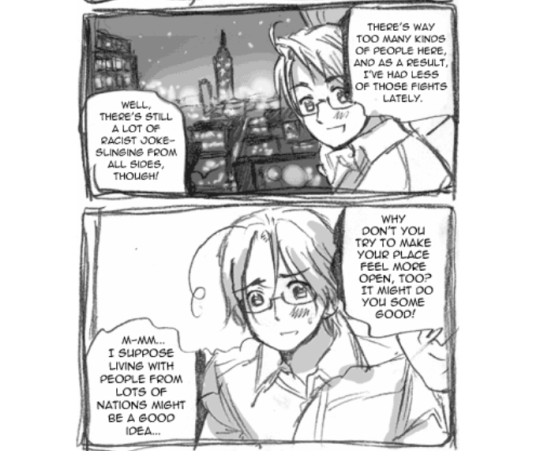

The
culmination of these arcs, albeit seemingly to be nonessential and unimportant,
is when Seychelles recalls Canada as a member of the G8 [x].

Years of
being forgotten and neglected caught up to Canada. Trivial as the situation may
be on the surface, to be remembered is to be important enough in the eyes of
another person. It’s a foreign and gripping moment that causes him to cry.

Likewise,
because this is so foreign to him, Canada doesn’t know what to do with himself.
In other words, he overcompensates by excessively reinserting his identity,
which remains fragile and still in a developing state.

This fragility
is most seen when America appears and laughs at Canada’s ridiculous clothing [x].
“There are times, every now and then, when I want to stand out from the shadow or let my hair down too!”

Another
parallel between the two is then introduced: Canada doesn’t want to remain in the
shadows and vies to be well-known in the world just like America; meanwhile,
America is jealous of Canada for his ability to get along with everyone.

In sum,
Canada’s invisibility lends his character most of its strength. It is through his
journey to establish himself that it becomes clear that Canada is not as
passive as one may think. For his entire life, he’s fought to
be remembered. It would follow, then, that his invisibility perhaps had a
double meaning to it; it was a physical reflection of how hollow, empty and
lacking he felt on the inside, a personal identity that needed to be filled and discovered.

 Ellawritesficssometimes