Note: This post will explore the mystery behind why Russia
covers his neck. This isn’t a theory, as I use facts to come up with a
speculation that, while probable, hasn’t been substantiated in canon. I find it
very important to distinguish between facts, theories, headcanons, and
opinions.
What’s the deal with Russia’s heart?:
I know, I know. This
post is about Russia’s neck, but I have to do some backtracking first.
All right. In canon, it’s normal for Russia’s heart to
spontaneously burst out from his chest.
In earlier posts, I’ve speculated that
this acts as a metaphor for how Russia’s conception of love has been equated
with violence.
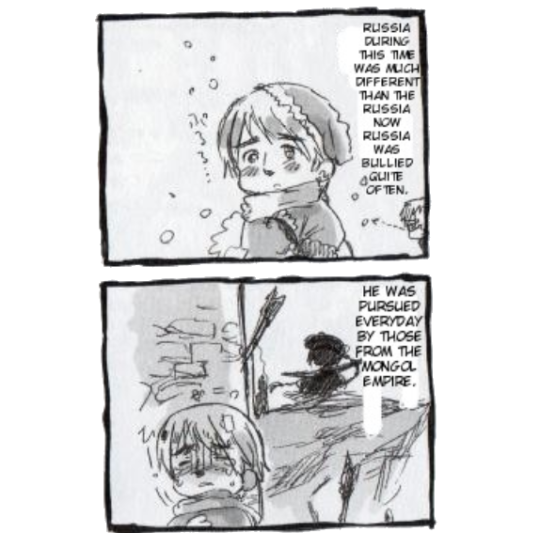
He grew up being routinely conquered and chased after.
Not
only that, but General Winter – who acted as Russia’s de facto parent figure
due to the protection he provided the latter with – also attacked [abused]
Russia on an annual basis [x].
As such, what Russia
grew to understand as love and friendship became irreparably warped.
Ex: He thinks that anyone he meets is his friend. This
includes General Winter, his abuser.
Ex: He uses violence as a solution to his problems. He’s
normalized it [x].
In conjunction with the first reason, I also believe that
Russia’s heart falling out so violently symbolizes being cut up from the inside.
Since the personification’s body is a physical representation of their nation’s
landmass, this would relate to the act of partitioning and being partitioned. The
heart and soul of a nation are tarnished upon being conquered.
Ex: Russia’s hobby during WW2 is partitioning Poland [x].
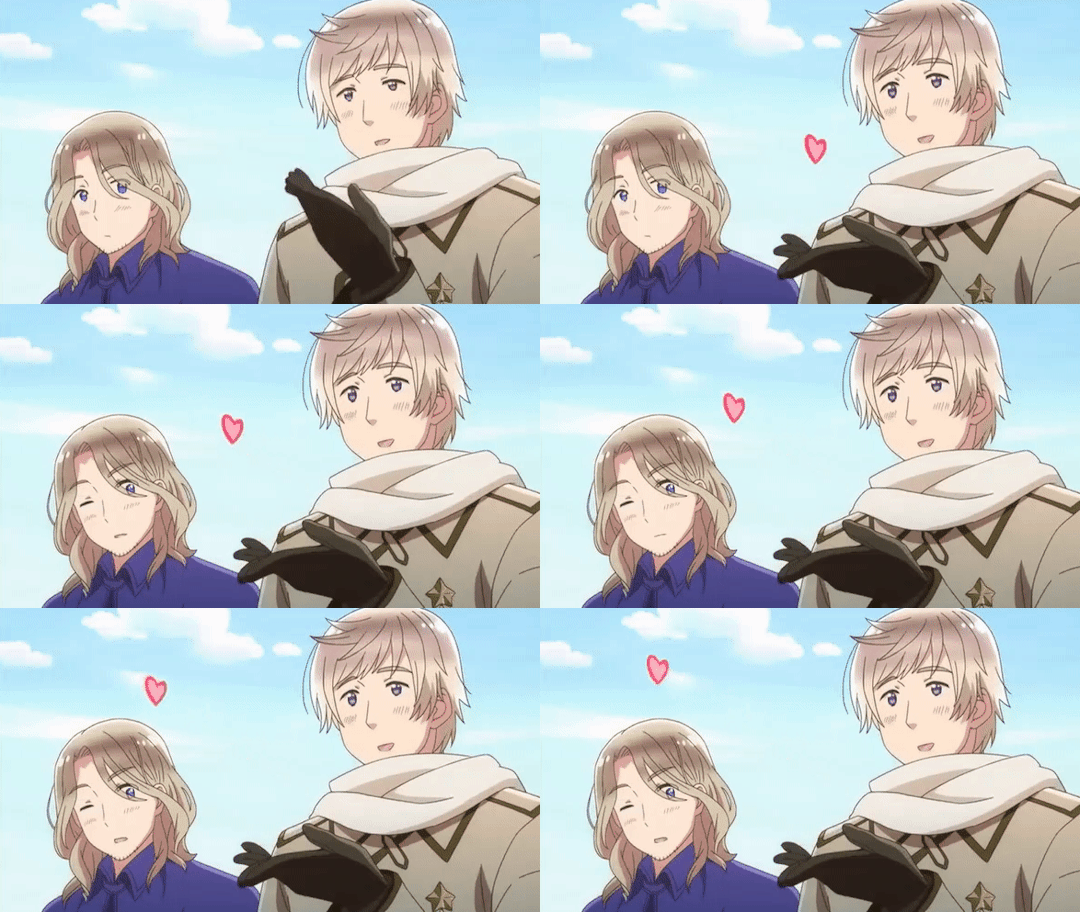
Ex: When he exerts political pressure on Japan, notice how
Russia sends a heart. Again, I interpret this as another example where Russia
has conflated love and violence [aggression], confusing the two of them.
Russia’s Neck:
As many others in the fandom have pointed out, there is a mystery
surrounding why Russia takes great lengths to cover his neck, most notably with
his scarf. It’s not just his neck, but I’ll get back to that in a moment.
Originally, the scarf was a gift given to him by Ukraine.
While she wanted him to keep warm, she also did this to get him to make Kiev
successful in return.
On the other hand, the scarf has taken on a much darker
meaning in Russia’s adulthood.
Ex: In Italy’s Chest Test Series, instead of his usual
scarf, Russia’s wearing bandages around his neck [x].
Ex: In the History Copy Book, there’s a strange panel with
an angle that reveals Russia wearing a single bandage around his neck [x].
What I haven’t seen people mention is that it’s not just his
neck that Russia tries to cover.
1) He’s often spotted clutching his chest, an
action that I believe is done to prevent his heart from falling out.
2) Russia takes great lengths to cover his chest
too [x] [x].
Putting this all together:
The answer I have that possibly explains all this isn’t
grandiose or complicated. It’s simply medical. I think that by covering up his
chest and neck, Russia’s concealing the physiological effects of heart failure.
The heart failure here is his heart falling out.
Conditions like Congestive Heart Failure occur when the
heart is unable to pump enough blood to give your body the sufficient oxygen it
needs. A symptom of this failure in the right side of the heart can cause
bulging tube-like veins to appear on the right side of the neck – jugular vein
distention.
If that’s the case, then no wonder Russia wants to cover up
his neck. Not to mention that he would without a doubt have massive scars and
damaged unhealed tissue from his heart popping in and out like a revolving door.
I’ll kindly direct you to my post directory, considering
that most of my posts tackle how Hetalia is riddled with serious,
thought-provoking, and dark subject matter [x].
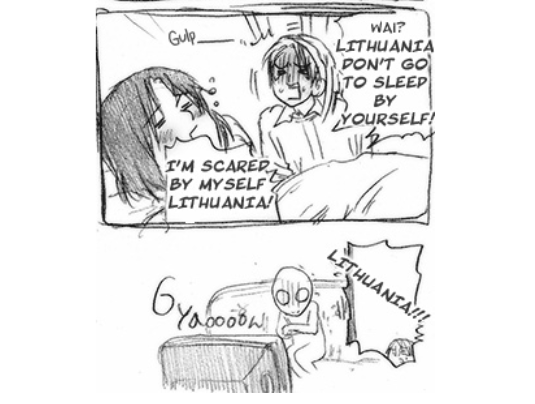
The scars that accumulated on Lithuania’s back, a
consequence of being under Russia’s rule [x].
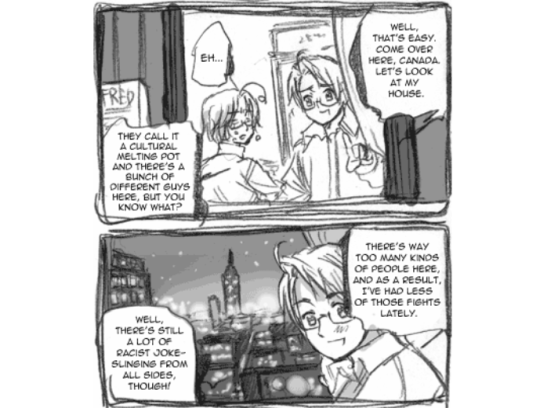
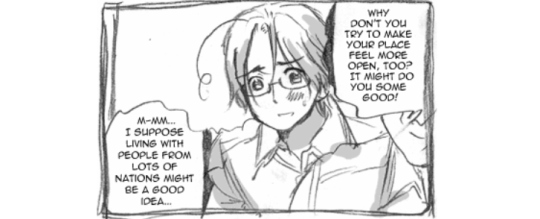
America giving advice to Canada on being open to welcoming people from different races, ethnicities, cultures, and religions [x].
England asking for Italy’s help in improving his artistic
skill during the second Industrial Revolution. Due to his and Romano’s rough and
sudden unification, Italy breaks down crying:
“It’s been so long since anyone has trusted me this much.” [x].
Prussia signing a treaty with Japan and teaching him German during the latter’s Westernization period [x].
My favourite is how America still hasn’t learned not to
read/ watch scary content [x].
This post will use attachment
theory to analyze Russia’s attachment style – how he forms relationships with
others – in adulthood. Unlike the case of Romano’s characterization [x], where
you can argue that attachment theory is actually used, this post applies
attachment theory to Russia for the sake of amusement. Although, things
strangely make a lot more sense when you look at him from this
perspective.
What is attachment theory?:
Attachment theory focuses
on the relationship between a child and their caregiver. Central to the theory
is the concept of needs. A child relies on their caregiver to protect them,
provide for them, and care for them. If all these needs are consistently met,
the child develops a healthy attachment to their parents. This healthy attachment style positively
affects both the child’s personality and their capability to establish and
maintain healthy relationships as they grow older.
However, if needs are not met at all, or are sometimes met and
at other times are not, this inconsistency causes the child to develop unhealthy attachment styles. As
such, they develop unhealthy personalities and form unhealthy relationships
with others.
The Ainsworth experiment was where this theory
originated. To test the attachment styles between toddlers and their
caregivers, they would put them in a room together at first. After a while, the
parent would leave and the child would be left on their own. Then, a stranger
would be introduced to the room and leave after the toddler had a chance to react.
The last part of the experiment analyzed the toddler’s reaction once they were
reunited with their parents again.
Being in a “strange situation” – a foreign room, absence of a
parent, and meeting a stranger [danger] – created a lot of
stress in the child. Since children seek protection from their caregivers, this
stress and fear would typically cause the child to become upset and seek
reassurance from their caregiver. It’s a survival instinct that innately kicks
in.
Those with a secure [healthy] attachment style would
cry or be upset for a bit but would be easily calmed once their caregiver
soothed them. The healthiness of this attachment style means that the child
knows that the parent is there for them – they can be relied on to satisfy
their needs.
While there are several
different unhealthy attachment styles, only one is important for this
post. An organized/ unresolved categorization is where Russia fits best. A
child with this attachment type functions better when their parent isn’t
around.
This is typically seen in
children who are abused and view their parent (s) as a source of fear. The
parent’s care is inconsistent in that they provide for the child and the child
attaches themself to them out of an instinct to survive; however, the abuse also
makes the parent the enemy. In the strange situation experiment, these children
would often approach their parent with hesitation or be paralyzed with
fear.
As adults, their attachment
system is subtle and needs to be activated. If they’ve had past traumas, such
as abuse, then they become disorganized. This often involves dissociation and
slipping in and out of consciousness. So long as they have trauma(s), they’ll
be disorganized. Sometimes, they’ll act in ways that are completely dependent
on others (activation), and at other times, they’ll be completely detached – perhaps from
reality.
What’s Russia’s attachment style?:
Russia’s organized/
unresolved attachment style, for the most part, stems from his relationship
with General Winter, who acted as his parent figure. The inconsistency of
General Winter’s care for Russia is seen in how he protected Russia from
invaders and yet attacks (abuses) Russia on an annual basis [x].
It’s far
from a healthy relationship. Not to mention that General Winter wasn’t always
able to protect Russia from countries who were accustomed to colder climates,
thus adding to the inconsistency of care that Russia received.
On the other hand, General
Winter wasn’t the only one who altered Russia’s conception of what a normal
human relationship is like. Having been conquered over and over again, in this
case by the Tatars, Russia normalized unequal power in a relationship.
This is why I believe that he
rejected becoming Lithuania’s friend when they first meet as children. They
didn’t have enough “power.” Notice how Russia’s environment has completely
misconstrued how he associates and attaches himself to others. What you’ll see
is that just like General Winter, Russia will repeat this abuse once he assumes
a position of power over others.
Point is, with a character
like Russia, there is no right and wrong. He’s not evil, and he’s not good. He
can’t have morals if he doesn’t realize that what he’s doing is wrong,
especially if it’s all he’s ever learned.
As such, Russia’s
understanding of friendship is warped. He believes that everyone is his friend,
including General Winter, his abuser.
A good example of this would
be when Lithuania points out to Russia that he shouldn’t really consider the
Allies to be his friends, given how they’re all ruled by self-interest. Russia
becomes dejected at this; he truly thought that they were his friends.
Russia’s Trauma:
We also know that given
Russia’s particularly rough and bloody history, he’s carried a lot of trauma.
Ex: A happy New Year’s for him
was not freezing to death [x].
Ex: He’s had several dramatic
shifts in government [x].
Ex: His bosses have tortured him. In this example, they ask him to stop a tank with his body.
Ex: During the Stalinization
era, he’s tasked with building a canal with no food or adequate clothing while
his boss – presumably Stalin – eats in front of him and wears a parka [x].
As mentioned above, because
Russia was subjected to so much violence, it’s been normalized for him. While
this is obviously wrong, violence is how Russia’s learned to solve his
problems [x].
Although, this isn’t canon,
Russia’s heart falling out – to me – acts as a metaphor for the fact that he’s
never learned what love is, let alone experienced it. Yes, he has his sisters,
but they couldn’t always be around for him.
Russia’s Dissociation:
There are several instances
in the manga where Russia dissociates to cope with a stressful situation.
A common coping mechanism for Russia is to
imagine being in a warm place, a long-time wish of his [x].
He also appears to
disassociate when he’s threatened with punishment if he doesn’t build a steam
engine [x].
In response to Latvia’s
trembling, Russia starts shaking him around and then snaps his neck –
presumably killing Latvia temporarily. Notice how Russia doesn’t even realize
the scope of what he did [x].
Activation:
While Russia is childish –
and therefore arguably detached from reality – there are moments where his
attachment system gets hyperactivated. His
childhood trauma is kicked into overdrive, and he becomes…terrifying.
Ex: When Lithuania outsources
himself to America after WW1, Russia isn’t exactly keen to see the latter off [x].
Ex: He’s commonly spotted
hugging and squeezing Soviet countries from behind to communicate his
possession over them/ desire to possess them.
Ex: He asks Moldova to call
him older brother [x].
Ex: In the present, Russia
wonders whether the ex-Soviet countries consider him as a friend.
Obviously, given the physical
abuse they were subjected to, they’re not very keen to be close to Russia. At
the same time, they also appear to realize that how Russia experiences his
reality and relationships isn’t normal. Again, he doesn’t realize that what he
did was wrong.
Just to put things into perspective, from a criminal law point
of view, Russia probably wouldn’t be convicted for his abuse, given that he
lacks the mental capacity – mens rea – to fully understand what he did.
In sum, Russia’s not an inherently
evil figure that maliciously inflicts abuse onto others. Instead, he’s a character
who has experienced his fair share of evil, and because it’s all he knows, he
inflicts this same evil on others. Of course, none of this pardons or justifies
his past actions, but hopefully it gives perspective into why he acts the way
that he does.
Russia getting excited
at the prospect of other nations being turned into kids [x].
Misconception: He’s
an anxious person without a backbone.
Reality: He’s an
anxious person with an exceptionally strong backbone.
Lithuania used to be a world superpower. While he’s quiet
and introverted – like the other two Baltic countries – the fierce warrior
aspect of his personality hasn’t quite left him.
The most common piece of information that is used to
characterize him is that he “tends to think too much, which gets him depressed
and a stomach ache,” [x].
Ex: In his volume
3 character note, he’s described as a “serious young man with a strong body.”
Ex: In Italy’s
Chest Test series, Italy is surprised at how tough and muscular Lithuania is [x].
Ex: During the
Battle of Tannenberg, we learn from Finland that Lithuania is a “sharp” person.
In other words, he’s not someone to be underestimated on the
battlefield.
Prussia does exactly this, and it doesn’t turn out very well for
him. He actually hides from Poland and Lithuania after the battle, although he later
becomes a lackey to Poland.
Misconception: He’s
a sweet, pushover type.
Reality: He’s a
sweet, pushover type that has admirable moments of defiance. Lithuania isn’t only
defined by the above [partial] misconception. Even though he’s often bossed around and
later plays servitude to Russia, he’s still able to exercise his own agency.
Ex: The common
mistake is to only conceive him as someone who is introverted and good-natured.
He’s also a big brother type [x].
Ex: In addition,
he’s also noted to be bossed around frequently in Volume 5 – keep in mind that this
strip occurs during the Soviet Era.
Nonetheless, Lithuania’s seriousness and “strong perseverance”
is something that has consistently prevailed in him, no matter how dire the
circumstance.
Ex: Despite being pressured, Lithuania refused to convert to
Catholicism and holds defiance toward Prussia over this [x].
Ex: In strips that presumably take place during the Soviet Era
– as the setting is in Russia’s house – Lithuania’s old defiance for Prussia is
still alive and well. He gives him a “cold stare” and asks Prussia to leave him
alone [x].
Despite admitting to not liking him, Lithuania’s still civil
toward Prussia and gives him advice on living in Russia’s house [x].
Ex: It was
Lithuania who rallied the other Baltics to declare their independence from the USSR [x].
Misconception: He and Poland don’t have good relations
anymore.
Reality: He has some issues with Poland, stemming from their
past, but for the most part the two of them still share a good relationship in
the present.
Ex: Lithuania pulled a lot of the weight during their
union.
Ex: The fact that Poland laughed in his face as Russia
dragged him away during their forced separation didn’t sit well with Lithuania.
He holds clear bitter feelings about it [x].
Ex: On the other hand, Lithuania still cares about Poland
and tries to warn the latter of Russia’s intentions to partition him once again
in WW2.
Ex: While Lithuania is “dragged” around by Poland, he’s stated to still “enjoy himself” as this happens. My understanding
of this is that even though Lithuania does a lot of things for Poland, he doesn’t
mind the company [x].
On a similar note, in the World Academy AU, Lithuania is too
busy to attend the Choral Club’s meetings because he’s doing favors for Poland [x].
While he may be a pushover, I don’t think Lithuania would be doing this if he
didn’t care about Poland.
Misconception: He hates Russia.
Reality: He doesn’t have great relations with Russia, but he’s
civil.
Obviously, they’re not ‘friends-friends’ due to their past
together; however, it’s not pure hatred either.
Ex: He received many
scars during his time spent under Russian control.
Ex: He’s noted to be rehabilitating with Poland in the
post-Soviet era.
Ex: It’s alluded that Lithuania may suffer from PTSD. As he
recalls declaring his independence, he also remembers that Russia used to
squeeze his shoulders – a metaphor for political pressure. Without realizing it,
he begins squeezing Estonia’s and Latvia’s shoulders. It’s hard enough to cause
them pain [x].
Ex: Upon gaining independence, he was eager to get rid of
any belongings that were associated with Russia [x].
Ex: When asked if he considered Russia a friend, Lithuania
doesn’t “want anything in particular” and yet realizes that it’s probably
better to placate Russia. Of course, this is to be expected. The transition
toward a healthier relationship with Russia will take a long time for the ex-Soviet
countries to achieve. There’s also the fact that Russia’s sanity is unpredictable.
On the other hand, they still attend events together, so it’s
not as if the possibility of friendship – or at least acquaintanceship – isn’t
something on the horizon [x].
Bonus Facts:
Following WW1, Lithuania lived with America. This is done to
represent the Lithuanians who out-sourced themselves during this time.
Lithuania is later taken back by Russia once the Great
Depression hits [x].
America’s pets were very fond of Lithuania.
He has a crush on Belarus. On their first date, which predictably
didn’t last all that long (three minutes!), Belarus breaks his fingers [x].
In sum, as sweet, meek, and good-natured as Lithuania is, he’s definitely not someone to be underestimated. He’s an amazing, well-fleshed out character that is far more than the nervous wreck he’s commonly portrayed as.
It’s well-known that England became increasingly bitter and temperamental
post the American Revolutionary War. The grudge resided deep, and he turned to criticizing
America as an outlet for his anger.
What I haven’t seen talked about is that America also held
quite a considerable grudge over this conflict. Instead what I often see is
that America’s portrayed as obliviously cheerful, as if the Revolution didn’t affect
him at all and that he didn’t suffer.
That’s simply not true. America’s more than capable of
holding grudges. What you’ll see, however, is that his grudges aren’t openly
displayed. He doesn’t express his anger directly. He’s either passive-aggressive
and petty, behaviours that are often mistaken as thoughtless rather than tactful
and deliberate.
Ex: America’s grudge over Alamo is revealed when he purposefully
does a poor job of drawing Mexico on a map [x].
That said, what this post aims to do is prove the emotional
consequences that America bore after his independence – note that this doesn’t
cover their present relations. I will also debunk the misconception that America
acted selfishly toward England. This is a slippery slope conception that assumes that
America doesn’t/ didn’t care about England, which couldn’t be any farther from the
truth.
America cares about England:
When England falls sick after the Revolution and despite
their volatile political relations, America goes to Canada’s house and demands to
see England. He claims that he’s unable to sleep due to how poorly things ended
and later attempts to force his way into the house. After refusing America
entry and America’s own refusal to leave, Canada is left with no other choice
but to force the door shut [x].
Once again, the difference between personal and political
relations is highlighted in this strip. Why else would America go to Canada’s
house having just fought against England, his previous guardian, for his
independence?
In an old WW2 strip that was later redrawn by Hima, America
panics when England falls ill and faints [x].
He cares about what England thinks of him:
As stated in earlier posts [x][x], America’s a very insecure
individual. Having spent a long period in isolation, America was left in a
place where he only had to look after himself, hence why he comes off as so egotistical
when he immerses himself in world politics again. It wasn’t that he was
purposefully selfish. He had merely grown accustomed to putting himself first
and the adjustment toward working with others didn’t come naturally.
This is likely why he’s sensitive to criticism. Not only did
he lack validation, but the fact that he presumably hadn’t been criticized very
often contributed to his fragile sense of self-worth.
Ex: In Volume 2, America’s stated
to avoid showing England his movies because of the criticisms they receive.
Although we later learn that he’s gotten over this fear of
showing England his movies and openly shows and lets the latter criticize them
in present times [x].
While America’s political dependence was severed from
England, his emotional dependence arguably still remained.
Ex: On one Valentine’s day, America grumbles after England doesn’t give him any chocolates.
He’s later found stuffing his face with a bucket full of
chocolates when England finds him. If anything, this comes off as spiteful to
me.
Translation: England won’t give me chocolates, so I’ll show
him that I don’t need him by eating as many as I can possibly find.
If you unpack this further by linking it to a strip in
volume 5, America’s gluttony is a reflection of how empty, lonely, and unfulfilled
he feels.
He consumes and overproduces to fill the emotional gap and
lack of company that he’s historically and personally experienced. Those who
are materialistic tend to be the loneliest and unhappiest people. Humans are
social creatures; they need interaction and stimulation. Those who turn to
material possessions may be stimulated, but it doesn’t last, nor does it
fulfill them.
Ex: England observes that America’s overconsumption and
overproduction may, in fact, stem from how he possessed little belongings when
he advanced settlements in his country. Notice the link with the chocolates too [x].
This is something that I’ve always admired about Himaruya’s characterizations.
He takes historical events, humanizes its psychological effects, and embeds it into the
nation’s personality.
He’s bitter:
As mentioned above, when America’s bitter over a grudge, he’s
often petty about it. On the other hand, just because he expresses his grudges
in a comical way, doesn’t mean that he’s incapable of being emotionally damaged.
Ex: America starts drinking coffee in spite of England [x].
In another strip, America is shown to have conflicted and melancholic
feelings about his past with England as he finds items that he had previously
stored away in his storage closet – a symbol for how he’s hidden from his past [x].
We learn that even though America’s finally gained the
courage to confront his past, he still hasn’t gotten over it. His grudge is
subtly there, as Himaruya ends the strip by having America drink coffee.
Ex: America practices making friends with whales when he
visits Japan for the first time [x].
When England offers to be his friend, America laughs,
refuses, and runs away.
Ex: When he and England get shipwrecked, the prospect of
them having to share a sleeping bag comes up. America watches England shiver
and deliberately decides not to sleep closer to him [x].
I’d like to end this by stating that regardless of their
grudges and the mixed feelings they felt after the Revolution, America and England
were still happy to see each other and joke around.
Ex: When he arrives in Africa, America’s happy to see
England.
Ex: England’s so worried about America and his reckless
behaviour that he has a nightmare about it.
Ex: America jokes with England during a spy mission.
In sum, while America’s emotional display can come off as
oblivious and cheerful, it’s a carefully calculated mask that hides his deep-set
resentment and hurt. By declaring his independence, America lost his best
friend and emotional support and vice-versa with England. The consequences of this loss are seen in how
insecure, lonely, and materialistic he is.
England: How can you go on knowing that your diet’s eventually going to kill you?
America:
Generally, I believe it has more to do with the fact that any reminder of
his past with England causes America to relive and reminisce over the mixed
feelings and volatile aftermath of his independence. He’d rather avoid
remembering it altogether.
In the case you were asking about, America’s just embarrassed
because England’s having a dream about how he used to wet the bed. It’s not
exactly something he would want everyone to know about.
America wasn’t actually happy. He has a habit of either forcing himself to be cheerful in the face of adversity, or just ignoring bad memories all together!
Post on America’s emotional reaction and grudge over the Revolution coming up tonight!
America mistaking England’s request for a rubber – eraser –
and instead handing him a condom [x].
“A guy like you?”
France referring to England as a golden caterpillar [x].
Greece’s reaction when Turkey gets his ass
handed to him by Chibitalia [x].
Germany and England’s temporary ‘truce’ one Christmas during
WW2. England hurls the soccer ball at Germany’s face, and he gets it right back.











 Ellawritesficssometimes
![[x].](http://www.hetarchive.net/scanlations/xmas2011/warawara.jpg)