Most dangerous nations: Belarus, China, Germany, Finland, Hungary, and Russia.
Most underestimated nations: Belgium, China, and Italy.
Hardest workers: America, Germany, Japan, and Romano (if he has the motivation).
Laziest nations: Austria and Romano.
I just want to preface this post by stating that Russia isn’t
evil, as stated in his volume 3 character note. Instead, he’s described as “naturally
scary.”
On the other hand,
the spirits, ghosts, and entities that follow Russia may, in fact, be evil.
Is Russia Cursed?:
Yes.
There are several sources that describe and/ or hint at his curse,
his cursing ability, and the cursed beings that follow him.
1) The
Russo-Japanese war. The Russian Orthodox Church was allegedly able to curse
Japan.
Russia’s also able to curse Japan after the fact, once
causing the latter to develop a stomach ache.
It’s no wonder that Japan is so opposed to Germany forming
an alliance with Russia during WW2. Notice the supernatural-esque words that Japan
uses to describe Russia:
“A monster created by fallout from nuclear tests”[x].
2) To get his revenge on America, England intends
to have him sit on the infamous Busby Chair, a chair that’s rumoured to kill
all those who sit on it.
Instead, Russia sits on the
chair, only to cause it to explode. Something about his aura appears to be too
overwhelming for the chair to handle.
3) After the failed Busby Chair incident, England
decides to summon a being to “crush America.” Russia appears instead.
There are two reasons why I believe Russia may have appeared in the circle. One, Russia fits the description of what England wanted to summon; he’s large, mentally twisted in that he has a warped sense of reality [x], and as the USSR would have been strong enough to crush America. Two, just the fact that Russia’s cursed.
Of critical importance is that not only does Russia admit to
having a grudge on England – likely stemming from their relations during England’s
Splendid Isolation period – but England also retaliates by claiming that the
two settle their grudge with a magic duel. No such duel occurs, but it’s the
fact that Russia’s capable of using [dark] magic that I want to place stress
on.
4) The remaining seven G8 countries mistake Canada’s
presence as something creepy and off. Nonetheless, France’s first thought is
that it may be General Winter, ghosts, or Russia’s old emperors following him.
5) Why does Russia say KolKol?
This part is theory. It hasn’t been confirmed
in canon.
A fictional tale included in the fourth original chapter of
the webcomic details how the Allied leaders – Roosevelt, Stalin, and Churchill –
reacted when the plane they were on was suddenly attacked by a demon [x]. As the
demon sets out to destroy the plane’s engine, neither Churchill’s nor Roosevelt’s
negotiations were able to stop it.
It’s only when Stalin threatens to throw the devil into a
Kolkhoz – a collective farm, commune – that the demon disappears. The story ends with
this quote:
“At the moment the
devil heard those words,
it flew away, never to be seen again.
From the kolkhoz that even the devil fears.”
The reason I mention this story is because,
in the panel above, we see Russia muttering “kolkolkol” in reaction to
Lithuania’s unfavourable remark aimed at his “old-fashioned” uniform.
If that’s the case, then perhaps
when Russia mutters “kolkolkol” it’s a form of repelling anything that he doesn’t
like, similar to how a priest repels a devil.
Bonus: Although unmentioned, there’s
also the curse that Rasputin allegedly cast on the Russian royal family before
he died.
What does England have to do with this?
You’ll notice that throughout the
manga, England is consistently wary and distrustful of Russia.
Ex: During WW2, Russia offers
England some of his tea. England’s immediately skeptical and suspects Russia of putting
something strange in it [x].
Ex: England calls Russia a psychotic bastard when the latter’s
heart falls out during a meeting. England had initially thought that the heart
wasn’t Russia’s.
Ex: England doesn’t hesitate to express his desire to kick
Russia out of the G8.
Ex: When he falls asleep during a world meeting, England has
a weird dream and blames it on Russia.
As mentioned above, the hostility isn’t only one-sided.
Russia doesn’t always get along with England either.
Ex: During the Splendid Isolation strips, England
acknowledges that Russia wants him dead
Ex: In the same strip where England falls asleep during a
meeting, Russia’s solution to wake him up is to hit him with a sickle.
Evidence of a demonic presence:
Given the evidence I’ve presented,
my answer is that because England is magical himself, he’s able to sense the
dark presence emanating around Russia. In other words, Russia spooks him.
Ex: England claims that Russia
being depressed is a dangerous omen.
Ex: During the 2013-2014 Christmas Event, right
before Russia arrives [with America and Japan], all ghosts, mythical beasts, fairies,
and monsters present feel a dangerous aura [x].
They later flee to avoid being
taken over by something evil. I don’t think this is a coincidence [x].
It’s for this reason that I believe
that Russia is once described as the person that England doesn’t want to meet
in private [x].
In the Merry Halloween strip, the
gag is that England and America host an annual competition where the two
attempt to out-scare each other. England brings a fairy friend to scare
America. Meanwhile, America uses Russia. The fact that England’s terrified of
Russia makes sense if you look at it from the perspective that Russia harbors
many dark spirits around him.
In sum, it would seem that England
is hostile toward Russia because he’s canonically cursed, can give curses
himself, and has malevolent spirits that follow him.
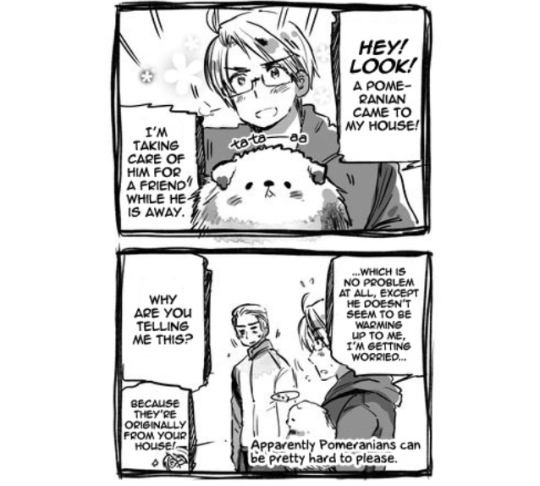
America taking care of his friend’s Pomeranian and asking for
Germany’s help.
Canada crying and doing his best to heal England after the
American Revolution [x].
Hungary secretly cleaning up for Austria after their empire
is dissolved.
After telling the story of Germany’s birth, you see a break
in Prussia’s egocentrism – or rather the act of it. He goes from “worship me
all you like” to agreeing to do laundry for Germany. In reality, he’s an
incredibly helpful, hardworking, and diligent person.
Canada: England’s sick, what do I do?
America: Sneak behind his back and sign your independence.
Canada: What’s wrong with you?!
Also Canada:
Looking at potential hints at ships is great, but I’d also like to use this forum to explore some of the most wholesome friendships in Hetalia. Today, let’s look at Japan and America. They’re compliments of each other, representing two polar personalities that balance out perfectly to create great comic relief. Among my favourites are the cultural misunderstandings that the two share.
Autobiographical Easter Eggs:
A lot of Japan’s bewildered reactions to America’s culture
is based on the own reactions that Himaruya experienced himself when he moved to New York.
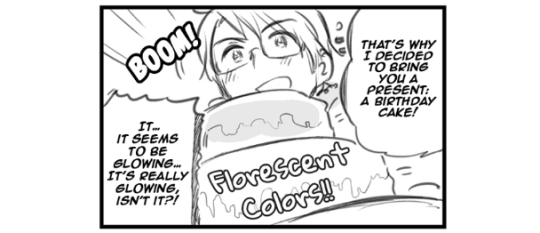
Ex: Japan takes a picture of the brightly coloured cakes in America.
So does Himaruya, who finds the colouring to be weird [x].
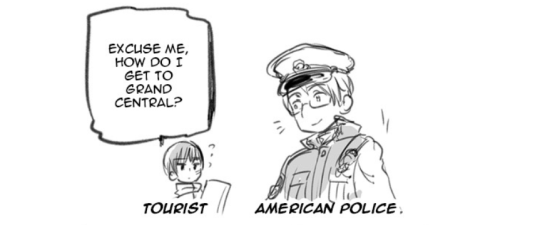
Ex: Through the strips, Himaruya advises Japanese tourists that American
police officers aren’t the best at giving street directions, unlike in Japan
where that’s their main purpose [x].
Where their relationship begins:
When Japan opens his country to the West during the Meiji
Era, Netherlands warns him that because America is young, he may force himself
in.
Despite this, America and Japan hit it off very well. Of
course, this is still exhausting for Japan, who’s both physiologically and chronologically
older.
One moment that really sets the pace for their relationship
is when America introduces table-turning to Japan. He wants to surprise Japan
into believing that it can answer any question.
What America didn’t expect was for Japan to reveal his
anxiety over whether he’ll be able to get along with other countries in the
future.
The sweetest moment is when America doesn’t hesitate to
reassure Japan of this by moving the table so as to say yes.
Since this post covers
their friendship, WW2 will be purposefully glossed over.
Post-WW2:
This one panel here has puzzled many people. When America
proposes a ridiculous world defense plan, Japan agrees without any debate.
Switzerland then reprimands Japan for not voicing his own opinion.
If we’re to take this meeting as occurring right after WW2, this
fits with the Japanese-American relations of the time, where the Japanese
government and society were completely restructured. If this were to be
depicted in the manga, Japan would have become a lackey to America during the
American Occupation of Japan.
Cultural Differences:
Culture shock or accidental misappropriations between them
make up the flesh and bones of their relationship.
Ex: Japan’s version of horror is far different than America’s [x] [x].
Ex: Japan is astounded by how large the food portions are in
America. Meanwhile, America is just as astounded by how small the food
proportions are in Japan.
Ex: Again, Japan likes to take photos of the fluorescent cakes
in America [x].
Ex: America likes to dance. Japan doesn’t.
Ex: America visits Japan on New Year’s day. He
takes it upon himself to study Japanese New Year’s customs, but accidentally
ends up using a wrong reading for “home etiquette.” It comes off as “sword
killing” instead [x].
Visiting:
The two visit and spend time with each other pretty often in
the manga.
Ex: Japan moves in with America for some time. America
kindly greets him with a large meal.
Ex: Japan invites America to come see the sakura bloom in the
spring.
What I also find funny is that there are times where America
becomes too much for Japan to handle.
Ex: Japan runs away when America asks him to sleepover after
watching horror movies. It’s not romantic in context. America’s just a big
fraidy-cat that needs someone there with him [x].
Ex: America invites Japan to his Christmas party, only to
leave the tab of said party on Japan. This prompts a good bout of lecturing [x].
Even more interesting is that we get a small snippet that
expresses America’s fears and secret recognition that he’s not well-received by
other nations. Japan is the only one he believes won’t abandon him [x].
Ex: America unceremoniously breaks Japan’s window. This
prompts another lecture [x].
He goes there to ask for Japan’s help in successfully scaring England on Halloween. (America and England host an annual competition where the two attempt to out-scare each other).
All in all, the relationship that Japan and America share is
definitely a sweet spot in the manga. The two are very close friends, and if
creative inspiration just so happens to dictate it, then yes, they would also
make for a good, well-rounded ship.
America: Aren’t you just the cutest little thing~!
When Japan visits him, there are small pieces of garbage all over his carpet. Because there’s the stereotype that Americans are obsessed with infomercial products, America places too much trust in his vacuum cleaner.
I’ll save FrUK for later, but I’d be happy to start a friendship series.
Let’s start with Japan and America. Friendship post coming up tonight!
As stated in “In just 2 minutes, you can grasp the exterior of
the European Economy,” a nation’s health is dependent on two factors – the
stability of their economy and their politics.
This post will examine what happens to a nation when their
political situation lacks stability.
Let’s go through some examples.
America:
The recent divide between Republicans and Democrats have
been a cause for concern for America’s health. The fighting between the two
political parties is enough for England to comment that the 2016 election must
have been exhausting for America [x].
America denies this, claiming that his body is strong enough
to handle the infighting.
The running gag is that all parties will bond over
how much they hate the new president once the election is over [x]. Point is, it’s
the fact that England’s worried about America’s health – stemming from his
political situation – that’s significant.
China:
China’s rough history of ups and downs, consisting of many rebellions,
conquests, moments of prosperity and unification, and division was a lot for
his physical body to handle. The consequence of these political conflicts is
that he develops aches and pains [x] [x].
England:
England is notorious for falling ill after/during political
conflicts.
This example is undeniably the most important one.
Remember that nations are representations of their citizens.
They exist because of them. Said body of citizens encompasses all groups within
the population. A German is a German, regardless of their ethnic heritage,
culture, and race.
That’s why I believe that Germany is described to “tolerate
his way through pain” during WW2 [x]. German Jews were still his people regardless of their ostracization and the monstrous atrocities
committed against them. This all had to be felt by Germany.
Not everyone was favourable of the Nazi regime either
(obviously) – the executions of those who spoke out against Hitler, assaults,
raids, and surveillance carried out by the Gestapo created an immense sense of
fear and terror for many Germans. Combine that with air raids. The politics of
this time were far from stable.
As always, I must point out that the nations are
subordinates to their bosses and are forced into complying with their orders, often
against their own free will and conscience. Full post on that here [x].
Ex: Germany didn’t want to annex Austria, but was forced to
by his ‘strange’ boss [Hitler]. [x]
Ex: He’s screamed at by his boss, and yet, still takes down
notes. [Out of obligation.] [x]
Ex: Germany didn’t want to form an alliance with Russia. He
did so out of a sense of duty [x].
Ex: While joking, Finland darkly hints at the real
possibility of Hitler being capable enough of imprisoning Germany should he
complain too much about him. It’s more than just “boss troubles” [x].
Ex: When taken as a prisoner of war, Germany compares torture to a mosquito bite. This is because of the pain he experiences on a daily basis during the war.
With all this in mind, what I want to stress most is that
the nations feel pain for their people in whole, aside from whatever actions
their government decide to take.










 Ellawritesficssometimes