*talking about the American Revolution.*
America: Remember when you fucked up so badly that the whole
world turned against you?
America: Congratulations, you betrayed yourself.


*talking about the American Revolution.*
America: Remember when you fucked up so badly that the whole
world turned against you?
America: Congratulations, you betrayed yourself.
Q: Hey!! I dont know if you do asks like this, but
i was wondering on how you would characterize Canadian provinces and
territories? Seeing as youre Canadian and a professional regarding all things
hetalia, as well as a super good writer, i feel like youd be a really good
person to ask!! Thank you for reading this and im sorry for bothering you;;!!
A: You’re not bothering me, no worries, and thank you very much! I just feel a bit awkward when people ask me how exactly to characterize a character/ personification. I strongly believe in artistic interpretation and don’t want to limit anyone’s creativity. You do what you feel is right and exercise discretion like you would with any other fan creation. I don’t want to impinge on your muse.
Q: How strong is America?
A: Strong enough to lift a full-grown buffalo [x] and drag around a Rolls Royce [x].


Q: The “oni chan” thing is true! In Japan, it’s
common for children to call older kids (especially teens) by oni/ onee chan/san
out of respect and adoration. They don’t need to be siblings at all.
A: Say it louder for the people in the back.
Direct translations and different cultural connotations have caused so much unnecessary fighting in the fandom. What amazes me is that the explanation was explicitly given in a translator’s note too. [x]
Q: Why do people think Spain would cheat on his
S/O? That would be completely out of character for him. Oh, on the Germany
thing. Is it possible given the pre-existing political body, the already
existing economic and political situation, Germany past the “baby”
state and skipped to childhood? I know fans of the Germany= HRE theory may not
like it, but I don’t like my home being that child.
A: Man, I don’t know. I focus on canon material, not whatever we crazy fans come up with. It is completely out of character for him, though.
Ex: He had his heart broken by his separation from Austria and is still clearly affected by it during the War of Austrian Succession. When Italy chooses Austria over him, notice how he claims to be dumped again. [x]

Not to mention that Romano finds him weeping afterward.

As for Germany’s existing body, I’ve mentioned this in a post before. Basically, the nations are cultural personifications that include the political.
Even if they’re dissolved, the personification will still exist until the culture completely dies out [x]. This is likely why Holy Rome didn’t die right away after his dissolution, albeit being sick. The body of people he represented still lived on.

I’m personally of the belief that Holy Rome is Germany [x]. There’s a lot of evidence substantiating the fact that he’s indeed Holy Rome but is suffering from amnesia.
However, I totally understand where you’re coming from.
I think what’s important to differentiate here is that the Holy Rome you see in the older strips was just as exaggerated and crude as old characterizations of other countries like France and Austria were. If you look at chapter 187 of World Stars, the Holy Rome depicted there is much tamer.
Side note, I don’t see a point in people denying that Holy Rome is Germany without any grounds/ evidence to base this on.
The denial for the sake of, well, denial, doesn’t do anything for me, I’d like evidence! My opinion isn’t set in stone either. I just haven’t seen someone put up a good case proving why Germany isn’t Holy Rome. Regardless, everyone is entitled to their own opinions, thank you for sharing yours.
Q: You mentioned North Italy helped a lot with
Germany’s friendship building, but what about Japan? Didn’t he help too? He’s
not the left over of an hot fudge sundae.
A: If you go back to the post, I say that Italy brings out the kindness in Germany. Italy does the same exact thing with Japan, who he views to be too formal.
The Axis learn new things and complement each other in their friendship. In that sense, Japan and Germany, as recluses, learn to open themselves up to the idea of friendship and companionship within their trio. They were always kind and considerate. Italy just has a knack for bringing out the best in people.
If Italy was to be removed from the dynamic, I really don’t think that you’d see the same kind of development between Germany and Japan.


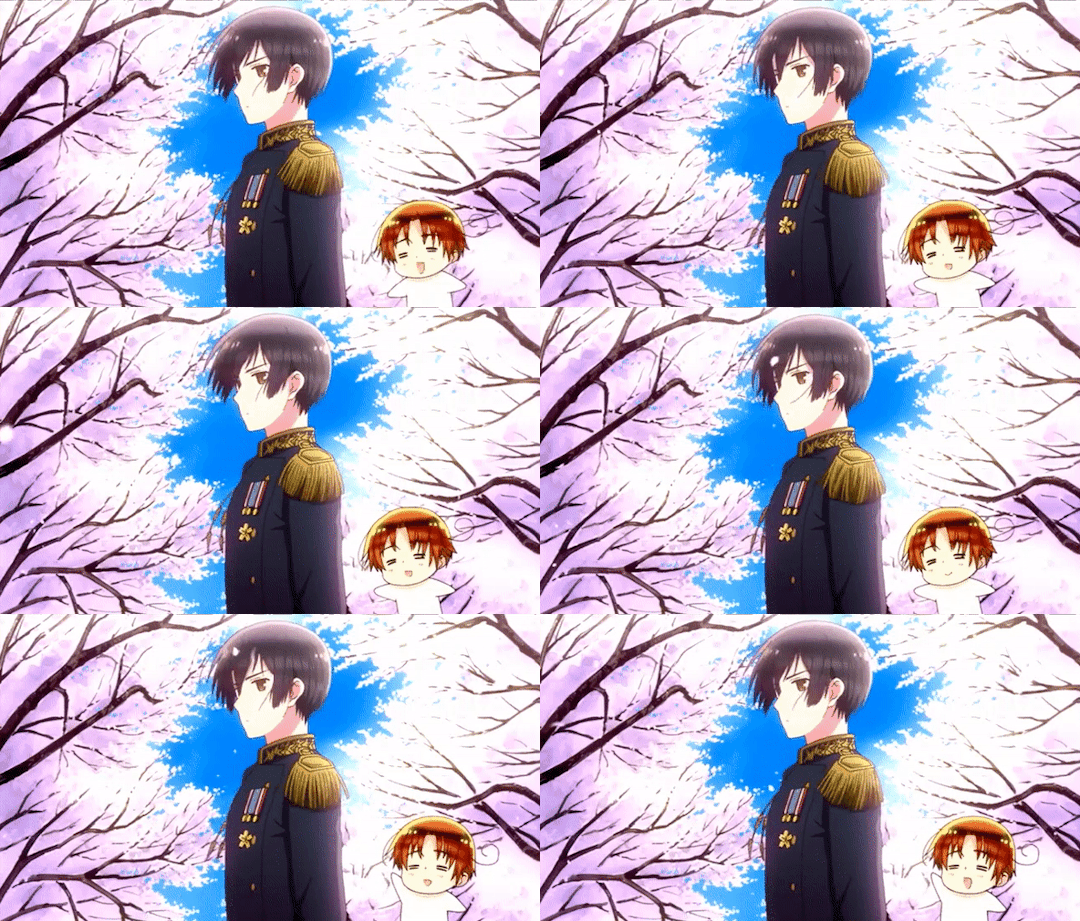
Misconception:
Japan’s emotionless
Reality: He’s shy,
but far from emotionless.
Due to his hikikomori phase, he became used to
communicating with others by reading their minds – he has clairvoyant powers.

Ex: Italy and
Romano initially believe that Japan doesn’t like them because of how contained he
was.

Ex: He’s an
introvert that taps into his extrovert side for business. He’s able to smile and
keep up with pleasantries. Like a true introvert, he’s drained after these
interactions.

Additionally, Japanese cultural display rules for emotion
are vastly different and more reserved than Western nations.

Fun fact: Nowadays, nations that are more reserved
emotionally in public tend to express themselves online in private more,
especially through the use of emojis. The Japanese
have some of the most innovative and creative use of emoticons.
Japan is very active online and has an Instagram account.

He
also has an appreciation for cute things, although he doesn’t realize it.

Ex: When he offers to wash Berlitz, he goes a bit overboard.

Ex: He asks to take a picture of England and America after they put on cat ears.


Misconception: He’s
weak because he doesn’t voice his own opinions.
Reality: He’s
tactful and is extremely careful with what he says out loud.

Ex: Following
WW2, he agrees with what America says, likely because it served to his own
benefit.


If you think about it, it’s amazing how within a decade
after the dropping of the atomic bombs, the Japanese were able to emerge as an industrial power large enough to compete with the United States.
Japan’s intelligence and resilience should be looked at as a
source of strength. It’s also important to mention that before his defeat, he
had pretty much ruled the Eastern Pacific.
Japan’s not always composed either. It’s said
that because he keeps his opinions to himself, he’ll “explode with 100 years
level” and that caution should be taken when this happens. [x]
Ex: He vehemently
opposes the idea of Germany forming an alliance with Russia during WW2.

Misconception: He’s
anti-social.
Reality: He’s extremely social, albeit not overtly.
Ex: He takes great lengths to set aside time to visit his
friends.


Ex: Japan has his own way of expressing
his happiness.


Misconception: He’s
inconsiderate.
Reality: He goes
out of his way to help others. It’s for this reason that he’s probably the most
considerate and sincere APH character.
Ex: He learns Western greetings and attempts to practice
them despite how much it sparks up his anxiety over maintaining his personal
space.


Ex: He helps England with artistic design during the Second
Industrial Revolution.

He also makes sure to praise and commend England for his
efforts, not to mention that these compliments are all genuine.


Bonus facts:
Due to his old historical chronological age, Japan’s body,
while appearing young on the outside, is actually old with age.

He’s a photo-lover.


Although Italy doesn’t remember this, Japan first
communicated with Italy in his dreams. This is the first time we see Japan’s
clairvoyant powers depicted.


He works so hard that even Germany worries about him.

He’s able to perform cleansing and purification rituals.


A pretty neat and complicated character, eh?


Considering that the nations are described as “odd beings”,
many aspects of their existence are either left open-ended or unanswered. It’s probably
meant to be like this, as it allows Hima to have more creative leeway.

On the other hand, there’s a consistent logic in the process
of how the nations are born that I’d like to go over.
For the most part, the nations are born as babies.
Ex: Egypt and his mother, Ancient Egypt.

This excludes…
1) The micronations, who are noted to be anomalies outside
the rules of nationhood.
2) Germany, who’s born as a young child given that he
already had an existing body (I’ll get back to this in a moment).
We know from Iceland that the nations spontaneously gain
consciousness and come into existence. It’s not a formal birth process. They’re also instinctively able to tell that they’re different from humans.

What signifies a nation as a baby is the nightgown they
wear. Personally, I don’t believe that the nightgown has any real significance
other than the fact that it acts as a plot device to distinguish the nation’s
young age.


Just like the nations are able to sense each other, the baby
nation is also able to sense their biological sibling.
This is seen with Iceland when he’s born. He sensed that
Norway was his brother upon gaining consciousness.

Norway also senses Iceland.

Likewise, we also know that later on, Iceland takes a DNA
test–in this case, it’s a land excavation–to confirm that there were no
Icelandic natives. Instead, the first people to settle in Iceland were
Norwegian.


That’s why Iceland and Norway are related.
On the other hand, America was colonized by several nations at once, not to mention that there
were already native tribes living there. As such, he’s referred to as an “ingredient.” He represents a mix of several cultures. [x]
Further, America doesn’t ‘sense’ an older brother from the pool of countries colonizing him. Instead,
Finland, France, and England deliberate over who will assume the role of America’s older brother.


It’s also important to mention that “onii-chan” in Japanese
does not always literally mean older brother. It can be an expression of “endearment” or “adoration.”


There are different cultural connotations that are
unfortunately lost in direct translations.
Despite this, America does, in fact, have a biological brother: Canada [x]

As mentioned above, most nations are born as babies. Germany
is an exception to this rule as he’s born as a young child…or is he?

Disclaimer, I’m going
outside canon now. This next part is theory based on canon fact.
Many people have speculated that Germany’s ‘existing’ body
means that while Holy Rome died, his body remained. Germany then resumed this
body after German Confederation.

The ‘existing’ body, then, would be the fact that Germany’s spirit
inhabited Holy Rome’s old body, hence the reason why he wasn’t born as a baby.
This perspective doesn’t make sense to me, as we know that
it’s possible for nations to live past their date of dissolution. More
importantly, Holy Rome lived past his dissolution.

Another problem with this perspective is that the nations’
bodies don’t remain when they die, but rather, they fade away. The nations are
personality-based, meaning that when their culture dies, so do they. [x]
Put another way, culture doesn’t die definitively. It fades
with time – A nation’s path to death is reflective of this.
This would explain why Holy Rome didn’t die right away, albeit being ill. The
German culture he represented was still alive and well.
Meanwhile, my take on Germany’s ‘existing body’ is vastly
different. I’m of the mindset that Holy Rome lost all his memories when he
became Germany. [post on that here].
In other words,
Germany wasn’t born as a baby because he was already existing, as in he had a living body.
In sum, while many questions about the nation’s existence
are left unanswered, there is a relative level of consistency regarding the
ages in which nations are born as well as the role that evolutionary instinct
plays in how they find their relatives.


The time’s come to begin delving into the older characterizations
in the series, those of which owe Hetalia much of its poor reputation today. What
doesn’t help is that those in the fandom either deny the mistakes that Hima
made in the past or ignore them completely. Both of these actions do more harm
than good.
To be as objective as possible, it’s important that we
acknowledge the series’ early, but nonetheless problematic past. In doing so,
this then opens up more avenues to discuss how the characters have evolved and
changed for the better. Put another way, it’s more effective to air out the
dirty laundry as opposed to letting it [rumours/ misconceptions] sit there in
an unresolved mess.
Another point to hit on is that it’s pivotal that we
recognize that Hima has learned from his past errors. The characterization of
the nations has moved way past the unfunny middle school sexual humour that
used to define them. While things went too far in the past, the fact that they
don’t today is enough to hold Hima into account.
Creators grow and learn from their mistakes. If they prove
to learn from said mistakes, there’s really no reason to continue to shame them
for something that was created years ago
– in this case, a decade.
That said, let’s get into it.
I’ll be blunt. The humour in the early strips is incredibly offensive.
I’m often reminded of how this type of humour was normalized back then. Not
only that, but I remember making some of these jokes myself without really understanding
the meaning of what I was saying. Of course, this doesn’t make any of this
right.
Some of these jokes would include France stripping and groping
other nations.

A good part of this content was owed to the fans as well, who
encouraged and requested nations to do these sort of things [x]. At the time, the
humour was supported because that was the joke culture. It wasn’t as connotatively
aware as it is today.
Briefly, as I’ve already touched on, France’s stripping
doesn’t stem from a French stereotype of sexuality. Instead, it stems from the
stereotype that the French tended to swoop in for fresh pickings of territories
after European conflicts. The best way I can describe it is that they were like
scavengers; they stripped the losing nations to the bone.
Ex: This is seen when France strips Austria clean after the
War of Austrian Succession.


The reason I’m going over this is simply to point out that
France’s stripping did occasionally have a logic to it, bizarre and problematic
as it was.
Likewise, since a nation’s body is a physical embodiment of
their geographic landmass, each body part respectively represents a certain
territory (e.g., Austria’s ahoge represents Mariazell).
This would explain why France ‘rubbed’ Italy’s chest when
his economy was doing poorly. He was seeking territories to profit from.


Like I said, bizarre and problematic.
Even so, there were still boundaries in place for France’s
early characterization. The running gag of the old humour was predicated on
recognizing that France’s behaviour was outlandish.
Ex: He was once arrested for his lewd behaviour.

Ex: In the first chapters of the original webcomic, he states plain
as day that love shouldn’t be forced on anyone.

Ex: For a supposedly territory-happy nation, he’s once shown to have grown uncomfortable at the prospect of imperialism.

Ex: Similarly, when Italy hadn’t covered himself properly,
France had no trouble pointing this out to him.

The humour may be perverse, but France wasn’t always
perverted. This is especially the case in
later strips, where this lewd behaviour has disappeared completely and for a
good reason.
There was a clear recognition that France’s characterization
was not up to par, and over the years, he’s blossomed into something truly beautiful.
The present France is the mouthpiece for exploring several
dark subjects in the series.
Let’s go over a few.
France gives us the best insight into the reason why nations
exist.

…


We implicitly learn from him [his citizens] the pain of constantly seeing loved ones die should a person possess immortality.


The angle then shifts to France, who gazes at a young family. How just a handful of panels can convey so much emotion, longing in particular, is beyond me.

There’s this one moment with Lisa, Jeanne d’Arc’s
reincarnate, that always sticks with me.

France felt betrayed by God in how
unforgiving history was for letting Jeanne die so tragically. When he first saw
Lisa, he believed God was playing a cruel trick on him.

When he realizes that Jeanne has been born into a much
happier life, the peace of mind on his face is undeniable.

It took remarkable strength for France to confront this resentment
and pain, let alone to have the heart to let go and accept that history has
paved a better course for Jeanne, albeit it being in a different life.
Given how rough his own history has been, the ability to
forgive and love reflects on how truly resilient and strong he is as a person.

France also acts as a great father figure to America, having
originally helped the latter gain their independence.
He comes to America’s centennial celebration. The genuity of
the gesture is what truly matters here. America wasn’t just a vessel for France
to spite England, contrary to how his government perceived this conflict as an
opportunity for. There’s a true supportive relationship here.

I’ll end on this. While France’s character may have been
poorly characterized in the past, that shouldn’t take away from how he’s
enjoyed now. He went from a character ‘stripped’ of meaning to a personality
teeming with complicated thoughts, emotions, and life nuances.
There’s nothing wrong with acknowledging the prior mishaps
of how he was depicted so long as it’s recognized that he’s since changed and
grossly at that.


Note: This post
can be very triggering for some people. Please take care of yourself and don’t
read this if you are sensitive to the topic of eating disorders.
To start, let’s lay out one ground rule. We know that
population statistics respectively affect the nations’ behaviours, habits, and
personalities. When something is common in the population, the personification
adopts it too.
For example, America’s people strongly believe in aliens and
conspiracy theories.


As such, America also believes in aliens and conspiracy
theories.


It would follow, then, that given how big the fast food and
dieting industries are in America –what a
massive contradiction that is – he would also be affected by this.
Well, he is.

While I can’t attest to how accurate this statistic is, Hima
cites that 60% of Americans are overweight. What matters here is that this
statistic explains why America is also ‘overweight’. He’s not actually. I’ll get back to that in a minute.


Point is, America has been struggling with weight and
dieting issues from some of the earliest strips. Of course, this is because the
fast-food industry really took off after WW2. The dieting industry came a bit
afterward when people began realizing how much weight they were gaining by
eating so much processed food.
The same thing happens to America. Initially, he doesn’t
realize the effect that constantly eating burgers has on his
metabolism.

This then leads him to inquire about the eating habits of
other nations as well as how they maintain their thin figures.


The problem with America is that this obsession with dieting
becomes unhealthy, exactly as it is with the American population. Eating
disorders and crash diets are chronic in North America. It’s a major problem
that isn’t really talked about. Hima, on the other hand, characterizes America
to accurately reflect this.
In his introductory chapter of World Stars (chapter 23), the
topic of his dieting session is immediately brought up. I don’t think this
would be done unless it was something pivotal to his characterization.
The character note claims that America’s gotten over his
dieting craze and has accepted that he’s not actually fat but rather muscular
and big-boned.


That’s the mental illness aspect of eating disorders. You
claim that you’re better despite the fact that you keep relapsing into
unhealthy habits. This thought process can be very convincing, as some people
with eating disorders truly believe that they’re healthy and that there’s
nothing wrong with what they’re doing.
Expectedly, later chapters contradict this.
Not even that, literally the next chapter depicts him
struggling with his weight. When he measures himself on the scale and a large
number turns up, he convinces himself that it’s broken. If that wasn’t enough,
he also calls Germany to fix the scale.


How I interpret this is that America is in denial and is stubbornly
fighting with himself over the number on the scale.
In the same chapter, he falls back to his old dieting tactics
and asks Italy about his eating habits.

This isn’t the first time the insecurity over his weight is
shown either.
Ex: In the strips depicting what each country is known for,
America is shown to be painting over the American stereotype of being “fat.” As
someone who seems to be struggling with his body image, it makes sense that he
wouldn’t want to be known as an obese country.

The problem with America is that he overeats, sets unrealistic
body goals, and then doesn’t follow through with these goals. This, in turn,
leads to a rigorous cycle of dieting and feeling poor about himself.


Ex: One of his New Year’s Resolution to “take better care of his
health” is to have a body fat percentage of 3%. Obviously, this isn’t a
realistic goal. It’s far from healthy.
Notice how being slimmer has been his resolution for the past 30
years. It’s not something that’s gone away, as it’s a problem that’s
persistently affected Americans over the years.

The cycle continues when, in the same strip, he treats
himself to a hamburger and milkshake.

The last that we see of this problem is when he trains China
to help him lose weight. [Chinese obesity rates have been on the
rise lately.]
Regardless of the fact that America possesses super strength
and possesses more physical endurance than normal, a 10,000 corkscrew punch workout is
not normal. If anything, this is indicative of another unhealthy dieting
tactic.

In sum, America’s dieting/ workout habits and
overconsumption of junk food are owed to the prevalence of the fast food and
dieting industries of his country. Given the evidence I just presented, it’s
not a stretch to claim that he suffers from body issues and has an eating
disorder.

America: I’m totally open to hearing other opinions!
Also America:

It’s more like it’s a recurring joke that others call him out for this and he denies it.


It’s not a stretch at all. In fact, this is something about
America’s characterization that has been consistent way back into the early
years of the series.
While it’s not controversial, this can trigger a lot of
people. Of course, I will give a trigger warning again, but for anyone who is
struggling/ has recovered from an eating disorder, please take care of yourself
first. I would rather you not read this and would happy to provide a summary if
you feel like this would cause you to lose progress and fall back on your old
habits.
Full disclosure, I struggled with an eating disorder for
four years. This isn’t something that I intend to take lightly, and the last thing
I want is to trivialize a subject as serious as this for the sake of angst. What
I do aim to do is explain why and how America is characterized like this.
Post coming up tonight.


What this post will explore is the impact of England’s
parenting style on America. There is no good and bad here. All I aim to do is
give reason and meaning to the problematic behaviour and relationships that are
depicted in the series. The characterization is done for a specific purpose;
what I seek to do is bring several parallels to light to prove this.
One of psychologist Karen Horney’s theories explored how
problematic parent-child relationships often result in the child developing
neuroses (mental health complications), such as anxiety or depression.
However, rather than assert all the blame on the parent, she
went on to explain how parents who have been reared in an environment void of
love, care, and affection are typically incapable of raising their kids in any other
manner.
Put another way, parents pass on their neuroses to their
children. You can’t expect someone to consistently provide the care, warmth, and love that
they’ve never experienced and learned themselves. On the other end of the
spectrum, these problematic parent-child-relationships and parenting techniques
are learned and repeated through generation-to-generation. It’s a cyclical
process, that, unless consciously recognized, results in all sorts of emotional
trauma.
Of course, this doesn’t mean that the parents can’t provide this warmth or affection.

What Horney believed to be the Basic Evil of these problematic parenting styles is Parental Indifference, which can also
include a hostile or rejecting attitude of the parents toward the child. This
parental indifference can cause the child to develop feelings of Basic Anxiety or Basic Hostility – both of which, if not attended to, can lead to mental
health issues.
For the purposes of this post, I only need to focus on Basic
Anxiety. Basic Anxiety occurs when the child develops feelings of loneliness
and helplessness in a world that they perceive to be hostile and dangerous.
That said, what I’ll now analyze is how England’s own
upbringing and resulting mental health issues from it were passed down to
America.
Let’s tie this back to the strips.
England’s isolated upbringing as the Black Sheep of Europe
leads him to unconsciously replicate this isolation in how he raises America.

Since he grew up alone, he doesn’t see a problem in leaving America for long
periods of time. He even admits to America that this is what he had to go
through as a child.
Thing is, while this is normal to England, it’s obviously
an abnormal parenting practice.

The point to stress here is that England is repeating
the problematic parenting styles of his older brothers, who played no part in
raising him. They would send him hexes or drive him away with arrows if he
got too close for their liking.
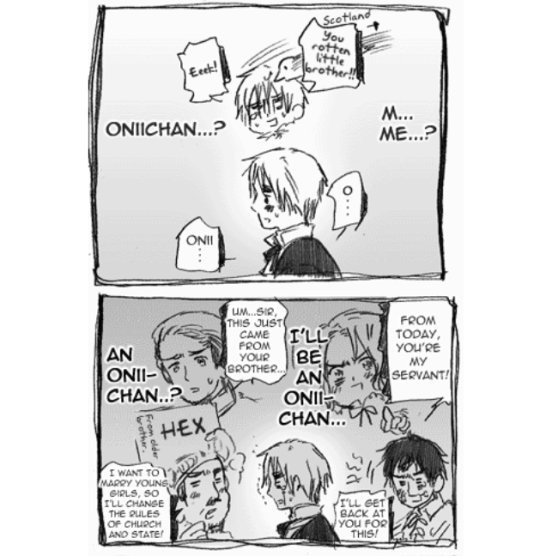
The parallels of loneliness and helplessness are quite
clear.
Ex: England feels
isolated in Europe, often a result of his hostile attitude toward other nations.

Ex: He feels
helpless when he realizes that everyone has turned against him during the
American Revolution.


The loneliness is most prevalent when England pokes into
America’s business, wanting to bridge the gap in their relationship, but being
too prideful and hostile to get anywhere with this.
Ex: He visits
America to “check up” on Lithuania, who was living with America at the time.

America also fears being alone and experiences feelings of
helplessness. This childhood fear still persists.

Ex: America pokes
his nose into other nations’ business to the detriment of damaging his
relationships with them. As such, he fears being alone and desperately clings
on to the few he’s able to maintain a good relationship with (e.g., Japan).


Both feel a compulsion to be the #1 at everything. As I’ll
get into in a moment, this likely stems from low feelings of self-worth and
poor self-esteem. What you’ll also see is that England especially hates coming second
to America.
Ex: England training to become physically stronger.
The
strip this is taken from is titled “England’s plan to be the strongest.”
Hmmm…

Ex: America mass producing and becoming a dominant economic power.

His dethronement of England in becoming the world’s #1
industrial power is not taken well by the latter.

Constantly being ostracized and insulted by other nations
has had a devastating impact on how England views himself.

America also struggles with self-esteem issues, although it
mostly has to do with his weight.
Ex: He refuses to
accept the number on the scale and claims that it’s broken.

Both cope with the stresses and difficulties of daily life
by hiding in their imaginations.
Ex: America’s
go-to safety mechanism is imagining superheroes to solve his problems.

Notice how England calls out how unrealistic America’s
reality is.

Of course, this is hypocritical given that England escapes
into the world of fantasy and magic when he’s feeling lonely or stressed.

Overall, what I find interesting and would highly recommend that
others look into is how similar England and America experience themselves and
their problems. Personality-wise, they couldn’t be any more different;
mentally, however, they’re quite alike.

 Ellawritesficssometimes