He’s an overgrown puppy that genuinely enjoys hanging out with his friends.


He’s an overgrown puppy that genuinely enjoys hanging out with his friends.
I can sure try! Psst. I’ll add a bit of a bonus by touching on his inability to see magical creatures too.
Post coming up tonight!


I think
it’s become obvious by now that almost every single nation embodies a good balance
between likeable and dislikeable traits. As such, it’s important to lay out
some essential characteristics if we’re to understand who England is as a
person, his motivations, his faults, and his highpoints.
While
England can be invariably cruel and pessimistic – especially towards America–
this stems from a latent insecurity that he keeps within himself. He pre-emptively
spites others to protect himself from the rejection he’s historically
experienced. In modern strips, his temper has calmed considerably, and this
spitefulness has transformed more into sarcastic banter and blunt teasing.
Nonetheless,
what this post will account for is why England’s loneliness caused him to have
such a volatile temperament, not to mention poor relationships with others.
The
following character notes are of utmost importance in preventing England’s
personality from being misinterpreted. [x]
He’s quite bad
at expressing himself. He himself knows that people often misunderstand him, he
uses this fact for self-depreciating jokes.
He could easily
be the most pitiful one in this webcomic.
His temper was
quite stormy during the decades after America’s independence.
Put
another way: England’s historical isolation caused him to develop a poor sense
of self-worth. To compensate for this, he worked hard to improve his nation and
external image of himself. Meanwhile, the insecurity remained even as he
emerged as a world superpower. Because he was so used to being teased and
berated, England treated others in a similar manner, only for this to work to
his own detriment.
Arrogance
and boastfulness quickly got the best of him. He fell hard and even deeper into
isolation after the American Revolution. His violent temper towards America is
a manifestation of his strong fear of rejection. What you’ll see is that
England is deeply considerate of others and wants to befriend them, but
unfortunately closes up and defensively makes scathing remarks to protect his
fragile self-image.
With all
that said, let’s tie this back to the strips and go through some examples.
We know
that having America as a ward helped ease England’s temper. He even admits
to this.

What’s
important to point out here is that this was during a time when America was
England’s primary ally.

England escaped the alienating
atmosphere of Europe by visiting America. America’s unconditional love was England’s security blanket.
This
security blanket was lost after the Revolution, thus explaining why England’s
temper explodes in the following years. He was all alone again.

England wants to be friends with America, but has trouble overcoming his loneliness. His crippling fear of rejection is often the cause.
In fact,
England can be quite shy at times. If anything, it proves how skeptical he is
to open himself up to others, let alone make the effort to get them to see him
for who he really is.

He embarrassedly
offers to be America’s friend when he realizes that the latter doesn’t have
any, only to defensively fall back on anger when America rejects him.


It’s a cruel
cycle of desiring to be close to another person, opening himself up, and either
1) rudely spiting them, inciting rejection or 2) politely engaging them as a ‘gentleman’,
only for this to incite rejection as well.
His anger
is a shell – it’s a tough habit to break, even though he woefully recognizes
how problematic it is in impacting how others perceive him.
The fact
that he doesn’t expect positive reactions from others is chiefly illustrated with how embarrassed he gets when he does receive praise.

Nonetheless,
England keeps trying to mend things with America to the extent that these efforts are excessively nosy.
He’s
skeptical that Lithuania will be treated well in America’s house, and takes it
upon himself to visit them. Curiosity is a form of caring, however skewed and
counterproductive as it may be.
Point is,
England’s covertly reaching out to America here, likely because he knows
firsthand what it’s like to be directly rejected by the latter. It’s the next
best thing he can do.

As
touched on above, it’s not just America that England’s isolated from. He’s not
referred to as the Black Sheep of Europe for nothing, after all.
During
the Splendid Isolation Period, and having experienced many political rejections
as a result of tensions with Russia, he desperately tries to convince himself
that being alone isn’t all that bad.

Eventually,
he’s able to successfully form an alliance with Japan. Of particular emphasis is
the strip’s title:
“The anglo-Japanese alliance between two lonely people.”
I really don’t think it can get more explicit than that.


Further,
this alienation among the other nations is a repetitive theme in the series.
England’s often left out of excursions and activities.
One
example that best demonstrates this is when Italy, Germany, and Japan take it
upon themselves to interview other nations about their Christmas traditions.
The whole strip entails England hiding in the background, fidgeting nervously
as he waits to be interviewed, only to be forgotten about.


Interestingly,
it’s Japan who remembers to interview England at the last minute. The two share
an implicit, but undeniably deep understanding of each other.

Another
way that England compensates for his loneliness is by turning to the
supernatural – his fairie friends. America thinks he’s crazy, but what he doesn’t
realize is that England likely summons these friends to mitigate his
loneliness, and therefore prevent himself from going mad.


The
imagery of a child-like imagination is later used to describe England’s love of
and desire to live in a world entirely made up of fantasy. He lives in his mind
because it’s safe. Similarly, he talks to his [real] fairie friends because he knows
that they’re safe too; they won’t ever reject him.

I’ve
brought this up before, but I think this is a good note to end on. During the
Anglo-Japanese alliance arc, which focuses on the subject of loneliness, why is
it that England is given the Kappa’s Miracle Cure?

It’s a
medicine said to cure any illness…
…but what
illness is there to cure if you’re an immortal being that will automatically
recover from illness anyway?
It seems
to me that the cure was intended for something less tangible, yet just as hard
to cure:
Heartsickness
and accompanying feelings of loneliness.

The fact that despite all that they’ve gone through, they’ve evolved to the point where they’re able to flat out roast each other…in a teasing manner of course.

Absolutely! Here’s a small source guide I’ve compiled for this:
Fantasy England [x] – Explains
why England can see magical creatures/ ghosts.
America’s Situation with Ghosts [x] – Explains why America can’t see ghosts.
Merry Halloween [x] – Explains
why America can only see ghosts/ magical creatures on Halloween.
World ☆Stars Chapter 23 [x] – Explains
why America can see aliens (Tony).


Bingo.
In fact, there are several instances where he’s shown to be
weakened.
His baseline strength is stronger than most of the other
nations regardless, but there’s an explicit economic reason for this. It’s not
just something inherent to him.
We first see his super strength emerge when he picks up the
wild bison and begins hurling it around. Notice how in the strip, the richness
of his culture and industrial strength are listed as reasons to account for
this.


Likewise, in “In just two minutes you can grasp the exterior
of the European Economy,” we learn that a nation’s health and well-being is
predicated on the stability of both their politics and economy.
“In this manga, a nation having a cold = something like a recession. By the way, when they’re physically unwell, the nation’s politics or economy is having problems.” [x]
It would follow, then, that if America gains strength from a
strong culture and economy, then he would also be weakened during political
turmoil and economic recessions. Now, to substantiate this claim…
1) The super strength is not inherent to America,
but is rather inherent to any personification who reaches enough political and
economic affluence.
Ex: Russia and America are referred to
as “super humans” by Finland, meanwhile the other nations aren’t that much
different from humans.

As I’ve stated before, I take this as a metaphor for how the
two nations emerged as dominant superpowers during the Cold War, both economically and politically (i.e. capitalist vs communist ideologies.)

Ex: Russia is
able to stop a tank with his body.

2) America’s economy impacts his health
Ex: During the Great Depression, he’s notably low in spirits
and appears to be fatigued and/or out of sorts. He solemnly apologizes and
allows the other nations to berate him for causing the Stock Market Crash without
any protest– this is completely uncharacteristic of him.

He even shivers in the face of their anger.

Each nation is given a negative number depending on how
badly their economies were affected as a result of the crash. Notice how
likewise to America’s presumably ill
health, their dependency on him and his [weakened] economy, strongly impacted
their own health and well-being.

Meanwhile, because socialism had an entirely different
production system, Russia is positively affected by the crash.

3) America’s sovereignty impacted his strength and
overall health.
In this strip, it becomes clear that England’s taxation of
America after the French-Indian War caused America to experience considerable economic “strain.”


That said, look at the differences in age between the first
and last panel.

Independence from England, and therefore the freedom from
taxation and a full control over his economic and political affairs, allowed
America to reach adulthood.
I mean, he’s literally defined as “Young America” in the first
panel. Essentially, England’s rule stunted both his growth and strength.
Which brings me to my next point.
4) The Revolutionary War further weakened America’s
physical strength
Considering that England almost won the war, it’s no
surprise that America would grow weak from it.
If he’s so strong, how come he physically struggled to
defend himself when England came charging at him? Not to mention that England had the upper hand.
Yes, America’s “naive” and was evidently surprised by this, but there’s a clear assertion and confrontation of physical force here.

5) Present politics are hinted at affecting
America’s strength
The dividing politics of America’s elections are enough for
England to concernedly inquire about America’s health.

Of course, America
denies this and expresses confidence in his body’s strength.

If anything, this still confirms that America can be
weakened by his political situation, as is the same of any other
personification.
America: Hey! I just got tickets to the circus. Wanna come?
England: No need. I get my daily fill of entertainment
by watching your country’s press conferences.

100% without a doubt.
Ex: When England
falls asleep during a meeting, America suggests that they leave him be. That opinion
is quick to change when England begins mumbling about America’s old bed-wetting
habit.

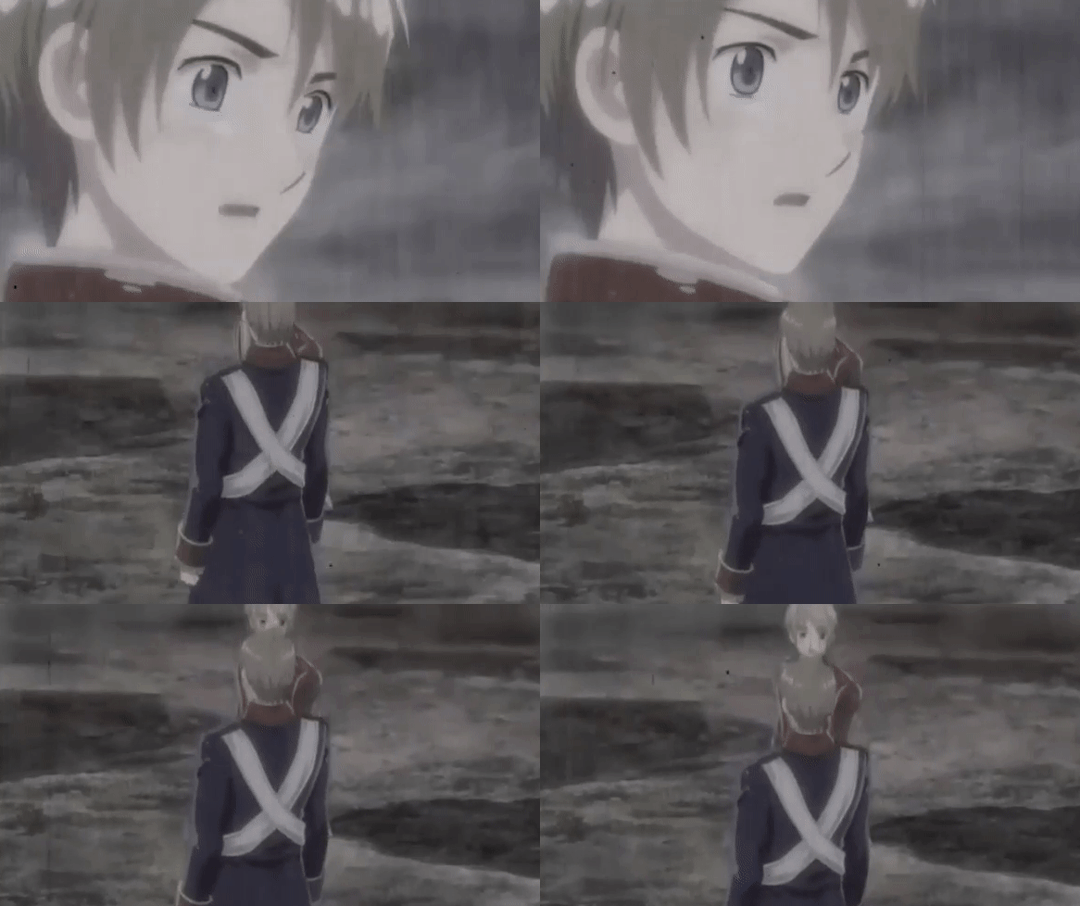
Ex: He asks
Lithuania to hide the toy soldier England gave him.


In a previous post, I went over how the nations have
considerable gaps in their memories for a variety of reasons. [link here]. That
said, I also find it important to reiterate that the nations are not always
able to repress or forget traumatic memories, and often carry these
experiences with them – it becomes part of who they are, their personality.
Yes, their memories are full of holes, but these experiences
can just as easily be retained. It’s not that they repress everything, but
rather that they don’t remember everything.
1) Sometimes there are triggers – such as an object
or person – that allow the nations to remember an experience more vividly.
Prior to that, they simply have a general emotive idea of the experience, good
or bad.
2) Sometimes the nations carry the memories with
them, either consciously – it actively affects how they relate and interact
with others – or unconsciously – it latently affects how they relate and
interact with others outside of their own awareness.
3) Sometimes, no matter how hard a nation tries to
repress uncomfortable, unpleasant, or anxiety-ridden memories, they’re unfortunately
unable to.
4) Sometimes the nations retain the memories, but
purposefully refuse to either mention or acknowledge them.
Given their dark, chaotic, and bloody pasts, it would make
sense for the nations to protect their sanity by not remembering everything.
Nonetheless, what this post will argue and focus on is how these experiences
influence the nations both at an unconscious and conscious level.
Without further ado, let’s tie this back to the strips.
America is a case of a nation who desires to forget his
past, but is unsuccessful in doing so. In particular, the experience he wants
to forget is his Revolution.

Likewise, while America retained vivid emotive and affective
memories from the Revolution, it’s only when he begins cleaning out old belongings
in his storage closet that he recalls the finer details of the unpleasant experience.

Simply put, even though America’s experience of the Revolution
has deeply affected him emotionally in how he perceives his sense of self, the
fact that the belongings flesh out these memories is essential in demonstrating
the limitations of his memory.
It’s just like what Finland’s claimed before; aside from physical strength and a strengthened immune
system, the nations aren’t all that much different from humans.

During a meeting, Italy’s boss takes an interest in Italy’s
immortality, and later remarks that it can be disadvantageous.
“You sure have been
through a lot, huh?”
Italy even agrees that his life has been tough.

Even more
interesting is that Italy claims that he gets tired of seeing the same people
all the time, only to reverse this statement and say that seeing the same
people can be refreshing in a way.

How I see this is that while Italy may see the same people,
he experiences them differently each time. Perhaps this is why
Italy refers to this as refreshing – could it be that while he sees the same
people, they evoke different memories and emotional reactions in him?
What’s also important here is the initial reluctance in
Italy to disclose more “private” accounts of his life. Notice how uncomfortable
he looks. Not every memory is good, so of course he’s not going to be keen on
recalling them.

The scene ends with Italy offering to disclose these secrets
should his boss treat him to lunch. This could very easily be interpreted as
him deflecting the subject.

Having lost huge aspects of his culture following his own Revolution
–given that many old furniture pieces and decorations were either discarded, sold or burned – France still retains strong feelings of grief over this
in the present.
Put another way, France’s past still lives with him in how
he presently experiences himself.


Lithuania too is an example of a nation who’s still
traumatized by their past. It impacts every aspect of his daily interactions.
As he and the other two Baltics recall their arduous paths
to independence, Lithuania further recalls a memory of Russia squeezing his
shoulders.
Notice how Lithuania repeats this behavior, albeit unknowingly,
as he squeezes Estonia’s and Latvia’s shoulders upon remembering this troubling
experience.

Just to prove how consistent this memory rule has been, I’d
like to point out that Lithuania has suffered from triggered-induced flashbacks
as early as the first original chapters of the web comic.
When privy to the fact that Russia intended to invade Poland
in WW2, Lithuania repeatedly recalls traumatic experiences where his own
country was taken over and conquered.


Lastly, Russia is a quintessential example of a nation who’s
affected by their past. What’s complicated about him is that he seems to
remember a lot about his past, despite their being holes in it, but fails to attribute
this to how he presently experiences himself.
In other words, while retaining many traumatic memories,
Russia doesn’t connect them to how distorted and unhealthy his conception of an ideal relationship is [either platonic or
romantic.]
For instance, take the Bloody Sunday strip. There, Russia
sheds tears over the revolt, considering how hard he had previously worked to
improve his nation.
The strip ends by largely hinting at him being tasked with
supressing the revolt through the use of violence.

“We don’t want children who can’t play nice, right?”
Now, let’s skip forward a bit to WW2.
As he and England discuss America’s boldness, you can
immediately start to pick up on how Russia’s past inadvertently affects how he perceives
the world and the people in it. Yes, he might have repressed the nuanced
details of his past, but he’s internalized a considerable amount of it without
his realizing.
He appears to take what happened during the Bloody Sunday revolt,
and applies the same rhetoric to America. Not only is his view of relationships
distorted, but so are his solutions to problems.
I specifically want you to pay attention to the child
imagery that emerges again with regards to how Russia equates rebellion with
immaturity.
“Aren’t the provocative [rebellious] ones more fun to snap
in half?”
Translation: Dissent is childish, and therefore it must be crushed [snapped].

In sum, while the nations do have considerable gaps in their
memories, they are still very much influenced by their past.


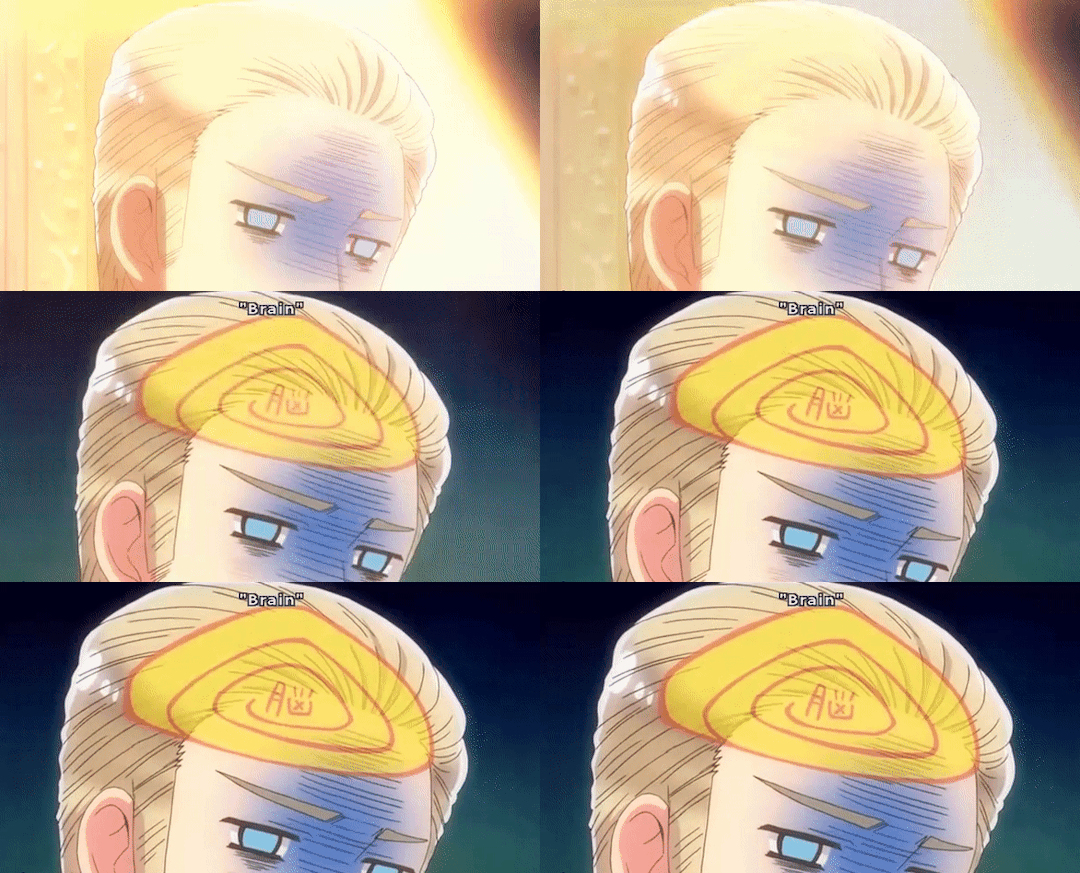
Before I start, it’s important to lay out some ground rules.
Thanks to Finland we know that the nations aren’t that
different from humans with regards to their physical strength and anatomy (with
the exceptions of Russia and America who are exceptionally strong).

The point in this is that the “not-so-different from a human
rule” pertains to their basic physiological structure. On the other hand, there
are immortal perks of nationhood, such as being impervious to experiencing the fatality of illnesses. They still can
fall ill, though. This happens when they’re….
1) Suffering from political instability.
2) They’re experiencing an economic recession.
3) There’s a rampant illness in their population (i.e Romano’s
Chorea).
With that said, we know that the nations are stronger than
normal humans regardless. They don’t age as fast, and as such, their memories
don’t deteriorate at nearly the same rate.
What this post will explore are the different examples where
nations have been shown to have gaps in their memories.

The thesis I’m putting forward includes a variety of
reasons to account for this:
One, older nations such as Japan and China have even larger gaps
in their memories as a result of their physical bodies aging. They’re therefore
unable to recall memories as fast as younger nations [This in part goes with my
third argument].
Two, the influence of their citizens pertaining to whether
or not the nations can see and therefore remember the existence of magical creatures.
Three, the nations simply aren’t able to remember
everything; it would be impossible.
And four, some
nations actively repress bad memories to minimize the anxiety and trauma they
previously experienced.
Without further ado, let’s go over some of these examples.
As stated above, the nations’ chronological age, while
influenced by their economic and political affluence, also seems to be affected
in part by how long they’ve lived (I.e. Both Japan and China refer to
themselves as old men.)
If Japan is shown to have higher blood pressure levels and hip pains as a
result of his old age, then it wouldn’t be too farfetched to assume that his
memory wouldn’t be as up to par as it would be in comparison to a nation younger
than him. Put another way, his age would cause him to have greater slips in his
memory.
It’s the body that’s old, despite not looking like it.


Ex: He’s unable
to remember who Lithuania is, and almost mistakes the latter to be Livonia.

Ex: While looking
through an album of him and Pochi throughout different periods, Japan
mistakenly recalls the chronology of them.

Likewise, China’s also referred to as an old man.

Ex: He admits to
being forgetful.

We’ve also seen the impact on how a population’s belief in
magical creatures respectively influences whether or not the nation will be
able to see them.
Ex: During the
Meiji Era, England could see the kappa and youkai spirits, meanwhile Japan couldn’t
as a result of his people no longer believing in them as strongly.

However, just as a nation can forget about magical
creatures, they can also re-remember them if popular culture strongly believes
in them again – presumably it would have to go past folklore superstitions.
While enjoying Japan’s hot springs, the two talk about
folklore.

Notice how Italy spots a strange creature beginning to approach them.
Although it’s not shown, the discussion of the topic could possibly mean that
Japan [and not just Italy] is also able to see the creature.

There’s also an exact replica of this hot spring scene
dating back to when they first met during WW2. I don’t think Hima did this for
no reason:


As Russia darkly puts it, perhaps it’s a good thing that the
nations don’t remember everything.

When Lithuania and Germany allegedly meet for the first time
during WW2, Lithuania expresses relief over Germany not remembering him. It’s
noted that Lithuania once beat-up one of Germany’s family members. This is
possibly a reference to when Prussia became a lackey to Poland under the
Lithuanian and Polish Commonwealth.

This is highly indicative of Germany existing well before
his ‘birth’ in 1871 given that Lithuania is fearful of being remembered and/or triggering
Germany’s memory. If anything, Lithuania’s fear of this points further in the
direction of Germany suffering from amnesia.
Why else is there a childhood version of Germany/Holy Rome pushing to be acknowledged in older strips? I’ve theorized before that this is
simply a part of his unconscious mind trying to get him to remember about his
forgotten childhood.

Or why is it that he’s seen to confusedly hold up Chibitalia in another strip?
“It’s me.” Jogging his memory much?

Similarly, Italy also dreams of a childhood version of
himself pushing to be acknowledged by him, only for Italy to refuse in doing so. Like
Germany, it seems that Italy has actively striven to forget his childhood.

Lastly, the most obvious hint of repressed childhood
memories is found in Buon San Valentino, where Germany appears to recall fuzzy
images of Chibitalia.


Prussia is the one to confirm this rule, considering that he’s
taken to recording every experience as a method in circumventing the inability
to recall them. It’s simply a matter of jogging his memory.

In sum, while the nation’s memories are limited, there are
different factors and contexts that account for this phenomenon. Age, trauma,
civilian belief, and limited physiological brain capacity seem to be the most
common reasons in accounting for this.

 Ellawritesficssometimes