After talking about how nations are affected by illnesses with @ellawritesficssometimes, I decided to write an extensive post to better explain my take on the matter.
Now, as Ella already pointed out, from canon we know for sure that personifications can experience what’s the human equivalent
of an illness in three different situations:
1) Economic recessions
or depressions
2) Political unrest
Rome was shown to be sick when there was some
unrest inside his territory, in spite of the successful external military campaigns.
3) An illness affecting a big part of the population
This is the case of Romano, for example, who as
a child was affected by Huntington’s Chorea. I remember reading the strip but
I couldn’t find it to have a better check, I would just like to note that this
isn’t actually a widespread disease, Huntington’s Chorea is by definition a rare neurodegenerative pathology. It has its highest incidence
among European population, with a peak of 10.85/100.000 in Molise, a region of
South Italy, while it’s extremely rare in Japan (0.5/100.000), so I guess that
this is what Himaruya was talking about.
Either way, it’s canon that personifications can
be affected by illnesses that are characteristic of their population or affect
part of it.
It looks quite straight-forward, doesn’t it?
And then there’s this:
America, who, in front of a sick England and wearing
what looks like his WW2 uniform, doesn’t seem to know what a cold is.
As Ella pointed out, this looks like a
continuity error. It doesn’t make sense for America not to know what a cold is,
as he has already experienced the Great Depression, knows that England was sick
after the Revolutionary War and should have seen some humans getting sick, anyway.
My point is that, while this could likely be a mistake
on Himaruya’s part, there could also be
an explanation.
The most straight-forward explanation could be
that America does know what a cold
is, but he associates it with a human disease, not with personifications, so he’s
merely confused at the use of the term and he’s asking France for
clarifications on this. His confusion might also derive from the fact that he has
never experienced such an illness, as Himaruya seems to imply in a following panel:
Here, Himaruya is talking about wars, but since
this is his explanation for America’s ignorance on the matter, I think that it
applies on broader terms, meaning that America has never had a cold before – or
at least, not such a bad cold that it left him as sick as England was.
This seems to clash with other canon
information we have about the way illnesses affect personifications, but I don’t
think it’s necessarily so.
Now, what I’m proposing is not canon, but it’s
not even merely a headcanon, as it’s an interpretation rooted on canon material.
I am of the opinion that the rules I listed at
the beginning are merely general rules,
but they don’t apply in the same way to every single personification: just like
humans, there is always a factor of individual variability to keep in mind.
The fact that there’s some individual variability
isn’t only a headcanon of mine, either, as we have seen it in other fields, one
of the most glaring examples being a personification’s strength: this is clearly
linked with a nation’s political and economic strength, however it also varies from
personification to personification. For example England, even at the peak of his
power, was never shown to be as physically strong as America – he was even surprised
when he witnessed America’s strength (who at that point, by the way, was only a
colony – for how prosperous his land might have been, he shouldn’t have been that strong unless it was also a
characteristic belonging to him as a person, that later emerged even more with his
status of superpower).
Going back to illnesses, some nations will tend
to suffer more debilitating effects from an economic recession, while others will be affected in a lighter way, for example getting away with some exhaustion
or a slight cold instead of being bedridden, and this depends only on them as
individuals – just like some people might get a fever of 39 degrees for only staying
out in the cold and others never get sick.
Based on the evidence, I would place America at
the second end of the spectrum. Again, it could be a mistake, but it doesn’t have
to be. This is up to interpretation.
Moreover, I’ve also found another small evidence
that might point to America having a stronger constitution than other nations:
Civil wars should be another instance where personifications
get sick, however America looks perfectly fine here – Canada looks worse than he is, and this makes me believe that,
while the general rules are always valid, the single personifications are
affected in different grades.
With this, I’m not trying to say that America doesn’t
get affected at all, but he has probably never experienced anything more than a
slight cold, and being isolated for so long he didn’t know that nations could
be affected differently – hence his confusion at seeing England so sick and the
fact that he didn’t know about it. Once again, his ‘what’s a cold?’ might be referred not in broad terms, but only in correlation
with personifications. This is why I believe that’s it’s not necessarily a mistake.
I really hope that it’s clear now! And don’t hesitate
asking if there’s any question 🙂
Re: Nations, Illnesses and Individual Variability
All right! So, as previously
discussed, the three rules @feyna-v laid out for us are canon. The first two are
explicitly stated in “In just 2 minutes you can
grasp the exterior of the European economy”, whereas the third one
derives from a solid example. I’m not here to dispute that.
However, there are few things
that I would like to point out and go over. Not all of it relates back to
America’s perception of colds either.
1) America not knowing what a cold is may
not be a consistency error:
A) Situating the Context
I think it’s important first
to situate the context under which these panels took place. Like Feyna said,
they take place during WW2 judging by America’s uniform. This comparison in
health happens at a time where America’s industrializing and profiting
immensely, not to mention that the war isn’t taking place on his own soil.
European land, politics, and civilian life was thrown into chaos. Despite
taking part in the war, for their own self-interest mind you, America wasn’t
nearly as affected as France and England were.
The fact that America is
stronger than France and England should be expected, as it falls consistent with
the inverse of the economic strength rule; if the nation’s economy is weak,
then they’re weak too. Wouldn’t it follow that if their economy is stable, that
their health would also be stable? It’s an implied yes.
Likewise, we know that during
the Cold War, America and Russia, as a result of their economic and political dominance
as global superpowers, were equated to superhumans by Finland. Today, America remains as a superpower.
Disclaimer: I’ve noticed that
Feyna and I have different methods of approaching the material :). If
I see a rule, I apply it to all unless an exception in the form of an example
or written statement is provided.
What I’m trying to get at
here is that using the former panel to compare America’s health is biased given
his economic situation.
How I interpret it is that
America’s health is stronger as a result of him not getting involved in
constant conflicts. France’s and England’s wallets are bled dry because they’re
consistently at war with each other or other European nations. As such, they
don’t possess the leisure that America experiences in not having to constantly
finance and handle the costs of these wars.
America “prospers” for a
number of potential reasons: he was previously spared from the costs of
international conflict, he entered the war later, he doesn’t have to suffer
from the loss of public infrastructure, and lastly, he began to industrialize again
after the Great Depression. The European nations also industrialized (in the beginning), but this
waned off dramatically as all resources were channeled into the larger war
effort.
Further, we don’t get to see
much comparisons of America’s health during economic recessions or slumps, save
for the Great Depression. Here, he’s notably weaker in spirits, confidence, and
potentially health. He shivers in the face of the other nations’ anger for recklessly
causing the recession.
Either way, the fact that
America is cowering in the face of the other nations’ fury is not him being his
usual self. When he’s at his peak, even when he’s wrong, he doesn’t seem to be
affected by opinions external to that of his own. This might imply that his
health actually declined during the stock market crash.
Nonetheless, because there’s
such a gap in the timeline, we don’t actually know how affected he was by the
political and economic turmoils following his independence and subsequent
isolation from European affairs.
Following that logic, this is
another reason why I believe that America not knowing what a cold is is a consistency
error. While he may be in better health relative to the the other nations, this
can be attributed to his economy. Isolation granted him a lot of privileges that
the European nations didn’t possess, regardless of the slew of economic slumps
he fell into during this time.
B) America attributes a cold with human
illness
As I just mentioned, we don’t
really know much about America’s health state following his independence. We
get snippets of WW1 where he seems to be fine, and we already know that he’s
doing pretty well off in WW2;after
the recession…still, there’s huge gaps that we have to work with here.
Given the economic-political
strength rule, the nation’s health is impacted by the strength of their economy
and stability of their political affairs. If that’s the case, I find it hard to
believe that America never experienced a cold, given how volatile and
fragmented the nation was at several points in history.
Not only that, but I find it
hard to believe that he experienced a cold and wasn’t able to attribute it as
such. Unfortunately, these gaps in the timeline make it impossible to draw any
solid conclusions.
Although, if I had to guess,
America would have had to have experienced a cold when he was still under
England’s rule. We still don’t know for sure if Hima has made America as an explicit
exception to the rule in how he’s affected by political movements or riots.
There’s also the fact that
while not being allowed to see England when he falls ill after the Revolution, America
still shows concern for how serious England’s condition is. If that’s the case,
then he would have had to have had some understanding of what the symptoms of a
personification-type cold entails. Admittedly, it does seem like he underestimates
the seriousness of the cold at first. Then again, the Revolution was an extremely
serious blow to England, a consequence America likely hadn’t seen before.
2) Physical
Strength Resulting from Economic/Political Strength vs Physical Durability/
Stamina
Feyna brings up an interesting point regarding how England at
the peak of his empire is never shown to be physically strong. However, I disagree.
What needs to be differentiated here in my opinion is the nation’s
stature and stamina and their physical strength resulting from economic and
political stability.
You will have nations like Prussia, who’s shorter in height from
malnutrition, but is nonetheless able to get physically stronger as a result of
his country’s situation. In other words, the rule isn’t exclusive. It may not
be super strength like America’s, but as stated before, other factors hinder
this strength. So yes, there is some degree of individualized
characterizations. My argument is that it’s the same rule applied in uniform culminating into different outcomes.
While England is never explicitly shown to demonstrate immense strength,
it’s not shown that he’s entirely weak either. Instead what you’ll see is that
his physical body is weak in handling conflicts and lacks stamina, but he
nevertheless possesses a considerable amount of strength – it just doesn’t last
for long.
For example, as I’ll get into in the next part of this post,
France gains additional physical strength as a result of Napoleon’s conquests.
In the end, with the help of allies, England musters the strength to defeat
France, but collapses right afterwards. He also demands money as compensation. He’s exhausted from the financial and physical stain the Napoleonic Wars caused him.
I think that can be attributed to how thin and small his
physique is. Simply put, England possesses the strength, but lacks consistent
stamina. It’s also important to mention the fact that we don’t get much strips
covering the peak of his empire following WW1.
3) Physical strength is something all nations can but don’t always
achieve [cont…]
With Prussia, we learn that the reverse of the economic/political
rule is also true. Prussia is told by Frederick I that he needs culture if he’s
to stand with the greater nations in Europe, which just so happens to be France
at the time. Prussia then reluctantly admits that his economy and industries are
faltering, implying that he is becoming weaker.
I’ll be quick, but the running gag of this arc is that Prussia [because of France] associates wealth and “awesome” [aristocratic] clothing with physical strength.
He’s tasked with observing France’s culture, and later becomes the latter’s
pupil. Notice the consistency with the reference to the economy here.
The whole premise is predicated on Prussia becoming a stronger
power in Europe, a status in which he temporarily achieves.
Point is, while France and Prussia associate gaudy clothing as indicators
of strength, Austria is the one to point out the fallacy in this perception.
I do recognize that there’s a military morale at play here too.
Still, taken into the context of how the nations have been conceptualized before,
there’s more to take away from this.
The underlying message is that it was never the clothes, but
rather the economic wealth and political dominance that provided them with
extra strength. The wealth was simply a misatribution of this; it allowed for them to dress themselves lavishly
and feel good… a placebo effect if you will.
(i.e Prussia dressed up aristocratically, convinced himself he
was powerful, and then actually became powerful by initially studying and learning
from France’s culture).
In sum, from France and Prussia, we know that it’s possible for
them to gain additional strength. It would follow, then, that how a nation
gains strength is not quite based on individual variability (as in their
physical body), but rather individual economic and political variability stemming from a uniform rule that allows for this diversity…
4)
Nations suffer differently from economic recessions (yes)
It’s depends on them as individuals (not quite):
I’m basing this answer from what we saw in the Great Depression
strip. Each nation’s health was affected depending on how badly their economy
suffered as a result of the recession.
Hima even went so far as to assign objective numbers to measure this.
It’s not that I don’t agree with Feyna on the fact that America
is overall stronger health-wise in comparison to the other nations. I actually agree,
but I don’t think it’s an individual character trait; I think it’s very much
vested in the function of the economic leisure his political isolation gave him, his influential mass industrial power, and his rise to superpower status following WW2.
He wasn’t strained by conflicts as much (not that he wasn’t at all) as the
other European nations were.
But, given how volatile his domestic politics were, I do believe
he’d would have to been affected by it. Again, we don’t know this for sure,
since the notion of it falls outside the jurisdiction of the strips.
This brings me to my last point:
5) Domestic American conflicts
The rendition that we do get of the American Revolution is too shallow
to draw any conclusions on how America fared during it. We know that he cuts off
ties with Canada, and that England meddled in the whole affair.
Still, I wouldn’t say that America looks perfectly fine in the
panel Feyna provided above either. If you compare his expression from the first
and second panel in the strip, the way he raises his eyebrows and the potential flushing of his face does reveal some
kind of tension or strain.
Either way, this is just me being nitpicky. I would want to see
more coverage of the American Civil War before I would feel comfortable
commenting on America’s health and well-being during the course of the conflict.
Considering how inconsistent America not knowing what a cold is
with regards to the rules listed above, I honestly do think that it was just a
consistency error – it’s a fairly old strip, after all.
When the assignments pile up on you out of nowhere
England’s character tends to get a lot of criticism, for, well,
how critical he is of America. Don’t get me wrong either. England can be
exceptionally mean. At the same time, however, as I’ve mentioned in previous
posts, he can also be just as sweet, considerate, and thoughtful.
To understand why England tends to take out his frustration onto
America, it’s important to situate this behaviour within the context of the Revolutionary
war, both before and after (duh).
The isolation and constant mocking that came with being the “Black
Sheep of Europe” took a huge hit on England’s self-esteem. Of course, being as
sensitive as he is, he responds with anger and keeps the accompanying feelings
of stress and anxiety to himself.
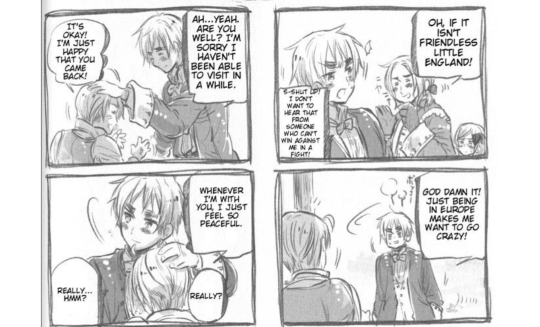
Things were different with America, who functioned as England’s
stress relief. England’s even noted to feel at peace when he’s with America.
This can be attributed to the fact that America’s youth and naivety
led to his unconditional acceptance and love for England. America was the one
person England could feel at home with. While the rest of the world hated
England, America didn’t.
That said, England became dependent on America emotionally. He
didn’t have to worry about being rejected by America…that is until America
began fighting for his independence.
To put it simply, America going against him broke England’s
heart. He felt like he could trust and rely on America to have his back, only to
be betrayed (in his POV) and isolated once more when other European nations sided
against him in America’s favor.
History repeats itself, and England found himself all alone
again.
While subtle, there are significant hints about just how deeply
the Revolution hurt him.
For one thing, it’s said that he’s suffered from 100 years
of heartbreak. Likewise, an even more telling emotional omen of the past is that
in one his character notes, three important pieces of information are given.
1) “His
temper was quite stormy during the decades after America’s independence.”
– Anger is a maladjustive way of
either expressing one’s need for something or acquiring it. In this case, it
could be a reaction to the loneliness he experiences after losing America.
2) “He’s quite bad at expressing
himself. He himself knows that people often misunderstand him, he uses this fact
for self-depreciating jokes.”
– This ties in with how easy it is to see him as an angry
person when he’s actually extremely sensitive.
Taking the latter two bits of information, you can see why Hima then
says this about England:
3) “He could
easily be the most pitiful one in this webcomic.”
In other words, England thinks lowly of himself, cares about
others’ opinions of him, poorly expresses his sadness by acting out in anger,
and yet doesn’t bother to fix these external misconceptions.
Like I said before, America was his best friend, and because
he can’t articulate his feelings well, England went from using America as a stress
ball to a punching bag (this term is used loosely).
For example, England is notorious for being a “scathing”
critic of America’s movies.
Nonetheless, what you’ll also notice is the subtle hints of America knowing that England cares about him.
Here, America –with a noticeably teasing look, as if he understands
more than what he voices– allows England to poke holes in his proposed world
defense plan.
Also pay attention to how England “commends” parts of
America’s plan.
Aside from these faults, the strengths in England’s
character prevail when they’re most needed. Even though any mention of America’s
dependence causes England to get sick, he visits America and celebrates the
occasion with him.
It causes him a lot of pain to do so, but he still commits
to it. Not only that, but he gives America the liberty bell on the 100th
anniversary of his independence, worries over and offers to repair the bell in
1958 despite the offer being turned down by American officials, and gives America
a new one another one hundred years later.
While America is amused by England’s evident embarrassment,
the next panel can easily be interpreted as him crying and laughing from
happiness.
Please note that the anime handles this scene quite differently, as it’s depicted more as in America laughs so hard that he cries.
I think it’s also important to end this by mentioning that
England was also America’s best friend. America is arguably just as lonely as
England.
When he was younger, America was scared to sleep alone. Regardless
if England always fell asleep before he did, America still needed him.
In “We’re Shipwrecked Too”, we get this awkward moment where
both of them consider sleeping closer to each other for warmth, but in the end
choose not to.
The tension here reveals that England isn’t the only one
having trouble working past the difficulties in their relationship.
Nevertheless, we also get moments where America reaches out
to England.
Ex: During a blizzard, he asks England to come and play
video games with him, but is turned down.
As seen in more modern strips, the two of them are slowly working
towards reconciliation and visit each other often. The perfect ideal would be
if they’re able to become best friends
again, not just in their hearts, but openly and expressively without any qualms
of what others might think.
How I imagine America’s cooking show would be like.
I don’t know why they cut this out of Buon San Valentino in
the anime, but I’ve always loved this scene.
Basically, America gets upset that England didn’t give him
any chocolates on Valentine’s Day.
When England finds America to give him some chocolate,
America obliviously tries to play it off, as if the whole matter hadn’t even
happened. The way America excessively stuffs down his chocolate is arguably a childish way of showing England that he’s not needed – [when he
actually is.]
Yeah, not buying it. America’s feelings were definitely hurt
here. Why else would he be “grumbling” about it?
I don’t know, we’re straying into speculative territory here. I like to work from the strips, and base my interpretation on the facts presented. Personally, I find it hard to believe that America wouldn’t know what a cold is, let alone being able to experience the symptoms and yet not link it to illness.
[Just a side note I forgot to mention before]:
In “In just 2 minutes you can grasp the exterior of the European economy,” we learn that the nations get sick as a result of recessions. It doesn’t say anything on whether or not they can get sick as a result of exposure to it.
However, I concur, as @guiltipanda pointed out, Romano contracted Chorea as a result of its prevalence within Southern Italy. But, my addition to that point would be that it has to be a significant political/societal problem as stated in the strip listed above. Remember that the nations have a stronger immune system than your average person.
In other words, the nations can contract illnesses from their people, it just has to be major.
[My speculation] While we haven’t seen it depicted where America directly views illness within his population, he would have had to.
1) Consider previous leaders who died of illness.
2) Consider how prevalent illness was without modern medicine + during times of war (especially in the trenches).
Likewise, although Canada barred America from seeing England when he acquired a cold after the Revolution, he was still aware of the existence and possibility of personification illness. He’s naïve and inexperienced, sure, but not to that degree. That’s why I would attribute it to both a consistency error and a logistical fallacy.
As for Hungary, unfortunately, I still have a ton of requests to get to beforehand! I’ve often see people claim that her love for yaoi is fanon. It’s…canon, not that it makes it anymore right. It’s not a mischaracterization, but is more of a miscalculation in how she’s depicted.
That’s why I mentioned the possibility of it being a consistency error in the post. Otherwise, it wouldn’t make sense given the lack of strength America has shown when he experiences economic depressions.
I.e. During the Great Depression, he’s visibly weaker, low in spirits, and is lacking in confidence to the point that he shivers in the face of the other nations’ anger. That’s not something you would typically see from him.
I’ve briefly talked about America’s naivety before, but
given how prevalent it is throughout the series, it deserves its own post.
For one thing, it’s important to define what I mean by
naivety. It’s not so much that America is gullible, as he’s more than capable
of reading the atmosphere, especially if it means getting what he wants.
Instead, this naivety has more to do with how inexperienced and childish
America can be, often without realizing it.
Likewise, I’ve also explained the role that America’s
isolation has played in this childishness. As a result of a lack of interaction
with other nations, America unintentionally comes off as egotistical. He grew
accustomed to only looking after himself, and this way of interacting with the
world stuck with him.
It’s hard for him to think about and put others first. Even
when he calls himself a hero and ‘saves’ others, it’s self-validating. Of
course, this doesn’t mean that he doesn’t have good intentions, because he
does. He’s a giant sweetheart, don’t get me wrong.
On the other hand, like an inexperienced child, America
lacks a balanced understanding between ability and expectancy. He often has
grand, unrealistic plans that involve him taking the lead in saving something
or someone.
That’s what this post will focus on; how, despite possessing
the ability to make calculated decisions, America still holds some pretty naïve
and unpragmatic beliefs on how life works.
All of this equates to the fact that he’s still relatively
childish.
For one thing, in WW2, he thought that a map of his country was a world map. This is possibly a play on the fact that children often think that the world revolves around them.
This childlike imagery appears again as America proposes
unrealistic world defense plans.
On another note, we also see that he’s not great at planning
for the future. Mass production led to inflation and plummets in stocks,
which ultimately resulted in the Great Depression.
However, during WW2, this mass production starts up again.
What’s interesting is that England remarks to himself that America might have
been traumatized during his childhood due to a lack of belongings and experienced poverty whilst
expanding settlements in his nation– it’s hinted that America overcompensates
for this by producing things in bulk.
Regardless of these economic downturns, America is revealed
to have never had a cold before WW2. Remember that nations acquire colds during
recessions. If this is the case, and it’s not just a consistency error, then
being spared from illness up to this point in time would have also influenced
his naive perception of the world.
Lastly, although possessing benign intentions to give
financial aid to smaller developing nations, America doesn’t seem to grasp at
the fact that loans are more economically harmful than good. Once again, this reveals how unrealistic he
is in being able to match his expectations with a likely outcome.
That said, it’s important to realize that America’s childish
naivety and unintentional egocentrism is only one side of his person. He’s
extremely intelligent and is crafty in getting what he wants.
Most of the time, however, he doesn’t have to use wit and instead
resorts to the easier route of relying on physical force. It’s for the latter
reason that I believe his character is often misinterpreted.
America: I’m going to make a historical documentary about my independence!




 Ellawritesficssometimes