image
image

The following post aims
to give a concise breakdown of America and Lithuania’s relationship. Since the
material can be used for both shipping and friendship purposes, I’ve tagged
things accordingly. In analyzing their relationship, I’ve sorted it into three
main themes. Let’s go over them.

Structure:

An overarching theme of
their relationship is structure and the previous lack thereof. Lithuania moved
in with America post–WW1 for employment purposes as his country was
experiencing an economic recession.

Source: Hetarchive, Lithuania’s Outsource pt. 1

image
image

Nonetheless, it’s
important to understand where the two were coming from emotionally prior to the
move.

America was living on
his own, having just recently come out of isolation. He still wasn’t on good
terms with England and hadn’t coped with the feelings of grief and bitterness
that accompanied his declaration of independence.

Point is, America was
lonely.

Ex: During an overseas visit
to Japan for trading purposes, America attempts to befriend a whale. He also
declines England’s offer—who was able to read into America’s covert
loneliness—of friendship. Note that this takes place a little bit before, during the Meiji era of Japan.

Source: Hetarchive, Black Ships Have Come.

image
image
image

Lithuania had it a lot tougher. His empire with Poland had been annexed, culminating in him being
forcefully torn from Poland by Russia. In Russia’s home, Lithuania was likewise
forced into servitude. We also learn that in between the world wars, where he
had briefly gained independence from Russia, Lithuania had accumulated several
scars on his back from the abuse he underwent at the hands of the former.

Sources: Hetarchive, Hetare 4: Pact of Steel + Hetarchive, While You Were Gone.

image
image
image

In light of the turmoil America and Lithuania both experienced, the personal and positive experience of living with someone gave structure to lives that had for too long revolved around the chaos of
politics.

This brings me to my
next theme.

Companionship:

The two became best
friends when they lived with each other. Both experienced the loss of a partner
(America, England, and Lithuania, Poland), so to find a friend in these times
was crucial for them in establishing a sense of normalcy in their lives.

For once, work didn’t
take priority and they were able to relax, enjoy each other’s presence, and essentially become best friends.

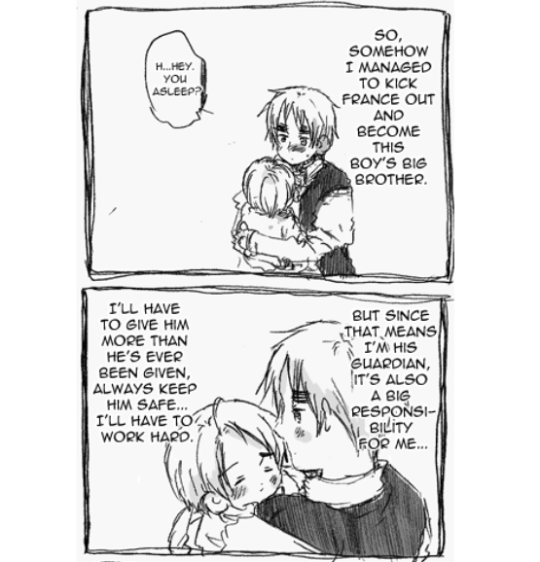
Lithuania cooked for
America and basically organized his whole life as he took up a clerical/ assistant position.

Source: Hetarchive, Lithuania’s Out-sourcing pt 1. 

image

Other peak examples of
their friendship would include:

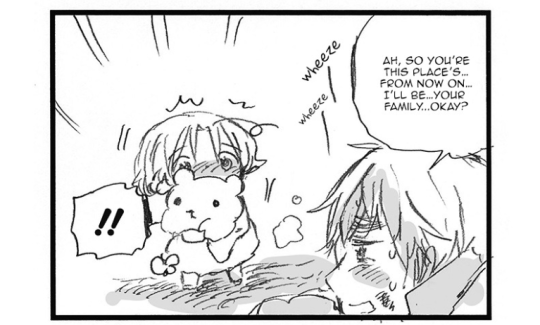
America’s pets taking a
liking to Lithuania and competing for his attention.

image

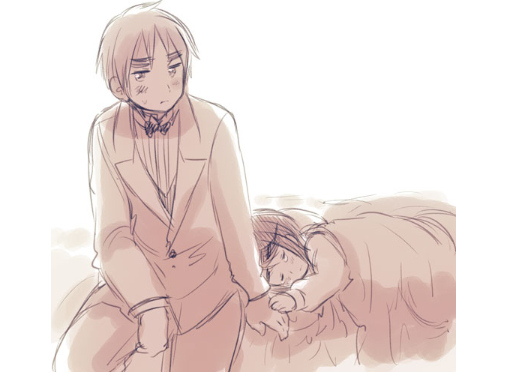
Lithuania sleeping with
America, since the latter was too scared to sleep alone having just watched a
horror film.

image

Source: Ibid + Hetarchive, Lithuania’s Out-sourcing pt 2.

Coping & Respite:

Lastly, the two’s
friendship was very much a healing experience.

America’s home provided
Lithuania with the sanctity of a healthy, stable, and safe environment—the polar
opposite of Russia’s home. He also felt comfortable enough to confide in America about his separation from Poland.

Source: Hetarchive, Lithuania’s out-sourcing pt. 1 + pt. 2.

image
image
image

Similarly, Lithuania
helped America cope with his separation from England.

Ex: When Lithuania first
moves in with America, we learn that America drinks coffee in spite of his
grudge towards England.

Source: Hetarchive, Lithuania’s out-sourcing pt. 1.

image

This grudge is touched
on again in the Cleaning out the Storage strip, where we learn that America had
shoved away items that reminded him of England (e.g., toy soldiers, a gun from
the revolution, and a suit that England gave him).

The strip involves
America cleaning out the closet—a metaphor for airing out his past and making
peace with it—and reliving his life with England as his parent figure.

Source: Hetarchive, Cleaning out the Storage.

image
image
image

After he’s finished
cleaning, Lithuania is perceptive enough to offer America coffee and the two serenely
enjoy the drink in America’s backyard. The nature is particularly important
because it shows how grounded and calm America has become as he decides to open
up to Lithuania.

The fact that America
drinks coffee too is symbolic in itself, as it shows that while his grudge and
spite are still present, there’s the hope and prospect that things will get
better as he matures. Essentially, Lithuania has become the familiar shoulder
for America to lean on.

image
image
image

In sum, while short-lived
and ending on the sad note where America became too poor to be able to host Lithuania
(following the Great Depression), the two shared a relationship that was full
of genuinity and sentiment.

The sadness on America’s
face as Lithuania is torn away from him says it all; it’s an arc in the manga
that I’ll always appreciate and have a soft spot for.  

Source: Hetarchive, Lithuania’s Out-sourcing pt. 3. 

image
image

Q & A

image

Ok, so one thing that I always wondered is
where do countries fight during a war? Like, what branch of the military? On
what front? For how long? Or do some leaders not let their countries fight? I
am confizzled, Queen Ella

(I’m not a queen ^^)

There is no specific branch that they fight
for.

Ex: They’ve fought in the trenches, the sea, and the air. 

Source: Volume 3,  A Battlefield’s Kickoff + Hetarchive, Hetare 3: Nonagression pact + Hetarchive, Germany & Cohabitation

image
image
image

Do you think america would participate in the
hook-up culture of today (especially with the incredible ease of todays tech)
or do you think he would steer clear of it? I can’t figure out what he would
do. On one hand its very common in american teen culture but on the other hand
I think either his experience as an immortal being and/or his eating disorder
may impact how he engages in that arena. ((I’m not making a remark on all
people with eating disorders – just Al himself)) – thanks!

Mmmm. I’m not comfortable making speculations
on that since there isn’t much canon information to work from.

I do know that the nations refrain from spending
too much time with humans. Time is distorted around the nations (regarding
their aging), so humans who are around the nations a lot will have their
perception of time become so warped that they’ll go insane.

Source: Hetarchive (Bamboo Thicket, eng trans., sep 18th, 2013). 

It’s also possible for nations to have friends.

Source: Hetarchive, Little Italy Back in the Days.

image

Make of it what you will!


Curious for your thoughts on things- not to be
crude, but do nations ever hook up? The strip “Frequency” having to
do with Greece and Japan made me wonder about if they actually are able to or
not, and if they do, what are the implications behind it?

Other than the Japan and Greece scene you
mentioned, there isn’t any other mention of nations hooking up. But, there’s a
whole arc in volume 1 discussing the nations’ sexual drives.

Sources: Hetarchive, Lazy Comic District + Volume 1. 

image

image

Lithuania is a great guy and deserves better
thing to happen to him : Facts

No objections.

Source: Hetarchive, Cleaning out the Storage.

image

I’ve realized some more parallels between
Chibitalia/HRE and Italy/Germany.Italy feared HRE as a child but would also
climb into bed with him and the whole river bath situation.He also warmed up
enough to him to love him back-one can only assume that thanks to BSV and the
fact that they kissed goodbye.Italy does the same stuff to Germany,sleeping in
the same bed as him and bathing with him along with other similar stuff.History
likes to repeat itself,huh?

Sharp eye! I’ve done posts mentioning all of those!

[x] [x] [x] [x] [x] [x] [x]

Q & A

image

Do you think that their canon heights are
meaningful in anyway at all (besides being shorter/younger to represent how
developed they are)? They seem inconsistent throughout the series when compared
to each other *during “adulthood”

I’ve done a few posts on
this. It first has to do with economic and political developments. Only then is
the average demographic height taken into consideration [x] [x]. 


How do you think
the countries view humans? as temporary pawns? good? bad? indifferent?

It’s definitely not
as radical and dramatic as you’re framing it.

These posts discuss what you’re talking about. To boil
it down, the nations don’t view humans as pawns but rather they serve their
bosses to the very letter. For other humans, they tend to keep their distance.
When a human spends too much time around a nation, their perception of time
gets so warped that they become insane. I also want to point out that the nations are
very friendly with humans. It’s their people, after all [x] [x] [x]

image

Last year, my
history teacher mentioned something about a theory that America gets its
greatness from its German roots and recently I realized that America embodies a
lot of the traits an Anglo-Saxon warrior is supposed to have in order to become
famous and, therefore, immoral. I’m sure this is just some stupid coincidence
but I was wondering what you think of it

I’m living for the enthusiasm but I think you’re
overthinking it. The stereotype model is based on sociological perceptions. In
other words, America embodies the generalization of what the world perceives Americans
to be. The stereotypical American is the blond-haired blue-eyed golden boy
whose prevailing belief in justice makes them the ‘super-hero’ of the world. Most people wouldn’t know about the Anglo-Saxon warrior.

Side note: I shouldn’t have to mention this, but
stereotypes are not the Truth (capital T) but a truth (a different construction
of reality).

Source: Hetascanlations, World Stars Chapter 23.

image

A lot of people seem to think Germany has
aspergers or some form of autism, any thoughts on that?

Personally, I don’t
think he has autism. My biases from therapeutic training sees someone who has repressed
certain emotions/ memories and is socially inept as a result of his chaotic
childhood. Post here [x]. 

However, that does not
mean you can’t interpret him that way! You can use a lot of Germany’s behaviours
and other idiosyncrasies to make a convincing characterization as someone who’s a high-functioning autistic.


If Hima is on a
hiatus, he might be going somewhere too, I guess. Does he have an active blog
now? I wonder if he uploads some pics. I noticed some pics on his
not-active-anymore blog but those were veeery old. What do you think?

Himaruya does have a
history of travelling during breaks. He doesn’t have an active blog, but
Hetarchive posts English translations of his WordPress blog. The posts aren’t old, though???

image
image

The purpose of this post is to delineate the fact that
nations that have cultural influences on each other are not biologically
related. While the influencee may adopt traits from the influencer in some
cases, it doesn’t always constitute a biological relation. What’s even more
confusing is that there are specific adopted traits that the nations use to
mark a biological relation.

I know this sounds obscure, but it’ll make sense when I go
through some examples.

Romania and Bulgaria
vs Romano and Veneziano:

A gag with Romania in the series is that he claims that he’s
a descendant of Rome, and, therefore, an Italy brother.

However, even though Rome did, in fact, instill significant
cultural influence in Romania, Romano is quick to reject this claim. He
identifies the presence of a curl as proof of biological lineage from Rome.
Remember that Rome is said to have had many grandchildren and adopted
grandchildren.

Source: Hetascanlations, World Stars Chapter 163 + Hetarchive (Bamboo Thicket, eng trans., October 30th, 2014).

image
image

Later, we see the same rejection occur with Bulgaria, who
has Roman ruins.

Source: Hetarchive (Bamboo Thicket, eng trans., Oct 22nd, 2014).

image
image

England, America,
Finland, and France: (+ more)

As I’ve stated before, England and America are not
biologically related. England is stated to be the fourth and youngest sibling
in his family, consisting of Wales, Northern Ireland, and Scotland.

Source: Hetarchive (Bamboo Thicket, eng trans., Aug 4th 2010).

In the Battle for America, it’s explicitly stated that
England becomes America’s brother. We also learn that because America was a
“melting pot” of several cultures at the time, he inherited certain physical
traits from his colonizers.

Source: Hetarchive, The Battle of America.

image

For example, in the trio’s feud to make America their little
brother, Finland notices that America looks like him.

image
image

The distinction between cultural influence and blood
relation is necessary otherwise it would lead to a slippery slope where all
nations are related to each other. So, unless explicitly confirmed by Himaruya,
nations aren’t related to each other regardless of their histories. Arbitrary
as the biological relations may be, you work with what’s given to you.

Lastly, I’ve seen people comment that there’s a confirmed
biological relation between America and Finland. That’s not the case. Finland says that America has some genes from his people. Remember that America emerged as a personification representing several cultures. The genes are the traits, but because America has so many cultural influences, they don’t consider each other to be blood-related.

The fact that America didn’t identify with Finland as a
family member in the first place is telling of this cultural influence, as well
as the fact that Finland offers to become a father figure for America, who in
the context of the strip had been feeling jealous of kids who get presents from their fathers on Christmas.

Source: Hetarchive, Christmas 2010 Event.

image

France and Canada:

Similar to the situation with England and America, Canada
inherits France’s hair.

Source: Hetascanlations, World Stars Chapter 192.  

image

France, America, Canada, and Seychelles vs England, Hong
Kong, India, Australia, New Zealand, Hutt River, Sealand, and Wy:

We learn that France’s cultural influence is a dominant trait
that prevents America, Canada, and Seychelles from inheriting England’s bushy
brows. Although, interestingly enough, Seychelles had initially been designed
to have one thick eyebrow and one bushy one to represent English and French influence.

Source: Hetarchive, Seychelles profile.

image

Meanwhile, without French influence, Hong Kong, Australia,
New Zealand, Hutt River, Sealand, & Wy inherited the bushy brows.

Source: Hetarchive (Bamboo Thicket, eng trans.,Nov 12th 2013) + Hetascanlations, World Stars Chapter 269.

image
image

Of most importance and what I can’t stress enough is the
example of Hong Kong. It proves, with the most clarity, that cultural influence
does not have a causal relationship with biological relation.

After becoming English territory, Hong Kong’s eyebrows grow
bushy from the resulting English influence on his culture.

Source: Volume 6, A wise man has no specialty.

image
image

It’s said that England put a curse on him to have his eyebrows become so thick, but you also have to remember that England’s eyebrows themselves are cursed. The implications would be that his influence caused the curse to pass on.

Source: Volume 5, Special Booklet.

image

Point is, as far as Himaruya’s concerned with his
characterizations:

Cultural influence ≠ biological relation.

image