
Q & A

image

Do you have a theory on Germania? It seems weird
that Rome is still his friend in heaven if he did kill him. Also Himaruya wrote
something along the lines “it’s ‘believed’ he killed Rome” so… he
didn’t really kill him?? Also he says they’re friends, but later says they hate
each other, with Persia and Germania being all buddy-buddy taunting Rome. And
why is he Prussia and Germany’s dad when Rome is a grandfather?

–  Yes, it is weird. You are right that the matter
of whether Germania really did deliver a fatal blow to Rome is left open-ended.
It’s neither a yes or a no.

– That’s also true. His character notes do tend to
contradict each other. I covered this more in detail in my characterization
post of Rome, although that was written after you sent in this ask 😊 [x]. 

– That last question isn’t necessarily true. The
relations between them is incredibly wonky. Germania’s referred to as both the
father and grandfather of Germany in different pieces of canon material. Search Hetarchive’s profile of Germania. 

Image: Grandpa Rome’s Visit Home, Hetarchive. 

image

I genuinely learn so much more about the manga
after you analyze it and uncover those hidden messages that have been embedded
into Hetalia ❤ Any chance you know a little something about India and/or
Thailand? Thanks anyway!

I’m glad! 

I do know some things and anyone can too if they search the relevant character tags on the English translation
of Bamboo Thicket, provided by Hetarchive! (ah geez, I sound like a
telemarketer…)

Not all information can be found on the blog, though! 

Just for fun, here’s one
fact each. 

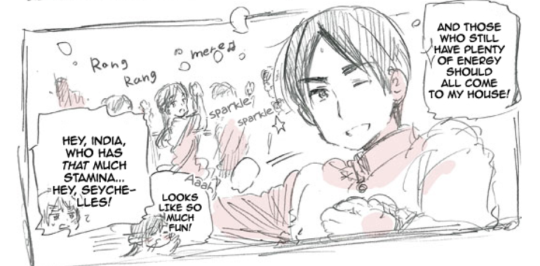
India: He has
considerable stamina.

Source: Halloween 2011 Event, Hetarchive. 
image

Thailand: He’s somewhere around 22
years old according to Himaruya.

Source: Hetarchive (Bamboo Thicket, eng trans., Nov 26th, 2010). 


I got a question about the U.S. states. I
know they are not officially canon, that’s not what I wanted to ask. In the
sketch Hima showed what they’d be like, am I mistaken or did he confirm that
they would not be America’s children but his relatives, like Germany’s states?
And that they were all male (brothers I think the state shown said)? I may be
wrong though, it’s been awhile since I seen it, but my friend got into it with
me over whether it disproved the whole his children thing.

Note: Originally in my
State-talia post, I accidentally cropped and posted an image from the question
below in the same Q & A where Himaruya created a hypothetical dialogue with
the states. Nothing about the information I gave or said was incorrect (again,
total accident and you can verify in the initial reblogs to see that I haven’t
changed what I said), but the image was misleading (it had to do with computer
programs/software being personified). Still not sure how that managed to slip
past me
[x]

Anyways, no. They’re not personified. We got a dialogue of
what it would be like if they existed. There is no confirmation of their
relation. All we know hypothetically is that while some possess “mixed feelings,” they still “love America very much.”

Source: Hetarchive (Bamboo Thicket, eng trans., Jan 10, 2015). 

image

image

Tbh, I don’t even know
where to start with this lol. This blog is pretty much dedicated to proving
that whole assertion, so I would recommend checking out my post directory 🙂


People have yelled at me before for me asking
for them only to give me proof for things, since i dont believe just from
someones word. No one ever wants to give proof and gets angry from me not
wanting to believe them until I get proof. So I’ll ask you, does Belgium have a
cannon nyo? And does France have a canon mother (Gaul i think it was)?

I’d suggest removing
those people from your life. If they can’t respect you, then they’re not worth
your time.

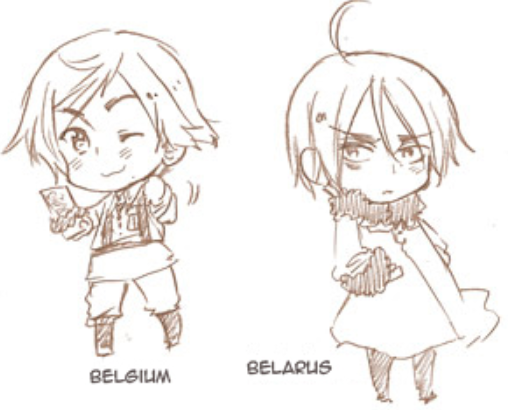
Belgium has a canon nyo. Just remember that the nyos that have made appearances in the manga don’t exist
in the same world. There is no canon Gaul. While it’s still not canon, Himaruya
has pondered over the idea of the Kingdom of the Franks being a parental figure to
France.

Source: Hetarchive (Bamboo Thicket, eng trans., April 1rst, 2011 + May 6th, 2008). 
image
image
image

In this post, I set out to prove against claims that Hetalia’s narrative promotes division and necessitates hatred among the
characters. Quite the contrast, Himaruya’s writings have shown that while
history may be rough, filled with grudges and periods of hostility, friendship
and camaraderie will always prevail. It’s for this reason that characters who may
experience a sudden, turbulent, heated, and disastrous pit in their
relationship will eventually gravitate toward the other and find it in
themselves to reconcile over time.

It’s much more complicated than hatred. Grudges exist but
they aren’t permanent. Political relations add more complexity to how the
nations negotiate their personal lives, which, in turn, adds more nuances to
their relationship. Some common themes, or rather stages, depicting the
aftermath of these fall outs include: resentment, external hostility to hide
feelings of nostalgia and longing, reminiscence, and reconciliation.

Point is, because history is a central tenet in depicting
the nation’s lives over time, their relationships are made to be dynamic. While
I have touched on this before, I would like to go into more depth with two specific
relationships. That is, China and Japan, and England and America.

That said, let’s tie this back to the strips.

China and Japan:

China raised Japan and considered him to be his younger
brother, albeit Japan’s denial of this. The two nonetheless shared a very close and
emotionally intimate relationship. 

image
image

Even in the midst of rising political
tensions between their nations and other conflicts, it didn’t compromise their
personal relationship. 

image

The breaking point in their relationship was Japan’s
betrayal of China. Japan enters an unsuspecting China’s home, asking for
forgiveness before stabbing the latter in the back.

image

As I’ve mentioned in the past, the Japan in this panel seems
to be forcefully dissociating himself from the situation, divorcing his
emotions with a blank face to complete the task. 

image

I say this because later, we
see China crying about how war has changed Japan. At the time, Japan wanted to become stronger. What’s important to note is that the strip portrays Japan as the antagonist, highlighting the consequences of greed and an imperialist mentality. 

image

We then learn that China developed a strong grudge against Japan for this betrayal.

image

However, it doesn’t end there. While we don’t get much insight
or interactions between them in the interim, they are able to reconcile.
China’s character song “Aiyaa four thousand years” gives us the best
perspective on China’s feelings over the matter, as it nostalgically covers his
early relationship with Japan and ends on a note of forgiveness with his wish
to be able to gaze at the moon with Japan again.

Source: Hetarchive, The Story about the Early Days of China and Japan

Skip forward and this reconciliation becomes apparent as
they openly interact with each other with no hostility. While they aren’t as
close as they used to be, notable steps have been taken to improve their
relationship [x]. 

image

England and America:

Just like the above example, England and America go through
several bumps in their relationship. However, what defines them best is that
they swing back and forth in a pendulum of hostility, bickering, longing, and a
need for the other. In the present, the bickering is still present, but it’s
playful in nature rather than hiding a latent grudge from the past.

Personal vs Political

Ex: After the Revolution, the two had tense relations. This
doesn’t stop America from becoming distraught after hearing that England fell
ill as a result of the conflict [x]

image

You’re not my friend, but I still need you

Ex: America refuses England’s offer to be friends, yet in a
volume 2 character note we know that America wasn’t well liked following WW2
and that only Japan and England were considered to be his real friends.

Source: Hetarchive, Black Ships Have Sails + Volume 2

image
image
image
image

Longing vs Refusal to Acknowledge

Ex: America gets
nostalgic when he cleans his storage closet and recovers items from his childhood
with England.

Source: Hetarchive, Cleaning Out the Storage.

image

Ex: England
dreams of his time spent with young America and sleep talks, making fond
remarks.

Meanwhile, this is the same person who would go out of his
way to criticize and nitpick at every little thing America did. While England can
be incredibly rude, it’s not for no reason. There’s a deeper meaning to it;
it’s a symptom of the heartbreak he experienced and his poor way of coping with
it.

Source: Volume 3, England Dreaming of Long Days Passed.

image

Ex: Bedridden and
gravely ill, England’s last wish is to have America say “England” like he used to. 

Source: Comic Diary 3, Hetarchive.

image

Reconciliation

As mentioned, their relationship in the present has moved
more to that of teasing.

Ex: America likes to pull pranks on England [x].

image
image

Ex: They regularly visit each other [x]. 

All in all, I often use these two relationships as examples to
illustrate how time makes relationships in the series dynamic. They aren’t
static in the sense that the past defines their present experience. Without a
doubt, the past does have an impact, but the fact that they’re immortal has to be
factored in if we’re to analyze how they are granted more opportunities to
overcome their grudges.

image

The post you referenced [x].

Thank you and sure thing!

America:

When he occupies Rome during WW2, he treats the Italy brothers as
friends rather than enemies [x]

image
image

Italy:

He makes temporary peace with France and asks not to fight
when they get shipwrecked during WW2.

Source: Volume 3, United States of Hetalia 2

image

He calls upon Santa (Finland) so all parties could stop
fighting and enjoy Christmas.

Source: Volume 1, 🙂 in the World.

image

He opts to reside with Germany as a [euphemistic-style] POW. When
asked why he doesn’t try to escape, he explains that he would prefer not to
fight.

Source: Volume 1, Axis Powers.

image

He doesn’t hold grudges against anyone regardless of
political conflicts.

Source: Volume 6. 

image

England:

He makes a temporary truce with Germany on Christmas (WW2).The two play soccer together. 

Source: Volume 3, A Battlefield’s Kickoff. 

image
image
image
image

As fans have pointed out in the past, many of the nations in
the series are not psychologically healthy. However, if I’m to use R.D. Laing’s
criteria of what differentiates a psychologically healthy person from someone
who’s not, three nations in particular stand out: America, England, and
Germany.

Psychological
Embodiment vs Disembodiment:

An embodied person is psychologically healthy. The person
experiences the world as if they’re “biologically alive” and develop a “sense
of being” in which they are acutely aware of their flesh, blood, and bones–
their body. Likewise, they understand themselves to be both a subject and an
object. In other words, their self and their body are one as they engage with the
outside world.

In a healthy
individual: (self/body) ↔ other

image

On the other end of the spectrum are those who are
consciously unembodied. These people experience a disconnect and divorce
themselves from their body. The body is felt like an object rather than part of
themselves and does not constitute the core of their being. This leads to
ontological insecurity. Essentially, they suffer from a weak, fragmented, and
unconsolidated sense of self.

The unembodied state:
Self ↔ (body-other)

image

There are three modes of ontological insecurity that an
unembodied person may experience but for the purposes of this post, I only need
to talk about one.

Implosion occurs when an unembodied person feels like a vacuum
and possesses an empty, unfulfilled sense of self. The external world is
overwhelming and crushes this empty identity. The individual then compensates
by attempting to fill this emptiness, albeit fearing what they could possibly be
filled with.

Some common examples of this would include the stress of
university. Unembodied individuals experience erasure under the pressure to
conform to uniform codes (standardized testing) and feel unimportant and insignificant
when they underperform. To deal with this stress, they turn to things like
fanfiction or Netflix to help fill the void of their disappointment and unmet
expectations.

That said, let’s tie this back to the strips.

America:

America’s fragmented sense of self lies in his inaccurate and
dichotomized perception of the world: everyone is either a hero or a bad guy,
and there are no grey areas in between [x] [x].

image
image

Ex: He tends to
include these clichés in the movies he makes [x]. 

image

While I may be reading into this too much, it’s still
interesting to look at it from the perspective that this is a coping mechanism
of his. America took on a lot of responsibility post–WW2 and became a
superpower. To deal with the stress, he adopted a hero persona to help him
forget about any misgivings or failures that would compromise this reputation.

I say this because even though America claims to be a hero, it’s
more of a persona than it is his true sense of self. I say this because America’s
actually quite the fraidy cat [x]. 

image
image

The hero persona helped fill in the gaps of any
grey areas that may have called the legitimacy of his actions into question. It
would have also consoled him in the times where he felt fear during war but
didn’t want to express it.

Overeating is also widely known as a stress-reduction
technique, something that America is notorious for [x]. 

image

Another instance of implosion would include America’s
tendency to overproduce. I’ve speculated before that this could be a result of
not only the poverty he experienced when he was younger but also as an attempt
to reduce any feelings of loneliness [x]. Longer post on that here [x]

image
image

England:

England’s experience of implosion falls with him turning to
the supernatural to avoid feeling lonely. He’s experienced chronic loneliness over
the course of the series. Some more notable mentions would include the American
Revolution and the Splendid Isolation strips [x].

After the Revolution, his relationship with America suffered
tremendously. Despite offering to become his friend in one strip [x], it took them
a while before they reconciled their differences. Although, it’s important to note that America secretly considered
England to be his friend, as mentioned in a Volume 2 character note.

Ex: During WW2, England’s still spotted talking to his fairy
friends, much to America’s confusion.

image

In modern times, we still see England favouring fantasy and
the supernatural over the real world [x]

image

Germany:

Germany experiences two forms of detachment.

The first one has to do with how he experiences himself as a
nation. As a “strange being” [x] that it is supernatural and not tangibly
explicable himself, I find it odd that he’s so transfixed on empiricism and
scientific data and is quick to dismiss anything to do with the supernatural [x]. 

image
image

The second form has more to do with how he experiences
emotions and establishes relationships with others. More detailed post here
[x].

The basic gist is that Germany treats his interactions with
others objectively [x], following manuals and guides instead of personally
[subjectively] forming emotional connections. He contrives his body as a
machine that can routinely follow social codes and, therefore, hinders his
experience in forming a connection with another person..

image
image