Random cosplayer
here- could you do a post on demon England sometime maybe, if it isn’t too much
trouble? I’m thinking of cosplaying him in the future and I know horridly
little about how much he was in canon and how he was portrayed in canon. You’re
pretty much the expert on this sort of thing and I’ve found shockingly little
official stuff online. Thank you so much for all of the work you do for the
fandom, it’s absolutely excellent! 😀 Keep up the good work and best of luck to
you!
Hello, and thank you!
I’m not sure what you mean by demon England… are
you perhaps confusing that with the Brittania Angel trope [x] ? Or is it the Halloween 2010 costumes you’re talking about? Even then, it was Prussia who was the demon. England looks more to be a vampire. Not all of the costumes are specified, though [x].
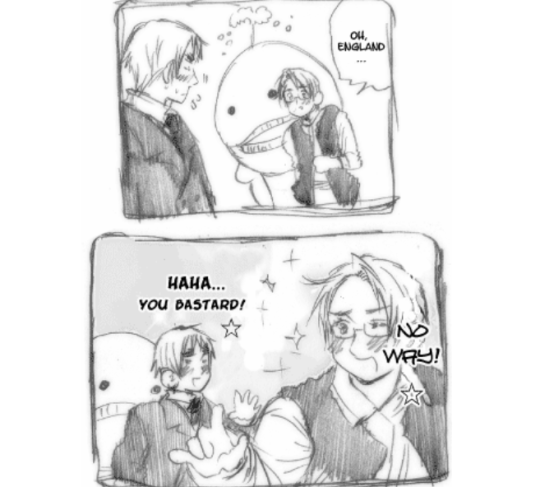
Do you think America is somewhat bitter at
Britain because he didn’t tell him about how humans aged and died or took
possibly 50 or so years to get a flower for him to give his friend? I know it’s
odd to ask but I just watched the davie episode and after watching it, certain
scenes like America running away and laughing after Britain says they could be
friends has a different feeling now.
It’s never really talked about nor are any links made. As
you figured, America must have learned for himself the hard way as he matured.
The grudge that prompted America’s reaction in the latter
strip you mentioned was mainly from the Revolution/ England meddling in his Civil
War [x] [x][x].
Ella, what are your thoughts on fans who create
OCs for countries that haven’t appeared in Hetalia?
As long as they’re respectful, who’s to stop
them? They’re exercising their creativity and tapping into their imagination.
Likewise, it would be hypocritical to criticize
someone else for taking the initiative to create their interpretation of a
country when that’s literally what Himaruya did.
What’s the source for America being modelled on
a Canadian?
Sorry about that,
thought I included it in the OP. It also has the note about Himaruya’s
American teacher not caring for geography all that much [x].
Out of all the countries who do you think is
the most lonely?
A lot of them are
lonely!
However, I would say
Russia is the most isolated since he doesn’t really have any solid friendships [x].
Idk if this is of any use to your DenNor
analysis but there’s that scene in a Hetaween event where Norway demands that
Denmark asks if he’s lonely after Den has already asked Sweden and Finland.
Denmark tells him that they’re always around each other so he’d know if he’s
lonely and Norway doesn’t seem completely okay with that answer…
Yes, but Norway’s just annoyed with his response [x].
I summarize
relationships for these posts, so I can’t use every example 🙂
I think all nations are
just inherently smarter than the average human, regardless of their populations’
intelligence levels. Yes, they do act foolish in the manga, but they’re just
comic gags/ stereotypes. If you think about it, each nation has gone
through several political, economic, and social revolutions. Centuries and millennias
of existence would inevitably lead to increased intelligence.
Italy never lost his
smarts either.
Ex: He participated in
the Second Industrial Revolution and invented cars [x].
It’s really random and
there’s not much logic to it. I’ll get into some patterns that I’ve found
in a more detailed post, but the basic rule is that regardless of history, nations
aren’t related to each other unless explicitly stated by Himaruya.
During his childhood, America experienced several periods of
loss and loneliness that ultimately impacted his personality. In turn, he developed
a chronic fear of being alone.
The most obvious event that comes to mind is the times where he was still under England’s care. England would leave for long periods of time
without visiting. America was terrified at the prospect of this and would beg
England not to leave.
Hints of the resulting loneliness he experienced during
these gaps in visits become obvious as young America picnics alone and achieves
some condolence by convincing himself that he’s not lonely [x].
While his
experiences in the Wild West may have caused him to harden and evolve from his
previous crybaby personality [x], his fear of being alone remained. I would even
argue against this piece of canon material and say that America’s still a
crybaby as an adult (other material contradicts it).
Another event that I would say had an impressionable impact
on America is the loss that he experienced with Davie. While he may have been
too young to comprehend immortality and mortal death, America still experienced
the loss of a close friend. He had gotten attached to someone only for them to
leave [x].
What’s interesting is that even after America gained his
independence and pushed England out of his political affairs, America was
unable to reconcile the idea of having a personal life without England. It’s
for this reason that I believe America goes to Canada’s house in desperation,
asking that he be able to see England who had fallen ill from the conflict [x].
On the other hand, America also detaches himself from the
pain of the loss that he experienced from the Revolution by storing away
objects that reminded him of his childhood with England (i.e., the toy soldier, suit, and gun) [x].
As mentioned, America’s fear of being alone has remained in adulthood:
He’s jealous of kids who get presents from their fathers on
Christmas [x].
He has a notable habit of asking other nations to sleep with
him after he’s watched/ read scary horror material [x] [x].
He clung to Japan during a time where all other nations
weren’t favourable of him [x].
The last is a speculative conclusion that hasn’t been
confirmed. England ties America’s tendency to mass produce to the fact that
he possessed very little belongings when building new settlements in his
country [x]. What I believe has merit is the argument that America turned to
stuff to help cope with his loneliness.
Me: *stays up for 18 hours at a time in the summer*
England’s about to faint and America says that he’ll do
anything. England asks that America say “England” like he used to when he was a
child. America refuses and lets England faint. Cut to England being fine several
days later.
Version 2: Volume 1
England’s about to die again. America uses
reverse-psychology with death and asks the latter out for
drinks to celebrate. Cut to England waking up.
I wouldn’t say that it’s death but more so loss in general. I think the Davie incident contributed to America’s fear of being alone. In my opinion, America being envious of children who receive presents from their fathers on Christmas speaks more to this desire not to be lonely.
Post coming up tonight!
What this post intends to explore is how Canada’s invisibility
serves as a literary device in fleshing out his character development. While
the approach to this is cruder in older characterizations, it still remains
that Canada’s struggle to establish his independence and form a unique and
memorable identity is integral to his character.
As such, rather than other nations deliberately ignoring
him, his invisibility serves as a reminder of how he struggled to find a place
on the world stage. His entire character arc in World Stars is predicated on
him detaching himself from England’s and America’s shadows and becoming his own
person. Longer posts on that here [x][x].
Invisibility on the
World Stage:
One misconception that I’ve seen perpetuated is that
England, France, and America intentionally ignore Canada, which makes them
terrible people. This simply isn’t true. The fact that they forget Canada is
completely unintentional. It’s supposed to represent how Canada as a nation
wasn’t very well-known around the world; there wasn’t something distinctly
unique to his identity that would make him stand out.
In older strips, the approach to this is much cruder. Some
examples would include Canada not being accounted for and being sat on during a
G8 meeting [x]. Interestingly, the one country who does recognize him, France, still admits that Canada doesn’t have anything remarkable about him. I did say cruder, didn’t I?
Likewise, after mistaking Canada for America, England
apologizes to Canada. He didn’t intentionally forget Canada. Again, the purpose
of this gag was to illustrate his lacking world identity and how he went from
lurking in England’s shadows to being overshadowed by America’s.
A common rebuttal to this latter point would be asking why
France and England were able to see Canada when he was younger.
The answer to this is simple. France and England had a
vested interest in the fur trade in North America, which is what made Canada a
financial mine for settlers. He was well-known to the world at the time. What’s
sad is that Canada was able to recognize the superficial reasons he was valued
for at a young age.
Ex: He mistakenly believes that England is looking at him
not as a source of resources but as an actual person of value. In reality,
England was analyzing Canada’s hair, which he believes was inherited from
France [x].
Nonetheless, the two do become family and treat each other
as such. However, the irony is that while England cares very deeply for both
America and Canada, he devoted most of his attention to America due to political
struggles (e.g., the American Revolution and the Civil War) [x].
Personal Relationships:
What I haven’t seen someone point out is that Canada’s
invisibility is limited to world meetings and his status as a personification
and not as a person. By this, I mean that when Canada represents his nation, he’s
forgotten, but in personal circumstances and interactions he’s remembered. It’s
for this reason I believe that the narrative goes from G8 countries forgetting
about Canada—which includes America—to America playing ball with Canada in the same strip.
On the other hand, others have argued that America throwing
the baseball at Canada is intentionally rude and abusive. It isn’t. America
throwing the ball too fast for Canada to keep up with served as a crude
political metaphor in signifying how Canada respectively struggled to keep up with America’s rapid rate of growth.
In world stars, this is most prominent as Canada gets
frustrated with America’s tendency to push and expect too much of him. The
problem is that Canada’s lack of identity and affluence is what allowed him to be
pushed around. Point is, later versions of the manga have used less crude methods
to portray this identity complex.
This doesn’t mean that Canada didn’t fight against this, though.
Ex: He reprimands America for overlooking him. The context
is that when America found out that England had fallen ill after the
Revolution, he goes to Canada’s house without thinking to ask Canada how
he was faring too [x].
On the other hand, this doesn’t mean that America didn’t
value Canada as a person either. The struggle between the two emphasized the
difficulty in balancing politics/self-interest and personal relations.
Ex: America’s jealous of Canada for possessing a personality
that makes it easy for him to get along with other nations [x].
Lastly, it’s important to call attention to the fact that
England valued Canada and was grateful when the latter both stepped up to his
defense and later tended to him at his bedside [x][x].
All in all, it would be unfair and one-sided to claim that
Canada is deliberately ignored by those close to them. It’s far more
complicated than that and instead detracts from his character development.
Canada: You can’t just finger gun your problems away.
America: Watch me.
“America, sir! What have you done in preparation for the upcoming midterm elections?”




 Ellawritesficssometimes
![x]](http://www.hetarchive.net/img/bamboothicket/halohalo2.jpg)
![[x]](https://i.imgur.com/f03SF.jpg)