Constantly forgiving a toxic person in your life like



Their perception of time is different, which makes it
difficult for them to establish close relationships with their citizens.
Ex: Canada spent
an entire weekend staring at Kumajiro’s eyelashes without realizing it [x].

Ex: Young America
befriends Davie, and the two spend their time searching for a blue flower. America
leaves and goes, finding Davie as a young adult and again as an old man with grandchildren.
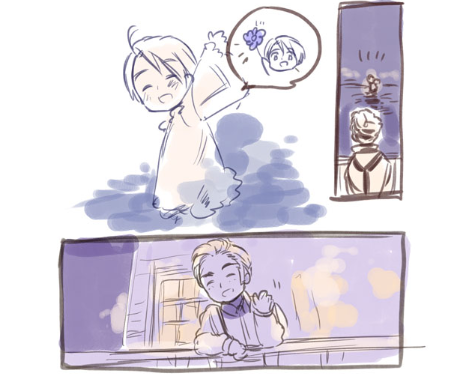


Since time runs differently for nations, it’s dangerous for
humans to be close to them for too long. Himaruya cites that because time is so
warped for the nations, a human wouldn’t be able to be around one for so long
without losing their mind. Essentially,
the nations’ immortality would rub off on these humans but at a grave cost [x].
Ex: England was
careful not to spend too much time with Howard. Nonetheless, in a blog post, Himaruya claimed that it’s possible that Howard may have retained his youth and lived longer than the average
human [x].
On the other hand, the nations’ immortality can rub off onto their pets without any consequences. Animals don’t possess the same cognitive
skills to comprehend time the same way as a human can. If an animal remains as
a nation’s companion, they’ll age so long as they’re constantly with each
other. Should the pet not be around their nation, they would resume aging [x].
Lastly, another factor to consider is that the nations are
too preoccupied with “diplomatic talks, fights, and being commanded around by
their bosses.” This makes it even more difficult for them to form external personal relationships,
although there are instances where the nation forms strong relationships with their
bosses [x].
I’ve talked about this before, but the nations aren’t celebrities
warranting high-end protection with limitless wealth.
Instead, they’re treated casually as if they’re any other
citizen.
Ex: They have passports [x].

It’s not “Oh my God! That’s France!”
but more like…
“Yeah, that’s him. Go, see him
for yourself,” [x].

The nations aren’t inherently wealthy either. Their wealth
and well-being depends on their economy (primarily their GDP).
Ex: France experiences an economic crisis and his wallet
runs dry [x].

In terms of housing, Himaruya’s said that the homes the
nations live in change depending on the era.
Ex: America first lived in a log cabin, then an “austere
English-style building in the suburbs, and now lives in an apartment building
near New York. Meanwhile, Italy’s lived in the same house and has remodeled it
over the years [x].
Ex: The American trait of living lavishly is reflected in
America’s present “luxurious” style of life. Using Italy again, he can’t afford
his electricity bill because he spends all his money on clothes instead [x] [x].

Ex: During “periods of peace” (I’m guessing the original
question was referring to eras without political conflict), Japan is said to be
“a young man leading an ordinary life with a strangely high rank that nobody questions
(i.e., for someone so youthful, he’s doing pretty well for himself) [x].
As mentioned in previous posts, we already know that the nations
are subordinates to their heads of state. Said control is very extensive [x] [x].


Ex: England’s boss once limited his consumption of alcohol
and sweets [x] [x].


The nations all work for their bosses and attend meetings
(e.g., world meetings, EU meetings) [x] [x].


Some nations even go to school for post-secondary education.


The type of work depends on their national industries.
Ex: America has done a hair iron commercial before [x].


In previous posts, I’ve already debunked the misconception that
Hetalia promotes fascist, racist, and imperialist narratives and linked both an
academic source and primary source materials from the manga [x] [x].
This post will unravel additional misconceptions that arise
when people 1) don’t read the manga and/or watch the anime 2) think the anime
is entirely representative of the manga, and 3) falsely think that the dub,
which has made some crudely offensive lines, is affiliated with Himaruya.
In no way am I advocating to wholeheartedly and blindly support
Himaruya, as he has made some culturally insensitive choices in the past—mistakes
of which he has clearly learned from in the following decade of content he has
produced.
Creators are capable of evolving from their mistakes, so to
hold them presently accountable for something that they did in the past is
childish and counterproductive. Outrage culture is the antithesis of growth; it’s
fueled by anger instead of reason and inhibits discussion rather than promotes
it.
On the other hand, what I am advocating for is that people
do their research and look into the series before hopping on the bandwagon to
hate Hetalia and make assumptions that have zero canon substantiation.
“The nations being ‘cute
and relatable’ is offensive.”
This would be a good argument if Hetalia’s tone intended for
serious discussion and historical accuracy.
It doesn’t.
Hetalia is a satire and a historical parody. Its entire
premise is stereotypes and making fun of them. Stereotypes aren’t always
accurate either, so to come to Hetalia expecting accuracy is to set yourself up
for disappointment. Stereotypes inherently implicate an outsider’s perspective.
You need to possess a certain humour for it and it isn’t meant for everyone.
Nonetheless, the series is oriented around poking fun at history
and at a deeper, more implicit level has an anti-war and anti-fascist agenda. The main genre is humour, so of course the nations are going to have
several comic gags, foolish blunders, and jokes. To expect otherwise is to again, mistakenly set yourself up for disappointment.
In working with a humour genre, Himaruya can’t cover certain
subjects, and, therefore, has to gloss over events. It’s not erasing history
nor is it trivializing the atrocities that occurred. The genre constrains what events
he can depict.
As mentioned before, there’s a stark difference between historical
situation and promoting a rotten ideology. Just because fascism and war are
depicted doesn’t inherently mean that it’s being glorified. What matters is how
the information is presented.
For example: People outside of Hetalia think that Nazism is
celebrated and that Germany is held up on a pedestal.
The real Germany that we see in the series is someone who is
morally opposed to annexing Austria but is forced to [x] . Remember that this is a
core theme of the series: nations are forced to follow their bosses’ orders [x] [x]. While unfavourable at times, this theme is understandably necessary for
avoiding the slippery slope where nations would be given more free will over such
matters.


Another strip alludes to the fact that should Germany
disobey his boss [Hitler] he could be imprisoned. Rather than the heroic, brave,
blindly patriotic, and invulnerable German man that would be depicted in propaganda,
we see the opposite in Hetalia [x] [x].


Germany is instead depicted as a tortured and worn man who
equates his daily life to torture. He claims that the pains of being a prisoner
of war is a mere mosquito bite in comparison.


Tell me, in what way is this promoting fascism and Nazi
Germany?
Colonialism:
Just like Hetalia mocks fascism, it also mocks sentiments of
colonialism.
Imagery is used to reduce colonizing nations to mere children
having squabbles. Their conquests aren’t glorified. They’re instead made to
appear foolish, ridiculous, and immature. France and England’s constant bickering
in the context of their conquests best highlights how colonialism is undermined
in the series [x].


Hetalia doesn’t erase the many planes of genocide that the indigenous
populations experienced at the hands of colonial powers. The humour genre restricts
what can be depicted, so it instead frames its focus on belittling the idea of
colonization by undermining historical narratives that have asserted the false
and non-existent racial superiority of these powers.
Ex: The nations
building holiday homes in America is a deliberate euphemism for the actual
practice of colonization.

Lastly, I have to point out that the criticism that America’s
personification is European-centric is false. America’s explicitly referred to
as “an ingredient for a country” during this colonization phase. Several groups
and cultures were present, which, as logic follows, would include both the
colonizing powers and indigenous populations in America at the time. In other
words, he wasn’t born as the outright personification of the country but rather
seems to have evolved into the title.
“【America, at this time】
He’s more like an ingredient for a country right now, to be
frank.
The East Coast in the 17th century is like a cauldron for the birth
of unique American culture, which may well have been a sign.”
Conclusion:
Overall, it’s ironic that as a series based on stereotypes
Hetalia is wrongly stereotyped for what its content consists of. Likewise, instead
of looking at Hetalia as a series that’s simplistic in nature, analyze how said
simplicity is able to mock and criticize imperialism, colonialism, fascism, and
racism via the device of satirical humour.

America: *dumps tea into the Boston Harbor*
America: (chuckles) I’m in danger.


Since when was Canada and Romano best friends?
Apart from the brief encounter when Canada asks Romano about independence,
there has been no interaction that shows them as friends. In fact, isn’t Romano
one of the ones who forgets Canada unlike his brother, Veneziano? I know he’s
friends with America, but only acquaintances with Canada, or an I missing
something?
They’re not friends? I’m
as confused as you. Like you said, they had that interaction in WS where Canada
asked Romano how he had gained his independence [x].
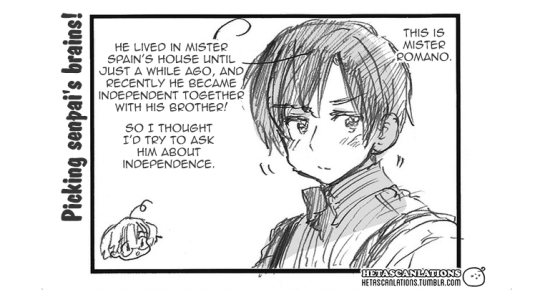
Not exactly. I think you’re
referring to the Christmas 2011 event. Veneziano recognizes Canada but we don’t
get to see Romano’s reaction [x].

do you believe that
monaco and france are siblings the way that norway and iceland are? like…
biologically (even though biology and nations is an iffy thing lol)

It is an iffy thing lol. I’m still in the process
of putting together a model, but to avoid a slippery slope, Himaruya has made
it so that descendants aren’t necessarily biologically related (e.g., Bulgaria
and Romania aren’t considered to be Rome’s grandsons, even though Romania
strongly insists otherwise).
Anyways, as for your question, no. Monaco is referred to as his protégé in a
volume 4 character note [x], although I’ve seen printed English translations where she’s referred to as his sister in the same note…
In Volume 6, she’s referred to as his “kind-of sister.”
She and Italy refer to France as big brother;
however, we know that Italy uses it as a term of endearment and given that
Monaco is his protégé, I would apply the same logic [x].
Hey, so, before some wars in the 1700s, the French and
Spanish had A LOT more colonized land in North America than England, so in
Hetalia, wouldn’t that make France more of a parental figure? Before the wars
in 1700s at least. (I got this from my AP US History book)
Hetalia isn’t historically accurate, so it’s not the best
lens for analyzing relationships between the characters. Use the original
source material for interpretation (i.e., the manga).
I’ve done some posts that highlight the paternal
relationship that France has with America
[x] [x], but it still stands that England was
his primary father figure/ mentor. Even so, we know that because of England’s
long absences it was minimal.
Ex: America is jealous of kids who get presents from their fathers on Christmas [x].


Hello! Can you tell please in which period of
time strip “While you were gone” takes place?
I think it takes place
during the intermission period between WW1 and WW2. Both Lithuania and Poland
were independent, but Lithuania still warns of political tensions and the
likely possibility of Poland being targeted. Italy had also just gained his independence [x].


I’m very
sorry to hear that.
In the series, what
we’ve seen is that if ordered to, the nations will promote propaganda despite
not necessarily believing in it. This doesn’t mean that you can’t characterize them as you wish either.
Ex: Germany is
morally opposed to annexing Austria but is forced to [x]. In a later strip, he’s
seen promoting the annexation with other officers [x].

I hope this helps. All the
best, and thank you for sharing your voice and permitting me to comment.

I’ve already done posts on this subject. You can find them in my post directory [x] [x]
Russia: I really liked that television show you had on. It was so funny~!
America: Uh…that was a White House press conference.
Russia:

I can’t speak for everyone, but generally a lot people
assume that political relations define personal relationships, when that hasn’t
been the case in the series [x].
It’s a weird concept to grasp if you’re just coming into the
fandom and haven’t read the manga, so I wouldn’t be so quick to fault them.
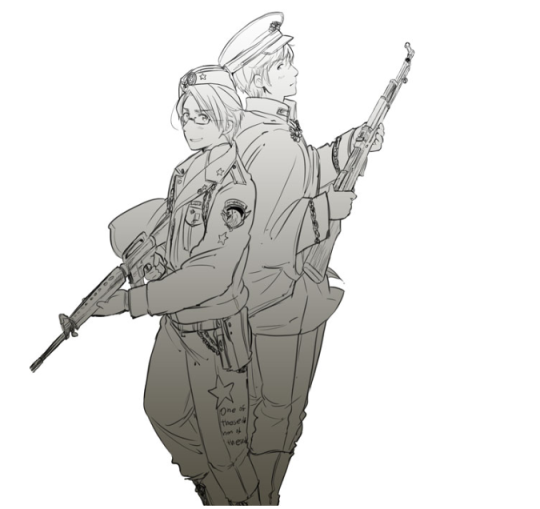


What this post will explore is how America’s character consists
of several binaries. In other words, his personality is predicated on contradictions.
Let’s go over them.
What you’ll notice is that even though America fought for
his independence and vied to be recognized as self-efficient, he’s still
equated to that of a child [x].


He’ll also often swing back and forth between a “I need you/
go away, I don’t need you” complex when interacting with England, who served as
his primary mentor/ parent figure.
Ex: He rejects England’s offer to become his friend in the
strips depicting Japan’s Westernization period [x].

vs
Ex: In a volume 2 character note, England and Japan are
listed as America’s only friends. Remember
that this character note isn’t applicable to modern times; it’s dated.


Ex: America arrives at the African Warfront in WW2 and
ignores England’s advice, only to be overwhelmed and defeated by Germany [x].


vs
Ex: Following his independence, America attempts to force
himself into Canada’s home after learning that England fell ill as a result of
the conflict [x].

While he may be an adult, America doesn’t always have an
accurate grasp of how the world really works.
Ex: He comes up with childish world defense plans that any
competent person (let alone adult) would realize is not realistic (let alone
possible) [x]

vs
Ex: He successfully invests himself in the massive economic growth
experienced in his country during the second industrial revolution [x].

The underlying comic gag is that America’s unable to read
the atmosphere [x].

Yet, in one of his character notes, it’s revealed that he
purposefully chooses not to read the atmosphere [x].
There are times where America will act purposefully
oblivious and there are times where he’s completely aware of what he’s doing.
What confuses people is that the latter occasion often involves him appearing
oblivious to hide his motives.
Ex: Not long after Russia switched sides in WW2, America
runs his mouth and refers to him as a “bad guy.” Note again, how childish this
perception of the world is.

However, when Russia confronts America and threatens him for
this comment, America seems to read the situation and feigns cluelessness to
avoid further conflict. You could also very easily read this as America being petty
the whole time and wanting to take a jab at Russia’s character.

Ex: America receives a one-way ticket to Siberia from Russia for his birthday. He ‘obliviously’ thanks Russia for the gift, not
wanting to give the latter the benefit of a reaction and promises to use it as
a tissue if he gets a cold…and then proceeds to do so [x].


Lastly, there’s the comic gag that America’s sense of
geography is egocentric in nature.
Ex: In one strip, he’s reprimanded for using a map of his
country as a substitute for a world map.

Vs
Ex: He deliberately omits Mexico from a map he constructed
because of his grudge over Alamo [x].

Point
is, he’s not dumb.
This one is fairly simple.
Basically, America’s infamous for being the “hero” of the series [x].

He’s strong yet also very
insecure of himself [x].
He’s insecure about his
weight and doesn’t realize that he’s not overweight at all (you’ll notice that the character note contradicts the strips following it). In fact, he’s just
muscular [x].


Ex: In this strip, he’s
shown to be aware of the fact that he wasn’t viewed very favourably by other
nations [x].

This one is a bit tricky.
There’s no doubt that
America cares about his friends and will go out of his way to make them happy
(e.g., gifts, hosting them) [x].

On the other hand, Himaruya
has to work with the global stereotype that historically American foreign
policy has mostly been of self-interest—a great power that has exerted
pressure to get what it wants.
What I really want to
stress is that much of America’s egocentrism isn’t on purpose. Longer
post on that here [x].
It’s also important to
recognize that the nations have two selves: the personal and the political.
They act differently according to their environment, whether it’s a world meeting
or a casual outing. They shouldn’t be confused as the same thing.
Still, there are times
where America will deliberately attempt to intimidate other nations into
complying with him. Like a child, he lives in his own world and isn’t receptive
to other opinions.
Ex: Canada gets fed up with
post-colonial America, berating the latter for being too domineering, bossy,
and selfish [x],


Ex: He claims to want to
work together with other nations. Moments later, he states that opposing
opinions won’t be tolerated.


Ex: He snaps bundled spoons
as an intimidation tactic to prevent other nations from disagreeing with him [x].

In sum, this post shouldn’t
be taken as an excuse to hop on the bandwagon to point out how flawed America
is. It’s quite the opposite. Be mindful that Hetalia’s whole premise is satirical
stereotypes; it doesn’t hurt to have a sense of humour either. His contradictions
and flaws are what make him funny and relatable.


As mentioned in previous posts, for the most part, America is characterized as someone who’s young, inexperienced, and naïve.
Like you said, he does genuinely think that he’s helping “the little guys” while the pragmatic outcomes of said policies aren’t as clean-cut [x].

On the other hand, he is aware that he’ll stand to benefit from helping others too.

The point to reiterate is that he doesn’t seem to be conscious of the negative consequences of his actions until after the fact. He’s impulsive (e.g., the Great Depression and African Warfront strips), and a lot of this is reflective of how American foreign policy has historically been like.
As I’ve mentioned before, the rhetoric says one thing—which is what the population and America the personification believes is its aim—and the outcome is reflective of the true motives of those in office.
 Ellawritesficssometimes