Yup!
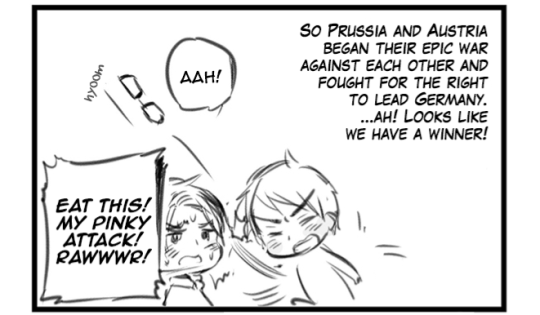
Source: Hetascanlations, World Stars Chapter 12.
Yup!
Source: Hetascanlations, World Stars Chapter 12.
I think that’s it. To do
my characterization posts, I have to pile through all the little cliques and
corners in the English-speaking fandom. I have seen more anti-England blogs
than I have for any other character; he’s also one of the most popular
characters. It’s just basic numbers, the more blogs there are on a character,
the more negative ones there are going to be. Since England is involved in a
ton of ships, that also reels in a lot of controversy.
Likewise, I didn’t only
say he was the most hated. I also mentioned that he’s one of the most contested
characters too, which fits in with what you said regarding how people both like
and dislike him.
This is how I think of
it: When you think of Hetalia, do you think of Austria? Is Austria the face of
the fandom? Or what about the memes? Why do all the old memes mock England more
than any other character (e.g., the bacon eyebrows, the googly eyes, etc lmao)?
Obviously, England isn’t the only face of the fandom.
I disagree. While
Austria isn’t as popular as England, I would say he gets an even balance of
positive and negative depictions (similar to England minus the popularity).
There are those who spin the crude characterizations from the Chibitalia series
and then there are those who ship him with Hungary or Prussia, for the most part. Some of my favourite
fics in the fandom are AusHun oriented.


As most people already know, the nations’ body parts represent
different geographical landmarks/ land within their territory..
What I’ve found particularly interesting about Hetalia is
that it plays around with the idea of Cartesian Dualism, conforming to its
rules at times, while at other times subverting it.
The basic and essential principle is that the mind and the
body are two separate things. Himaruya, on the other hand, blurs those
boundaries.
I’ve broken down representation of this dualism into a model
consisting of three categories.
1)
Physical body part = geographical elements
2)
Geographical element –> personality influence
3)
The sociological collective –> bodily influence
Let’s break down these categories.
Fairly self-explanatory. As mentioned above, geographical
elements of the nation are reflected in the personification’s body.
Source: Comic Diary 2, Hetarchive.

The body in question here is the
body of land as opposed to that of the personification’s.
In these instances, the geography
and/or climate of the country affects the personification’s personality.
Ex: Iceland’s volcanoes and cool
weather are reflected in his canon hot and cold personality. He’s quick to rise
with anger but just as quick to cool off.
Source: World Stars Chapter 114, Hetascanlations.

This last category has more to do with the collective unconscious
of the society in question.
Ex: Both Italy brothers’ curls represent the “sexual
something” of Italians and function as an erogenous zone.
Source: Notes and Etc, Hetarchive.

Ex: Austria’s mole is said to have a similar function to the
Italy brothers’ curls.
Source: Hetarchive (Bamboo Thicket, eng trans., June 26, 2008).
My best guess is that this is a reference to Freud, who
believed that humans at their core are primarily sexual and aggressive beings
and that civilization exists only by repressing these urges into the unconscious mind.
Lastly, although it doesn’t exactly fit into this category, Austria’s glasses also represent his “musical something.” It would stand that this is a larger reflection of Austrian culture considering that classical music is something they are known for.
Source: Hetarchive, Notes and Etc.

In sum, while I understand that Himaruya likely didn’t have
an intent of tracing out and implicating Cartesian Dualism into his characterizations,
it still provides us with an interesting lens to analyze his work. It also proves
that a lot more thought and consideration was put into the characters than he’s
given credit for.
This doesn’t include all of them, but Comic Diary 2 is the
strip you’re looking for.

Source: Hetarchive

No worries. I’ve briefly touched on it but not in its
entirety.
I’ve boiled it down to three main categories:
This occurs when a nation is conquered and is forced to live
with their conqueror/ annexer.
Ex: Chibitalia
and Austria under the HRE household.
Source:
Hetarchive, Chibitalia (Main storyline.)

When administrations crumble and there’s no other place to
go…
Ex: England hosts
France during the Vichy Regime.
Source: Volume 5,
Liberté, Égalité, Fraternité and…

Due to their dire financial circumstances, Lithuania and
Romano move into America’s house and end up working for him.
You could argue that this is in a way, involuntary, but I
would say it’s more along the lines of necessitated.
Source: Hetarchive/ Hetascanlations, World Stars Chapter 58 + Lithuania’s Outsourcing Series


I think you’re referring to the one that was animated, which
is from Volume 6.

However, there is another scene like this in World Stars [x].


Germany: You’re terrible at insults.
Austria: Nonsense.
Also Austria: ↑
One is just a structure Himaruya uses. I find it funny when
he does that little side bubble thing, where the characters give snarky
comments with a miniature version of their faces.


I also think the political and economic jokes he makes about
the EU are quite funny. Obviously, not the situation itself but dark humour never
hurts!
Ex: Spain and Greece attaching themselves to Germany.


The following post will examine hints of romance and/or useful
tools that can be incorporated when characterizing this pairing.
Briefly, it’s important to situate the course of their
relationship.
When they were younger, Hungary used to beat up Austria. Remember
that Austria was originally born as a fighting nation and only became an
indoors person after he resorted to marriage to solve his problems [x].

This power-balance later shifts when Austria acts as the
head of the Holy Roman Empire household and Hungary becomes his subordinate [x].

Although it’s not depicted, the two are later married under
their dual monarchy. Hungary’s cited birthday (June 8th) is also
their wedding day and corresponds with the Austro-Hungarian Compromise of 1867 [x].
It would be inaccurate to say that Hungary passively
accepted being under Austria’s rule with open arms, not to mention that it
would disparage the strength of her character. It’s a lot more “complicated”
than that.
Hungary is described as having “defiant feelings” over having been under Austria’s rule. In tandem, she’s also said to have “complicated,
yearning-like feelings towards him,” [x].
How I’ve interpreted this before is that the nations have
two selves: the personal and the political. While Hungary may have resented
Austrian power, she didn’t represent Austria the person despite the fact that
he was the embodied personification of the nation in question. Hungary was
ultimately caught between a rut of representing her nation’s best interest and
her own experience as a person in her own right.
Still, even when she was a servant to him, Hungary still
considered those in the HRE household to be her family. Regardless of the difficult
nuances of their political statuses, there were deep personal bonds present that
shouldn’t be overlooked.

Likewise, we also know that Hungary developed a complex over
settling down and feared that her battle skills would get rusty [x].

This is far from the case.
Ex: Hungary was keen to fight for Austria during the War of Austrian Succession [x].


As mentioned, the series doesn’t cover the course of their marriage
and instead depicts the aftermath. On the other hand, several hints of romance
are enough to suggest the likely possibility that the two did and still do hold romantic feelings for each other.
Ex: Hungary is too shy to visit the then annexed Austria and
instead asks Germany how he’s doing. Her reason for not wanting to see Austria
is that the state of her economy had caused her to develop a dishevelled appearance.

Either way, it seems that she still cared about how she
looked around Austria. Notice how she blushes too.
Ex: In the same time period, Hungary secretly cleans up
Austria’s room without him noticing.

The most well-known example is during Buon San Valentino.
Ex: Hungary receives a Valentine’s Day gift from an
anonymous source. The deliverer gives a description that matches Austria’s [x].
However, it’s not so anonymous to the reader given that the
strip’s title is “Hides his name but not his Mariazell.”

The two are also very close in modern times.
Ex: They spend the Christmas 2007 event together as a
couple. Their relationship is enough to make Prussia—who was already
feeling lonely—cry [x].


Ex: They coordinate their Halloween Costumes together—
Hungary dresses up as Austria’s prince in the Halloween 2011 event [x].


In sum, while historical tensions may have caused reciprocal
tensions in their political relationship, this doesn’t necessarily mean that
the same tensions were reflected as strongly in their personal relationship.
The two genuinely do care for each other and haven’t seemed to have abandoned
their husband and wife roles; this is on top of the suggested romance between them.

What she’s thinking: This is so much fun~!
What he’s thinking: I’d rather be at home in my underwear.

 Ellawritesficssometimes