They coordinate their Halloween costumes.
Ex: Mad nurse and mad doctor [x].


AusHun will always have a special place in my heart. It was one of my first ships!

Shipping post coming up tonight!

Isn’t it super sad that almost the whole fandom forgets about
the fact that Italy is really good with clothing and fashion but wears big,
silly t-shirts instead?
I mean, France of all people pretty much states that Italy
isn’t very good at fashion [x].

Then again, I don’t think Himaruya can make up his mind on
what Italy’s sense of fashion is given how contradictory pieces of canon
information are.
Ex: Italy can’t pay his electric bill because he’s spending
too much on clothes + his dressed-up cosplay ventures [x] [x]

If there is a significant demographic shift in
a country (ex. if a minority group shifts to become the majority), will the
personification’s appearance and/or behavior also change? P.S.: Your content is
always awesome! I love your stuff, keep up the good work and thank you!
Thank you!
The nation’s appearances
first and foremost are based on stereotypes. Even if a minority becomes a
majority, more emphasis is placed on how the country is known to the world.
However, internal demographic traits and political, social, and economic
developments can affect the nation’s health, behaviours, and personalities [x].
Try to bear with me while I ask this, I’m not the
greatest with words so the phrasing might not come out right. Um, this has
confused me, unification is like a marriage, right? Okay, so wouldn’t they be cheating
on their spouse if their dates other nations. And what would of happened to two
married nations of other suddenly married another nations. Wouldn’t break and
upset their people, wouldn’t that cause trouble… And if they represent the
same country how’d that work. I’m sorry, very confused.
Even though the words
are used interchangeably, unification
is more often used in reference to the formation of one country (i.e., states,
territories coming together; German Unification, Italian Unification), whereas
marriage involves the union and/ or partnership between two countries.
Unions don’t necessarily have
romantic overtones either [x].
I was just wondering, do you think the
england’s personality is at all influenced by the germanic stereotype? some
consider him part of the germanic family (historically england has strong
germanic influences + he has blond hair where the rest of his family seem to be
brunettes and redheads) and he’s definitely bad at showing his emotions, or do
you think these stereotypes only apply to actual german-speaking countries?
Probably not. He may not
be good at conveying himself, but unlike the Germanics, England is volatilely
expressive. He’s not stoic but rather extremely hot-tempered, sensitive, and
impulsive [x].
On the other hand, there
has been some Germanic influence depicted, albeit minimal. From what I can
recall, there is one panel depicting the Danish Conquest of England [x].
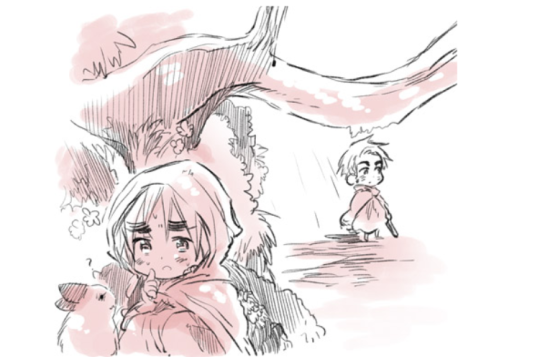

Thank you, same to you :D.
I know that Austria spent part of his life in his
wheelchair [x], and that Romano had chorea when he was younger (Vol 1).


Misconception:
She’s not a pervert or presently maintaining that she’s a raging pervert.
Reality: Old tropes
pretty much characterized her as a fujoshi. The latter has since been
discarded, although some, much tamer elements of it remain.
Ex: Due to the high volume of gay porn videos in her country,
Himaruya depicted her to be obsessed with “cute boys,” [x].
Later in the series, we still see her getting excited over similar
things, but it’s much in the same way that any girl fawns over a cute boy—butts,
abs, muscles, or in this case, a fan request steering Austria onto the topic of
underwear.

Misconception:
She and Austria hated each other; therefore, a romantic relationship between
them is impossible.
Reality: Hungary possessed
“defiant feelings” over being under Austria’s rule, but also held “complicated,
yearning-like feelings towards him,” [x]. Evidence suggests that they still have
romantic feelings for each other.
The point of differentiation here is how the nations are
able to separate their political and personal selves. How I interpret this is
that she was defiant towards Austria the country, not Austria the person
whom she lived with in the same house.
A further substantiation would be a character note claiming
that Hungary is fond of Austria because he was the first person to treat her
with kindness, as opposed to other nations in the past who treated her very
poorly (Vol 1).
Nonetheless, the two still fought a lot until they formed a dual monarchy.


As for hints of romance, there are several [x].

Ex: Austria ‘anonymously’ sends Hungary flowers for
Valentine’s day [x].

Ex: They spend their holidays together seemingly as a
couple. Prussia actually tears up at the sight of them, a likely mix of
jealousy and lamenting over his own loneliness [x].


Ex: Not necessarily romantic per say, but Hungary secretly
cleaned up after Austria despite their marriage (empire) having been dissolved.

Misconception:
She and Prussia hate each other.
Reality: 9/10 times,
they’ll be fighting, but they don’t truly hate each other. It’s more like they really don’t get along.
Ex: She’s said to hate Prussia due to him “making fun of her
hardships in childhood,” [x].
This bickering dynamic doesn’t go away as they mature [x].
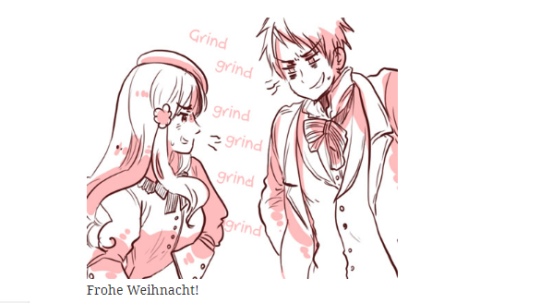

Ex: They consider each other to be family during the
holidays. Of course, that doesn’t stop Prussia from finding an excuse to initially bar her and Austria entry into his and Germany’s home. He was just being an ass,
nothing more.


Still, this shouldn’t
negate the fact that they worked with each other on several occasions.


Strips even allude to the fact that Prussia has unreturned
feelings for her.


Misconception:
Hungary gave up everything for Austria and rendered herself weak and feminine.
In other words, she copped-out.
Reality: While
Hungary had a complex over settling down with Austria and feared that her
battle skills would get rusty, she did anything but cop-out [x].

Even though she bore stereotypical feminine household
chores, she still holds the title as the “manliest” country in the comic (Vol 2).
Ex: She didn’t hesitate to aid Austrian troops and kicked
some ass while doing so [x].

Bonus facts:
She used to represent an equestrian tribe [x].
She was raised to be like a man by Magyar and initially
identified as such. This only changed when she matured and realized
that she was actually a girl [x].
She and Romania get along like dogs and monkeys (the
Japanese equivalent of the saying “like cats and dogs”).


She’s described as a big sister-type (e.g., she acts maternally
towards Italy and Germany) [x].


What this post intends to do is use Horney’s theory of
personality to analyze why Germany’s strive for perfection and productivity
comes at the cost of compromising his true self and confidence.
The tyranny of the shoulds is a term that Horney coined to
explain the occurrence in which someone’s idealized self-image replaces their genuine
self-confidence. What the person strives to be and appears to others acts as
their confidence, whereas they don’t feel confident in who they truly are,
ultimately forcing them to continually put up the former front of
superficiality. An extreme form of this would be the person developing feelings
of shame and disgrace toward their real self.
Put another way, the real self (who you are) is replaced by
how one should be. For example:
“One should always be productive.”
“One should always be punctual.”
“One should never give up.”
“One should be in control of one’s feelings.”
“One should schedule one’s day to maximize utmost
efficiency.”
Sound familiar? It should, because these are the shoulds
Germany is ruled by.
This neurotic compulsion to strive to be someone you’re not
eventually leads to the person internalizing this ideal, albeit unrealistic,
sense of self. The consequence of surrendering your real self compromises the
person’s chances of achieving personal growth and happiness. They’re never
happy with themselves and only focus
on how they present themselves to others.

In Germany’s case, he puts up a front of competence, order,
and productivity. He shoulders a lot of pressure to hold up the EU and has
internalized this responsibility to look after other member-states [x].


His work self has become his primary identity…his master
status.
Of course, this doesn’t mean that he’s incapable of unwinding. He’s very favourable of vacations [x].

Nonetheless, there’s no doubt that he’s a workaholic [x].

Ex: Several character notes identity him as bearing an
overly serious and compulsive personality type.
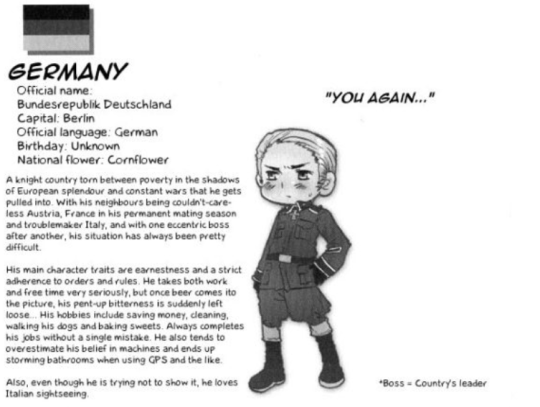
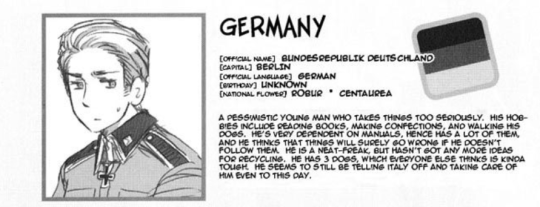

Ex: He has a whole character song dedicated to schedules, punctuality,
and routine. Public appearances are an indication of self-worth to him [x] [x]

Because Germany identifies with his work self, he’s
internalized repressing his emotions to the point that when he does experience
them (e.g., embarrassment, happiness), he becomes incompetent and lacks
confidence in himself.
Ex: He’s not used to being praised for his abilities outside
of work life. In this case, he doesn’t know how to react when Italy commends
him for his drawing skills [x].

Ex: He’s well-known for his inability to smile [x].


Ex: When it comes to interpersonal life, Germany is clueless
and has to rely on manuals (e.g., dating advice, teaching him how to smile). He
doesn’t need manuals for matters like business or economics due to familiarity
and experience, but when it comes to socializing he sheds this cloak of
competence and becomes dysfunctional without them [x].

There are also instances where Germany’s work self overrides
others’ impression of him, even when he attempts to be personal and social.
Ex: His first character note in World Stars [x].

Ex: Italy mistakes him as being angry [x].


In sum, I’d like to end this with a passage from his
character song “Einsamkeit” that best exemplifies how his work self has
compromised who he truly is. He’s essentially alienated himself despite frequently being surrounded by other nations for his work [x].

The side of him that likes romance novels, dogs, and confectionary is completely overlooked.
I’m always said to be scowling,
But my smiling face hasn’t been erased
You may think I’m frightening,
But it’s only because I’m straining to laugh
Strong Eisamkeit (Loneliness)

Friend: You just
need more social interaction. Try leaving your house.
Me: Fine.
Also me:

Thank you! Sure, I don’t see why not. Here’s one for
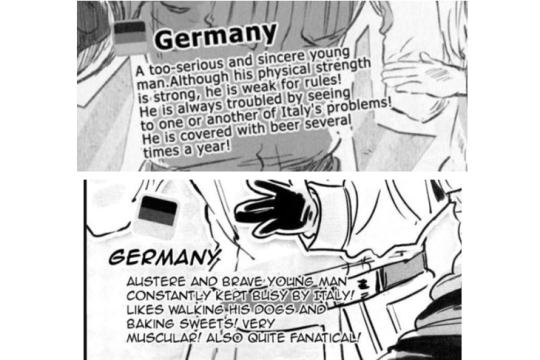
Germany (Volume 2):


“A
pessimistic young man who takes things too seriously. His hobbies include
reading books, making confections, and walking his dogs.
He’s
very dependent on manuals, hence he has a lot of them and things that things
will surely go wrong if he doesn’t follow them.
”


“He
is a neat-freak, but hasn’t got any more ideas for recycling.”


“He seems to still be telling Italy off and taking care of
him even to this day.”


Misconception: He’s
weak.
Reality: Austria
was born a fighter [x], but as he turned to marriage to solve his political
problems, he lost shape and became accustomed to home life. He’s actually quite
lazy now [x].


Misconception: He
was cruel and heartless when he ruled over Chibitalia.
Reality: While he
was strict and stern with Chibitalia, a lot of this can be attributed to the extreme
and exaggerated humour employed by Himaruya in the series’ early days.

Even with the strict punishments, Chibitalia still shared
many fond moments with Austria—nations living in Holy Rome’s household
considered each other to be family and even maintained this sense of closeness
decades afterwards [x] [x].


Misconception:
Due to historical tensions, it’s impossible that he and Hungary were able to
possess such a strong relationship under their empire. [x].

Reality: Yes and
no.
You have to remember that the nations are people too. They
have a political self and a personal self. It’s for this reason that while
Hungary has “defiant” feelings from her time spent under Austrian rule, she also
has “complicated, yearning-like” feelings for him [x].
How I interpret this is that she despised Austria for what
Austria the country stood for at the time but not who he stood for as a
concrete and separate person.
Lest we forget all the times where it’s hinted that the
two still have feelings for each other. The most notable panel that substantiates
this claim is from Buon San Valentino. There, Hungary receives a Valentine’s
day gift from someone with “glasses and one hair standing up,” [x].
“He hides his name but not his Mariazell.”

Misconception:
Austria and Prussia hate each other.
Reality: Again,
yes and no. It depends on the time period. The ‘hatred’ isn’t deep-set but
rather it’s temporary. Himaruya once said that it would be fun to draw Austria, Germany, and Prussia as a “chaotic sort of family,” [x].
Undoubtedly, Prussia gets on Austria’s nerves…a lot [x]. (Another good reference would be the Maria Theresa series).

Still, the strips have also shown that they don’t truly hate each other.
Ex: Austria
receives a censored letter from Prussia (who was under Soviet rule at the time)
and reads it out of pity [x].

Ex: The two still
consider each other to be ‘family’ and spend their holidays together despite
all the fighting it causes (Christmas 2010 Event).
(Prussia initially didn’t want to let Austria spend
Christmas with him because he was a “lesser German”. He was just being an ass;
I wouldn’t take it seriously, especially given Germany’s response).


Bonus Facts:
He’s considerably self-critical.
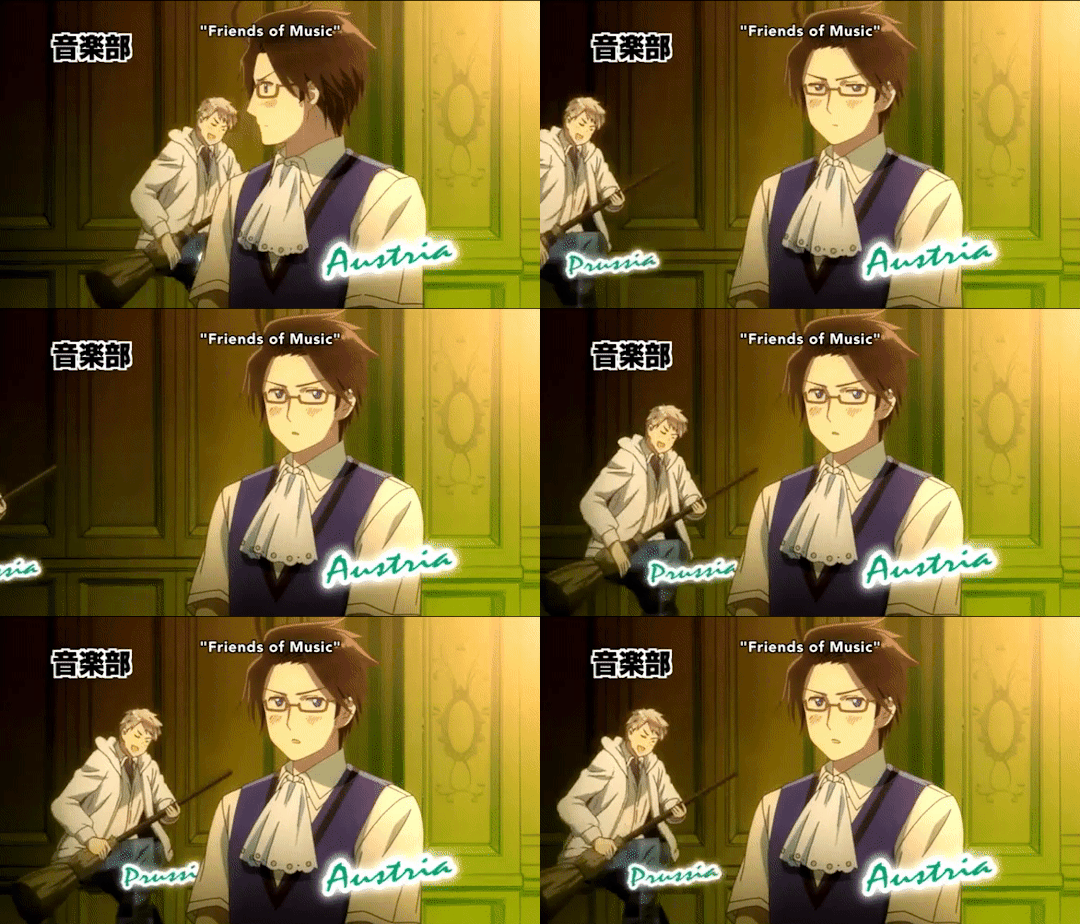
Ex: He wears his glasses to avoid looking plain. It’s not
from poor eyesight. Instead, they represent his “musical something,” [x].
Ex: Being unsatisfied with his appearance is enough to make
him feel discontented [x].

Similar to Freud’s “anal-retentive” personality-type,
Austria is a stingy [x] perfectionist [x].
His mole acts as an erogenous zone, not his ahoge
[Mariazell] [x].
He gets grumpy when he doesn’t have coffee.

He spent part of his life in a wheelchair [x].
He doesn’t have a sense of direction.

He once avoided fighting with Prussia because he didn’t want
to harm young Germany [x].


Me: I’m going to get so much done this summer.
Also me:


 Ellawritesficssometimes