Me: I want a relationship.
*tries to establish eye contact*
Also me:

Me: I want a relationship.
*tries to establish eye contact*
Also me:


This guide will go over
the stereotypes that affect how the Germanic nations are able, or rather, unable
to express their feelings. The steely emotionless stereotype of Germans/
German-speaking countries often prevents the respective nations from being
understood properly. It’s not that they’re incapable of experiencing love or
feeling care and affection. It’s quite the contrary. Instead, they just have a
difficult time showing and communicating how they feel [x].

For the purpose of this
post, I’ll only be going over the Germanic nations that are listed in this
strip, as they are what Himaruya characterizes to be of German inheritance and influence.
I recognize that there are many more Germanic countries than this. I’m just
going by what we see portrayed in the manga.
That said, let’s go over
some examples.
The German stereotype of
being emotionally steely and hot-tempered is a complex that Germany is defined
by in the manga.
He’s sweet and
compassionate but is often mistaken to be angry by those around
him [x].

Germany also claims to
have trouble smiling. It’s not something that comes naturally to him [x] [x].


In terms of
relationships, Germany is emotionally withdrawn. This is most seen in Buon
San Valentino [x].
There, the premise of
the arc is that Germany has trouble defining what his relationship with Italy
is.
He first buys a popular
book in Germany titled “Communicating with your partner.” The comic gag
of this is the stereotype that Germans aren’t savvy at reading emotions; they’re
‘emotionless.’ Obviously, this isn’t truly the case.

As Germany reads this
first book, he begins to question whether Italy likes him as a friend or as a
romantic partner.
When Germany gives
details of his relationship with Italy to Austria, Austria is repulsed due to
the romantic overtones = seeing someone every day, kissing and hugging them,
bathing with them etc. The irony is that Austria later realizes that Germany
was talking about Italy, an anomaly of a person who normally does all these
things.


Unfortunately, Germany
doesn’t know this, and he forms the conclusion that Italy has romantic feelings
for him. It’s a “misunderstanding.”
Since he’s still clueless about this aspect of human relations, Germany then buys a book that gives dating advice.


His dismay grows when he remembers that Italy’s a guy [wow!] so of course, his next course of action is to ask Austria if he can practice these newly learned romantic gestures on him.


He later reveals to Austria that he has no previous experience with romantic relationships and that he’s only read romance novels.

The strip culminates in
Germany mistakenly proposing to a very confused Italy.

Despite having never
been married, Prussia is the most sensitive and emotionally-expressive Germanic
nation.
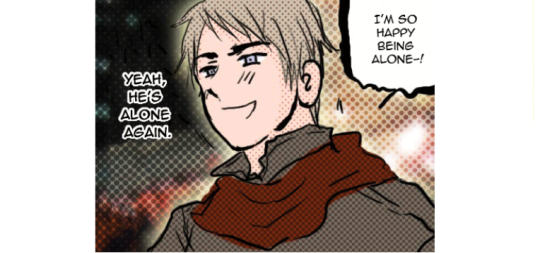
He’s often found crying
and lamenting over the fact that he’s single and “alone.”
Ex: He cries when he
spots Hungary and Austria spending their Christmas together during the 2007 Christmas event [x].


The Germanic stereotype
has more to do with the fact that he’s a poor socializer.
For example, he’s given a
book on “How to Socialize with People.” He sneezes and claims to be bored with
it [x].

In direct contrast to
Prussia, as someone who’s been in several marriages, Austria is arguably just as
clueless as the German brothers.
He may have solved his
problems with marriages…

…but when it comes to
relationship troubles, he’s read his fair share of manuals and guides too.
Austria had copies of both
books that Germany purchased in Buon San Valentino. Had he have known this
beforehand, he would have lent them to him.


He becomes flustered
when Hungary reads the dating book and laughs at how inaccurate it is. It would
be to his own embarrassment should he have admitted that he had been an avid
reader of it.

On the other hand, in his defense, it’s largely hinted that he’s the one who gave Hungary flowers on Valentine’s Day.

Switzerland’s similar to
Germany in that he’s an angry-type that’s soft on the inside and well-intentioned.
He shouts at Japan to
give his own opinion, scaring the latter despite the good intentions of this
action. It’s tough love in that he’s trying to get Japan to stand up for himself.


He cringes and gets
angry for remembering all the fond moments that he had experienced with Austria during
their childhoods. This is sometimes at the expense of ruining the fond moments that
he shares with Lichtenstein [x].


Nonetheless, Switzerland
shooting at Italy in the frilly pajamas that Lichtenstein made for him is
iconic, and you can’t tell me otherwise.

Sweden’s slightly
different in that his minimal facial expressions are intimidating to people.
Finland finds Sweden
scary at first… [x]

…but later warms up to
him and realizes that Sweden smiles and expresses his happiness subtly [x].


In reality, he’s also
quite the softie.
He sews smaller
clothes for Finland [x].

He acts as a father
figure to Sealand [x].

In sum, while the
Germanic nations may come across as hard and steely, they’re easily among some
of the sweetest, most considerate characters in Hetalia.


[You’re so polite omg
bless you]
Yes, both Austria and
Prussia share similar issues, likely because of the steely stereotype that’s often applied to the German people. I think this
is the post you’re talking about [x].
And for sure! I’ll put together a quick guide
on this tonight!

Most dangerous nations: Belarus, China, Germany, Finland, Hungary, and Russia.
Most underestimated nations: Belgium, China, and Italy.
Hardest workers: America, Germany, Japan, and Romano (if he has the motivation).
Laziest nations: Austria and Romano.


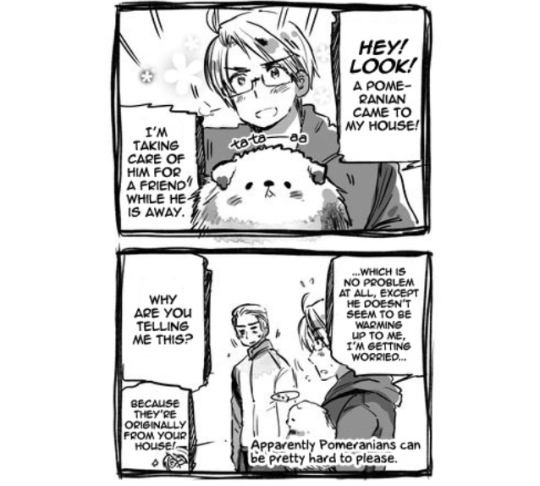
America taking care of his friend’s Pomeranian and asking for
Germany’s help.
Canada crying and doing his best to heal England after the
American Revolution [x].


Hungary secretly cleaning up for Austria after their empire
is dissolved.

After telling the story of Germany’s birth, you see a break
in Prussia’s egocentrism – or rather the act of it. He goes from “worship me
all you like” to agreeing to do laundry for Germany. In reality, he’s an
incredibly helpful, hardworking, and diligent person.

Q: i read on one of the hetawikis that italys curl was added as a last
minute thing to make him cuter, but himaruya said that now the curl is
“important.” any thoughts?
A: There’s one character note that states that the curl represents “the
sexual something of the Italians” [x].
Q: Your post on how fascism isn’t promoted in the manga was
extremely helpful, so thank you. Just wondering. Is there any strips that
depict how the people react to the war?
A: Disclaimer: This is
coming from someone who’s half Jewish. I shouldn’t have to say this, but
knowing the internet…
All that’s shown is how hopeful the people are [x].
You have to situate the context and realize that the German people had just
come out of a massive economic recession. The war promised them a solution. (Unfortunately, this solution and the many years leading up to it involved scapegoating, unjust persecution, assaults, and discrimination).

Point is, Hetalia never promoted Fascism. As
discussed in this post [x], all it does it situate the reason why the Germans
went to war – namely because of how stringent the compensation mandated by the
Treaty of Versailles was. It doesn’t tackle anything past that. Given the young targeted demographic, the atrocities committed during WW2 aren’t covered or touched on.
Again, there’s a difference between situating a
historical context vs promoting a horrible political ideology.

A: Thank you! I’m by no means a gun expert, but in one
of the first original web comics, he does appear to be holding a sniper rifle [x].

There’s also the famous Finnish sniper Simo Häyhä “White Death” from WW2 that might have made such a headcanon
to be taken as fact. Other than that, you’re right. I don’t recall any of his
character notes mentioning this ability. Most of them can be found here [x].
Q: What’s your favorite time Germany
wasn’t being “strict follow the rules never smiles” in the manga. ( I just saw
a picture of Germany putting on a puppet show for America and Russia and he
said “don’t nuke it out, hug it out” and I was like man I need more of this
side of Germany).
A: Chapter 20 of World Stars! Italy asks Germany
to help him clean Romano’s messy room. Germany seems looser here and even
returns some of Romano’s snark, although still being up to the challenge [x].


Q: Can Norway and England see General Winter?
A: It seems to be Northern countries who experience winter that have interactions with
General Winter.

What I’ve always found to be insane is that not
only is Finland immune to the cold, but he’s friends with General Winter [x].


What this post will explore is
how other nations – to lesser degrees – are able to possess greater physical
strength than the average human. While it’s not necessarily the extreme strength
that we see with America and Russia, the
additional strength gained by nations at different points in history is still
very much present.

As stated by Finland, America and
Russia are super humans, whereas the rest of the other nations aren’t so
different from regular humans in terms of their physiology – aside from the obvious facts
that they’re immortal, don’t age and heal faster. After all, they are referred
to as “strange” and “odd” beings [x]. Some things about them are abnormal.


How I’ve interpreted the panel with
Finland before is that the superhuman
phrase is a reference and pun for the Cold War, where America and Russia emerged
as economic and political superpowers.
They were the two most powerful nations during this period.

The rules for this are laid out
in the strip titled “In just two minutes you can grasp the exterior of the European
economy.”
There, it states that when a
nation experiences political strife/ economic recessions, their health worsens
and they develop a cold. It would follow, then, that if a nation’s politics are
stable and their economy is performing abundantly well, they become stronger –
literally.
“In this manga, a nation having a cold = something like a recession. By the way, when they’re physically unwell, the nation’s politics or economy is having problems.” [x]
That’s why young America
initially gained his super strength. His economy was doing exceptionally well [x].


As such, this
would also explain why during times where America’s economy is strained and his
political affairs at home aren’t stable, he loses some of this strength and
appears to be weak. (Longer post on that here [x]).
Ex: The Great Depression – one of
the largest economic recessions to date.


Likewise, as a result of the Soviet
Union gaining steam [and territory], Russia had already acquired super strength
during WW2.
Ex: Russia was able to stop a
tank with his body.

The reason that America and
Russia’s strength is so extreme is that their power was globalized.
Meanwhile,
consistent with the rule above, other nations who gained economic and political
power also got physically stronger, albeit not nearly as strong as Russia or
America given that their influence wasn’t as reaching (e.g., European
superpowers instead of global superpowers).
I should also mention that the English empire was indeed a global superpower; on the other hand, the political sphere hadn’t yet been globalized during their prime (e.g., the UN and global international relations).
That said, let’s go over some of
these examples.
A referenced European superpower
that became weakened during the War of Austrian Succession [x].
Pay attention to the specific
wording as France loots from the defeated Austria.


When Hungary acts as Austria’s
reinforcement during the War of Austrian Succession, she’s referred to as “freakishly
strong back then” [x]. The back then is especially important, as it proves that the
country’s strength and position reflects itself in the personification’s
physical strength.


France became strong as a result
of the Napoleonic Conquests [x].
Again, notice how exhausted the enemy
nations are after they finally defeat him [x].


It’s also hinted that super
strength, even when the nation isn’t particularly powerful, can be tapped into
by the personification.
After the American Revolution,
England falls ill. America visits Canada’s house, begging to see England. When
Canada refuses him entry, America attempts to force his way in. In the end,
Canada is able to shut the door on America [x] [x].


It would seem that during moments
of adversity/ stress, an adrenaline instinct kicks in, thereby allowing the
personification to temporarily tap into this super strength. Put another way,
all nations are capable of acquiring super strength if their country is
powerful enough; however, in astringent circumstances, the personification can attain
it nonetheless.
In sum, super strength, albeit in
differing degrees, isn’t something exclusive to America and Russia. As shown in
the strips, other nations have become stronger in reciprocation to their
country’s strength and power.


Any strip that revolves around independence or revolution is
phenomenal in my opinion.
America – Fighting for independence from England [x].


The Baltics – Declaring independence from the USSR [x].

France – The fear of other European nations in response to
the French Revolution [x].


Italy– Fighting for independence from Austria [x].

Russia – Bloody Sunday [x]


+ the 1917 Revolution [x]


 Ellawritesficssometimes