image
image

The purpose of this post will be to clarify much of the
confusion that has been generated by changes made in the anime concerning Germany’s
birth.

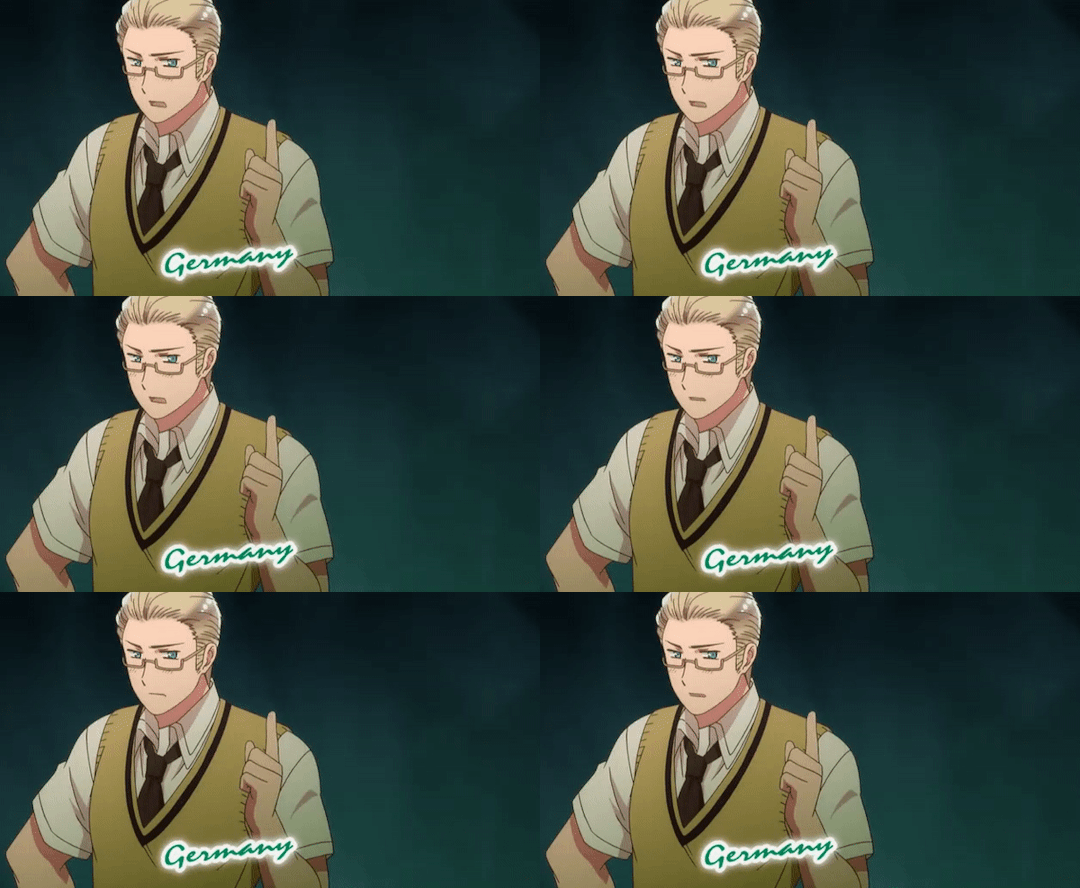
In the anime, what you’ll see is that the process of Germany’s
birth is depicted as a clear result of the German states huddling [combining]
together to form one state.

Meanwhile, in the manga, the process of Germany’s birth isn’t actually shown – all that’s
revealed is the end result. It’s left vague and open-ended, perhaps for the
purpose of giving Himaruya leeway to later confirm that Holy Rome is, in fact,
Germany.

That said, let’s go over the strips that cover Germany’s
birth.

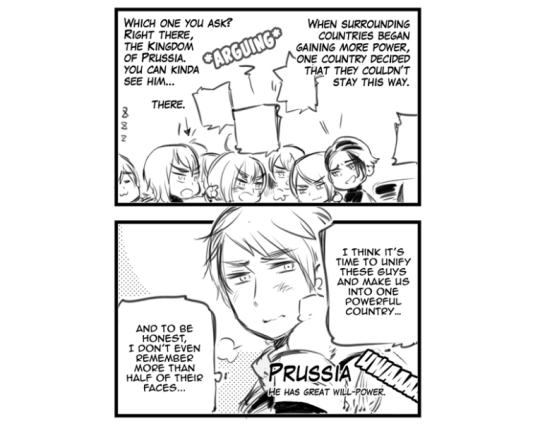
Chapter 12 of World Stars:  

In this chapter, a meeting for all German states is held [x]. 
image

Prussia’s suggestion of merging into one sovereign state is received
well.

image
image

Admittedly, before the German states are able to form
Germany, they’re excited about “the birth of their new baby brother.” I’ll get back to this in a minute, hold on.

image

Austria stops the process and claims that he’ll assume
responsibility over Germany once he’s born.

image

Prussia kicks out Austria from the German Confederation.

image

What’s critical is that when Germany is born, the previous
process in which the German states were to huddle together to form him isn’t
shown.

Instead, the strip skips straight to Germany being born.

image

My explanation:

I’ve done a full post on this [x], but it’s important that I
go over this again before comparing it to other strips.

The reason that I believe the German states aren’t depicted
to be huddling together, only to step back and reveal a new personification –
as shown in the anime – is because the personification already existed.

Holy Rome hid in Prussia’s house after his dissolution

[x]. 

He
didn’t die right away.

image

On top of that, we know that Holy Rome became sick as a
result of the fragmentation and lack of unity in his empire. This illness only
became worse once he was dissolved.

image

I
believe the reason that Germany was born as a young child is because he changed titles. The existing body panel is meant to be taken literally in
this sense. The personification was already alive – but not well.

Note: I also recognize that baby nations canonically wear nightgowns. As I’ll reveal below, I believe Germany was wearing a nightgown for an entirely different reason.

image

As stated in chapter 1 of World Stars, it’s completely
possible for nations to change titles and assume new personalities.

image

Since your
personality is very much driven by life experiences and memories from them, to have a new
personality inevitably means that you’ve obtained new memories.

Or, in Holy Rome’s case, for him to assume a different personality
as Germany would mean that he’d have to completely forget about his past life. Otherwise,
these past memories would influence his personality.

So, maybe Germany’s an amnesiac Holy Rome then…is there any
evidence of that?

Yes.

In the same strip, Prussia reminding Germany that he can
call him big brother several hundred times can easily be interpreted as him attempting to trigger the newly-born Germany’s memories of being Holy
Rome.

image

As such, the fact that Germany emerges wearing a nightgown,
as a child, can likewise be interpreted as an amnesiac Holy Rome – who also
conveniently wore a nightgown in his later days – stepping off his deathbed for the first time. In
other words, German Unification fixed Holy Rome’s health, the only problem
being that he’s lost all of his previous memories.

Ex: Holy Rome, sick in bed as Prussia reads him fairy tales.

image

Ex: An edited comparison of Germany and Holy Rome, both of whom are wearing nightgowns. They also look exactly alike.

Left – Germany, Chapter 12 of World Stars, Right – Holy Rome, Chapter 187 of World Stars.

image

Lastly, this would explain one German state’s sobbing
reaction to Germany being born.

image

This is all behind the scenes speculation, but I believe
what happened is that when the German states initially agreed to form into one
country prior to Austria’s interruption, they believed that Holy Rome was dead.
Remember that Holy Rome was hiding in Prussia’s house. That’s why they thought
they would be gaining a new younger brother.

The reason that the process of Germany’s birth was skipped
the second time around is, again, because the personification (Holy Rome) that
represented them already existed.

This panel, then, can be interpreted as one of Germany’s
older brothers realizing that Holy Rome hadn’t in fact died and had been alive the whole time.

Comic Birz Episode 11: 

Timeline wise, this was made before World Stars. Nonetheless, here too, the process of Germany’s birth isn’t depicted [x]. All we see is the end result.

image

Volume 6: The Life of the Great Man, the Awesome Me

This is a redrawn and reprinted version of Comic Birz
Episode 11. It’s especially important because it’s what the anime adapts, as World Stars hadn’t yet come out at the time.

Notice again how the process of Germany’s birth isn’t
depicted. It doesn’t show the German states huddling together.

image

Bonus: Chapters 20 and 57 of World Stars 

I think you already know what I’m getting at here.

image
image

The Big Difference: The Anime Depiction

Unlike the strips listed above, Germany’s birth in the anime
is drastically different. It actually shows Germany’s birth process.

Episode 5 of World Twinkle animates this, adopting the strip
from Volume 6.

I cannot stress this enough: The German States huddling
together and later stepping back to reveal a young Germany is not canon.

image

With all that in mind, I can see how easy it would be to
assume that Holy Rome and Germany are separate persons just by basing opinions off the anime. While the connection between them isn’t confirmed in canon,
however, the manga leaves things far more open-ended.

Just another thing about your betrayal post. enemy nations will form alliances with each other if it serves to their leaders’ benefit.

Totally! That’s what I love about Hetalia.

The personifications can temporarily hate each other on a
personal level and yet be aligned due to politics.

Or, they can be political enemies and still view each other with
positive regard on a personal level.

Or, they can dislike each other on both a political and
personal level and yet still be allies.

Just to give an example of what you mentioned, we see this
with Austria, Russia, and France during the Seven Years’ War.

image
image

                                                           +

image

                                                           +

image
image
image
image

Note: This is an example and reference post. By no means does this cover every case or detail in the manga. 

PART 1

America:  

Fear of Criticism–

Ex: In earlier strips, he’s
depicted to be reluctant to show England his movies.

image
image

This changes as he later
warms up to showing England his latest movies, only to have it be brutally
ripped apart, again. He’s gotten so used to being criticized by England that he’s normalized it all together.

image
image

Perhaps because of these
criticisms, on top of how poorly his movies are rated, is what caused him to
begin “laughing off the negative as something positive.”

image

Fear of Being Challenged

He likes to be the #1 at
everything. 

image

While it’s not made explicit, it’s clear that others’ opinions
threaten him.

Ex: He claims to want to hear
alternative opinions but later refuses to accept them.

image
image

Ex: He crushes bundled
spoons, likely as a form of intimidation, to prevent other nations from
disagreeing with his world defense plan.

image
image

Fear of Being Alone–

Due to England’s long absences,
he grew lonely.

image

This translates into adulthood,
where he pesters other nations into hanging out with him.

Ex: He breaks into Japan’s
house + desperately tries to convince himself that at least Japan likes him,
despite all other nations ‘hating’ him.

image
image

Discontentment with his
weight–

Ex: He doesn’t like being
called fat.

image

Ex: He refuses to acknowledge
the ‘number’ on his scale and instead convinces himself that it’s broken.

image
image

Austria:

Fear of Being Plain–

Ex: He doesn’t need to wear glasses
but feels simple without them [x].

image
image

Canada: 

Fear of Being Ignored/
Forgotten–

image

Canada was neglected in his
childhood and consequently developed low self-esteem and self-worth.

Ex: He mistakenly believed that
the then colonizing England was looking at
him as a person
and not as a resource when they first meet. If anything,
this fleshes out how young Canada wasn’t accustomed to being valued on a
personal level. As such, he doesn’t value himself later on in life.

image
image

Ex: He at one point believed
that America was disinterested in him.

image

Ex: He was once too shy to communicate
with America directly, so he used England as a mouthpiece.

image

Ex: He cries when Seychelles
remembers that he’s a member of the G8 .

image
image

Discontentment with Looks–

Ex: He doesn’t think he’s
good looking.

image

England:

Fear of being weak + inferior–

Ex: After being conquered
several times over, young England aspired to become strong himself.

image

Ex: He longs for the golden days of his empire [x].

Ex: He especially feels
inferior when America surpasses him in manufacturing during the Second Industrial
Revolution.

image
image

Ex: In “England’s Plan to Be
the Strongest”, England trains to become stronger – an implicit acknowledgment
that he’s lost power.

image

Low self-esteem–

Ex: As a child, he took France’s teasing
insults to heart and believed that he was “unrefined.”

image

Ex: While he’s critical of
others, he’s just as critical of himself. He’s self-deprecating.

image
image

Fear of Being Alone–

As the “Black Sheep of
Europe, he was constantly isolated from other countries.

image

Ex: The American Revolution.

image
image
image

Without exaggerating
and as I’ve proven in other posts, the nations suffer from a lot of things; to
name a few, anxiety, depression, and PTSD. One thing that they don’t have and
have never suffered from is Stockholm Syndrome.

Of course, the whole unequal power dynamic between the conquered country and
their conqueror makes for an unhealthy relationship, no doubt. However, it’s
within these relations, problematic as they may be, that the conquered
countries are able to form better personal relationships with their ruling
country.

What needs to be
differentiated here is that the nations have a persona as well as a person. Put
another way, they relate to each other both politically and on a personal
level. This is why you’ll see nations fight over one seeking to obtain sovereignty
and yet still attempt to befriend each other despite their hostile political
relations.

Ex: America wanting
to visit a sick England after the American Revolution.

image

Regardless if the
nation is conquered and ruled over, what I’ll argue is that they’re still able to
exercise agency and free will. Not only that, but they don’t wholeheartedly
comply, have their own opinions, and their survival is never threatened should
they oppose their ruling nation. It’s for this reason that Stockholm Syndrome
doesn’t compare to what we see in Hetalia.

There are many
problems with the characterization in these earlier strips [x]. Stockholm Syndrome
isn’t one of them.

What is Stockholm Syndrome?:

Stockholm Syndrome
occurs when a hostage forms an emotional bond with their captor. This, in turn,
is at first a survival response that eventually becomes internalized and warped
into an unhealthy attachment. [x]

The victim’s response
occurs in four stages; shock, denial, traumatic depression and recrimination,
and resolution and integration.

The shock stage
occurs when the victim realizes that their life is in danger. On a surface
level, their behaviour appears to be cooperative and friendly when they abide
by their captor. In reality, they’re only trying to stay alive.

The denial stage occurs
as this cooperative rationality further moulds itself into the victim’s
thinking. The victim minimizes and dismisses the abuse committed by their
captor as they spend more time with them.

The traumatic
depression and recrimination stage occurs when the victim begins to see their
captor more and more as a provider. This is called traumatic infantilism, which
entails the victim’s becoming increasingly compliant, obedient, submissive, and
more sympathetic toward their captor. It’s a survival tactic whereby children
are engrained to cling to their caregivers for protection.

The last stage, resolution
and integration, occurs when the victim loses their agency [identity] and
identifies with their captor. In their eyes, their captor gives them life. This
is especially in cases where the victim’s life is saved by the captor.

The attachment grows
so strong that being released from their captor is now seen as the danger
rather than being with them. Again, it’s like a child being separated from
their parent. The trauma causes the victim to develop an infantized mentality. They cling to the figure with the most power, someone who can offer the most protection.

That said, let’s tie
this back to the strips.

Why Italy didn’t have Stockholme Syndrome:

Don’t get me wrong.

The trauma that both
Italy brothers went through in being conquered and fought over by other
countries is not healthy at all.

image
image

Holy Rome attempting
to drag Chibitalia against his will is not healthy.

image

Austria’s harsh
punishments of Chibitalia are not healthy.

image
image

Despite all this,
Chibitalia does not have Stockholm Syndrome.

I’ve said this
before, but a lot of the older characterizations of the nations are cruder,
more exaggerated, and not up to par as they are now. Hima’s grown as a
content creator, and it’s important to recognize that. 

I acknowledge the
problems of these earlier storylines.
All I’m aiming to do is prove that
Chibitalia isn’t a victim of Stockholm Syndrome.

Chibitalia’s life isn’t
ever in danger, unlike a victim of Stockholm Syndrome. Although, he is
a hostage in that he has no choice but to live in Austria’s house.

image

It’s bullying that
Chibitalia fears, not a fear for his life.

image
image
image
image

The boss and house
system that the series depicts involves the conquered nations acting as a
servant to the ruling nation.

image
image

Despite this power differential, they live together and have been seen
to treat each other as family members.

image
image

Chibitalia still
exercises agency and opposes Austria and Holy Rome on several occasions.

If Chibitalia’s life
was truly in danger, he wouldn’t have drawn a mustache on Austria’s portrait.

image

Nor would he have painted,
dressed up in costumes, or spent more time with Holy Rome than he absolutely
had to. Politics and nationhood personas aside, they’re people living in one
house, dysfunctional as the reason that brought them all together was.

image
image
image

Not to mention that
Chibitalia refuses to form an empire with Holy Rome. 

However little power that
he had, Chibitalia wasn’t wholeheartedly complying to demands in order to
survive. He didn’t sympathize or adopt Holy Rome/ Austria’s perspective as his
own. Instead, he maintained his individuality and held firm on his opinions.

image
image
image

If anything, Holy
Rome learns from Chibitalia and apologizes for all that he’s done before he leaves for war.

image

Admittedly, there is
one moment where Italy is taken hostage by Spain in the Maria Theresa Series. When given a choice between
the two, Italy chooses to stay with Austria. This is the closest that we come
to an aspect of Stockholm Syndrome, and yet, it’s distinctly not the same.

image
image

Just imagine it.
Italy loses his grandfather, his security blanket and protector, and is living in
a new house with big, scary adult nations. Eventually, they warm up to them and
he grows accustomed to the new niche he’s found. Being conquered and having to
move again would disrupt that environment – his comfort zone.

That’s why I believe
that Italy chose Austria. It didn’t have to do with survival. Spain would have
taken good care of him, probably even better than Austria in terms of emotional availbility. Italy
simply wanted to stick with what he was familiar with, with those whom he had
formed a close personal bond.

It’s also important to mention that Italy is still a child in this strip. He’s
terrified and respectively clings to Austria because that’s who he’s been
raised by ever since Rome’s passing.

Lastly, when he’s not
forced to choose between who he’s ruled by, Italy doesn’t perceive his freedom
from Austria to be dangerous, as would someone with Stockholm Syndrome. He
zealously fights for his autonomy.

image

In sum, while many
aspects of the older strips are questionable and problematic, applying a label as severe as
Stockholm Syndrome is not warranted. It actually detracts from the discussion
acknowledging how the series has evolved for the better…

There’s nothing wrong with
acknowledging past mishaps of a content creator if they’ve already proven to
have learned from these mistakes.

image
image

This is a lot to unpack, but, to put it briefly for now,
Chibitalia/ Italy does NOT have Stockholm Syndrome. If you research the
definition and the respective components required for it, the situation with Holy
Rome and Austria doesn’t even come close to fitting it.

Yes, there are some
very unhealthy aspects
regarding the power dynamic of being conquered and
forced to live under someone else’s roof.  I’ll go into more depth of that later. Still,
while Italy may have bonded with Austria and Holy Rome, none of it comes from a
need for survival.

Not only that, but Italy opposed Austria and Holy Rome’s viewpoints
on several occasions rather than wholeheartedly agreeing with them. Stockholm
Syndrome involves no agency on the part of the victim. Italy, on the other
hand, exercised his own agency and independence regardless of how restrained
his freedom was.

This disorder isn’t something to be applied as lightly and
easily as it has been in the fandom. It lends the series a lot of unnecessary
bad rep.

Anyways, post on young Italy’s home environment coming up
tonight.

image
image
image

Note: This
theory will make use of Freudian theory. While I recognize that Freud’s ideas
do not bear much contemporary relevance, that shouldn’t take away from the fact
that many of his concepts (e.g., erogenous zones, childhood memory repression,
catharsis) are nonetheless employed by Hima in the series. The purpose of this
post is to give some insight into the psychologies of the characters.

image

Terms I’ll go over: Psychosexual stages of development, Causality, Oedipus
Complex, Electra Complex, Penis Envy, Castration Anxiety.

Yes, that’s right. Freud’s ideas are very much prevalent in the
series. A big area of his work was analyzing the impact of childhood on
personality development. Freud believed in causality, meaning that who you are as
an adult can be directly traced back to your childhood.

How you’re parented and
brought up is the most crucial factor. I don’t need to go into this in too much
detail, but basically, we go through five stages of development titled: Oral,
anal, phallic, latency, and genital.

For the purposes of this
post, I only need to talk about the phallic stage of development.

The phallic stage occurs
between 3-4 until 6-7 years of age. This stage involves the awakening of sexual
desires. However, I cannot stress this enough that the sexual desires are
autoerotic, meaning that the child does not derive any sexual pleasure or
stimulation.

Basically, the child merely
becomes aware of the fact that their genitalia differentiates them physiologically.
This would involve them developing a curiosity of their genitalia given that
they’ve gained a newfound awareness of it.

image

Another tenet of the stage
involves the child being unconsciously attracted – again, not sexually – to their opposite-sex parent and developing a
hostility toward their same-sex parent.

For example, it’s common for
little boys to claim that they want to marry their mothers when they’re older. The
love isn’t sexual, at all. It’s predicated on the child wanting to be closer to
their opposite-sex parent.

If anything, the stage
involves a perceived competition between the child and their same-sex parent
for the attention of the opposite-sex parent. Put another way, a little boy
would perceive his father as a barrier to receiving his mother’s full love and
affection and would thus develop a hostility toward the father.

It’s all unconscious. The child
doesn’t realize why they feel this way, but they do. Another example of this
would be children hopping into bed with their parents. They unconsciously split
up the parents without realizing the meaning behind their actions.

Boys develop an Oedipus Complex,
which involves them desiring to possess their mothers and replace their
fathers.

Girls develop an Electra
Complex,
which involves them desiring to possess their fathers and replace
their mothers.

For this hostility/ stage to
be resolved, the child must learn to identify with their same-sex parent.

If this hostility/ stage goes
unresolved, however, the child can develop another complex depending on their
perceived gender.

Boys develop castration
anxiety, a fear of losing their penis resulting from the jealousy and
competitiveness they feel toward their father.

Just to unpack that a little,
Freud’s theories are allegorical. The child doesn’t actually fear losing their
penis. What they do fear is losing the power associated with it. That said, it’s
critical to situate the context in which Freud came up with these theories.

A little boy perceives his
father in the family to be the most powerful figure – that’s because at the
time, society was strictly patriarchal. Those with power at the time had penises;
male genitalia and power are unconsciously equated together. In competing for
his mother’s affection, the little boy wants to overthrow the father’s power in
the family dynamic.

If the Oedipus Complex goes
unresolved, and the male child fails to identify – form an alliance – with their
father, then they perceive this competition to be lost. As such, they lose
power.

Castration Anxiety at its
core has to do with the male child perceiving themselves to have lost against
their father as opposed to forming a bond with them.

On the other hand, girls who
fail to form an alliance with their mothers develop feelings of Penis [power] Envy.
They are unhappy with the lack of power they have and don’t identify with their
mothers and their respective social position.

Where Hungary Fits Into This: 

Hungary’s tricky, because she
originally didn’t identify as a girl. She thought she was a boy for centuries
and therefore identified as such. Regardless, what you’ll see with Hima is that
he purposefully makes references to Hungary’s confusion over her genitalia.
That’s what really locks her into this stage of development.

Castration Anxiety: 

To begin with, Hungary was
raised as a man by Magyar. He taught her how to fight.

image

That’s why, when she loses to
Turkey on several occasions, she questions whether she’s strong enough. Her
strength is seen as a sign of manhood. This would be her experience of
castration anxiety… of losing power and being weak.

image

Power Envy:

The penis envy complex with
Hungary doesn’t develop right away. She [He] identified with her same-sex
parent without any problem despite the fact that she lacked a mother figure. Point
is, Hungary, as a boy, identified with Magyar, the father-figure.

The complex develops as
Hungary slowly begins to realize that she’s different physiologically from
other boys.

She develops chest pains but
is quick to wave this off. (Her breasts are growing, but she doesn’t realize this.)

image

The differentiation stage
begins when Hungary mistakenly tells Prussia that men grow penises when they’re
older. 

image

Prussia, of course, tells her that that’s not how the male genitalia
works.

image

What’s important here is that
Hungary’s conceptions are beginning to shift, even if she doesn’t believe it
right away.

image

Right before she settles down
in Austria’s house is the last that we see of her dismissing her physiological differences. Prussia’s reaction to her exposed chest as he fixes her injuries is what does it for her.

image

It’s tentative, but she still recognizes her physiological difference.

image

One joke in particular from this scene is
important, silly as the surface of it may be. Prussia offers to treat Hungary’s injuries by ripping off his crotch cloth.

The symbolism of this is that by refusing the crotch cloth, Hungary’s embraced her womanhood.

image

I don’t think Hima did this
for strictly comical purposes.

Not to mention that one of
her character notes explicitly states that she developed a complex over
worrying about her fighting skills getting rusty after settling down. [x]

image

Ex: A lot of this stems from the
fact that she first existed as an equestrian tribe and used to hunt with a bow
and arrow. 

[x]

Under Austria’s rule, notice how
conflicted she is when she says that she has “no interest in hunting.”

image

Nevertheless, this shouldn’t be
any reason for worry considering that Hungary’s also noted to be one of the manliest
characters in the comic…

image
image

…and for a damn good reason
too.

image
image
image

One thing that angers a lot of people and bothers me personally is Hungary’s relationship with Austria when she was living with him. She should have hated him because of how her people felt at the time. Why didn’t she?

That’s not necessarily
true, though.

In one of her
character notes, it states this:

She does have
defiant feelings about being under Austria’s rule but at the same time she
harbours complicated, yearning like feelings towards him.

I think the point to differentiate is that the
nations are both historical personifications and people in their own right.
Hungary could have hated Austria for being, well, Austria, and yet yearned for
him as a person. [x]

That’s what I believe Hima’s getting at here.

image

Q & A

Q: If
the UN has a personification does that mean the EU also has a personification
or is it not significant enough to have one? Another question is that why do
you think certain countries haven’t been given a personification in the hetalia
series, countries like aph Indonesia and Hawaii, is there a reason for this or
is it just a creative choice by the creator?

A: The EU does not have a personification.
There’s no real reason for this. It doesn’t have anything to do with
significance.

 As for creating other characters, Hima typically cites that he
wants to travel to the country in question before he personifies them.


Q: How
much does France like anime?

A: A
significant amount considering that it’s so popular among his people.
Characteristics of the population are often reflected in the personification’s
attitude, behaviour, habits, and overall personality.

Ex: He’s
involved in a debate over anime voice actors with Japan, Taiwan, Vietnam, and Thailand.

image
image

Q: Any
theory of why France has some perverted tendencies? I know that he just likes
to show affection to others, but sometimes it goes too far.

Q: Why does France strip people, like that’s a pretty recurring
theme from the napoleon strips he was shown to have the thing stripping people from their clothes
and during the Christmas event of 2007 he stripped a bunch of nations naked.

A: It
did go too far.
The old characterization of France is pretty awful. However,
the sexualized humour of it is not what people think. It’s honestly just bizarre,
but it does have a logic to it.

France’s stripping of people doesn’t have to do with a French
stereotype of sexuality from my understanding. It’s a historical representation
of how France picked and reaped at leftover territories after European conflicts…
a scavenger if you will. A good idiom in relation to this would be stripping something to the bone.

Just like France stripped Austria for winnings after the War of
Austrian Succession, this was likewise translated into how he interacted with
other nations – by stripping them. [x]

image
image
image

Hopefully, this makes sense, yes?


Q: Do
you think that England has some “big brother” trauma?

A: 100% he does.

Ex: England tears up when he’s faced with the prospect of
becoming America’s guardian. At first, he actually hesitated in accepting the ‘big
brother’ label because of how poorly he was treated by his own older brothers. [x]

image

The bad memories of his older brothers’ treatment of him that England doesn’t even accept the label of ‘big brother’ at first when he assumes responsibility for America.

image
image

Also… 

image

Q: Are
the nations’ homes and/or things provided by the state or they work and earn
money themselves to pay for their own stuff?

A: It’s not clear whether the state provides anything for them.
All we know is that the nations work for their bosses and that the wealth of
the country is reflected in how much money the nation has (e.g., GDP).

Ex: France’s wallet is empty as a result of his economy’s poor performance. [x]

The personification is a physiological embodiment of their nation. Each city/ landmark is reflected in one part of their body.

That’s why, when France ‘rubs’ Italy’s chest during an economic recession, he’s looking for territory to leech money off.

image

 Do you see what I mean by bizarre logic?

image

Briefly put, we know that Prussia is East Germany, but he hasn’t been formally introduced or referred to as such. 

On the wiki page, they cite “Germany is playing an impossible game” as the strip where Prussia’s status as East Germany is confirmed. It pretty much is [it refers to German Unification], but again, it’s not explicit. Technically, it’s not confirmed then, as I’ll elaborate on later.  

I actually disagree with how this was done. No matter how obvious something is, I’m of the mindset that things shouldn’t be accepted as canon until it is explicitly stated as such. Most East Germany references have to do with German Unification or Prussia working for Russia, however, no labels are given…

Guide on what we know about Prussia’s extremely probable status as East Germany coming up tonight! 

image