Note: I made a timeline error, as pointed out
by @feyna-v. Thank you! Please disregard the last few posts. It was a
silly mistake on my part. Thank you!
It’s not clear when exactly
Italy goes through the later stages of puberty, but unless there’s an
inconsistency in the timeline, it appears that it occurs before the Austrian
Wars of Succession. Once Italy voice drops, Austria and Hungary buy him male
clothing to wear.
In the Maria Theresa series, Italy is
shown to be wearing boy’s clothes. He’s also shorter than his adult height,
which means that he hasn’t matured in full yet.
Later, as he begins fighting for his independence from Austria,
you see that Italy has grown up, or has at least come very close to it.
The same thing happens with Romano too. Before he leaves Spain’s house, he’s matured significantly.
That said, Italy went through puberty some time before the Austrian Wars of Succession, and aged into an adult as he got closer to his independence.
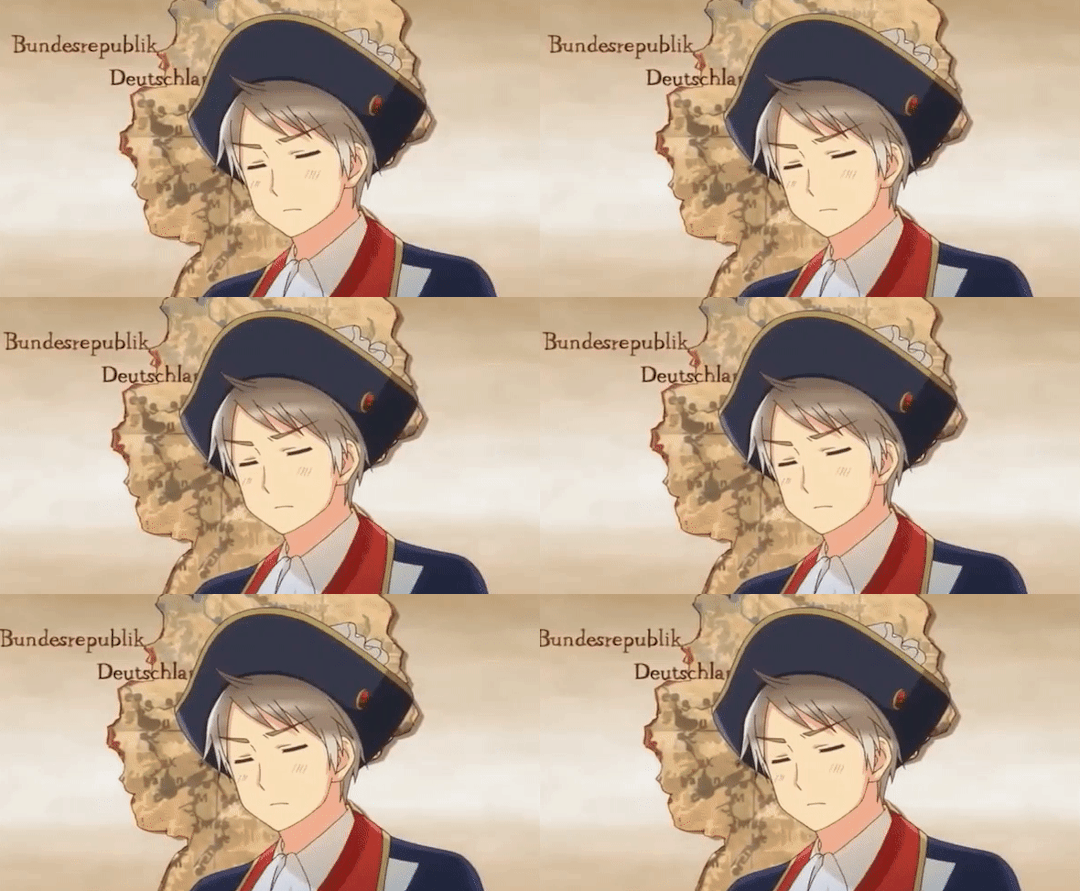
Let down my guard and tell you brats how I feel a second
Now I’m the model of a modern major general
The venerated Prussian warrior whose men are all
Lining up, placing me up on a pedestal
Writin’ letters to relegates
Embellishin’ my elegance and awesomeness
But the sheep is in the room
The truth is in ya face when ya hear the British cannons go…
The answer to the title is no, by the way. To
elaborate on why I believe this is, it’s important to understand that the modern
definition of a nation-state is much different now than what it was centuries
ago. People often organized themselves in terms of city-states, kingdoms,
principalities, or small territories.
That said, during the Renaissance era, Italy
consisted mostly of small city-states. This would explain Italy’s full name,
Italy Veneziano, an obvious reference to the city of Venice. This fragmentation
was due to the larger foreign powers of Austria, Spain, France, and the Holy
Roman Empire coming in and taking land for themselves.
However, as I just said, Italy Veneziano is
repetitively referred to as North Italy, which simply includes Venice. He
doesn’t only represent Venice. I
don’t mean to say that North Italy wasn’t born
to represent Venice, though. That certainly seems to be the case. What I am
saying is that as the concept of a nation changed, so did Italy. He likely absorbed
the entire northern region. I mean, we’ve already seen this multiple times in
the series where nations adopt new lands and titles. Take the Teutonic Knights
and Prussia for example.
Now, this wouldn’t be a theory if I didn’t have any evidence, so here.
Then, at the end of the strip, North Italy mentions
that parts of his house were taken. We already know that a nation’s house, or
rather, an empire to be more applicable to the time period, consisted of other
nations under their rule. However, in Italy’s case, his house consisted of the
many different sovereign city-states of northern Italy.
So no, I wouldn’t worry about Italy Veneziano
disappearing anytime soon just because Venice is likely to sink in the coming
years. He’s got the whole rest of northern Italy to embody.
Further, and as I’ll get into with a much, much larger post, there is no dominant
Italy – between the two Italian brothers, I mean. The south and north are different
enough for them both to personify the land, and Hima makes sure to mention this
countless times.
I sure do, that’ll be tonight’s theory! I’ll be building on this panel to explain how his soul, or rather, spirit, is characterized. Big surprise, Hima used another pun.
Despite the lack of political marriages between the nations today, I always imagine that they’re still able to get married as humans. Like, they have citizenship as any other regular human would, and get married as such without it having anything to do with the fact that they’re nations.
Since
it’s unclear when Ancient Rome died, as we don’t know whether he personifies
the Byzantine empire or not, it’s hard to say how Italy’s life was afterwards.
As for your second point: that
seems about right. Basically, in very generic terms, the Treaty of Verdun (843)
broke up the Carolingian empire.
When Louis the Pious died – son
of Charlemagne – his sons began fighting for his inheritance. One son, Charles
the Bald received the Kingdom of the West Franks (France). Louis the
German received the East Franks (Germany),
and Lothair – who kept the title of Holy Roman Emperor – gained the middle
strip which included the Papal States (part of Italy) and Lorraine (part of France).
In short, it created rough boundaries that would later develop into France and
Germany, but not quite Italy yet, as it still consisted of several smaller
states at the time.
Let’s tie this back to Hetalia.
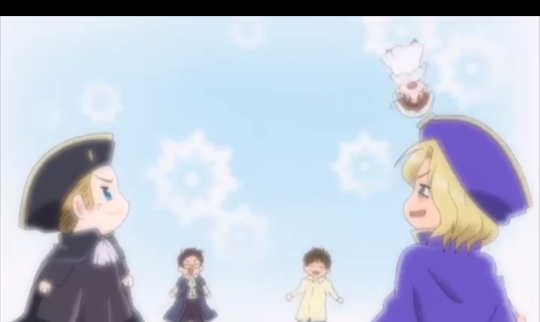
I’m pretty sure the scene you’re referring to is when Austria, Spain, Holy
Rome, and France are kicking around Chibitalia (and Romano) like they’re soccer
balls, right? This can be seen as the brothers fighting for inheritance/
dominance over the land, despite none of them receiving Venice right away,
which I’ll get into in a second. I should also mention why Spain and Austria were
there: Spain was part of the house of Hapsburg, and Austria pretty much
controlled the Holy Roman empire.
Anyways,
Venice (Italy Veneziano) was a politically independent state at the time of the
treaty. Eventually, Austria succeeded in acquiring Chibitalia. Holy Rome’s
obsession with Chibitalia has a lot to do with the fact that despite
controlling Italian territory, Venice wasn’t under his jurisdiction until
Austria assumed control over Chibitalia.
Thank you for sharing your
thoughts 🙂 Given the history, your theory is very well
supported. I definitely believe it!











 Ellawritesficssometimes