Thank you! Happy Canada Day to my fellow Canadians.

Thank you! Happy Canada Day to my fellow Canadians.


In light of
Canada day, I think it’s about time that I dedicated a full character analysis
to him. What I aim to do is disprove any claims that Himaruya has made Canada
into a flat, two-dimensional character. It’s quite the contrary.
Canada’s
well-known for his invisibility and the overused jokes that accompany this
characterization. However, to say that this is all that defines Canada is to
overlook the amazing depth that this invisibility has on his personality.

While it’s
easy to look at Canada as the nation that’s ignored during meetings, what this
post will explore is the ways in which Canada’s character is far more fleshed
out than what is popularly conceived in fanon.
From birth,
Canada was objectified by European colonizers for his abundance of resources [x].


After
England fights France to assume control over Canada, Canada mistakenly assumes
that England is the first nation to actually look at him as a person and not
merely as an asset.

In reality, England was staring at Canada’s hair, which he
had inherited due to French influence.

When told
that England will become his family, Canada is ecstatic. He had grown
accustomed to being valued for his resources rather than as a living being. Already,
we begin to see how Canada’s worth is not attributed to his person—who he
is.

The
importance of this scene will be critical to understanding why Canada suffers
from such poor self-esteem in his adulthood.
The main
complex that Canada suffers from is that he lacked a solid identity and
conception of himself. Being surrounded by greater, more politically and
economically relevant powers when he was younger can mainly be attributed to
this.
Canada’s
self-esteem was contrived in relation to those around him. He felt inferior,
and these feelings later became entrenched in how he views himself.
Ex: Canada
grew up alongside America, who excelled and aged at a much faster rate [x].

Ex: England
devoted a lot of his attention toward America, leading Canada to feel neglected
and excluded [x].

Living in
America’s shadow consequently caused Canada to believe that he wasn’t worthy
of the latter’s attention.
Ex: He once believed that America was disinterested in him [x].

Ex: He used England as a mediator to speak on his behalf to America. Notice
how America is perplexed by Canada’s behaviour here. Canada thinks poorly of himself and attributes this same train of
thought to how he perceives others to think of him [x].


Although, it also has to do with the fact that America doesn’t believe that Canada has an accurate conception of the real world, and, therefore, isn’t ready to gain his independence [x].

What’s even
more unhealthy is that Canada uses America as the means of assessing his worth.
Ex: He
believes that he’s simply a plainer version of America given their similar looks [x].

Ex: He
doesn’t believe that he’s handsome [x].

Ex: When England
falls ill after the American Revolution, Canada cries and claims that even
though he’s not as strong as America and doesn’t possess a lot of money, he’ll
try his best to heal the former [x].

The irony
of this is that it’s alluded that Canada may possess his own form of
superstrength. In the same arc, America tries to force himself into Canada’s
home after being denied access to visit the then sick England. Canada is able to shut the door on him [x].


Of particular interest to me is how in Canada’s fantasy, England’s cheering him on, likely symbolizing how badly we wants the latter to pay more attention to him.
Constantly being
overshadowed by America and England and internally comparing himself to America
created a lot of tension and frustration in Canada.
It’s only
during his independence arc where we begin to see him release these emotions.
Canada wants to form his own autonomous identity. To him, America
contravenes and gets in the way of this from happening.
Ex: Canada
reprimands America for being selfish and self-absorbed on several occasions [x].


Even after
gaining his independence, Canada lacked a solid self-concept and was still
mistaken for America by other nations.
Ex: Cuba mistakes him as America [x].

What’s
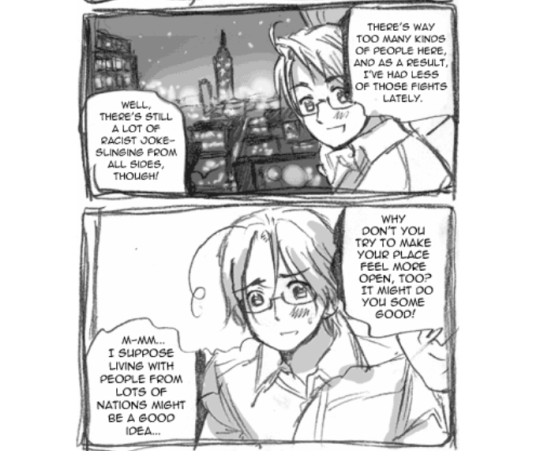
always been a seamless turning point for me is how it was America who helped Canada
form his multi-cultural identity.


The
culmination of these arcs, albeit seemingly to be nonessential and unimportant,
is when Seychelles recalls Canada as a member of the G8 [x].

Years of
being forgotten and neglected caught up to Canada. Trivial as the situation may
be on the surface, to be remembered is to be important enough in the eyes of
another person. It’s a foreign and gripping moment that causes him to cry.

Likewise,
because this is so foreign to him, Canada doesn’t know what to do with himself.
In other words, he overcompensates by excessively reinserting his identity,
which remains fragile and still in a developing state.

This fragility
is most seen when America appears and laughs at Canada’s ridiculous clothing [x].
“There are times, every now and then, when I want to stand out from the shadow or let my hair down too!”

Another
parallel between the two is then introduced: Canada doesn’t want to remain in the
shadows and vies to be well-known in the world just like America; meanwhile,
America is jealous of Canada for his ability to get along with everyone.

In sum,
Canada’s invisibility lends his character most of its strength. It is through his
journey to establish himself that it becomes clear that Canada is not as
passive as one may think. For his entire life, he’s fought to
be remembered. It would follow, then, that his invisibility perhaps had a
double meaning to it; it was a physical reflection of how hollow, empty and
lacking he felt on the inside, a personal identity that needed to be filled and discovered.

Canada, to America: I’m not too patriotic. You’re just projecting.
Also Canada:


One thing I’ve noticed is that fans approach and analyze
relationships between the nations from a human perspective. The problem with
this is that it doesn’t capture the elasticity and interchangeability of
titles of beings who are immortal– not mortal– go through. In other words,
aside from direct biological relations which don’t change, you can’t apply
words of human organization to immortal beings who routinely change how and who
they relate to.
For example, just because a nation lives with another
nation, doesn’t automatically make them family. In the case of a nation, they
don’t live with other nation(s) by choice but rather circumstance. Often
enough, it was the product of being conquered.
Some nations living together will choose to identify as a family,
as their bond as a unit most closely resembles one. Nonetheless, these
families, or households rather, are temporary.
Ex: Hungary refers to Holy Roman Empire’s household as a
family [x].

Ex: Having lived with France in Rome’s household
for some time, young Italy referred to France as big brother.

Out of respect, some nations will continue to refer to the
other nations they lived with as an older brother. In Japanese, “onii-chan” is
a term coined out of affection and adoration for a figure. It doesn’t mean
older brother in a blood sense.
Ex: France claims to be the older brother figure of the
world. Meanwhile, only Italy and Monaco choose to refer to him with this title
of affection [x]. Again, not to be mistaken with a relation.

A nation can be a guardian for several centuries and later
evolve into a companion, friend and/or mentor figure.
This is best seen with America and Canada, biological
brothers who temporarily held a family unit with their colonizers. Although,
they didn’t physically live together, settling for occasional visits instead.
For one thing, it’s important to distinguish the fact that biological relations are inherently sensed by the nations.
There’s a difference between Iceland, who senses Norway to
be his brother from birth [as does Norway]… [x].


…and England and France, who make America and Canada their
family [x].


Ex: America doesn’t inherently sense a brother among his
colonizers, Finland, France, and England.
Instead, they fight over who will assume the role of
America’s brother [x].


As mentioned, it’s difficult to apply human words for
relationships to capture relationships between immortal beings. It doesn’t
quite fit. Think of it this way: The nations have unique experiences that we as
humans will never have. So, why are we using words that describe our
experiences to describe theirs?
Respectively, England has trouble deciding what America
should call him.


Again, notice America’s choice of the word onii-chan.
Titles like guardian and older brother, two very different
terms, are loosely thrown around. Of course, older brothers can be guardians, but you’ll see what I mean by this muddled distinction in a moment.

It’s hard to make sense of a relationship
using words that don’t describe but instead confine and water down the
complexity of the colony-colonizer and simultaneous guardian-adoptive
relationship they’ve established.
This uncertainty and fumbling to find words that best
describe their relationship is seen again when America declares his
independence. Even he doesn’t know if what they had entailed a parent-child or
sibling relationship [x].
Nonetheless, he cuts off these ties and no longer views
England as this type of figure for him.

The point I want to emphasize is that due to political
circumstances, the nations’ relationships with each other are dynamic. It’s not
as rigid as human forms of organization; therefore, it doesn’t make sense to
approach these family-like dynamics from a human perspective. It’s like
comparing apples and oranges.
Lastly, to avoid falling into a trap of reasoning, there’s a
stark difference between conquering/ colonizing a nation and living together and
willfully forming a union [economic or political] and living together.
Ex: Switzerland adopted Liechtenstein into his household and
the two consider each other to be siblings. Because this is how they presently
identify and relate to each other, they are siblings.


What this post will explore is the impact of England’s
parenting style on Canada. There is no good and bad here. All I aim to do is
give reason and meaning to the problematic behaviour and relationships that are
depicted in the series. The characterization is done for a specific purpose. What
I seek to do is bring several parallels to light to prove this.

One of psychologist Karen Horney’s theories explored how
problematic parent-child relationships often result in the child developing
neuroses (mental health complications), such as anxiety or depression.

However, rather than assert all the blame on the parent, she
went on to explain how parents who have been reared in an environment void of
love, care, and affection are incapable of raising their kids in any other
manner.
Put another way, parents pass on their neuroses to their
children. You can’t expect someone to provide the care, warmth, and love that
they’ve never experienced and learned themselves. On the other end of the
spectrum, these problematic parent-child-relationships and parenting techniques
are learned and repeated through generation-to-generation. It’s a cyclical process,
that, unless consciously recognized, results in all sorts of emotional trauma.

What Horney believed to be the Basic Evil of these problematic parenting styles is Parental Indifference, which can also
include a hostile or rejecting attitude of the parents toward the child. This
parental indifference can cause the child to develop feelings of Basic Anxiety or Basic Hostility – both of which, if not attended to, can lead to
mental health issues.
For the purposes of this post, I only need to focus on Basic
Anxiety. Basic Anxiety occurs when the child develops feelings of loneliness
and helplessness in a world that they perceive to be hostile and dangerous.
That said, what I’ll now analyze is how England’s own
upbringing and resulting mental health issues were passed down to
Canada.
Let’s tie this back to the strips.
England’s isolated upbringing as the Black Sheep of Europe
leads him to unconsciously replicate this isolation in how he raises Canada.
Since he grew up alone, he doesn’t see a problem in leaving Canada for long
periods of time.

He even admits to America that this is what he had to go
through as a child.

Thing is, while this is normal for England, it’s obviously
an abnormal parenting practice. The point to stress here is that England is
repeating the problematic parenting styles of his older brothers, who played no
part in raising him. They would send him hexes or drive him away with
arrows if he got too close for their liking [x].

The parallels of loneliness and helplessness are quite
clear.
Ex: England feels
isolated in Europe, often a result of his hostile attitude toward other
nations.

Ex: He feels
helpless when he realizes that everyone has turned against him during the
American Revolution [x].


What hurts Canada is that when England does visit, most of
his attention is devoted to America.
In another post [x], I’ve explored how Kumajiro acts as a mouthpiece
for Canada; he voices the feelings that Canada doesn’t dare to say out loud.
Ex: Kumajiro
tells Canada to stand up for himself. At the time, he wanted to ask England to
have lunch with him.

Ex: Kumajiro uses
stuffed animals to draw an analogy concerning how excluded Canada feels.
England neglects Canada in favor of America. Nonetheless, England still cares about Canada [x].


Canada experiences his exclusion in that he’s not memorable
to other nations and is often forgotten and rendered invisible.
Ex: The remaining
G8 members don’t recall him during a meeting [x].

Ex: He’s often
mistaken as America, especially by Cuba.

Constantly being ostracized and insulted by other nations
has had a devastating impact on how England views himself. Those who are hurt, hurt others [x] [x].


Canada too suffers from self-esteem issues.
Ex: He doesn’t believe that he’s handsome [x].

Ex: He believes that America is disinterested in him [x].

This escalates in Canada being too shy to speak to America
directly. He uses England as a mouthpiece instead. All of this is reflective of
his low sense of self-worth [x].

While this side of England isn’t revealed often, he’s an
incredibly sensitive person.
Ex: Visiting America – a child that loved him
unconditionally – helped England cope with his anxiety over being excluded from
European circles.

Ex: He tears up when Canada comes to his aid during the
American Revolution [x].

Ex: He drunkenly sobs in front of America, revealing how he
wishes that their relationship had turned out better [x].

Ex: He tears up after watching a fantasy movie, lamenting
over how harsh reality is in comparison [x].

Canada’s sensitivity relates more to his fragile sense of
self and identity.
Ex: He cries when Seychelles remembers that he’s part of the
G8 [x].

Ex: He cries when England falls ill after the American
Revolution and worries about whether he’ll be able to successfully nurse the
latter back to health [x].

We all know how hot-headed and temperamental England
can be. There is no question about that. It’s what he’s most known for [unfortunately].
On the other hand, what most don’t recognize about Canada is
that he also has quite the temper.
The only difference is that Canada has much more patience
than England. It takes a lot to make him angry. Regardless, Canada will still
stand up for himself if his buttons are pushed too far.
Ex: Canada once spent three hours pointing out America’s
faults, causing the latter to cry [x].


Throughout his and America’s independence arcs, Canada on
several occasions calls out America for his self-righteousness and hypocrisy [x] [x]


In sum, I highly recommend looking into the similarities
between England and Canada’s sense of self. While their personalities may be
different, they uncannily suffer from the same mental health issues.

England: What’s wrong with him? You’d think he’d just been traumatized.
France: He turned on the news.
England: So?
France: It was American news.
England: Oh dear god.

England isn’t a good parent figure, far from it, but you’re wrong
by saying that he wasn’t grateful for the help Canada gave him. That’s a
misconception that needs to stop being perpetuated.
Ex: He tears up when Canada comes to his aid during the American Revolution [x].


Ex: There’s this exchange that you mentioned where England falls ill and Canada tries to nurse him back to health [x].

I’ll kindly direct you to my post directory, considering
that most of my posts tackle how Hetalia is riddled with serious,
thought-provoking, and dark subject matter [x].
The scars that accumulated on Lithuania’s back, a
consequence of being under Russia’s rule [x].

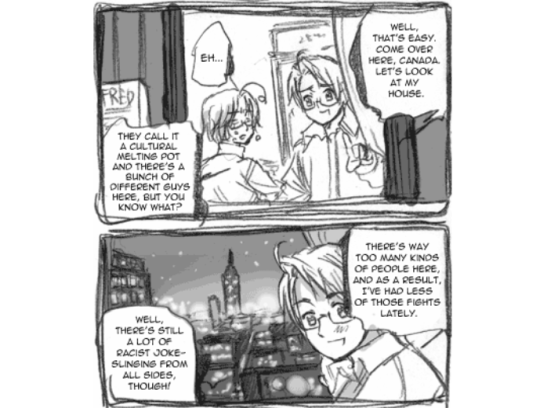
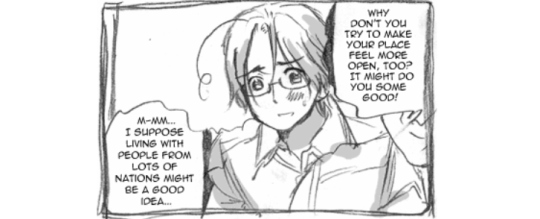
America giving advice to Canada on being open to welcoming people from different races, ethnicities, cultures, and religions [x].
England asking for Italy’s help in improving his artistic
skill during the second Industrial Revolution. Due to his and Romano’s rough and
sudden unification, Italy breaks down crying:
“It’s been so long since anyone has trusted me this much.” [x].

Prussia signing a treaty with Japan and teaching him German during the latter’s Westernization period [x].


 Ellawritesficssometimes