Russia getting excited
at the prospect of other nations being turned into kids [x].

Russia getting excited
at the prospect of other nations being turned into kids [x].

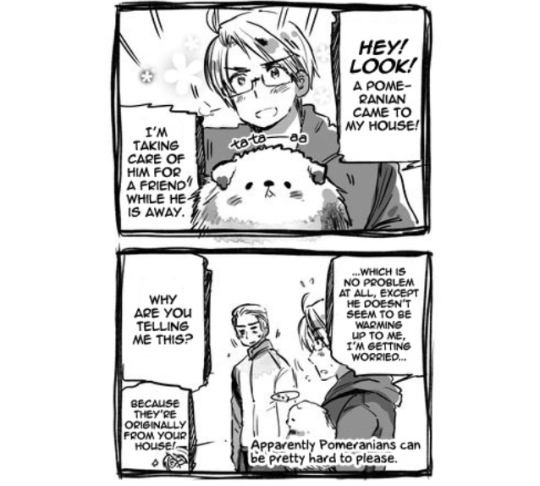
America taking care of his friend’s Pomeranian and asking for
Germany’s help.
Canada crying and doing his best to heal England after the
American Revolution [x].


Hungary secretly cleaning up for Austria after their empire
is dissolved.

After telling the story of Germany’s birth, you see a break
in Prussia’s egocentrism – or rather the act of it. He goes from “worship me
all you like” to agreeing to do laundry for Germany. In reality, he’s an
incredibly helpful, hardworking, and diligent person.

Canada: England’s sick, what do I do?

America: Sneak behind his back and sign your independence.
Canada: What’s wrong with you?!
Also Canada:

Asfklkdvgsfg no!!!!
The nations are representations of their people, ALL of
them. It’s not in their nature to discriminate against one particular group of
their population, even if their government has/ continues to do so in the
present.
Simply put, the nations represent their people. The irony
and complexity of the series is that by being forced to work for their
government [a populational minority], the nations may not serve their peoples’
best interest. Post on that here [x].
If anything, in canon, these tensions would cause America’s health to decline. If it’s serious enough, he would also feel pain. In canon, the stability of a nation’s politics affects the personification’s health. If their political affairs aren’t stable – e.g., there’s a large political divide and tensions are high – then the personification will become unwell [x].
Anyways, this strip is so important. I can’t stress it
enough [x].


I’m not particularly big on headcanons, but I sometimes do charts like this 😀
Most insecure nations
–
America, Canada, England, Germany, Italy,
Romano, and Poland.
Loneliest nations
–
America, England, Iceland, Prussia, and Russia.
Happiest nations
–
Denmark, Finland, Seychelles, and Sweden.
Most sarcastic nations
–
England, France, Norway, and Romano.
Nations we need more of
–
Belgium, Belarus, India, and Vietnam.


Not much is known about
this phenomenon, especially since most of the coverage of these events are
glossed/ skipped over. On the other hand, there are some things that I can potentially
clarify and shed light on.
First, let’s go over
some examples.
We get a brief – albeit shallow
–depiction of America’s Civil War in chapter 211 of World Stars. No insight is
given, other than the fact that America is visibly distressed [x].

We get two strips that
cover Spain’s Civil War.
One involves Romano
getting mad at Spain for not participating in WW2. Romano had fought in the Spanish
Civil War and got shot in the butt during the conflict. Meanwhile, Spain is too
poor to give a significant contribution to the war effort [x].

Another strip involves
Romano calling Spain after he and Veneziano were taken as prisoners of war by
England. Spain explains that he can’t bail the two out because he was too busy
making roses. This seems to occur at the end of the Spanish
Civil War [x].


We get a brief look at
Russia’s title change from Russia to the USSR in this panel here. It’s from one of
the first original webcomics [x].


It’s a common headcanon
that during civil wars, a separate personification develops. For example, the
US Confederates would have developed their own personification.
While this hasn’t been
shown, rules in canon can potentially support this.
In chapter 1 of World
Stars, it’s stated that personifications can exist for as little as a few days
to several centuries – or millennia if you consider the Ancients, China, Japan,
and Turkey [x].

There’s also the
hypothetical example where Canada dreams of Quebec becoming an actual country [x]. What’s important is that the new nation is born after the secession is
legally recognized, thus differentiating the situation from the American Civil
War.

Something that’s always
puzzled me about this scene is its ambiguity. When Canada states “anything but
Montreal” it could easily be interpreted as Montreal – as a municipal personification
– evolving to represent Quebec as a nation. Given that states and Japanese
prefectures are personified, it’s not far-fetched for a city to be personified
as well. We just haven’t seen this yet in canon.
On the other hand, we
also know from the above panel that personifications can change their personalities
as a result of a title change.
In that case, when two gov’ts fight for power in
a civil war, there isn’t a need for a second personification except in the case
where two legitimate states form. The end result is that if a new gov’t assumes
power and changes the name of the country, the personification can undergo a
personality change.
That said, since very little information is known about civil wars in Hetalia, it’s difficult to draw anything conclusive about them.


They’re all massive nerds when it comes to
Japanese culture/ anime. Not all of these attempts are successful either.


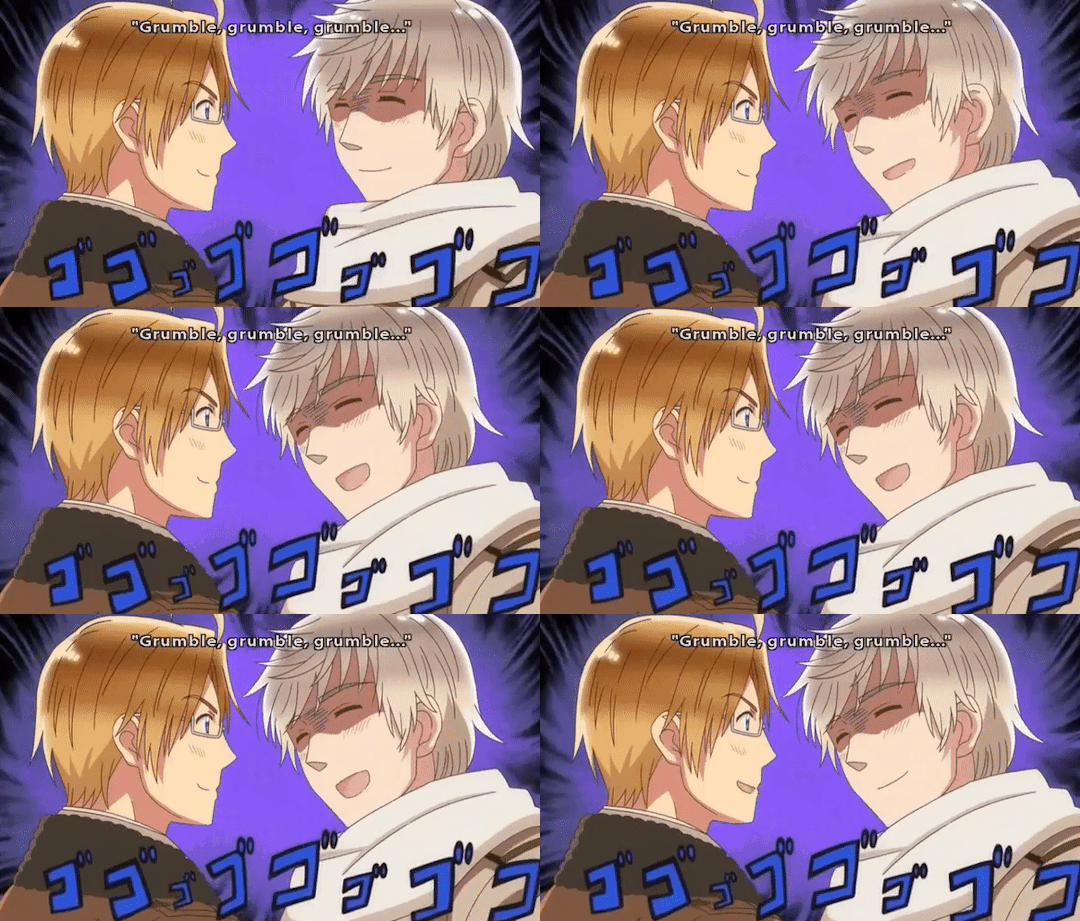
What this post will explore is
how other nations – to lesser degrees – are able to possess greater physical
strength than the average human. While it’s not necessarily the extreme strength
that we see with America and Russia, the
additional strength gained by nations at different points in history is still
very much present.

As stated by Finland, America and
Russia are super humans, whereas the rest of the other nations aren’t so
different from regular humans in terms of their physiology – aside from the obvious facts
that they’re immortal, don’t age and heal faster. After all, they are referred
to as “strange” and “odd” beings [x]. Some things about them are abnormal.


How I’ve interpreted the panel with
Finland before is that the superhuman
phrase is a reference and pun for the Cold War, where America and Russia emerged
as economic and political superpowers.
They were the two most powerful nations during this period.

The rules for this are laid out
in the strip titled “In just two minutes you can grasp the exterior of the European
economy.”
There, it states that when a
nation experiences political strife/ economic recessions, their health worsens
and they develop a cold. It would follow, then, that if a nation’s politics are
stable and their economy is performing abundantly well, they become stronger –
literally.
“In this manga, a nation having a cold = something like a recession. By the way, when they’re physically unwell, the nation’s politics or economy is having problems.” [x]
That’s why young America
initially gained his super strength. His economy was doing exceptionally well [x].


As such, this
would also explain why during times where America’s economy is strained and his
political affairs at home aren’t stable, he loses some of this strength and
appears to be weak. (Longer post on that here [x]).
Ex: The Great Depression – one of
the largest economic recessions to date.


Likewise, as a result of the Soviet
Union gaining steam [and territory], Russia had already acquired super strength
during WW2.
Ex: Russia was able to stop a
tank with his body.

The reason that America and
Russia’s strength is so extreme is that their power was globalized.
Meanwhile,
consistent with the rule above, other nations who gained economic and political
power also got physically stronger, albeit not nearly as strong as Russia or
America given that their influence wasn’t as reaching (e.g., European
superpowers instead of global superpowers).
I should also mention that the English empire was indeed a global superpower; on the other hand, the political sphere hadn’t yet been globalized during their prime (e.g., the UN and global international relations).
That said, let’s go over some of
these examples.
A referenced European superpower
that became weakened during the War of Austrian Succession [x].
Pay attention to the specific
wording as France loots from the defeated Austria.


When Hungary acts as Austria’s
reinforcement during the War of Austrian Succession, she’s referred to as “freakishly
strong back then” [x]. The back then is especially important, as it proves that the
country’s strength and position reflects itself in the personification’s
physical strength.


France became strong as a result
of the Napoleonic Conquests [x].
Again, notice how exhausted the enemy
nations are after they finally defeat him [x].


It’s also hinted that super
strength, even when the nation isn’t particularly powerful, can be tapped into
by the personification.
After the American Revolution,
England falls ill. America visits Canada’s house, begging to see England. When
Canada refuses him entry, America attempts to force his way in. In the end,
Canada is able to shut the door on America [x] [x].


It would seem that during moments
of adversity/ stress, an adrenaline instinct kicks in, thereby allowing the
personification to temporarily tap into this super strength. Put another way,
all nations are capable of acquiring super strength if their country is
powerful enough; however, in astringent circumstances, the personification can attain
it nonetheless.
In sum, super strength, albeit in
differing degrees, isn’t something exclusive to America and Russia. As shown in
the strips, other nations have become stronger in reciprocation to their
country’s strength and power.


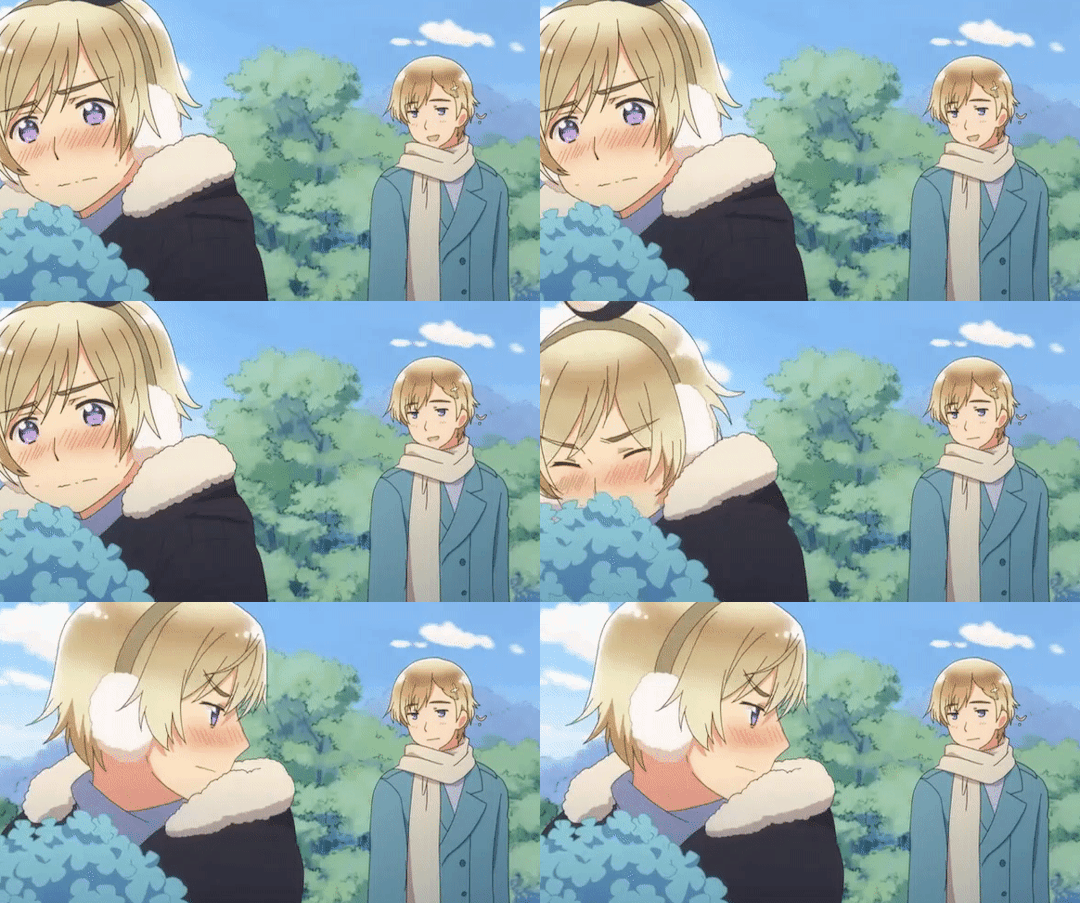
Note: This is a
guide. It’s not meant to cover an exhaustive list of all relevant examples in the manga. If I did that, this post could
easily be a novel.
Before I get into the direct blood relations of the
characters, this guide aims to chart out and differentiate between the different
types of relationships that we see in the manga.
Biological siblings, obviously, means that the nations in question
are blood-related.
Ex: America and Canada.

Ex: Greece and Egypt and their moms, Ancient Greece and
Ancient Egypt.


The best example of a biological relation is that of Norway and
Iceland’s.
Iceland had no native people. Since it was Norwegians alone
who first settled on the island, the two are directly related [x].
Iceland innately senses Norway when he’s first born.
Norway
also senses Iceland.


Likewise, DNA testing – in this case, a land excavation – is
done to confirm their biological relation.


Now, let’s do a comparison.
When America’s born, he doesn’t sense a biological brother
among the countries colonizing him. The reason for this is that he’s referred
to as an ingredient, meaning that not only were there native tribes living on
the land he represented but that America existed as a mix of several European
cultures [x].
The point to differentiate here is that America doesn’t have
a direct biological relation to these colonizing countries due to the large
volume of them.
Instead, what you’ll see is that the colonizing countries
fight over assuming the role/ title of being America’s big brother, or
onii-chan.


Continuing from America’s example, after he chooses England
over France, he asks England if he can refer to him as onii-chan – ‘Big Brother.’
As stated in the translator’s note, onii-chan can be used as
an expression of adoration and endearment. Put another way, ‘big brother’ here
has an entirely different cultural connotation. It’s a brother-figure relationship
and isn’t meant to be taken literally.


Not to mention the fact that England initially rejects the
label of onii-chan, claiming that “just ‘England’ is fine.’” The reason England
is hesitant to accept the label stems from the horrible relationship he has
with his own older brothers.


France is another example where the term Big Brother is used affectionately.
Ex: He claims to be the Big Brother of the world.

Ex: He’s described as a Big Brother-type.

Ex: The first thing that he does when he meets Lisa, Jeanne
d’Arc’s reincarnate, is introduce himself as Big Brother.

Ex: The reason that Italy refers to France as Big Brother is simply because they grew up in Rome’s house together for some time.


This title of endearment is confirmed in one of Hima’s blog
posts, where he clarifies that Italy and Monaco both call – as in refer – to France as Big Brother [x].
More examples of France’s use of the title ‘Big Brother’ can
be found here [x].
One last example of this is that of Netherlands, Belgium,
and Luxembourg.
Netherlands and Belgium are biological siblings. Meanwhile,
Luxembourg refers to Netherlands, France, Spain, and Belgium as Big Brother and Big Sister respectively [x].
While the translation is noted to be rough, the distinction
is nonetheless made very clear.

A full post on this can be found here [x].
All that needs to be known is that when two nations
willingly unite – not to be confused with being conquered/ annexed – the personifications
involved are considered to be married.
Austria is notorious for this, being noted to have solved
all his problems in the past through marriage (e.g., the Austro-Swiss
partnership, The Hapsburg Monarchy, the Austro-Hungarian Empire).

In the manga, sharing similar ancestors doesn’t make the
nations involved biologically related. In this case, I’m talking about cultural
influence.
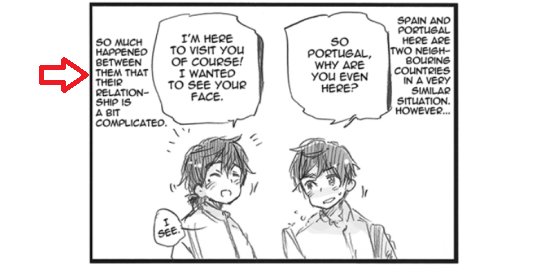
Ex: Spain and Portugal. (Chapters 77-79 of World Stars).
Both are noted to share a similar ancestry. As such,
Seychelles can’t tell which one is Portugal when she has a letter to deliver to
him.


Given the context in which the topic of their physical resemblance and relationship is discussed, if they were siblings, France would have attributed the reason for their likeness to this. He doesn’t.
Not once is a relation ever confirmed except for the fact that they’re neighbors.
Point is, it’s the similar ancestry that causes them to look alike.
+

+

Ex: Romania and the Italy Brothers [x].
While Romania may have inherited much of Rome’s culture, he’s
not related to the Italy brothers.


This brings me to my next point.
While cultural influence often affects the physical
and personality traits of nations, it doesn’t make them biologically related.
Ex: Seychelles was originally designed to have one thick
eyebrow and one thin one to represent French and English influence.

Ex: As an amalgamation of several cultures, America
resembles bits of Finland, France, and England.

Ex: France’s influence prevents America, Canada, and
Seychelles from inheriting England’s bushy eyebrows [x].

Ex: Young Canada inherits France’s hair due to his
influence. This is before England had assumed control over him.

When a country is conquered and their conqueror is on the
same continent, the conquered personification lives with the conquering personification.
Ex: France, Holy Rome, and Chibitalia living in Rome’s house (panel used above).
Ex: Chibitalia and Hungary living in Holy Rome’s house. Despite the rough start, they become so close that they refer to each other as family.


Ex: Romano, Netherlands, and Belgium living in Spain’s house.
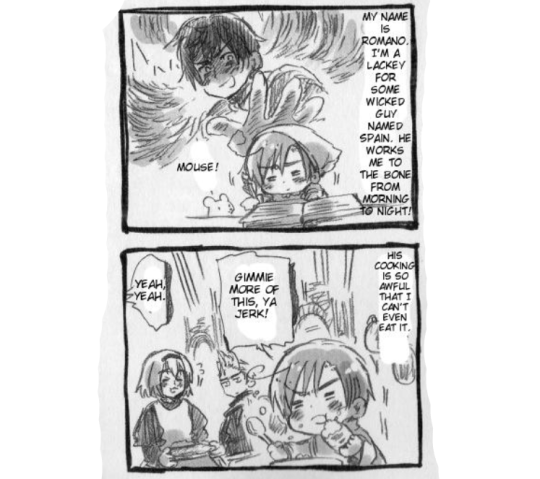
In modern times, we still see this occur, albeit it’s a bit
different.
The Chinese provinces +
Macau and Hong Kong (under a one country two systems principle) all
live in China’s household.


*Note – I made up the labels of house and household system
to better clarify and more easily distinguish between the two different living circumstances.
In canon, ‘House’ and ‘Household’ are terms used loosely and interchangeably in the translations.
The household system is separate from the house system in
that because the colonies are on separate continents, they’re part of a
household. In other words, they’re together and considered to be a unit despite
not living with the ruling nation.
Ex: England visits America, but America doesn’t live with
him in England.

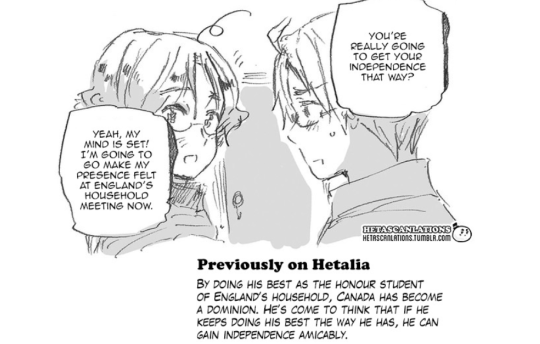
Ex: England hosts a household meeting, requiring the colonies to travel [x]. (America is already independent here, by the way. He’s not part of the household.)
Ex: Likewise, England has holiday houses in Hong Kong and
India, as alluded to in one of his character songs [x].
“
Curry, Chinese cuisine, my holiday houses’ meals.”
Ex: Hong Kong, who used to live with China and referred to him
in a more intimate way [x], changed after he became an English colony.
When he becomes Chinese territory again, he refers to China
as teacher/ Mr., seeing him more as a mentor.


What I want to stress here is how fluid interpersonal relationships
between nations are in Hetalia. They’ve lived for centuries; how they view and
interact with each other changes with time. Their relationships – aside from
biological relations – aren’t as static as human patterns of organization.


 Ellawritesficssometimes