When people think you’re innocent because you’re smol


The more I analyze the series, the more I realize just how
deep and profound it is. When I first got into the fandom, I would have never
dreamed of finding any significance in Kumajiro, a bear of all things. However,
a psychologist would have a field day with Canada and this childhood friend.
Yes, I admit: Kumajiro is a bear on top of all else. He’s
real. Taken symbolically, however, he’s also possibly a representation of
Canada’s repressed childhood, a childhood in which he actively strives to
forget.
Most psychologists agree on the fact that your childhood has
a major impact on your personality. Genetics play a role too, but the
environment (i.e how you were raised) severely impacts how you relate to
others. For example, if you were raised in a hostile and neglectful
environment, it’s harder for you to place trust in others, let alone form
healthy relationships.
Freud believed that right from birth, we’re ridden with
anxiety = you’re in a new environment with strange sounds and bright lights as
opposed to the warmth and security your mother’s womb previously provided you
with.

To cope with and minimize this anxiety, we employ defense
mechanisms. Thus, if your childhood was so scarring that it cripples your
ability to function normally, you employ the defense mechanism of repression.
That is, you push away these traumatic memories into the back of your mind
(your unconscious) so that you’re unable to remember them.
Another concept frequently used in psychology is that of your
shadow. Your shadow represents your inferiorities and insecurities. Basically,
it’s the unwanted truth you avoid acknowledging in light of preventing yourself
from being or feeling vulnerable.
What I’ll be arguing is that Kumajiro is Canada’s shadow.
Notice how the running gag between the two of them is that Kumajiro forgets who
Canada is. That itself, could be a representation of Canada’s own psyche and the
accompanying fears of being forgotten.
Likewise, Kumajiro has been with Canada ever since he was
born. Now, consider the fact that Canada also forgets Kumajiro’s name. This can
easily be interpreted as Canada wanting to forget (repress) the childhood in
which he was forgotten. (Pretty meta, huh?)

Freud also believed that the experience of childhood has a huge impact on your personality; it helps form who you are later in adulthood. Regardless if you repress these childhood memories, they’ll still unconsciously influence your behaviour, how you perceive yourself, as well as how you relate to others.
Let’s tie this back to the strips.
As a result of being neglected in childhood, in other words
living in America’s footsteps, Canada developed a low sense of self-worth.
Fun fact: The suffix Jiro in Japanese is typically used for
the second-born son, which, if put into the context of Hetalia, could equate to
Canada being second-best to America.
A coinciding cause for Canada’s feelings of worthlessness stems
from how he was initially objectified by England and France. They took interest
in him because of his resources, and as such, first viewed him as a colony…
Here, England assumes full control over Canada. Canada expresses
joy when he perceives that England is looking at him as a person, as opposed to
the land he personifies. What’s heartbreaking is that England is actually just
analyzing the hair Canada had inherited from France. Point is, Canada doesn’t
value himself because he wasn’t valued during his childhood.


This inability to value himself hasn’t left Canada in
adulthood either.
For, example, he doesn’t think he’s good looking.

So, how does Kumajiro fit into this? Why do I think that he
emblemizes Canada’s childhood insecurities?
Because your shadow is the core of your psyche, holding your
deepest desires and insecurities, it’s also the most truthful part of yourself.
Can you think of any moments where Kumajiro speaks the unconscious
truth of what Canada is feeling but never expresses?
Because I sure can.
1) In the same strip where Canada claims that he’s
not good looking, Kumajiro notes that Canada’s “too self-deprecating.”
2) Here, Canada is left in the background as
England and America work through the difficulties in their relationship.

Things may get a bit disturbing now. Basically, Kumajiro uses
dolls to illustrate how “well-behaved baby bear” Canada is not given enough
attention, as “big bear” England is paying too much attention to “rowdy baby
bear” America.
The scene then ends with Kumajiro concluding
that “well-behaved baby bear” should be loved more.


Obviously, this role-play is metaphorical of England,
Canada, and America’s relationship to one another.
Kumajiro also openly
encourages Canada to be more assertive, something that he wants to do but is
nonetheless unable to. Again, this all falls back on repressed conflicts
guiding our behaviours without a deliberate conscious realization.
3) Kumajiro tells Canada that it’s all right to
speak up for himself in asking England to have lunch with him.

In sum…
Kumajiro is a representation of Canada’s childhood
inferiorities. He forgets Canada because Canada still perceives himself as not
important enough to be remembered. On the same note, Canada forgets Kumajiro in
an attempt to repress memories related to the childhood neglect he experienced.
Perhaps Canada doesn’t know who he is himself.
“Who are you?”
“I’m Canada…[?]”
But…what exactly does that mean if you lack a solid self-concept?

What would you say if I told you that he symbolizes Canada’s repressed childhood inferiorities?
Post coming up soon!


I get asked
about this a lot, so I thought I would clarify a few things…
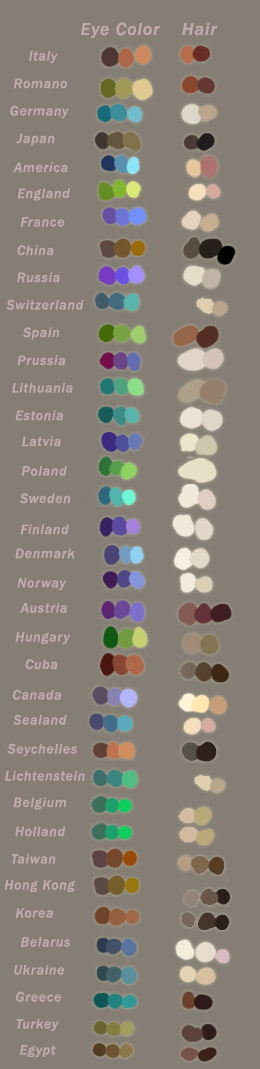
“Why do the nations’ eye colors keep changing?”
Hima
directly answers this question on his blog by stating that there’s “sufficient
freedom” regarding the eye colors of the nations. This would include sometimes
adding light brownish or greenish tints.

Although,
this obviously doesn’t explain why Sweden and Finland have solid brown eyes (and darker hair) in the first episode of
the anime. Regardless, that’s an animation inconsistency, not a canon one.

Likewise,
if you’re wondering why eye colors go from blue to violet to green, as seen
with the Nordics, there’s actually a justified reason for this.
Hima
provided a chart years ago revealing the different range of hues/mixes that each
nation’s eye and hair colors can assume.
“I tried to put every character’s hair and eye color in order. Being that this is something like an approximation, they do things like change in illustrations. But it’s like this, and I hope it’s good and easily understandable.”


That said,
there isn’t really one correct eye color for the nations, nor is there one
correct hair color; it’ll always differ slightly.
Make sense
now?

You can find the chart here:


As a primarily soft-spoken person, Canada
dialogues with himself more than he does with others. By that, I mean that he
keeps to himself, and yet, ruminates too much on what others think about him.
He desperately wants to be noticed throughout the series, but nonetheless
struggles to do so by forming his own unique identity.
A lot of
his invisibility can be attributed to how he lurks in the largely influential shadows
of America and England.

Canada
served as England’s watchdog during both wars. A lot of the battles that
Canadians fought in were generally attributed to British victory. In other
words, they didn’t receive the credit they deserved. That said, this lacking
and undeveloped identity caused Canada to remain behind the scenes.

Likewise,
until about the 1930s, Canadians consumed a lot of American media, pop culture,
and literature (we still do, but before we virtually had none). There wasn’t
anything distinctively Canadian for citizens to relate their shared experiences to other than the wilderness and agricultural life.
It wasn’t
until the 1970s-1980s when Canada’s reputation as a middle-power, peace-maker,
and most importantly, multicultural nation, took off. I say ‘reputation’ mainly
because we still have our fair share of racial issues (especially with the
Indigenous populations), but please remember that this series is predicated on
generalizations of what a nation is known
for.
Anyways, it
was America who served as Canada’s inspiration in forming a new national
identity by also becoming culturally diverse. There’s a long-standing joke in
Canadian academia that we’re always 100 years late to developments the US has
already undergone.


I mention
all this because you’ll see that the basis of Canada’s insecurities is formulated around how he’s not well-known, especially
in comparison to America, whom he’s often mistaken for.

It’s not
that Canada doesn’t attempt to stand out either, because he does.

In fact,
America picks up on this and tells Canada that he doesn’t need to change who he
is – his identity.
Jealously,
Canada then tells America that he hates his [blunt honesty]. Clearly, this is
merely a result of Canada projecting his frustrations onto America, given that
the latter has such a strong national presence in the world.
It’s
important to mention that they don’t actually hate each other, despite going
through many ups and downs in their relationship as they were growing up.

Being
constantly forgotten has eaten away at Canada’s confidence. His expectations
are so low that he cried when Seychelles remembered that he’s part of the G8.


It’s not
just being noticed that Canada worries about either. He doesn’t have a high
sense of self-esteem, and truly believes that he’s not good looking.

Here, he
worries about others not wanting to have anything to do with him.

He also
clearly fears rejection, having once used England to communicate with and relay
messages to America. How I see it is that Canada internalized his invisibility
as part of his self-concept, equated it to a low sense of self-worth, and then
actually began to believe that he wasn’t worth
the time of others.

Despite
these obvious insecurities, it’s important to end on the note that while Canada
may be soft-spoken, he’ll still assert himself if necessary. He’s a pushover,
yes, but not to the extent that he’ll lay down and willingly let himself get
completely run over.

France: You have a reminiscent look on your face, what’s
that for?
England: I’m just thinking about how different America and
Canada are.
France: And yet, they get along so well now. They’re perfect
complements of each other.
England: That’s just it. I can’t help but laugh.
France: Oh?
England: One’s patient enough to build a rocket ship, while
the other’s reckless enough to fly in one.

Oh yeah, totally!
You have America, who rides down staircases with ironing boards.

And then you have Canada, who prepares sushi wearing a ninja
mask and a “Hip-Hop” apron.
They’re both wild.


No worries!
Leave it to another fellow Canadian to give our personification more visibility 😉
While I’ll
omit and save more detailed mentions of Canada’s childhood for another post, it’s
still important to shed light on his insecurities…and BOY is he ever full of
them.
That said,
I think it’s important to understand that while the nations represent their
people, they’re also people themselves. Like us, they’ve had experiences – both
good and bad – that not only shape who they are but also how they interact with
others.
What I’m
trying to say is that some of their personality traits are a cumulative historical product, rather than one that is reflective of their present
national stereotypes. Canada is self-deprecating as a result of years of perceiving himself as inferior.
Post coming
up tonight!


Chapter 214 of World Stars pretty much sums up your question.


 Ellawritesficssometimes