image
image

What this post aims to do is cover Japan’s relationship with
other Asian nations. While a tricky subject for good historical reasons, I
think that while he initially had a rough start, Himaruya does a fair job of
balancing a narrative that promotes worldwide peace and reconciliation without
trivializing or obscuring the tragedies of the past.

By that, I mean that while there are many unresolved
historical issues between Japan and other Asian nations, Himaruya is still able
to have the respective personifications get along amicably. They’re not
portrayed as close personally, but they are nonetheless civil and friendly. To
portray them in the former fashion would be insulting, especially given how there
are still tensions regarding how these unresolved historical issues are to be
properly compensated for and addressed. 

Nonetheless, Himaruya is able to work
around this and the narrative of world peace by portraying them as being civil
with each other. He even offers several instances where Japan expresses regret
for his past actions—albeit implicitly.

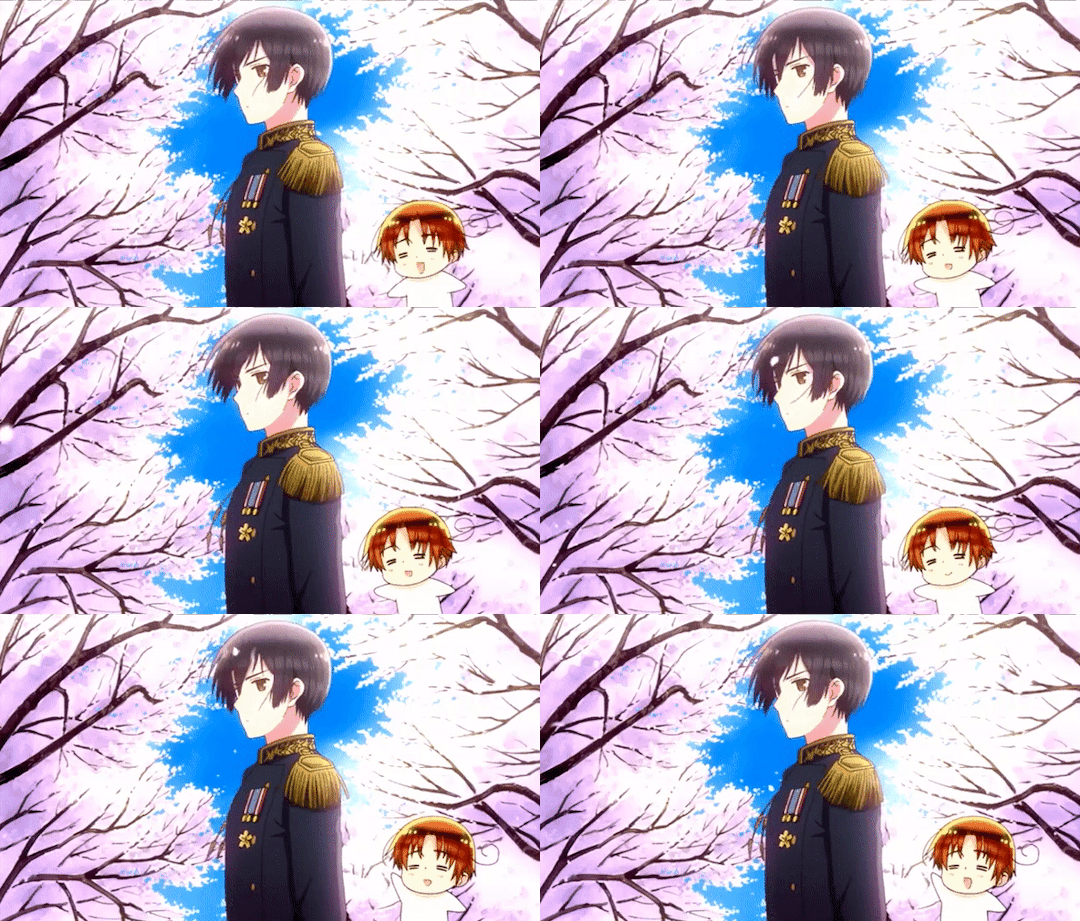
There’s this panel, which alludes to his desire to make
peace in East Asia and achieve reconciliation. I’ve done a longer post on this
here [x], and there’s also a scholarly article that covers the meaning behind this
specific panel in much more detail. Point is, Hetalia doesn’t trivialize or
obscure these dark historical realities but rather it offers hope for the
potential of reconciliation and co-operation as well as the capacity to
overcome grudges.

Article:

Sands, A. T. (2013). Belittling japanese nationalism in hetalia: axis powers. Humanities and Social Sciences Review, 2(3), 125-144.


Source
: Volume 3. 

That said, let’s go over some examples:

China:

There’s the infamous scene where China is betrayed by Japan
during WW2. What I want to place particular stress on is how Japan disconnects
from the situation emotionally—notice how blank his expression is—and asks
China to forgive him.

Source: Hetarchive, The Story about the Early Days of China and Japan.

image
image
image

Chafed and devastated, as he raised Japan and considered him
to be a younger brother, China fears that war has changed Japan and that the
two will never reconnect. Russia reassures him that time will heal their wounds…and
they do.

Source: Hetarchive, The Story about the Early Days of China and Japan.

image
image

It takes a long time, but the two do in fact reconnect. China’s
character song, “Aiyaa 4000 years” expresses China’s longing to look under the
same moon as Japan again (i.e., to reconnect.) China’s signature verbal tick—aru—is scattered throughout the whole song; it’s not until World Stars that
we learn that his aru is symbolic of his hopes, dreams, and romance.

Source: Hetascanlations, World Stars Chapter 43. 

image

In the same World Stars Chapter, we see the two of them
working on improving their diplomatic relations.

image

Another example of their co-operation would be them
designing postcards together.

Source: Hetarchive (Bamboo Thicket, eng trans., Oct 26th, 2011). 

image
image

Again, they may not be as close as they used to be, but they’re
nonetheless on relatively good terms with each other.

image

South Korea:

As mentioned, Himaruya had a rocky start and many lessons to
learn after his characterization of South Korea received a lot of [warranted]
flack.

South Korea claims to hate Japan and will disagree with
anything he says at world meetings, yet he also seems to aspire for Japan’s
approval by mimicking him and showing the latter his creations.

Source: Hetarchive, It’s My First Appearance and All I Get Are Some Scribbles!  + Hetarchive,  Opening of the Meeting at the Center of the World

image
image
image

Unfortunately, that’s the brink of their relationship, since
South Korea’s poorly chosen perverted tendencies have caused Himaruya to
ultimately abandon using the character. Because of this, I can’t comment on any
progression in their relationship. The point I want to emphasize is that they
don’t outright hate each other. Although, South Korea’s grudge is certainly
present in what little interactions that we have.

Taiwan:

Taiwan is the Asian nation whom Japan probably shares the
closest relationship with.

From the inception and early sketches of the series, she is
seen defending Japan, telling China to back off from him.

Source: Hetarchive, Taiwan’s Web Profile.

image

In the present, the two also get along just as well.

Taiwan is very friendly with him.

Ex: She tells his fortune for fun.

Source: Volume 4, Ilha Formosa ~Beautiful Island~

image
image

Ex: She gives him chocolates for Valentine’s day. It’s
hinted that she may even have romantic feelings for him, judging by France and
Italy’s suggestive expressions.

Source: Hetascanlations, World Stars Chapter 42. 

image

Hong Kong:

This relationship is more indirect, but it still tells a
lot. Hong Kong considers China to be his teacher, as they currently reside
together. The fact that Hong Kong finds it suitable and acceptable to ask Japan
for favors is indicative of China having no problem with them interacting.
Although, it is humorous that Hong Kong turns to Japan rather than relying on China to
help purify the air in his country.

Source: Volume 6. 

image

All in all, it’s not so much that Hetalia leaves tragedies
of the past unacknowledged. It’s satirical genre in tandem to its promotion of
world peace limits what it can cover and what stories it can tell. On the other
hand, it doesn’t trivialize or erase these tragedies either. Instead, while
seemingly simple, it’s able to promote narratives of co-operation and civility
in spite of past and current political tensions.

image
image
image

Misconception: She’s weak and unassertive

Reality: Even though we don’t get much canon material of her, her
character notes state otherwise.

Those who wish to
accurately depict her should take note of the fact that she’s described as a
smart girl with a strong mind—I’ll get more into that in a little bit.

Source: Volume 2.

image
image

Ex: There’s an old
sketch where she stands up to China and tells him to back off from Japan. The
panel seems to take place in the period where China still held a wartime grudge
against Japan.

Source: Hetarchive, Taiwan’s profile.

image

Ex: Her appropriate
reaction to Italy requesting to place his head on her chest. Please note that
this took place during the Chest Test series, where Italy places his head on the
chests of all complying nations. The intentions weren’t perverted in nature…it’s
more reminiscent of Goldilocks and the Three Bears.

Source: Hetarchive (Bamboo Thicket, eng trans., Nov 8th, 2013).

image

Misconception: She doesn’t get along with other Asian nations and is
reclusive.

Reality: She’s on very friendly terms with other Asian nations.

I know that her
history is complicated, but it’s also important to recognize that Hetalia is a
series that promotes worldwide peace and solidarity.

While it does avoid certain topics—as necessitated
by its comedic and satirical genre—that doesn’t mean they’re trivialized. The
series has shown that in spite of experiencing rocky political relationships,
the personifications are nonetheless able to maintain a personal life separate from
it.

Ex: In the present, Taiwan
is a regular visitor of China’s home.

Source: Volume 4, Ilha Formosa ~Beautiful Island~ + Volume 5.

image
image

Ex: She’s on good
terms with Hong Kong. He visits her, and she visits him. 

Source: Hetarchive (Bamboo Thicket, Nov 25th, 2013).

image
image

Besides that, she’s
particularly close with Vietnam.

Ex: She chooses
Vietnam’s Halloween outfit, much to the latter’s dismay.

Source: Hetarchive, Halloween 2013-2014 Event.

image

Ex: She convinced
Vietnam to take a photo with her. The significance of the moment rests with the
fact that Vietnam is insecure about her inability to smile.

Source: Volume 4, 

Ilha Formosa ~Beautiful Island~.

image
image

Misconception: She’s
a flat character with no personality.

Reality: She could definitely
use more development, but she still has unique attributes.

While Taiwan’s
character is due for some fleshing out, as is the case with most female nations
[unfortunately], the facts that we do receive about her are enough to work with. The
information is all there; you just have to look for it.

Ex: She’s a skilled
businesswoman.

Source: Hetarchive, Halloween 2013-2014 Event.

image

Ex: She likes
fortune-telling.

image

Source: Hetscanlations, World Stars Chapter 239.

Ex: She’s a good cook
and likes fashion.

Source: Volume 5. 

image

Bonus facts:

Strips suggest that
Taiwan may be attracted to both men and women.

i.e., she gives
Valentine’s Chocolates to Japan (France and Italy’s suggestive looks are
important) + she purposefully convinces Vietnam to wear a tight Halloween
costume and oggles at Belarus and Ukraine.

Source: Hetascanlations, World Stars Chapter 42 + Hetarchive, Halloween 2013-2014 Event.

image

She’s a bird
lover. 

Source: Volume 5 + Hetarchive (Bamboo Thicket, eng trans., Jan 22nd 2011).

image
image

She’s an avid fan of
anime.

image

Q & A

image

A good majority of the fan-fiction I read about
Belarus is about how she’s obsessed with Russia. Is there more to her than just
her obsession? I know she’s really really likes Russia but I want to believe
that’s not all to her character.

Honestly, no. Her
obsession is what shows up in most of her appearances. This doesn’t mean that
she can’t act normal, though. I have a post dedicated to showing that [x]. However,
even in the moments where she’s not hostile or aggressive, the gimmick still
ends up relating back to Russia.

It’s unfortunate, but
that’s just how it is. I’m still waiting for Himaruya to do something with her
character, as she’s only had one appearance in World Stars. It’s not even a
full appearance…

Source: Hetascanlations, World Stars Chapter 235.

image

I’m not an expert or anything, but I think
Canada has some symptoms of having abandoned child syndrome (ACS) or something
similar to it. Almost any official story arc involving him is about how he’s
neglected by everyone, his own family too. Poor baby I just want him to be
happy D’:

Without a doubt, Canada
was neglected as a child, but it’s not to the extent of abandoned child
syndrome. I’m also iffy on your claim that he’s neglected in every arc he’s
portrayed in. In fact, a key theme of America and Canada’s relationship—which
is depicted in more depth in World stars—shows that Canada is actually taken
for granted by America. America relied on Canada to follow his every command;
Canada’s character development revolved around him learning how to stand up for
himself.

I’m always hesitant to
medicalize characters because often enough labels like abandoned child syndrome
are thrown around without any substantiation, leading to exaggerated and
inaccurate conclusions (very similar to false claims that Chibitalia suffered
from Stockholm Syndrome).

The only symptom I would
say that Canada does have is guilt and believing that he did something wrong/
something is wrong with him that caused the neglect + accompanying
feelings of depression. Otherwise, he doesn’t have clinginess, he doesn’t
experience withdrawal from social activities, he isn’t resistant towards
others, he doesn’t have any sleeping or eating disorders, and he doesn’t have a
problem with substance abuse.

Source: Hetascanlations, World Stars Chapter 180. 

image

Oh, and I’m not an expert either ^^


Hey,
why do you think Germany doesn’t share the same last name as Prussia?

I agree with Hetarchive’s perspective on this. They believe
that the last name wasn’t given in order to leave more ambiguity in the relationship
between Holy Rome and Germany. They also go on to point out that the founder of
the Holy Roman Empire was named Ludwig (actually Louis, but Ludwig is the
German name version of Louis).


Hey Ella, do you have a theory as to why
Veneziano and Romano call Rome grandpa and not father? Is it a term of
endearment like “big brother” or are they actually blood related? And
if so do you think there was another nation between them and Rome that would be
their parent but didn’t last long? I’ve been wondering about that since day one
😅

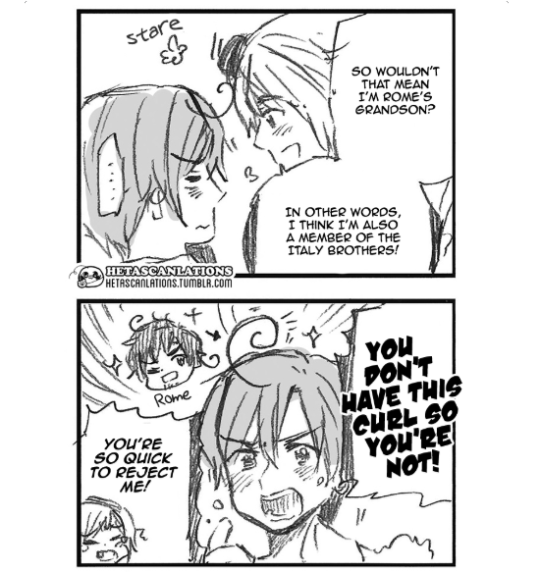
No theory needed. It’s confirmed that they’re biologically
related. Their descendancy is confirmed through a curl of all things. It’s used
to discount Romania’s claim that he’s biologically related to Rome in spite of
being largely influenced by the latter’s culture.

Based on what I’ve seen in the manga, I think
the grandpa label is interchangeable and they just used what felt right to
them. Rome was older when the two of them were born, so ‘Grandpa’ likely felt
more appropriate in spite of the fact that he was their sole parent figure.

Source: Hetascanlations, World Stars Chapter 163.

image

 Another example: Ancient Egypt had a more
youthful appearance, which could explain why Egypt refers to her as Mom.

image

Is it true that England once hired China and India
to cook for him?

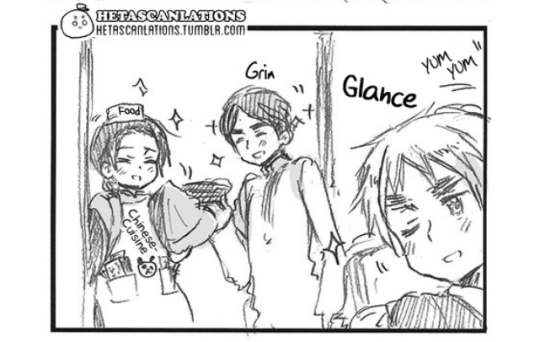
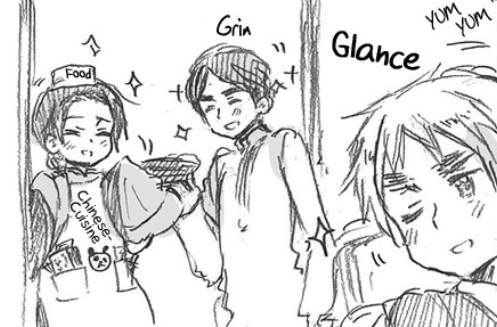
Yes. It’s meant to represent their cuisine’s
growing influence in his country.

Source: Hetascanlations, World Stars Chapter 291. 

image

Out of context, it looks like a sitcom…

*insert laugh track*

image

Q & A

image

Hallo Frau. Ellawritesficsometimes..Would you
be able to make a post on the relationship between India and China. Well I have
been researching about relations and have found that even though India and
China don’t have an amazing diplomatic relations they have a lot of cultural
relations such as cinnamon and fishing nets and also a lot of trade.

Sorry, friend. I can’t
make a post on that given that they’ve had one canon interaction. It should be
more, but that’s all we have to work with [x]. 

image

wait…I was going through your blog and I saw
you tag a post with ‘taiwan x ukraine’ what’s that about? keep up the good
work!

Mhhhmm.

I’ve made a post on
that. Taiwan has had some considerably gay moments. [x]. With Vietnam too. 


America’s hero is
George Washington I will drown and die with this headcanon GLADLY goodbye-

Considering that Prussia sees Fritz as a role model and father figure, it’s not entirely impossible.

 Here, have American presidents dressed in
steampunk attire.

Source: Hetarchive (Bamboo Thicket, eng trans., Oct 29th, 2014). 

image

Hi! Could you explain why
England didn’t want little America to call him big brother. I remember in an
episode he starts remembering spain, france, and his own brothers when America
asks if he can call him that. I didn’t really get why he was bothered by it.

I’ve already done a post on this 🙂 [x]


Hi, I hope I’m not bothering. I just wanted to say something
maybe obvious(??). With Genoa being a republic of its own as some kind of
city-state first and soon being brought in history to be part of the whole
kingdom of Italy in the unification, does it make sense that the
personification is still there as Genoa but the nowadays version? As an Italian
we have lots of stereotypes on Genoans (like with uhh every bigger city and
region and part of Italy) could that have changed its personality?
 

The personifications are
cultural personifications. It doesn’t matter if they aren’t official countries.
The word nation is a much broader term. If Genoa’s culture is truly unique and
the people there identify with it, there’s no reason for him not to be alive. We
just haven’t seen a confirmation in canon yet. 

Anyways, this post fleshes out what I’m saying in more detail [x]

image
image
image

Note: This post
can be taken as both a friendship and shipping post, so I’ll tag it
accordingly. I say shipping in the sense that this material would be useful tools
to incorporate into characterizations should anyone wish to write this pairing
more in tandem to canon.

A trend I’ve noticed in the fandom is that many people are
quick to dismiss the possibility of Japan and England sharing a good
relationship. I suspect that the anime’s portrayal of them in WW2 has a lot to
do with this conception. That said, what I seek to prove is that their
relationship—more specifically friendship because that’s what it is—extends before WW2. The two are and were actually very close allies.

That said, I’ve organized their relationship into three main
themes. All themes are linked to one another and contain substantive parallels
between their characters.

Loss of a Brother
Figure:

Both England and Japan experienced the pain of losing a
brother figure. Japan lost China, who raised him, and England lost America, who
he raised. While Japan’s historical isolation extends into the time where he
and China were still personally involved with each other, there is nonetheless the
unique parallel that both countries have experienced personal isolation.

Ex: China
developed a grudge after Japan betrayed him in WW2. Please note that the grudge
has since eroded away in the present.

Source: Hetarchive, The Story About the Early Days of China and Japan.

image

England and America both experienced a substantial loss and
tear in their personal relationship following the Revolution. This has also
since been rectified in the present.

Ex: America drank coffee in spite of his grudge over the
Revolution.

Source: Hetarchive, Lithuania’s Out-sourcing Series pt. 1

image

Ex: England dreams about raising America, an echo of his
latent and longing desire to live in the past again.

Source: Volume 3, England Dreaming of Long Days Passed.

image

Loneliness and Isolation:

Of course, the two didn’t just experience personal
isolation. They’re both known for their political isolation.

Ex: England,
being geographically isolated from continental Europe, became ostracized from other European nations.

Source: Volume 3, England Dreaming of Long Days Passed.

image

Ex: Japan grew
accustomed to telepathically communicating with other beings. In fact, he grew
so accustomed to it that when he first met Italy, he wasn’t in the habit of
speaking verbally [x]. 

Obviously, this isn’t overlooking the Westernization he
experienced during and after the Meiji era. The point is that his previous
isolation impacted his communication patterns.

image

Ex: In fact,
several strips in the series depicts Japan being overwhelmed upon opening his
country.

Source: Volume 4, Netherlands and Isolationist Japan. 

image

The neat tie between the two characters is that Himaruya
dedicates an entire strip to the two of them forming the Anglo-Japanese
alliance. The title of said strip is pretty self-evident as to how their
isolation impacted them:

“The Anglo-Japanese Alliance Between Two Lonely People.“

image

Lastly, there is also this comic gag that depicts their neko
versions overcoming their isolation by sharing a kitty box [x]. 

image
image

Cultural Sharing:

A last theme coursing through their relationship is the open
dialogue between their cultures. In other words, the two have a history of
sharing their cultures.

Ex: England enlists Japan’s help in teaching him how to make
better industrial design [x].

image

Ex: Japan adds his own spin to a traditional Christmas card and
England reciprocates the favour [x]. 

image
image

Ex: England hosts Japan at his café and aims to give the
latter an authentic English experience of the space [x]. 

image
image

Overall, England and Japan share a very gentle and generous
relationship, overlooked as it may be in light of other relationships that tend
to be underscored in fanon.

image
image
image

In this post, I set out to prove against claims that Hetalia’s narrative promotes division and necessitates hatred among the
characters. Quite the contrast, Himaruya’s writings have shown that while
history may be rough, filled with grudges and periods of hostility, friendship
and camaraderie will always prevail. It’s for this reason that characters who may
experience a sudden, turbulent, heated, and disastrous pit in their
relationship will eventually gravitate toward the other and find it in
themselves to reconcile over time.

It’s much more complicated than hatred. Grudges exist but
they aren’t permanent. Political relations add more complexity to how the
nations negotiate their personal lives, which, in turn, adds more nuances to
their relationship. Some common themes, or rather stages, depicting the
aftermath of these fall outs include: resentment, external hostility to hide
feelings of nostalgia and longing, reminiscence, and reconciliation.

Point is, because history is a central tenet in depicting
the nation’s lives over time, their relationships are made to be dynamic. While
I have touched on this before, I would like to go into more depth with two specific
relationships. That is, China and Japan, and England and America.

That said, let’s tie this back to the strips.

China and Japan:

China raised Japan and considered him to be his younger
brother, albeit Japan’s denial of this. The two nonetheless shared a very close and
emotionally intimate relationship. 

image
image

Even in the midst of rising political
tensions between their nations and other conflicts, it didn’t compromise their
personal relationship. 

image

The breaking point in their relationship was Japan’s
betrayal of China. Japan enters an unsuspecting China’s home, asking for
forgiveness before stabbing the latter in the back.

image

As I’ve mentioned in the past, the Japan in this panel seems
to be forcefully dissociating himself from the situation, divorcing his
emotions with a blank face to complete the task. 

image

I say this because later, we
see China crying about how war has changed Japan. At the time, Japan wanted to become stronger. What’s important to note is that the strip portrays Japan as the antagonist, highlighting the consequences of greed and an imperialist mentality. 

image

We then learn that China developed a strong grudge against Japan for this betrayal.

image

However, it doesn’t end there. While we don’t get much insight
or interactions between them in the interim, they are able to reconcile.
China’s character song “Aiyaa four thousand years” gives us the best
perspective on China’s feelings over the matter, as it nostalgically covers his
early relationship with Japan and ends on a note of forgiveness with his wish
to be able to gaze at the moon with Japan again.

Source: Hetarchive, The Story about the Early Days of China and Japan

Skip forward and this reconciliation becomes apparent as
they openly interact with each other with no hostility. While they aren’t as
close as they used to be, notable steps have been taken to improve their
relationship [x]. 

image

England and America:

Just like the above example, England and America go through
several bumps in their relationship. However, what defines them best is that
they swing back and forth in a pendulum of hostility, bickering, longing, and a
need for the other. In the present, the bickering is still present, but it’s
playful in nature rather than hiding a latent grudge from the past.

Personal vs Political

Ex: After the Revolution, the two had tense relations. This
doesn’t stop America from becoming distraught after hearing that England fell
ill as a result of the conflict [x]

image

You’re not my friend, but I still need you

Ex: America refuses England’s offer to be friends, yet in a
volume 2 character note we know that America wasn’t well liked following WW2
and that only Japan and England were considered to be his real friends.

Source: Hetarchive, Black Ships Have Sails + Volume 2

image
image
image
image

Longing vs Refusal to Acknowledge

Ex: America gets
nostalgic when he cleans his storage closet and recovers items from his childhood
with England.

Source: Hetarchive, Cleaning Out the Storage.

image

Ex: England
dreams of his time spent with young America and sleep talks, making fond
remarks.

Meanwhile, this is the same person who would go out of his
way to criticize and nitpick at every little thing America did. While England can
be incredibly rude, it’s not for no reason. There’s a deeper meaning to it;
it’s a symptom of the heartbreak he experienced and his poor way of coping with
it.

Source: Volume 3, England Dreaming of Long Days Passed.

image

Ex: Bedridden and
gravely ill, England’s last wish is to have America say “England” like he used to. 

Source: Comic Diary 3, Hetarchive.

image

Reconciliation

As mentioned, their relationship in the present has moved
more to that of teasing.

Ex: America likes to pull pranks on England [x].

image
image

Ex: They regularly visit each other [x]. 

All in all, I often use these two relationships as examples to
illustrate how time makes relationships in the series dynamic. They aren’t
static in the sense that the past defines their present experience. Without a
doubt, the past does have an impact, but the fact that they’re immortal has to be
factored in if we’re to analyze how they are granted more opportunities to
overcome their grudges.

ellawritesficssometimes:

Why
Hetalia isn’t racist + why it doesn’t promote Japanese imperialism/nationalism

Before I start, it’s important to get a few points out of the
way given that many of the misinformed critiques of Hetalia have been made by
people who haven’t read the original source material (i.e., the manga).

  • There’s a difference between historical
    situation and promoting a horrid ideology. Just because a series depicts war
    and Nazis doesn’t mean that they’re inherently glorified. Of most importance is
    that Hetalia promotes peace and reconciliation in spite of depicting war.
  • The wars that are depicted are general and the atrocities
    are deliberately glossed over. This is necessary because Hetalia is comedic in
    nature.
  •  Hetalia is based on stereotypes, good or bad.
    While some of the jokes are admittedly offensive, no nation is singled out nor
    are any specific nations made to be superior in comparison to others. Every
    character is made fun of for their stereotypes. Its humour isn’t meant for everyone.
  • Hetalia is satire. It mocks war and nationalist
    sentiments rather than promoting it.
  • The dub is not canon. That includes many of the
    insensitive jokes that Funimation scripted. 
  • The anime itself is unrepresentative of the
    manga. It can only cover so much material. Don’t judge a manga by its anime
    just the same as you wouldn’t judge a book by its cover.
  •  It’s also important to note that Seychelles has
    always been dark-skinned in the manga, unlike in the anime where she was drawn
    as pale-skinned. However, I do concede that even in the manga, her skin should
    be darker [x].

Since I’ve already created many posts on this subject, here
are some resources corroborating the above points
: [x] [x] [x] [x] [x].

In addition, I’ve also found a scholarly article in a
university publication that does a fantastic job of not only dismantling many
of the misconceptions about Hetalia but also many of the baseless critiques
that have been aimed toward it:

  • It’s a fair, level-headed piece that uses original source material to prove that
    Hetalia mocks and undermines sentiments of Japanese imperialism and nationalism
    while also demonstrating that it takes a definitive anti-war stance.
  • What I particularly like about it is that it
    acknowledges that some of Himaruya’s early choices were made in poor taste but
    is still able to substantiate the stance that this insensitivity isn’t
    supportive of racist sentiments.
  • It also shows artwork/content that glorifies
    Japanese imperialism and nationalism and then compares it to Hetalia.

Overall, it’s very well-written, sourced, and informed. Below
will be a list of important quotes that I took from the article. I highly
encourage for people to read the whole thing, as it breaks down a good amount of examples from both the manga and anime [x]. The article can be found through Google Scholar.

Source: 

Sands, A. T. (2013).
Belittling japanese nationalism in hetalia: axis powers. Humanities and Social Sciences Review, 2(3), 125-144.

Quotes: 

“Hetalia does not
portray violence or accurate portrayals of history; Hetalia is a collection of
gags mocking militarism and stereotypes,” (125).

“Hetalia condenses
history for comical effect but retains an anti-war sentiment by belittling
wartime axis beliefs…In Hetalia, each character’s nation is targeted for
ridicule through its stereotypes, and I argue the stereotypes are not intended
to create a sense of racial inferiority,” (126).

“A close examination of
plot, character development and imagery reveals a subtle disdain for
nationalism, which purposes racism and false history,” (126).

“Manga and anime can be
a good outlet for nationalists to use, but it can also be a tool to combat
nationalism,” (128).

“For every Hetalia fan,
there is another furious anime blogger appalled by it. As the battle over
Hetalia’s purpose rages in anime and manga circles, academia has of yet not
entered the discussion with earnest,” (129).

“Hetalia does gloss over
almost all of the war, especially the darker parts of the war, but if you watch
the whole show, it is easy to realize the show is not about WWII,” (129).

“Korea as an ‘other’ in Hetalia is not nearly as
physiologically different from his Japanese counter part… Although Korea is not
portrayed physically inferior to the Japanese, critics argue his immature personality
and actions are racist. Himaruya’s choice to make Korea an immature teenager
rather than an adult may not have been the most sensible of choices, but it was
also necessary for him to create jokes tailored to Japanese stereotypes of
Koreans, which he could then subvert…On some levels, the jokes are insensitive,
and they are not politically correct,” (130).

The author also goes
on to mention how inappropriate and weird some of the “sexually charged” jokes
were, starting from page 131.

“In Hetalia, every nation has its moments when its actions
are designed to make people laugh at it, and Japan is no exception. Rather than
idolizing Japan, Hetalia’s representation of Japan is a socially awkward,
emotionally repressed, and sometimes obsequious character to be laughed at. He
is neither the proud solider in Sensoron nor the charismatic scholar of
Kenkanryu…

If Japan’s character had been a fearless soldier immune to
cultural gaffes, I would argue Hetalia would be purporting an idealized notion
of the “self” in order to promote nationalism. Himaruya’s version of Japan,
however, could not be farther from an “idealized self,” nor does he try to
blatantly dichotomize or attack a perceived “other,” (132).

“Hetalia does have politically incorrect and at times
racially insensitive caricatures. Gag comedy is based on jesting stereotypes
and thus has to have some degree of politically incorrect imagery and character
personalities. Neither in the original web comics nor in the anime version that
followed it did Hetalia attempt to isolate Japan as the dignified “self” people
should idolize. The “others” are often portrayed at the butt of the jokes, but
each nation also has its turn to be the dominant character, even at the expense
of Japan’s pride. Critics can dislike Hetalia for being tactless at times, but
I argue their accusations of supporting malicious racism are based on curt
examinations of the show, which do an injustice to Himaruya’s true intentions,”
(133).

“Hetalia’s critics decry it for more than just its perceived
racist notions; they also denounce it for its interpretation of WWII and other
historical events, which lack acknowledgement for grievances against Japan.
Gag-comedy constrains Himaruya to a small amount of time to touch on important
historical events, such as China’s discovery of Japan, Russo-Japanese War, and
WWII amongst others. The time constraints naturally appear as historical omission
for the sake of defending the nations; however, Hetalia does not attempt to
omit history to protect Japan’s pride, but rather it condenses history for
comical effect,” (133).

“By mocking the tools and ideas of war and degrading it into
a minute-long gag, Himaruya expresses his contempt for war and the foolishness
of man to pursue it, thus creating an anti-war message rather than glorifying
the imperial state as Kobayashi did,” (135).

Page 136: a good
example of how the Axis were anything but glorified, season 1 episode 18.

“Himaruya may have glossed over the atrocities of war, but
he did not glorify Japan,” (136).

“I believe that in season 4 episode 26, the final three
fragments before the credits represent Himaruya’s sincere belief in the need
for reconciliation amongst East Asian nations and Japan…Japan informs the viewer
he wanted to wait until the last to show his final technique, and in a close up
of Japan’s emotional face he proclaims, ‘But if you’re serious, I’ll get
serious, too! My final secret technique: Expression of Regret!’…

“The simplicity of the idea that peace could be solved by a
pair of underpants is the joke’s punchline, but I believe, underneath the surface,
it represents a metaphor that the path to peace and reconciliation in East Asia
is far simpler than assumed. For Japan, the path is regret,” (136-137).

“Himaruya is trying to make a comedy out of history. Hetalia
does omit many historical facts, but it was never trying to be a serious
historical discussion. When Hetalia condenses history for comical effect, the
imagery and dialogue indicate the scene is solely a gag. Himaruya’s metaphors
and cinematography suggest he views war as senseless. Rather than supporting right
wing nationalism, Hetalia appears to be a satirical anti-war anime,” (137).


Conclusion:

With all that in mind, Hetalia may have had its faults—and
still does to a far lesser extent—but
it has never advocated for war, racism, or nationalist and imperialist drives.
If anything, interpretations of the series have caused the exact division that
Himaruya’s writings have long been opposed to.

image

I forgot to mention this, but it’s nonetheless crucial to
the narrative Hetalia pushes.

The scene where Japan betrays China substantiates how
Hetalia does anything but glorify Japanese imperialism.

China warmly welcomes Japan into his home.

Meanwhile, due to political tensions, Japan has already
mentally committed to positioning himself as the enemy in spite of the
brotherly relationship they shared. To the reader, he becomes the antagonist,
someone who enters China’s home—a metaphor for his trust—and
egregiously violates it.

If the series truly promoted imperialism why is it that
Japan asks China to forgive him right before he brandishes his weapon? The mood
isn’t that of superiority and triumph; it’s of shame and regret.

Source: Hetarchive, The Story About the Early Days of China and Japan. 

image