I wanted to ask about Belarus. Does she have an
outdated personality like France? Should I consider her old appearance as
inaccurate?
I’ve said this before, but very
little is known about Belarus. She’s a bit of an anomaly, so I’m not inclined
to form a solid opinion on her.
Most of the canon information about
her personality is from an untranslated PC game that Himaruya created and posted
on his blog. As for any changes? She appears in a few non-linear strips and the
first three printed volumes but makes a marginal appearance in World Stars.
Where we do see her more often is in
the Holiday Events (e.g. in Halloween 2011 and Halloween 2013-2014 you get
larger glimpses than in the Christmas Holiday Events where she also appears).
Judging by her character there,
she’s still obsessed with Russia and has violent/ impulsive tendencies, yet
she’s also calm and almost…regal at other moments [x]. However, it’s nowhere near
to the same extent as some of the borderline insane information given from the
PC game.
(She mistakes Taiwan’s greeting as normal lol).
I’d prefer to have a recent arc of
chapters/ strip deliberately focusing on her before I assess what aspects of
her characterization have remained and/or if it hasn’t changed at all.
Since Mochis are versions of the countries they
represent, does that mean that America’s strange dad complex can be backed up
by the weird lettuce-daddy Mochi comic strips? Cause Lol, I hope so.
I really wanted to
say no to this but knowing Himaruya, that literally might be a factoring
reason lmao. Although you have to remember that this lettuce also once wanted to
take over the world, only to be eaten by Canadamochi [x].
Okay so this has been in my mind for a while. I
was reading over some chapters from the manga to establish notes for myself and
came across the terms ‘junior’ and ‘senior’ used. Specifically in the It’s a
Treasure Box Full of Countries and Ch. 201. I was wondering if it’s meant to be
out of age establishment (Hutt River calls Wy, Molossia, and Sealand juniors
and himself Wy’s senior) or ranks (Australia calls himself Canada’s senior but
could also mean age… )? What are your thoughts?
Most of the time it has to do with
chronological age.
Then again, you also have South
Korea asking Japan and China (who in the
series are older than him) to call him older brother [x].
I saw something saying that romano has more
arabic(?) blood than italy, that’s why he’s darker than him (hair, skin, etc)
but I wasn’t sure if it was someones headcanon or canon
It’s considered to be canon by most
since his hair still remains darker than Veneziano’s. It’s listed in his Hetarchive
article [x]. Some LJ posts also link to Japanese fans who have saved old trivia
information that Himaruya later deleted from his blog.
By the way, in one of your posts, you mentioned
that “in WW2 when he’s occupied by the Nazi regime, England takes France
into his home”. Can you show me which strip that’s in? (I can’t find
it…) Thanks!
It’s from Volume 5: “Liberté, Égalité, Fraternité and…”
Yes, because clearly
something that depicts war and division must
be promoting it. Of all the things to criticize Hetalia for given the
controversy its generated—albeit mainly from past content—this isn’t something that it has
ever stood or advocated for.
What this post aims to
do is examine the ways in which the nations are impacted by the chronicity of
the wars they’ve endured as well as the coping mechanisms that they employ to bear
these hardships. Aside from the predictability of physical pain and illness,
there is a disturbing sense of normalization and domesticity in how the nations
negotiate their lifestyles in war. It’s
maladaptive.
That said, let’s go over
some examples.
Physical Pain and Illness:
The most obvious impact
of war and political struggles—both
domestic and international—is the physical strain that it puts on a nation’s body.
Ex: During the Second World War, Germany and Italy are both taken as
prisoners of war. Germany compares the pain of torture to a mosquito bite, as
his daily life is far more painful.
Ex: England falls ill on several occasions following major political conflicts
(e.g., the American Revolution, the Napoleonic Wars, World War II) [x].
Ex: China complains of body aches, stemming from political infighting
in his country [x][x].
Sense of Helplessness:
Of course, smaller
powers are rendered vulnerable and pliable to the discretion of larger powers.
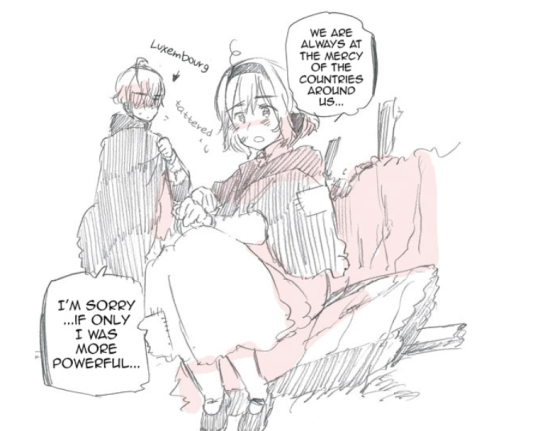
Ex: Belgium and Luxembourg discuss their inability to protect themselves
during both World Wars [x].
Ex: The conditions that Russian soldiers experienced were so bad that
Russia becomes ecstatic when Germany takes him as a prisoner of war. He
compares the German POW camps to heaven.
Ex: England’s normalized being captured by
the Axis and pre-preemptively brought a spare change of clothes [x].
Suspicion and Hostility:
War is a breeding ground
for distrust and betrayal. As such, the nations must always be ready to fight
for their lives, even in seemingly innocuous circumstances.
Ex: When the two first
meet in World War I, Germany second guesses himself several times on whether
Italy poses a threat to him.
Ex: Russia shares his tea
ration with England. While skeptical at first, England accepts. The sweetness
of the tea initially causes England to conclude that Russia poisoned him. What
matters here is the fact that England rationalized this outcome as a legitimate
possibility…[x].
Domesticity, Normalization, and Adaptation:
As horrible and gruesome
as war may be, there are still moments where the nations are able to enjoy
themselves and share a good laugh. The problem, then, is that having had
experienced countless wars, the nations bring the domestic into the world of
war—i.e., war becomes their home and the private
and public sphere divide becomes muddled.
Ex: England drinks tea in
the middle of the battlefield. Trivial as this may appear, on a latent level,
he’s attempting to include a routine and sense of normalcy in an environment
that is otherwise chaotic and unpredictable.
Ex: After infiltrating
America’s war camp, Prussia teases Germany for his impression of an American.
Ex:Having just occupied
Rome, America asks the terrified Italy Brothers if they could make him
authentic Italian cuisine [x].
The casualness in the way
America speaks is disturbing considering that from his perspective, taking over
another country is normal. It’s not
something that should produce fear but rather should be accepted as is. He
doesn’t consider the Italy Brothers to be his personal enemies. The personal is not political in this case.
Relief:
The best nations that
illustrate the burdens of war are those who have passed on. Rome and Germania
visit Earth together and upon reflecting on their lives, they reach a similar
conclusion: death gave them a sense of liberation.
They’re no
longer bound by their bosses’ orders and aren’t forced to participate in wars
they have no interest in being involved in [x].
“Hey England, I will choose liberty after all. I’m no longer
your child or your baby brother. From now on I’m independent,” [x].
[Speaking to Canada]—
“Aren’t you the one who’s been all England this and England
that lately? …You’ve been obliging England and eating nothing but marmalade,
even though you actually like maple syrup more, right? Your will’s like a
fluffy feather,” [x].
“I guess it’s because laughing off the negative as something
positive is my style,” [x].
Canada:
“J-Jackasses…saying whatever they want…yeah, okay, fine, I’m
Mr. Blandy Bland! Dammit!—Argh, today I’m going to show-em! But what argument can I make—?” [x].
To a sick and bedridden England following the American Revolution—
“Please don’t say such sad things Mister England…I’m…I’m not
as strong as America and I don’t think I can make much money. I might be
useless, but is there anything I can do to help..?” [x]
(About America)—
“It’s true that we’ve been together since we were born, and
I do think we’re more than brothers. But the paths we’ve taken are completely different
and most importantly, our personalities are polar opposites…” [x].
China:
“War has really changed Japan, aru…Japan is not Japan
anymore, aru…I don’t like it, aru…” [x].
“Time goes so quickly when you are having fun…I’ve lived for
several thousand years and yet…really, the good things are over in the blink of
an eye…” [x]
England:
After becoming young America’s guardian—
“So, somehow I managed to kick France out and become this
boy’s big brother. But since that means I’m his guardian, it’s also a big
responsibility for me…I’ll have to give him more than he’s ever been given,
always keep him safe…I’ll have to work hard. He’ll have many obstacles and hard
times ahead. Hard trying times. And even this wide and bountiful land must give
him his share of misery. Now It’ll be the two of us. He and I. We’ll support
each other. That’s how we’ll live,” [x].
During the American Revolution—
“Eh…it couldn’t be…? Does this mean you’re all turning
against me? Why is it turning out like this? [Have I handled things so poorly
that I have nothing but enemies now!?]” [x].
“I will teach you a good word; ‘Discretion.’ Have you ever
heard of it? Seeing you reminds me of my old timid self. Make sure to fix that
before we meet again,” [x].
France:
“If you can’t be stylish everyday, isn’t life just cloudy skies?” [x].
Talking about his immortality to one of his citizens—
“If you’d like to put it into words, it’d be like a ship!
The Government is the mast, the citizens are the wind and they are swimming on
the sea of time—or so
it was said. If the mast is standing straight and a good wind is blowing, the ship
goes forward. But well, of course, there’s also the possibility of the ship
suddenly getting stranded!
As long as there is
someone who can fix the ship, you can keep on using it forever, right?” [x].
Talking about Jeanne d’Arc to someone he believes is her reincarnate—
“Yes, her execution was on May 30, 1431. The
king abandoned her and no one lent a hand to save her in her final moments. Her
patriotic volition was unbound. She gave everything for the sake of her
country. It’s sad to see that those who have patriotic volition like hers tend
to meet tragic ends…
That’s enough history! Now it’s time for me to share
something about myself. It’s a thought I always keep in mind. I believe that
anyone who’s been toyed with by history is always reborn. They’re born under
normal circumstances. They laugh, they play…and even fall in love just like
anyone else.
In their next life, they live out a happy and peaceful life
somewhere in this world. That’s what I truly think. When I first saw you, I
thought God was pulling a cruel trick on me…but I see you’re living a happy
life. It seems like my wish has been granted.”
—Volume 4, A Bientôt! (Until We Meet Again).
Russia:
During the Bloody Sunday Revolt—
“I finally made this nation stronger and more prestigious
than others by myself… I worked so hard. Why is it that nothing goes right…? Why
do they always end up hating me? Everyone says it’s my fault, my fault. I’ve
endured it for centuries. Why can’t everyone just get along nicely with each other…? [x].
Lithuania asks him about a dream that he wishes to come true—
“Living in a warm place…surrounded by sunflowers,” [x].
Germany:
“Geez! I don’t know if you meant it as a joke, or if you really didn’t know, but instead of a collection of shady people, surely there’s much more to Italy that’s charming?! For example, the ancient ruins that speak volumes of history, the amazing works of art, and the unparalleled wealth of culture…the sun that shines upon this beautiful land…” [x].
“Compared to my daily life, torture from you bastards would only be about as bad as getting bitten by a mosquito!”
—Volume 1, Axis Powers.
Italy:
“Sometimes I get tired of seeing the same people all the
time, but then when I see them so much, it’s like they’re new and refreshing
again, these sort of things happen,” [x].
“Ah, sorry Germany, but I just remembered. If we go back the
way we came, there’s a really amazing ristorante! A ristorante known as ‘my
home’..!” [x].
Japan:
“Well, since you arrived, America, the environment and the people
around me have changed so much. Right after I opened up so many things happened
in rapid succession. I feel that knowing people and cultures of countries I had
only heard the names of before is wonderful…but I’m still a little anxious on
whether I’ll be able to get along well with all of them from here on out.”
—Volume 2, Japan and the Footsteps of Westernization.
“When I don’t get out of my house and only communicate with
those I can read the minds of, I start to forget how to speak verbally…”
Do You think that it’s okay to think in China,
India and Turkey as Ancients Nations. I don’t know if to be an Ancient, the
nation has to be old and had passed a long time ago.
There’s no explicit rule on what makes an ancient an ancient. I use a
rule of thumb and go by chronological age.
Yes, to China given that he’s lived for 4000+
years (e.g., he’s alive the same time as Rome) [x].
India, we don’t know enough information about
to pinpoint if he’s a more recent personification/ if he has an ancient
counterpart.
Yes, to Turkey too. In one of the drama CDs, it’s
revealed that he was the one who killed the Byzantine Empire (previously Ancient
Greece) [x].
Why does Turkey wear a mask?
No real reason is given. The
closest we’ve come to an answer only leaves us with more ambiguity… (Source:
Christmas 2007 event).
On the other hand,
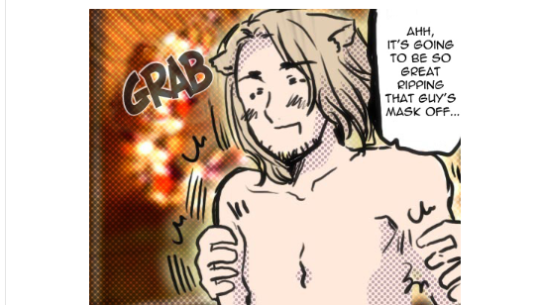
Himaruya does play with the idea of the mask. He’s created posts, where if you
click on Turkey’s image, a new image of him without a mask will appear [x].
What do you think of Germanys character song Steady Rhythmus?
A lot of people seem to be confused because it’s rock/“metal”. Idk
why tho, considering that a shitload of Germans (including me) love those genres.
I mean, we have rock/metal bands and festivals everywhere
Not a fan of it, but I do get why it’s of that genre. I
actually kind of like Prussia’s “My song that is written for me, by me”, save
for some parts lmao. The instrumentals are good.
Would Prussia still be considered a nation, or is he now
human? If we’re ignoring the East Germany theory, that is.
The simple answer is that he seems to be somewhere in
between. He takes longer to heal, yet Gilbird is still around him. Since
the personifications’ immortality rubs off on their pet, Prussia may have still
retained some of his immortality, although it could be waning. Hypothetically,
if Prussia was human, being constantly around Germany—whom he lives with—would drive him mad [x].
The main reasons I say this are:
1) He’s once referred to as being “in a pitiful state of an
enclave” [x].
2) When asked if Prussia would eventually fade away, Hima states
this: [x].
Do you think that Italy is underestimated by others nations,
sometimes?
Yes and no.
Germany often underestimates him, being biased from what he
witnessed of Italy during the World Wars.
Ex: Germany’s reaction at
the Galata Bridge scene where Turkey recalls how strong young Italy used to be (Source: Volume 4).
There are also moments where nations recognize that it’s
better not to underestimate Italy (Source: Christmas 2011 Event).
Most dangerous nations: Belarus, China, Germany, Finland, Hungary, and Russia.
Most underestimated nations: Belgium, China, and Italy.
Hardest workers: America, Germany, Japan, and Romano (if he has the motivation).
Laziest nations: Austria and Romano.
As stated in “In just 2 minutes, you can grasp the exterior of
the European Economy,” a nation’s health is dependent on two factors – the
stability of their economy and their politics.
This post will examine what happens to a nation when their
political situation lacks stability.
Let’s go through some examples.
America:
The recent divide between Republicans and Democrats have
been a cause for concern for America’s health. The fighting between the two
political parties is enough for England to comment that the 2016 election must
have been exhausting for America [x].
America denies this, claiming that his body is strong enough
to handle the infighting.
The running gag is that all parties will bond over
how much they hate the new president once the election is over [x]. Point is, it’s
the fact that England’s worried about America’s health – stemming from his
political situation – that’s significant.
China:
China’s rough history of ups and downs, consisting of many rebellions,
conquests, moments of prosperity and unification, and division was a lot for
his physical body to handle. The consequence of these political conflicts is
that he develops aches and pains [x] [x].
England:
England is notorious for falling ill after/during political
conflicts.
This example is undeniably the most important one.
Remember that nations are representations of their citizens.
They exist because of them. Said body of citizens encompasses all groups within
the population. A German is a German, regardless of their ethnic heritage,
culture, and race.
That’s why I believe that Germany is described to “tolerate
his way through pain” during WW2 [x]. German Jews were still his people regardless of their ostracization and the monstrous atrocities
committed against them. This all had to be felt by Germany.
Not everyone was favourable of the Nazi regime either
(obviously) – the executions of those who spoke out against Hitler, assaults,
raids, and surveillance carried out by the Gestapo created an immense sense of
fear and terror for many Germans. Combine that with air raids. The politics of
this time were far from stable.
As always, I must point out that the nations are
subordinates to their bosses and are forced into complying with their orders, often
against their own free will and conscience. Full post on that here [x].
Ex: Germany didn’t want to annex Austria, but was forced to
by his ‘strange’ boss [Hitler]. [x]
Ex: He’s screamed at by his boss, and yet, still takes down
notes. [Out of obligation.] [x]
Ex: Germany didn’t want to form an alliance with Russia. He
did so out of a sense of duty [x].
Ex: While joking, Finland darkly hints at the real
possibility of Hitler being capable enough of imprisoning Germany should he
complain too much about him. It’s more than just “boss troubles” [x].
Ex: When taken as a prisoner of war, Germany compares torture to a mosquito bite. This is because of the pain he experiences on a daily basis during the war.
With all this in mind, what I want to stress most is that
the nations feel pain for their people in whole, aside from whatever actions
their government decide to take.
No. What happens is that America chooses China to attack the
axis so that he can assess China’s feats. How I interpret this is that America
is covertly analyzing China’s strength and possibly feels threatened by him.
Note: This is a
guide. It’s not meant to cover an exhaustive list of all relevant examples in the manga. If I did that, this post could
easily be a novel.
Before I get into the direct blood relations of the
characters, this guide aims to chart out and differentiate between the different
types of relationships that we see in the manga.
Biological:
Biological siblings, obviously, means that the nations in question
are blood-related.
Ex: America and Canada.
Ex: Greece and Egypt and their moms, Ancient Greece and
Ancient Egypt.
The best example of a biological relation is that of Norway and
Iceland’s.
Iceland had no native people. Since it was Norwegians alone
who first settled on the island, the two are directly related [x].
Iceland innately senses Norway when he’s first born.
Norway
also senses Iceland.
Likewise, DNA testing – in this case, a land excavation – is
done to confirm their biological relation.
Now, let’s do a comparison.
When America’s born, he doesn’t sense a biological brother
among the countries colonizing him. The reason for this is that he’s referred
to as an ingredient, meaning that not only were there native tribes living on
the land he represented but that America existed as a mix of several European
cultures [x].
The point to differentiate here is that America doesn’t have
a direct biological relation to these colonizing countries due to the large
volume of them.
Instead, what you’ll see is that the colonizing countries
fight over assuming the role/ title of being America’s big brother, or
onii-chan.
Onii-chan:
Continuing from America’s example, after he chooses England
over France, he asks England if he can refer to him as onii-chan – ‘Big Brother.’
As stated in the translator’s note, onii-chan can be used as
an expression of adoration and endearment. Put another way, ‘big brother’ here
has an entirely different cultural connotation. It’s a brother-figure relationship
and isn’t meant to be taken literally.
Not to mention the fact that England initially rejects the
label of onii-chan, claiming that “just ‘England’ is fine.’” The reason England
is hesitant to accept the label stems from the horrible relationship he has
with his own older brothers.
France is another example where the term Big Brother is used affectionately.
Ex: He claims to be the Big Brother of the world.
Ex: He’s described as a Big Brother-type.
Ex: The first thing that he does when he meets Lisa, Jeanne
d’Arc’s reincarnate, is introduce himself as Big Brother.
Ex: The reason that Italy refers to France as Big Brother is simply because they grew up in Rome’s house together for some time.
This title of endearment is confirmed in one of Hima’s blog
posts, where he clarifies that Italy and Monaco both call – as in refer – to France as Big Brother [x].
More examples of France’s use of the title ‘Big Brother’ can
be found here [x].
One last example of this is that of Netherlands, Belgium,
and Luxembourg.
Netherlands and Belgium are biological siblings. Meanwhile,
Luxembourg refers to Netherlands, France, Spain, and Belgium as Big Brother and Big Sister respectively [x].
While the translation is noted to be rough, the distinction
is nonetheless made very clear.
All that needs to be known is that when two nations
willingly unite – not to be confused with being conquered/ annexed – the personifications
involved are considered to be married.
Austria is notorious for this, being noted to have solved
all his problems in the past through marriage (e.g., the Austro-Swiss
partnership, The Hapsburg Monarchy, the Austro-Hungarian Empire).
Ancestors:
In the manga, sharing similar ancestors doesn’t make the
nations involved biologically related. In this case, I’m talking about cultural
influence.
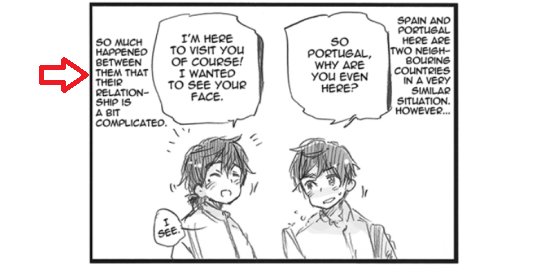
Ex: Spain and Portugal. (Chapters 77-79 of World Stars).
Both are noted to share a similar ancestry. As such,
Seychelles can’t tell which one is Portugal when she has a letter to deliver to
him.
Given the context in which the topic of their physical resemblance and relationship is discussed, if they were siblings, France would have attributed the reason for their likeness to this. He doesn’t.
Not once is a relation ever confirmed except for the fact that they’re neighbors.
Point is, it’s the similar ancestry that causes them to look alike.
While Romania may have inherited much of Rome’s culture, he’s
not related to the Italy brothers.
This brings me to my next point.
Influence:
While cultural influence often affects the physical
and personality traits of nations, it doesn’t make them biologically related.
Ex: Seychelles was originally designed to have one thick
eyebrow and one thin one to represent French and English influence.
Ex: As an amalgamation of several cultures, America
resembles bits of Finland, France, and England.
Ex: France’s influence prevents America, Canada, and
Seychelles from inheriting England’s bushy eyebrows [x].
Ex: Young Canada inherits France’s hair due to his
influence. This is before England had assumed control over him.
The House System:
When a country is conquered and their conqueror is on the
same continent, the conquered personification lives with the conquering personification.
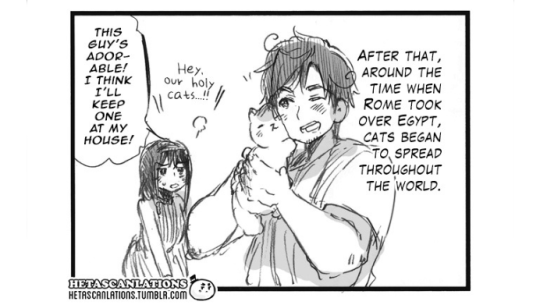
Ex: France, Holy Rome, and Chibitalia living in Rome’s house (panel used above).
Ex: Chibitalia and Hungary living in Holy Rome’s house. Despite the rough start, they become so close that they refer to each other as family.
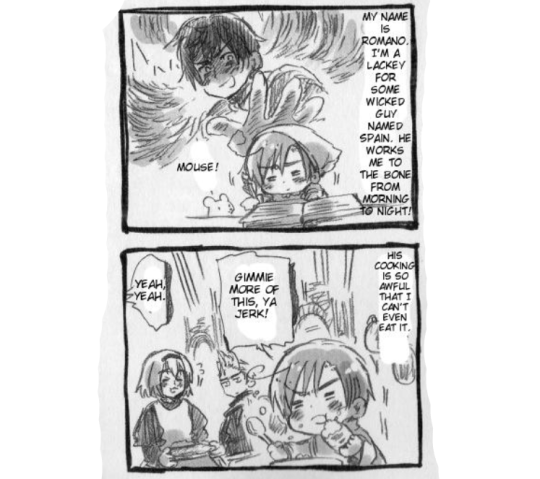
Ex: Romano, Netherlands, and Belgium living in Spain’s house.
In modern times, we still see this occur, albeit it’s a bit
different.
The Chinese provinces +
Macau and Hong Kong (under a one country two systems principle) all
live in China’s household.
The Colony/ Household System:
*Note – I made up the labels of house and household system
to better clarify and more easily distinguish between the two different living circumstances.
In canon, ‘House’ and ‘Household’ are terms used loosely and interchangeably in the translations.
The household system is separate from the house system in
that because the colonies are on separate continents, they’re part of a
household. In other words, they’re together and considered to be a unit despite
not living with the ruling nation.
Ex: England visits America, but America doesn’t live with
him in England.
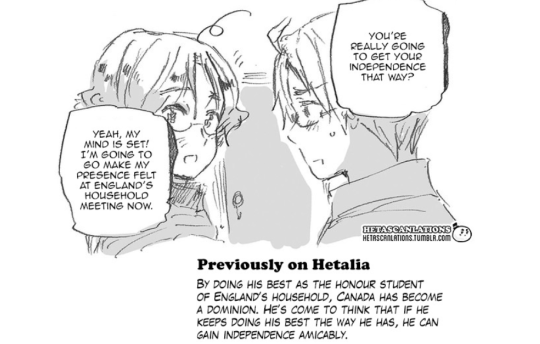
Ex: England hosts a household meeting, requiring the colonies to travel [x]. (America is already independent here, by the way. He’s not part of the household.)
Ex: Likewise, England has holiday houses in Hong Kong and
India, as alluded to in one of his character songs [x].
“
Curry, Chinese cuisine, my holiday houses’ meals.”
Ex: Hong Kong, who used to live with China and referred to him
in a more intimate way [x], changed after he became an English colony.
When he becomes Chinese territory again, he refers to China
as teacher/ Mr., seeing him more as a mentor.
What I want to stress here is how fluid interpersonal relationships
between nations are in Hetalia. They’ve lived for centuries; how they view and
interact with each other changes with time. Their relationships – aside from
biological relations – aren’t as static as human patterns of organization.
Sure! Before I get into a post strictly focusing on relations, I think it’s necessary to go over the types of relationships that we see in the series.















 Ellawritesficssometimes