image
image

The nations are two-fold representations. By that I mean
that they have a literal body and a figurative body.

Bear with me, things get a bit tricky, but I’ll break it
down to the best of my ability.

Basically, the figurative body is what influences the nation’s
physical body.

The figurative body
is composed of two parts.

1) There’s the geography
of the nation. The landmass is sometimes referred to as their body or house,
despite the real physical one that they possess.

The geography can influence both the physical appearance and
personality of the personification.

Ex: Since Sealand’s geographic body is small, so is his physical
one.

image
image

Ex: Iceland’s contrasting volcanic and freezing temperatures respectively
causes him to have a hot and cold side.

image
image

2)  There’s the personality
of a nation. The personality of a nation (not to be confused with the
personification’s personality) is defined in terms of culture in the manga [x]

If the culture is well-developed
and thriving, then the personification will also thrive and be able to grow; to
age. However, if the culture is repressed, then the personification’s growth
will also be stunted.

The reason I’m outlining this is essentially to show how
geography/climate and historical events are reflected in the personifications’
appearances and personalities. Information on the impact that this has on their
health can be found here [x] [x]

What this post will focus on, however, is why some nations
have scars and either suffer from or are affected with other physical symptoms.

Let’s go over some examples.

Ancient Rome: 

Before dying, Rome was noted to have many wounds and scars –
a physical reflection of the turmoil his people suffered from.

image

Lithuania: 

We know from his time spent in the USSR that Lithuania acquired
several scars on his back. The military repression of several revolts and the
banning of diverse cultural practices in favor of an atheist state very likely
had a role in causing these scars to appear.

image

Latvia: 

Latvia’s case is similar to Lithuania’s. While we don’t know
if he has any scars, we know that Russia pushing down onto his head ultimately
stunted his growth. How I interpret this is that it’s a metaphor for political repression.

image

Put another way, Russian control stunted Latvia’s growth,
which, in turn, was reflected in the personification’s physical body.  

image

China:

It’s hinted that China gained scars after being betrayed by
Japan in WW2. It’s both a literal and symbolic stab to the back.

image
image

Germany: 

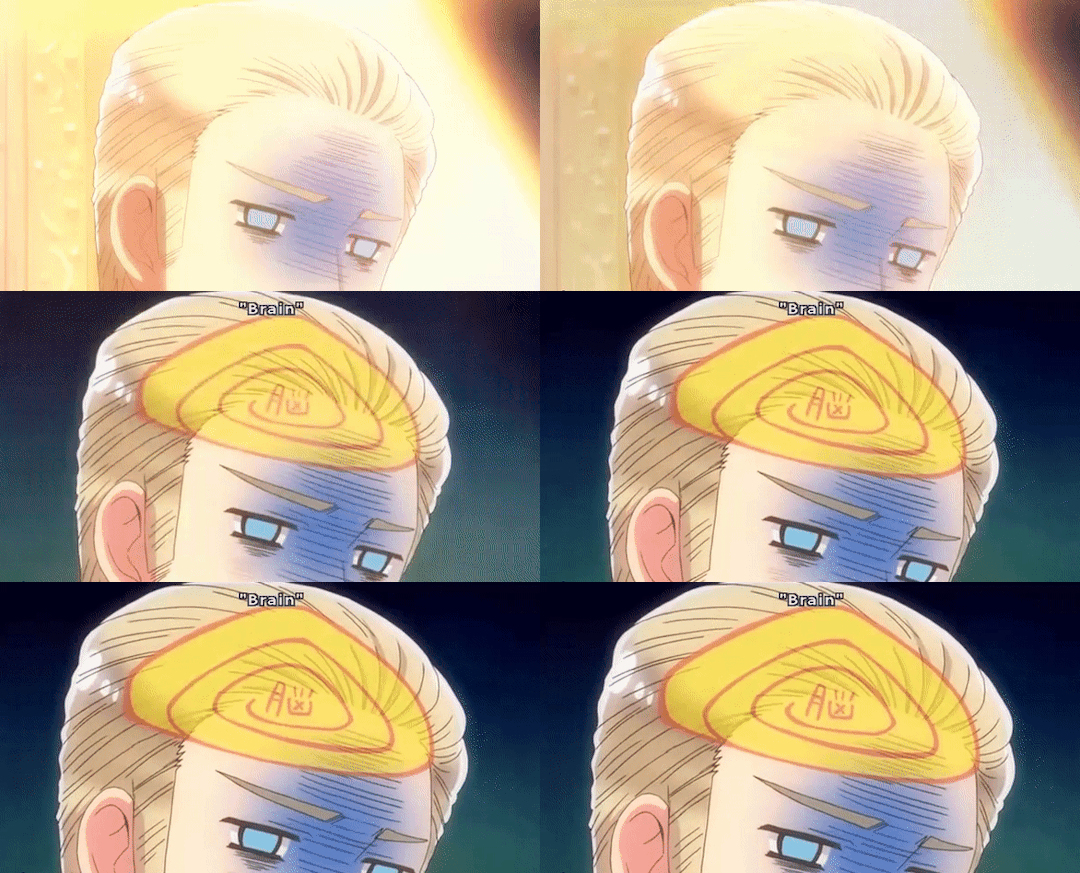
Each time America engages in reckless financial activities,
a new wrinkle develops on Germany’s forehead.

image
image

Finland: 

Estonia’s quest to become a Nordic causes Finland’s back to
be itchy whenever he’s talked about.

image

Bonus cases that aren’t so clear…

Russia: 

When he’s not wearing a scarf, Russia is shown to be wearing
bandages around his neck.

image

Netherlands:

An unknown event caused him to develop a scar on his
forehead.

image
image
image

Before I go through case examples, I want to go over some
important ground rules pertaining to the subject of economics and how nations are
affected by it.

1) When a personification has a cold or is
physically unwell, they’re having problems with their politics and/or are
experiencing a recession.

image
image

2) An economic recession will impact a nation’s
health differentially depending on their economic standing.

Ex: During the
Great Depression, some nations were more affected than others, as designated by
greater negative signs.

image

3) If the nation itself is poor, so will the
respective personification.

image
image

With all that in mind, just like political independence and
a stable, functioning government, the strength of a nation’s economy is an
equally important factor in influencing the personification’s age. The best way
I can explain this process is that a nation’s age is a result of an amalgamation
of factors.

Some personifications will go through a gigantic growth spurt
in reaction to their country’s own surge in economic prosperity. 

Other
personifications, while lacking official political recognition, are able to age
upon achieving and maintaining economic prosperity through high GDPs.

Lastly,
there are officially recognized nations who remain young as a result of poor and
inconsistent economic growth.

America: 

Of course, I’ll start with the most obvious and well-known
example. America grew up quickly in tandem to his growing economy, despite lacking
independence from England.

“Because he was relatively tolerant of religion forms, America became a melting pot for various cultures, arts and crafts. Soon, he began to grow an industrial prowess and rivaled England himself.”

image

Meanwhile, Canada, who didn’t possess the same
economic strength, aged at a much slower rate than America.

image

The point to differentiate between the two brothers is the
impact that their economies had on their biological ages.

Chinese Autonomous Territories: Macau and Hong Kong 

While they are presently considered to be autonomous territories under a one country-two systems mode of governance and therefore lack full
recognition as nations in themselves, Macau and Hong Kong’s strong industrial
economies allowed for them both to age. 

This lack of official autonomy is depicted by both of them
living in China’s household.

image

Macau: 

Macau was originally Portugal’s underling. He was East Asia’s
centralized and most successful trading port before being superseded by a
younger Hong Kong. 

image

As such, despite being part of Portugal’s house, Macau’s
commercial success was enough to make him an adult.

image
image

That’s all we know, as he’s not given an exact canon age.
Now, he remains as an older brother figure in China’s house. Again, it’s his
economy that primarily contributed to his physical maturity.

Hong Kong:

Hong Kong was little when he became English territory. 

image

Becoming an economically-successful trading port is what contributed to his growth. 

image

However, because he’s not a nation-state in himself,
this would explain why he’s 16-17. If he did become a full-blown nation, the
consistency in this rule would likely have him age again.

Historically, Macau’s a lot older than Hong Kong – this might
offer a plausible explanation for their differences in age.

image

Taiwan:

This one’s a bit tricky and controversial given the testy
disputes regarding China’s claim of sovereignty over a self-governing Taiwan.
Nonetheless, there’s still an economic factor that accounts for the reason why
Taiwan is older in age [as opposed to a small child]. She’s also a strong
industrial power, despite not receiving international recognition.

image

On the other hand, Taiwan was officially recognized as China
in the UN before losing its seat in 1971. This also may have had an impact on
Taiwan’s age, although since none of this is presented in canon, all I can do
is speculate.

Latvia: 

Not only was Latvia historically repressed politically, but
his agricultural economy isn’t doing all that great today either. Both of these
factors account for his young age, regardless of how long he’s existed
chronologically.

image

Moldova:

As one of the poorest countries in Europe, it’s no wonder
that Moldova’s growth has been stunted.

image

In sum, while economic sufficiency and success is only one
of the factors that allow a personification to age, it’s influence has a strong impact.

image
image
image

They owe their
existence to them. 

Ex: France lays out the rule that as long as the nation
possesses a stable government and a large enough citizenry to identify with
said national identity, the respective personification will remain and continue
to be immortal.

image

This rule is further confirmed in World Stars, where France
explicitly admits that he exists because of his citizens.

image

They openly interact with one another + humans know of their existence. 

image

A common misconception that people often make is that the
nations’ identities are a secret kept from the public and that only their bosses
know about them. That simply isn’t true.

In fact, while some humans are shown to be perplexed by the
nations’ immortality, their overall existence is known to the public.

image
image

Ex: France introduces himself to Lisa, Jeanne d’Arc’s
reincarnate.

image

Ex: Italy flirts with his own citizens.

image

Interestingly, Italy’s also admitted to getting tired of
seeing the same faces of his citizens every day – a consequence of his
immortality. However, he does add to this and claims that seeing
these same faces can also be refreshing.

Point is, on top of their being no knowledge barrier of
their existence, the personifications openly interact with their citizens.

image

The Nations are Citizens Themselves. 

Ex: Romano has his own passport.

image

Ex: Russia isn’t exempt from civilian duties, such as manual labor.

He’s forced to build a waterway alongside his people under
impoverished conditions.

image

He fought alongside his people in both world wars (as well
as any other personification), and endured the same notoriously terrible living
conditions that his soldiers were exposed to.

image

Ex: Coinciding with the last example, the nations serve in
their military. Here, America is tasked with tightening security among his
troops after Germany and Prussia successfully infiltrated them.

image

Population Demographics Affect the Nation’s Personality Traits, Behaviours, Habits, and Physiology:

Given that this is a series predicated on stereotypes, this
isn’t all that surprising.

Ex: China has a video game addiction resulting from this
becoming a rising problem among Chinese youth.

image

Ex: Germany strictly adheres to the directions of his GPS.
Hima drew this from a news story of a Bavarian who caused an accident by
following GPS directions.

image
image

Ex: Post WW1, several Lithuanians immigrated to America to
outsource their labor so that they could send money back home. As such,
Lithuania lived with America during this time.

image

The same thing happened with Romano. He went to live with America
during the first Industrial Revolution –a direct effect of his own people
migrating there for work.

image
image

Ex: As a result of his shifting cuisine (i.e. Indian and
Chinese influences), England is beginning to learn how to cook.

image
image
image

Ex: A nation’s obesity rate likewise impacts the weight of
the personification.

image
image
image
image

Before I start, it’s important to lay out some ground rules.

Thanks to Finland we know that the nations aren’t that
different from humans with regards to their physical strength and anatomy (with
the exceptions of Russia and America who are exceptionally strong).

image

The point in this is that the “not-so-different from a human
rule” pertains to their basic physiological structure. On the other hand, there
are immortal perks of nationhood, such as being impervious to experiencing the fatality of illnesses. They still can
fall ill, though. This happens when they’re….

1) Suffering from political instability.

2) They’re experiencing an economic recession.

3) There’s a rampant illness in their population (i.e Romano’s
Chorea).

With that said, we know that the nations are stronger than
normal humans regardless. They don’t age as fast, and as such, their memories
don’t deteriorate at nearly the same rate.

What this post will explore are the different examples where
nations have been shown to have gaps in their memories.

image

The thesis I’m putting forward includes a variety of
reasons to account for this:

One, older nations such as Japan and China have even larger gaps
in their memories as a result of their physical bodies aging. They’re therefore
unable to recall memories as fast as younger nations [This in part goes with my
third argument].

Two, the influence of their citizens pertaining to whether
or not the nations can see and therefore remember the existence of magical creatures.

Three, the nations simply aren’t able to remember
everything; it would be impossible.

And four, some
nations actively repress bad memories to minimize the anxiety and trauma they
previously experienced.

Without further ado, let’s go over some of these examples.

Age:  

As stated above, the nations’ chronological age, while
influenced by their economic and political affluence, also seems to be affected
in part by how long they’ve lived (I.e. Both Japan and China refer to
themselves as old men.)

If Japan is shown to have higher blood pressure levels and hip pains as a
result of his old age, then it wouldn’t be too farfetched to assume that his
memory wouldn’t be as up to par as it would be in comparison to a nation younger
than him. Put another way, his age would cause him to have greater slips in his
memory.

It’s the body that’s old, despite not looking like it. 

image
image

Ex: He’s unable
to remember who Lithuania is, and almost mistakes the latter to be Livonia.

image

Ex: While looking
through an album of him and Pochi throughout different periods, Japan
mistakenly recalls the chronology of them.

image

Likewise, China’s also referred to as an old man.

image

Ex: He admits to
being forgetful.

image

The Ability to See Magical Creatures:

We’ve also seen the impact on how a population’s belief in
magical creatures respectively influences whether or not the nation will be
able to see them.

Ex: During the
Meiji Era, England could see the kappa and youkai spirits, meanwhile Japan couldn’t
as a result of his people no longer believing in them as strongly.

image

However, just as a nation can forget about magical
creatures, they can also re-remember them if popular culture strongly believes
in them again – presumably it would have to go past folklore superstitions.

While enjoying Japan’s hot springs, the two talk about
folklore. 

image

Notice how Italy spots a strange creature beginning to approach them.
Although it’s not shown, the discussion of the topic could possibly mean that
Japan [and not just Italy] is also able to see the creature.

image

There’s also an exact replica of this hot spring scene
dating back to when they first met during WW2. I don’t think Hima did this for
no reason:

image
image

Repression of Traumatic/Guilt-Ridden Memories: 

As Russia darkly puts it, perhaps it’s a good thing that the
nations don’t remember everything.

image

When Lithuania and Germany allegedly meet for the first time
during WW2, Lithuania expresses relief over Germany not remembering him. It’s
noted that Lithuania once beat-up one of Germany’s family members. This is
possibly a reference to when Prussia became a lackey to Poland under the
Lithuanian and Polish Commonwealth.

image

This is highly indicative of Germany existing well before
his ‘birth’ in 1871 given that Lithuania is fearful of being remembered and/or triggering
Germany’s memory. If anything, Lithuania’s fear of this points further in the
direction of Germany suffering from amnesia.

Why else is there a childhood version of Germany/Holy Rome pushing to be acknowledged in older strips? I’ve theorized before that this is
simply a part of his unconscious mind trying to get him to remember about his
forgotten childhood.

image

Or why is it that he’s seen to confusedly hold up Chibitalia in another strip? 

“It’s me.” Jogging his memory much?

image

Similarly, Italy also dreams of a childhood version of
himself pushing to be acknowledged by him, only for Italy to refuse in doing so. Like
Germany, it seems that Italy has actively striven to forget his childhood.

image

Lastly, the most obvious hint of repressed childhood
memories is found in Buon San Valentino, where Germany appears to recall fuzzy
images of Chibitalia.

image

They Can Only Remember So Much:

image

Prussia is the one to confirm this rule, considering that he’s
taken to recording every experience as a method in circumventing the inability
to recall them. It’s simply a matter of jogging his memory.

image

In sum, while the nation’s memories are limited, there are
different factors and contexts that account for this phenomenon. Age, trauma,
civilian belief, and limited physiological brain capacity seem to be the most
common reasons in accounting for this.

image
image
image

Misconception: China
hates Japan

Reality: While he
does hold against a grudge against Japan for betraying him in WW2, he’s deeply
affected by it.

We all know the scene. Japan stabs China – literally and
figuratively – in the back. You’d think this would generate hatred on
China’s part…

image
image
image

…but this couldn’t be anymore true.

China raised Japan. He was there with him through everything.
He protected Japan from other nations, like Mongolia, only to receive nothing
for it.

image

In other words, China’s heart was broken. A telling scene in
which this is confirmed is when China drinks away his sorrows and breaks down
into tears as he recounts what Japan has become.

image

Unfortunately, we are not provided with much insight on how
Japan and China fare in modern times, as we don’t get many moments where they
exclusively interact with each other.

Misconception: China
is weak

Reality: He
possesses immense strength, but because of his age he lacks stamina.

Ex: This strip
illustrates America’s perception of China’s innate strength and/or capacity for
it.

image

Despite this, however, because he’s lived for so long, China’s
physical body has aged and weakened. This is an exception to the rule of a nation’s
political and economic situation affecting their physical strength.

The physiology is more applicable to how they lead their
daily lives.

Ex: He’s referred to as a grandpa in modern times, and tires easily.

image

Ex: In another modern
strip, he’s affected by his population’s growing obesity rate and subsequently
gains weight despite his efforts to circumvent this.

This can be taken as another demonstrative impact of his
physiology age given that older people also have trouble shedding weight.

It’s still important to note that he’s nonetheless referred
to as a powerhouse [for obvious political and economic reasons.]

image

Accurate Conception:
China is likely an Ancient.

He’s lived for approximately 4000 years. Given that Quintillus, a Roman emperor, was once
seen to be holding a baby China, I would say that this pretty much confirms his
status as an Ancient.

This is aside from the fact that Quintillus can time travel
– the timelines correspond without the need for him to do so. Point is, this is a more concrete example of how old China is.

image

Misconception: China’s
rude and stand-offish.

While he can be petty and complain like a disgruntled old
man in comparison to some of the younger nations, China is probably one of the most
wholesome characters in the series.

Ex: He acts as a
mentor to Taiwan, Macau, and Hong Kong. The latter two live with him. 

image
image

Ex: When Hong
Kong wants to leave China’s house, China begs for him to stay and promises to
stop cleaning Hong Kong’s room so often.

image

Bonus Facts:

He doesn’t like to lose.

image

He believes in fortune + luck and is able to see ‘monsters.’
Monster culture is just another way of Hima naming a nation’s ability to see magical
creatures.

Ex: He compiles an index of monsters. While it does contain
regular creatures, it also bears real monsters.

image
image

Not to mention that the other nations expressed fear towards
China in “Hetalia of the Dead” as they believe that he’s fully capable of summoning
dark spirits.

image

Amazing character, right?

(I hope you don’t mind me adding to the politics discussion): I’d like to bring up the interesting case of China. As far as I know, there is little mention of the politics between China and his boss in the anime/manga, which is actually a very accurate description of how opaque Chinese politics really is. For example, the last documentary that the PLA has allowed was shot in the 1990s. The citizens who openly protest are silenced, and the rest are kept in the dark, i.e. not told anything.

We do get a bit of insight on this opaqueness in Volume 5, where China begins censoring everything in response to Hong Kong wanting to leave him.

Other than that, yes. I think Hima doesn’t touch on the topic for this exact reason. 

image

Do you think you could do another post on the nations and their politics?

Sure! While I’ve touched on the differences of the nations’ own wills in comparison to those of their bosses, I haven’t really talked about the extent to which they’re involved in their politics. Not to mention that they’ve been shown to be aware of corruption, and yet have very little power to do anything about it. 

Post coming up soon! 

image