This post will explore how openly and inclusively concepts of
love and sexual attraction are depicted in the manga. While the nations don’t
have canonically assigned sexual orientations—of course, with the exception of Sweden—
it’s the fact that there is a representation of diversity within the series
that matters. Obviously, the term ‘Sexualities’ in the title is used very loosely
for lack of a better word.
In no way will these be all examples included in the manga, but this
should provide a good scope for understanding how Hetalia approaches human sexuality
and the capacity to love.
England:
England is once described by France as being aroused by anything [x].
Germany:
In the infamous Buon San Valentino strips, a series of
mishaps occur where Germany misinterprets his relationship with Italy to be a
romantic one and proposes to him (really???).
Regardless of the misunderstanding, what matters is that Germany was okay with
the idea of entering a same-sex relationship [x]. Not only that, but he had totally committed himself to it.
France:
In a volume 2 character note, France is said to go for “guys
and girls of all types”, including non-humans “as long as they’re beautiful.”
In the 2007 April Fools’ event, we also learn that he may
have a preference for “macho men.”
Italy Brothers:
Both are notorious for being girl-lovers, without a
question. It’s part of the Italian stereotype [x][x].
On the other hand…
Italy admits to Germany in Buon San Valentino that his first
love was a guy, presumably referring to Holy Rome [x].
In a Volume 2 character note, it’s left open-ended on
whether Romano has a taste for men.
Bonus:
Spain quasi-proposes to Romano when gay marriage is legalized in his country [x].
Sweden:
Sweden remains as the only aph character to possess a canon
sexuality. He’s homosexual, but only feels this way toward Finland. It’s
one-sided, as Finland doesn’t reciprocate this sentiment [x].
Taiwan:
Strips have suggested that Taiwan may be attracted to women.
In the Christmas 2011 event, she’s unable to concentrate due
to the exposure of other female nations’ cleavage.
In the Halloween 2013-2014 event, she checks out other
female nations.
When you’re interested in someone but you’re both too stubborn to make the first move
England: If you win, you better not rub it in, you hear me?
France: Who do you take me for? Of course I won’t!
“Hey England, I will choose liberty after all. I’m no longer
your child or your baby brother. From now on I’m independent,” [x].
[Speaking to Canada]—
“Aren’t you the one who’s been all England this and England
that lately? …You’ve been obliging England and eating nothing but marmalade,
even though you actually like maple syrup more, right? Your will’s like a
fluffy feather,” [x].
“I guess it’s because laughing off the negative as something
positive is my style,” [x].
Canada:
“J-Jackasses…saying whatever they want…yeah, okay, fine, I’m
Mr. Blandy Bland! Dammit!—Argh, today I’m going to show-em! But what argument can I make—?” [x].
To a sick and bedridden England following the American Revolution—
“Please don’t say such sad things Mister England…I’m…I’m not
as strong as America and I don’t think I can make much money. I might be
useless, but is there anything I can do to help..?” [x]
(About America)—
“It’s true that we’ve been together since we were born, and
I do think we’re more than brothers. But the paths we’ve taken are completely different
and most importantly, our personalities are polar opposites…” [x].
China:
“War has really changed Japan, aru…Japan is not Japan
anymore, aru…I don’t like it, aru…” [x].
“Time goes so quickly when you are having fun…I’ve lived for
several thousand years and yet…really, the good things are over in the blink of
an eye…” [x]
England:
After becoming young America’s guardian—
“So, somehow I managed to kick France out and become this
boy’s big brother. But since that means I’m his guardian, it’s also a big
responsibility for me…I’ll have to give him more than he’s ever been given,
always keep him safe…I’ll have to work hard. He’ll have many obstacles and hard
times ahead. Hard trying times. And even this wide and bountiful land must give
him his share of misery. Now It’ll be the two of us. He and I. We’ll support
each other. That’s how we’ll live,” [x].
During the American Revolution—
“Eh…it couldn’t be…? Does this mean you’re all turning
against me? Why is it turning out like this? [Have I handled things so poorly
that I have nothing but enemies now!?]” [x].
“I will teach you a good word; ‘Discretion.’ Have you ever
heard of it? Seeing you reminds me of my old timid self. Make sure to fix that
before we meet again,” [x].
France:
“If you can’t be stylish everyday, isn’t life just cloudy skies?” [x].
Talking about his immortality to one of his citizens—
“If you’d like to put it into words, it’d be like a ship!
The Government is the mast, the citizens are the wind and they are swimming on
the sea of time—or so
it was said. If the mast is standing straight and a good wind is blowing, the ship
goes forward. But well, of course, there’s also the possibility of the ship
suddenly getting stranded!
As long as there is
someone who can fix the ship, you can keep on using it forever, right?” [x].
Talking about Jeanne d’Arc to someone he believes is her reincarnate—
“Yes, her execution was on May 30, 1431. The
king abandoned her and no one lent a hand to save her in her final moments. Her
patriotic volition was unbound. She gave everything for the sake of her
country. It’s sad to see that those who have patriotic volition like hers tend
to meet tragic ends…
That’s enough history! Now it’s time for me to share
something about myself. It’s a thought I always keep in mind. I believe that
anyone who’s been toyed with by history is always reborn. They’re born under
normal circumstances. They laugh, they play…and even fall in love just like
anyone else.
In their next life, they live out a happy and peaceful life
somewhere in this world. That’s what I truly think. When I first saw you, I
thought God was pulling a cruel trick on me…but I see you’re living a happy
life. It seems like my wish has been granted.”
—Volume 4, A Bientôt! (Until We Meet Again).
Russia:
During the Bloody Sunday Revolt—
“I finally made this nation stronger and more prestigious
than others by myself… I worked so hard. Why is it that nothing goes right…? Why
do they always end up hating me? Everyone says it’s my fault, my fault. I’ve
endured it for centuries. Why can’t everyone just get along nicely with each other…? [x].
Lithuania asks him about a dream that he wishes to come true—
“Living in a warm place…surrounded by sunflowers,” [x].
Germany:
“Geez! I don’t know if you meant it as a joke, or if you really didn’t know, but instead of a collection of shady people, surely there’s much more to Italy that’s charming?! For example, the ancient ruins that speak volumes of history, the amazing works of art, and the unparalleled wealth of culture…the sun that shines upon this beautiful land…” [x].
“Compared to my daily life, torture from you bastards would only be about as bad as getting bitten by a mosquito!”
—Volume 1, Axis Powers.
Italy:
“Sometimes I get tired of seeing the same people all the
time, but then when I see them so much, it’s like they’re new and refreshing
again, these sort of things happen,” [x].
“Ah, sorry Germany, but I just remembered. If we go back the
way we came, there’s a really amazing ristorante! A ristorante known as ‘my
home’..!” [x].
Japan:
“Well, since you arrived, America, the environment and the people
around me have changed so much. Right after I opened up so many things happened
in rapid succession. I feel that knowing people and cultures of countries I had
only heard the names of before is wonderful…but I’m still a little anxious on
whether I’ll be able to get along well with all of them from here on out.”
—Volume 2, Japan and the Footsteps of Westernization.
“When I don’t get out of my house and only communicate with
those I can read the minds of, I start to forget how to speak verbally…”
I’ll open things with a quick reminder that the practice of
judging characters because they don’t live up to the perfectionist and
fictional [unrealistic] standard that we hold them up to is hypocritical. Real
life interactions and relationships are full of flaws, blemishes of the
character, mistakes, and regrets.
Instead of holding up characters to this impossible pedestal,
I believe that we should devote our efforts to appreciating how their life
experiences reflect that of our own. Cliché as this saying may be, it’s something
that’s always held to be true: no one is perfect. This includes fictional
characters.
The fact that America and Canada’s relationship consists of
several moments of jealousy, selfishness, and resentment is what makes their
characters so developed. To get from point A to point B, a required component
of character development is to overcome some sort of personal, emotional,
spiritual, and physical struggle.
The scenarios in which these characters attempt to negotiate
through these hurdles can be messy. Mistakes are inevitable and they will say things that they don’t truly mean. It’s important to
recognize this rather than singling out a panel as evidence to prove that a
character is “rude.” That’s a very simplistic way of looking at things. Not
only that but context and motivation are needed if you’re to understand the
true reasoning behind these outbursts, which are far more complex than merely painting
the picture of a character lashing out for no particular reason.
That said, I’ve organized the breadth of America and Canada’s
relationship into three main themes: Identity, jealousy, and autonomy. Let’s
explore them.
Theme: Identity (or
the lack thereof)
The most prevalent theme coursing through America and Canada’s
relationship is identity. Canada’s struggle to overcome his invisibility
primarily rests on his inability to form a stable and memorable self-concept,
something distinct that he can use to formulate his own unique identity.
The problem is that he lives in the much larger shadows of
England and America, albeit mostly the latter’s.
Ex: America is described as the source of all of Canada’s
woes [x].
Ex: Kumajiro advises Canada to find something that shows who
he is.
Ex: He’s often mistaken by other nations for America and has
to deal with repercussions and hatred that isn’t even intended to be directed at
him. In this case, Cuba assaults Canada, thinking that he’s America.
Another problem that Canada has by virtue of his invisibility
is that he lacks an assertive presence. Remember that this is an old trope in
the manga, so the humour will be a bit more exaggerated than something you
would see in recent strips.
Ex: He has trouble “getting in a word” to America. Here, he
had hoped to tell America to quit acting so “domineering” to other nations, as he
ends up on the receiving end of other nations’ hatred.
Ex: Canada reflects on how, even as a child, he wasn’t
that memorable.
Ex: Canada’s sat on by Russia during a meeting due to
lacking a certain presence and charisma.
Ex: France and England both don’t remember Canada right
away, as there is nothing distinctly remarkable about him. Again, I’ll repeat
that the manga is based on stereotypes. Canada’s invisibility reflects how he’s
still negotiating his national identity—what he’s known for.
Note: Canada’s anger
here is justifiable. I want you to remember that when we look at other examples
where he snaps and becomes angry. The emotions don’t simply emerge in a vacuum
(i.e., out of nowhere). It’s pent-up emotions that he’s suppressed, having been
pushed down, taken for granted, and ignored for most of his life.
One scene that I’ve noticed has been grossly misrepresented
in the past is this baseball scene. The gist of it involves America throwing a
baseball too fast and hard for Canada to keep up with. It’s not meant to be
abusive on America’s part.
If you look at the panels it’s meant to represent how
symbolically, America pushes Canada too hard, operates at a much faster pace,
and expects a lot from the latter. In particular, the differences in their
paces will be important, as it’s something that Himaruya brings up again in World Stars.
Notice how it’s only after Canada has been pushed enough that
he strikes back at America. The two get into a heated argument and both call each other names. It begins with
America expecting Canada to do a favor for him and Canada responding that he’s
not America’s “handyman,” as in he’s not someone who can be taken advantage of
to do the latter’s dirty work.
America’s criticisms fall short when Canada loses his temper
and criticizes America’s flaws for three hours straight. It’s enough to make America cry.
While America may take advantage of Canada, he also acts as
Canada’s greatest support. On several occasions, he encourages Canada to form
his own unique identity.
Ex: He advises Canada to be more receptive to welcoming
immigrants to his country. Canada later becomes known for his
multiculturalism.
Ex: After Seychelles remembers that Canada’s a member of the
G8, Canada overcompensates in his gratitude by dressing up as his stereotype.
America tells Canada that he’s fine the way that he is, amusedly remarking how
Canada went out of his way to stand out [x] [x].
As mentioned, it’s not just America that causes Canada’s
identity (or lack thereof) to be obscured and insignificant. England too overrides
Canada’s sense of self.
Ex: Canada at one point once used England as a mouthpiece to
negotiate treaties with America [x].
Ex: Post–American Revolution: America attempts to visit
England, who fell ill following the conflict. Canada gets angry at America for
one; barging in, and two; only worrying about England and ignoring how Canada was
also implicated in the war [x].
“I’m Canada! This is Canada!
Can’t you see anything else besides England?!”
Canada refuses America entry, which ignites another
argument. America criticizes Canada’s will and his inability to separate
himself from England. In this case, America touches on how Canada eats
marmalade instead of maple syrup to appease England.
Once again, it’s only after Canada is pushed far enough that
he returns America’s insults. This scene is especially important because it
culminates in Canada asserting himself by forcefully shutting the door on
America.
Theme: (Mutual) Jealousy
In light of being ignored, Canada unhealthily compares
himself to America. This hopeless endeavor is a major contributing factor to
his poor self-esteem.
Ex: Canada thinks that he’s plain and not good-looking. This
conclusion stems from comparing himself to America, who’s well-known and
described as a good public speaker [x].
Ex: Canada being overshadowed by America is crudely portrayed
when America sticks his own flag on Canada’s forehead [x].
Ex: Canada takes an interest in American pop culture and
media entertainment. America doesn’t reciprocate [x]. Keep in mind that Canadian
media is a more recent phenomenon, as Canadians used to consume a lot of
American content before things like CBC.
It’s symbolic of how Canadian content is often mistaken as something
produced in Hollywood. This is seen in the Hetalia of the Dead strips, where
New Zealand mistakes a Canadian film as American.
Ex: After realizing that America doesn’t know anything about
his pop culture, Canada wonders if America has no interest in him and reflects
on their childhoods [x].
Take note of the fact that they play in a field of flowers,
as it will turn up as a metaphor in later chapters. Similarly, the idea of
America aging quickly is reflected in the fast pace in which he makes decisions
and excels versus that of Canada, whose growth and path to independence is hesitant
and slow.
This is a brilliant and covert connection made by Himaruya, as it
links back to the baseball strip [Fly Canada-san, fly!] where America pushes
Canada too hard.
Lastly, it’s crucial to mention that the jealousy is mutual
between Canada and America. Canada is jealous of America’s large impression and
status in the world, whereas America is jealous of Canada possessing a
personality that allows him to get along with people [x].
Theme: Autonomy (or the lack thereof)
The final theme I would like to touch on is autonomy. The
premise of this layer of characterization is twofold. On one hand, it involves America
self-interestedly expecting too much of Canada and pushing him too hard until
they both explode and feed each other a piece of their minds. On the other
hand, it involves the two of them unequivocally supporting each other,
regardless of where their political interests lie.
As mentioned, America is Canada’s biggest supporter. He’s
the one who encourages Canada to fight for his independence.
Ex: America urges Canada to gain his independence from
England and gets angry when he perceives Canada’s wish not to pick a side as
being indecisive [x].
Ex: They speak to each other, despite technically being
enemies in the aftermath of the Revolution [x].
Canada’s sheltered life as a subordinate to England is
revealed in his naïve perspective of world politics. He has trouble wrapping
his head around how England and America are able to keep trading with each
other while in the midst of a fight. Having never been in control over his own
affairs, Canada doesn’t recognize that practicality comes above personal issues
in politics.
Ex: After improving his relationship with England, America
attempts to establish a treaty with Canada. The way he does so is abrupt and
rubs Canada the wrong way. He’s both spoken for and spoken over [x].
Another link is made with older strips. America “drags”
Canada at his own pace without realizing that Canada operates and does things
differently.
America’s opinion that he never voices out loud after Canada
reprimands him is particularly important. He knows that Canada is slow and won’t
make any moves on his own. It’s because he recognizes that Canada’s grown
accustomed to living in England’s shadow.
Ex: The second time America asks Canada about his
independence, he gets a response…more or less [x].
What disgruntles America is that Canada expects to gain his
independence by being on good terms with England. As someone who had to fight
for his autonomy and has experienced the harshness of the ‘real world’, America
can’t control this next outburst. It’s out of concern for Canada’s naïve,
childish, and softened perspective of the world.
Remember that childhood metaphor I mentioned earlier? This
is it.
“Is your head a field of flowers?!”
Ex: To get Canada a more immersed understanding of the
world, America encourages him to do some travelling instead of simply focusing
on domestic issues [x].
In the same strip, he pushes Canada to become independent
again. His rationale is that without England in the mix, the two can be closer.
What doesn’t sit well with Canada is America’s self-interest; what he has to
gain by improving their relations.
Regardless of how much he wants to deny it, America’s
influence on Canada is profound. Canada even recognizes this as he declares his
independence [x].
Ex: It’s no secret that America “underestimated” Canada and
believed that the latter wouldn’t be able to support himself [x].
On the other hand, when he does visit Canada to congratulate
him on his independence, the progress they achieved in their relationship is
unmistakably present.
Rather than shout and get into a fight, as illustrated in a
sequence depicting what they would have liked to say to each other, the two accept their differences in opinion, enjoy the congratulatory moment, and remain civil. They were always best
friends in their hearts. This reconciliation confirms the sentiment [x].
Conclusion:
In sum, even though Canada may still struggle over his
identity in modern times due to America’s overbearing influence and frequently
get into arguments with America, it doesn’t do their relationship any justice
to characterize them as hating each other. America cares very deeply about Canada
and acted as his biggest support, regardless of his egotism. Canada too cares
very deeply about America despite getting frustrated with the latter when his
boundaries are pushed too far. Siblings are siblings, and while they may fight
and get on each other’s nerves, the two are still very close.
Why else would they host a cooking show together? [x].
Canada: I always advocate for peace :3
Also Canada:
In previous posts, I’ve touched on the notion that pets in
Hetalia often function as a mouthpiece for their respective nation. Put another
way, while they are separate physical beings, symbolically they serve to
represent the psyches of their owners (i.e., their thoughts, feelings, and
emotions) [x].
Thus far, I’ve picked up on three consistent themes.
1)
They tell the nation something they need to hear.
2)
They speak what the nation doesn’t dare to say
out loud.
3) In conjunction to #2, they often reveal what the nation is
feeling.
That said, let’s tie this back to the strips.
America:
The best example where America’s pets mirror his feelings is
their fondness of Lithuania.
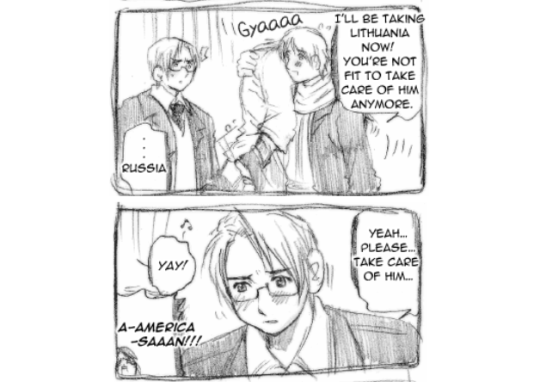
America becomes disheartened when he can’t afford for Lithuania
to live with him anymore [x].
However, in earlier strips, we learn that America’s pets
hold a similar affection for Lithuania [x].
Canada:
Before, I’ve speculated that Kumajiro represents Canada’s
psyche.
The focal point of Canada’s characterization is his struggle
to form a stable and memorable identity and overcome his invisibility. As such,
neither Canada nor Kumajiro getting each other’s names correctly figuratively reflects
how Canada still hasn’t figured out who he is.
Hence, Kumajiro’s infamous “Who are you?” catchphrase has another
level of depth to it [x]. He’s not just asking Canada who he is [as in his name]
but also who Canada stands to represent as a person and a nation. His identity and
self-concept is something that he continues to negotiate and work his way
around.
Some other examples would be…
Canada is too shy to ask England to have lunch with him.
Kumajiro then reassures Canada that it’s okay to be more demanding and urges
him to speak up for what he wants.
In the aftermath of the American Revolution, England diverts
most of his attention toward America. Kumajiro uses stuffed animals to convey Canada’s feelings. The puppet story depicts how Canada feels
neglected and excluded [x].
“I think the well-behaved baby bear should be loved more,
but what do you think, whoever you are over there?”
England:
England becomes dismayed after watching a fantasy movie and
laments over his desire to live in such a world. His magical friends don’t hesitate
to give him a required dose of reality [x].
Iceland:
Mr. Puffin acts as both a mentor and mouthpiece for Iceland.
He’s able to see right through Iceland and recognize what he’s truly
feeling. In this case, he’s aware of how lonely Iceland is [x].
On the other hand, when he first meets baby Iceland, he comforts
him. At the time, Iceland was still figuring out his existence and questioned
why ‘no other guys like him’ existed. Mr. Puffin assures him that other
nations do exist, just in far geographic proximity [x].
He also teaches Iceland knowledge about the world from his
travels [x].
He can see and communicate with supernatural beings with his barrette but hasn’t been shown to be capable of using magic (e.g., he’s not part of the magic club in the World Academy AU). [x].
So far, it’s only England and his three older brothers and Romania whose magic-performing abilities have been confirmed.
It might be. While America did get a unicorn for his bicentennial as a gift from England, it’s unclear if the one he encounters near a forest is the same one [x].
What this post will
explore is how, despite his independence, America is still equated to a child
by England. I will also touch on how America fights against this image and
overcompensates by attempting to discard any association of his childhood with
England.
England:
As designated by the title,
America’s independence didn’t stop England from infantilizing him. Instead,
what you’ll see is that in light of losing his responsibility of guardianship,
England turns to criticizing everything America does and often meddles in his
affairs. Unconsciously, he’s unwilling to relinquish the authority that he had
over America.
Of course, America is
chronologically young in comparison to other nations, but there is still
something distinct in the way that England fusses over everything the former
does. It’s similar to an estranged parent that hasn’t come to terms with the fact
that they’ve lost control over their adult child.
Some examples of England’s
meddling would be…
Ex: England is caught
meddling in America’s political affairs during the latter’s Civil War [x].
Ex: England conveniently
shows up when America attempts to establish a trading agreement with Japan [x].
Ex: When Lithuania moves
in with America to pursue work, England immediately turns up. He wants to know
how Lithuania is being treated.
Translation: he wants to know what’s going on in
America’s life but is too prideful to admit it [x].
Some examples of his critical,
often condescending, attitude toward America would be…
Ex: When America arrives
at the African Warfront in WW2, England is dismayed over having to “babysit.”
In the same strip, he has
an entire dream sequence where he worries about America injuring himself.
Ex: He hypocritically
reprimands America for running his mouth during a world meeting despite having
a foul mouth himself.
Ex: He bashes America’s
[admittedly childish] world defense plan, referring to him as a “spoiled child” [x].
America:
America’s hero complex,
in large, is an expression of his autonomy, his ability to succeed, and the
ability to assume the responsibility of making choices for both himself and
others. The only problem is that any reminder of his past with England doesn’t
reconcile with this new image of himself.
It’s for this reason that
I believe America suppresses any hint of his childhood with England. In other
words, it works against the mature, capable person that he’s constructed
himself to be.
Ex: England falls asleep
during a world meeting. It’s only until England starts murmuring his dream out
loud that America wakes him up. To be fair, it would be mortifying to have your
past bedwetting habit revealed.
Ex: America drinks
coffee out of spite. Drinking tea would be an acknowledgment of his past as a
subordinate. It’s a childish way of him wanting to differentiate himself from
England [x].
Ex: Lithuania finds the
toy soldiers that England gave to America when he was younger. *In arrives
England for a surprise visit* America becomes distressed and tells
Lithuania to hide the toy soldiers [x].
In sum, even though
America formally gained his independence from England, both struggled to readjust
and form new images of themselves in the aftermath.







 Ellawritesficssometimes