Au contraire, he’s a wall-texter [x].

Au contraire, he’s a wall-texter [x].


Before, I used to dismiss the idea of time travel in
Hetalia. Looking back, I can see that this limited my understanding of several
bizarre and inexplicable occurrences in the manga.
In a fictional series
where the nations are immortal, being referred to as “strange” and “odd”
beings, it’s honestly not that far-fetched to consider that they’re capable of
time travel.


This is especially true given the facts that…
1) Time is experienced differently by the nations.
Ex: Canada spends an entire weekend staring at Kumajiro’s
eyelashes. It passes by without him realizing this [x].


Ex: If a human were to spend enough time around a nation,
their perception of time would become so warped that they’d go mad.
Ex: Pets don’t go mad when they’re around their nation
owners. Instead, their lifespans increase. Should they separate from the
nation, however, they would become normal pets again and resume aging [x].
2) Some nations are capable of magic,
fortune-telling, clairvoyance and other supernatural abilities.
Ex: England’s and Romania’s ability to cast spells.

Ex: Japan’s powers of clairvoyance and mind-reading [x]– I’ll
get back to this later.

Evidence of time travel in Hetalia is either extremely
subtle or so right in your face that it’s easy to overlook.
Could it be that the pets don’t age because the nations are beings that are able to transcend space and time? In other
words, what if time is bent around the nations, which, in turn, causes their
pets not to age?
They’re timeless beings in that they’re immortal. While they
do age, it’s very incremental. They still remain youthful, likely because time
is slowed for them. In that case, the reason that the pets won’t go mad by
being around a nation is that they don’t perceive time the same way that humans
are able to.
Are the nations able to time travel then?
Evidence from the manga suggests that they’re indeed able
to.
Let’s go over some of these examples.
If you factor in time travel, this would explain the sudden
appearance of anachronisms when you least expect it. I used to think that these
were silly comic gags. My opinion has since changed.
Ex: When America pulls out a computer to google where
Germany is in 1942, England isn’t surprised. Instead, he’s able to pinpoint
exactly how far into the future the model is and reprimands America for showing
off.

Ex: Why is it that during the 18th century, Japan
appears to be listening to music…with earbuds? [x].

Ex: The Roman Emperor Nero is once depicted to be playing an
acoustic guitar.

They’re aware that it’s an
anachronism. Perhaps either Rome or Quintillus – another Roman Emperor who’s
canonically able to time travel – brought that there. I’ll get back to
Quintillus in a moment.
As mentioned above, Japan has been shown to be able to read
minds, see into the future, and establish contact with others without having
ever met them in person before.
Ex: Japan demonstrates his clairvoyant powers during the
Meiji Era. The fourth wall is broken as the scene pans in on
Himaruya scrambling to finish a comic.


Ex: When Japan first becomes acquainted with the Italy
brothers, they’re put off by how silent and reserved he is. Japan later admits
that he’s not used to speaking out loud with those whom he’s read the minds of [x].


If anything, this alludes to the fact that Italy and Japan
have technically met before.
Notice the title of the strip too. “A melody that transcends
history and reaches you…”


After falling into bed with Holy Rome, Chibitalia has a
strange dream where he encounters a presumably divine being that leads him to –
yes, Japan. This confirms what Japan claims in World Stars. He did, in fact,
read the mind of Italy and communicated with him far before they formed their
alliance in WW2 [x].


That’s not it, either.
Italy in adulthood has a ‘unpleasant dream’ of a child that looks
exactly like him pressing to be acknowledged [x] [x].


How I’ve interpreted this before is that it symbolically
represents Italy’s unconscious mind repressing memories from his childhood. Put
another way, he’s refusing to remember – acknowledge – bits of his past.
Taken literally, this could also mean that Italy’s child
self is transcending time and space to get him to remember his past.
Or, what about this scene? Italy encounters his child self, recognizes this, and feels ashamed for
lying about how [not] strong he’s become [x].


Germany also appears to have these strange encounters with chibis.
Ex: In the same strip, a child that looks
exactly like Germany/ Holy Rome presses to be acknowledged as well [x].

Ex: Germany’s once shown to be holding up Chibitalia.
“It’s me!”

What if this is Chibitalia traveling into the future
to get Germany to remember about his past as Holy Rome? At the same time, it could symbolically represent childhood memory repression. Of course, this is all making the assumption that Germany is, in fact, Holy Rome.
Most obvious of all is that there’s a real character in the series
who’s physically able to time travel.
The play on Quintillus’ time-traveling abilities is that
because historical records about him are shifty, his timeline leaps back and forth.
Himaruya took this, made it literal, and gave Quintillus time-traveling powers [x].


Ex: We see Quintillus visit Germany in modern times making
sure that the latter’s research and re-writing of Roman history are accurate [x].

With all the evidence I presented, I truly do believe that
the nations are able to time travel. It’s not just limited to their ability to
slow time for those around them. They seem to be able to manipulate it too, being able to disappear on
a whim…


Yes and no.
As mentioned, the colony system in the manga doesn’t have the colonizing nation live with their colony 100% of the time. Instead, the colonizer visits the colony in the latter’s home.
Ex: England visits America at his home. Long gaps of time pass between each visit.

Ex: In his character song “Absolutely Invincible British Gentleman”, England mentions that he has holiday homes – presumably in India and Hong Kong given the lyrics.
“Curry, Chinese cuisine, my holiday houses’ meals.” [x].
What you’ll see is that the word “home” is also used generically to refer to a piece of land/ territory/ settlement. It’s just like how nations will refer to their entire country as their house.
(e.g., “My house [country] has the best food!”)
Another example would be Finland and Sweden’s colonization of America. They make a settlement [home] in America, only to have it taken from them by Holland. In this case, the strip is making a reference to New Sweden, otherwise known as Delaware [x].


England [to America]: Relax, you yank. Germany’s not anywhere near here.
Germany:
You’ve been hit by
You’ve been struck by
My smooth arsenal
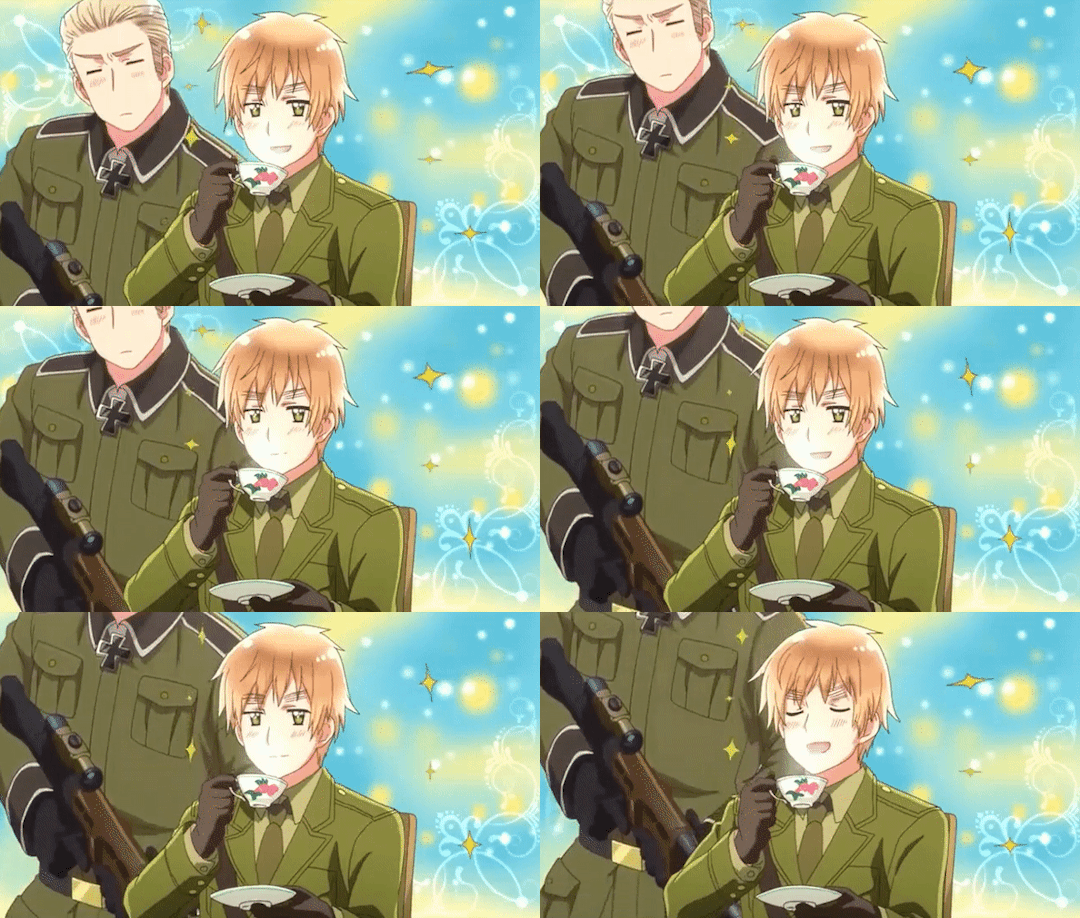
Oh, I love the humour! There’s several fourth wall breaks
and anachronisms, but my favourite has to be the fact that Himaruya literally
titled a strip “Fuck you.” [x].

In the original web comic – the earliest version –there’s
one example of this [x].


Other than that, as we know now, Hima changed course with
the nations’ characterization. They’re subordinates who follow their bosses’
orders, and while they’re able to exercise resistance in terms of recognizing
corruption, the strips have repeatedly shown that they don’t have the authority
to change these circumstances [x] [x].


Misconception: She’s average.
Reality: While Hima intended for her to be average, her
characterization took a drastic turn [x]. She’s anything but average.
Ex: She’s a model student within Africa.

Ex: Regardless of her isolated position, she avidly studies
foreign relations [x]. Either way, she’d need to given how globalized the world’s
economies have become. The 2008 Financial Crisis affected her too, after all.


Ex: She’s described as a go-getter [x].


Ex: She’s not subtle about her economic transactions with
European tourists. She’s well adept at making her tourism industry thrive.
“Good –foreign
currency–
noon!” [x]

Ex: She’s good at sales promotions [x].


Ex: Prices in her country are more expensive in response to
high volumes of European tourists.

Ex: As a matriarchal society in which women are the
breadwinners of the family – as also cited by Hima in her character notes [x] –Seychelles
is not only strong and tenacious but admirably self-effficient.

Misconception: She’s a ‘stupid’ and ‘plain’ airhead.
Reality: She’s a lively, bubbly personality who simply
smiles a lot. The term airhead is used to describe her weird personality given that she’s composed of a mix of several cultures. It has nothing to do with her intelligence.
Ex: An unconfirmed African nation refers to Seychelles as an
airhead due to French and English influence.

Ex: She loves salted and pickled fish [x] [x].


Ex: She’s notorious for her butt-shaped coconuts [x].

Ex: Her isolation from other African nations parallels that
of Iceland and the other Nordics. A unique moment is shared between them where
Iceland senses her situation and relates to her fear of being forgotten. I can guarantee
you this is where the IceSey pairing came from.


Misconception: She’s related to England and France.
Reality: She inherited much of their culture, along with
some Indian and Chinese influence. What ties her and France and England together
is that she used to be a colony of theirs at different points in time [x].

Ex: A scrapped design intended for her to have one thick
eyebrow and one thin one to represent French and English influence.

Ex: Later, it’s shown that French influence on her country
has prevented her from inheriting England’s thick brows [x].

Ex: Her cuisine represents a mix of several cultures.


Bonus facts:
Both the Allies and Axis get stranded on her island during
WW2.

She’s a homebody [x].

Her costume as Captain Hook during the 2011 Halloween Event
is likely a reference to the fact that young pirates used to have hideouts on
her island [x] [x].

She’s tough on litterers.

She was the main character in an unfinished dating
simulation titled “Gakuen Hetalia” [x].

In sum, Seychelles is a wonderful character, regardless of
how little canon representation she has. She’s a cheerful and vibrant spirit
that bravely powers through the obstacles of her isolation, namely economic. Nonetheless,
she makes the best out of her unique cultural inheritance and isn’t afraid to
show it off. What’s unfortunate is that much of this complexity is watered down
in light of disliking her for coming between popular ships.


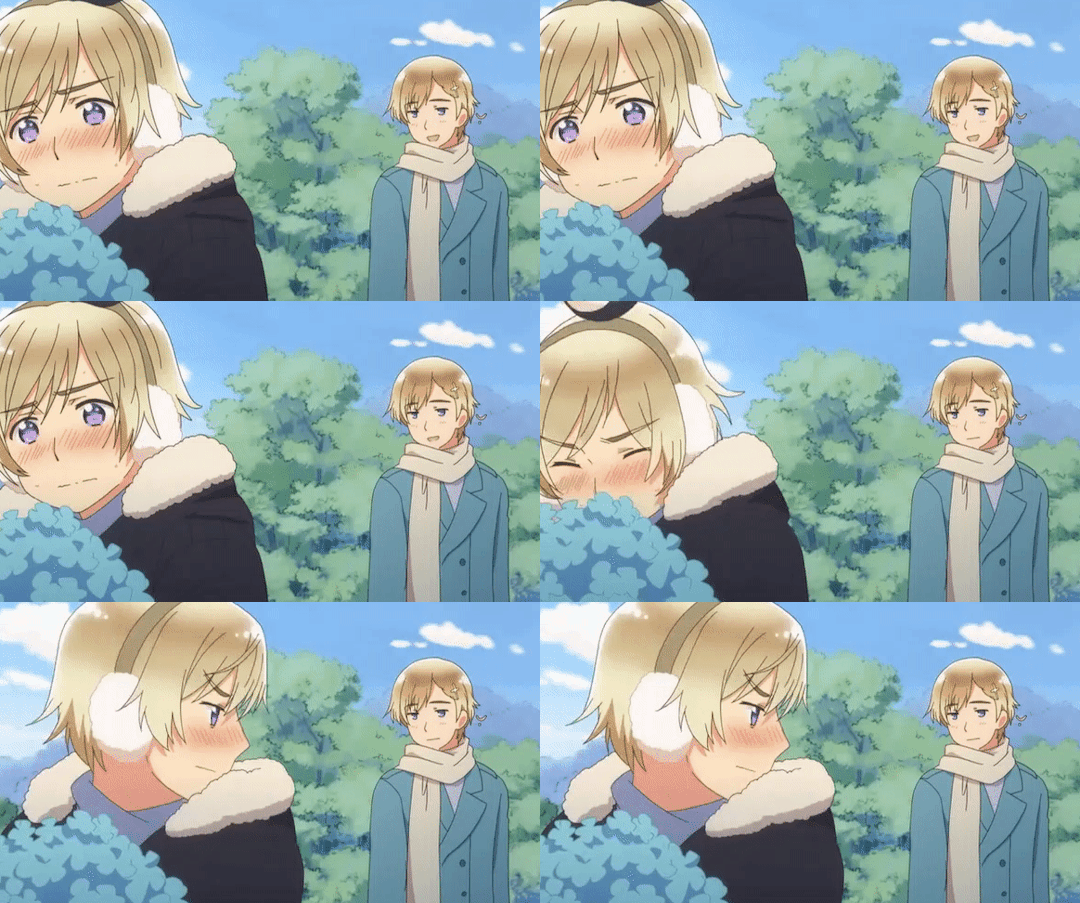
Note: This is a
guide. It’s not meant to cover an exhaustive list of all relevant examples in the manga. If I did that, this post could
easily be a novel.
Before I get into the direct blood relations of the
characters, this guide aims to chart out and differentiate between the different
types of relationships that we see in the manga.
Biological siblings, obviously, means that the nations in question
are blood-related.
Ex: America and Canada.

Ex: Greece and Egypt and their moms, Ancient Greece and
Ancient Egypt.


The best example of a biological relation is that of Norway and
Iceland’s.
Iceland had no native people. Since it was Norwegians alone
who first settled on the island, the two are directly related [x].
Iceland innately senses Norway when he’s first born.
Norway
also senses Iceland.


Likewise, DNA testing – in this case, a land excavation – is
done to confirm their biological relation.


Now, let’s do a comparison.
When America’s born, he doesn’t sense a biological brother
among the countries colonizing him. The reason for this is that he’s referred
to as an ingredient, meaning that not only were there native tribes living on
the land he represented but that America existed as a mix of several European
cultures [x].
The point to differentiate here is that America doesn’t have
a direct biological relation to these colonizing countries due to the large
volume of them.
Instead, what you’ll see is that the colonizing countries
fight over assuming the role/ title of being America’s big brother, or
onii-chan.


Continuing from America’s example, after he chooses England
over France, he asks England if he can refer to him as onii-chan – ‘Big Brother.’
As stated in the translator’s note, onii-chan can be used as
an expression of adoration and endearment. Put another way, ‘big brother’ here
has an entirely different cultural connotation. It’s a brother-figure relationship
and isn’t meant to be taken literally.


Not to mention the fact that England initially rejects the
label of onii-chan, claiming that “just ‘England’ is fine.’” The reason England
is hesitant to accept the label stems from the horrible relationship he has
with his own older brothers.


France is another example where the term Big Brother is used affectionately.
Ex: He claims to be the Big Brother of the world.

Ex: He’s described as a Big Brother-type.

Ex: The first thing that he does when he meets Lisa, Jeanne
d’Arc’s reincarnate, is introduce himself as Big Brother.

Ex: The reason that Italy refers to France as Big Brother is simply because they grew up in Rome’s house together for some time.


This title of endearment is confirmed in one of Hima’s blog
posts, where he clarifies that Italy and Monaco both call – as in refer – to France as Big Brother [x].
More examples of France’s use of the title ‘Big Brother’ can
be found here [x].
One last example of this is that of Netherlands, Belgium,
and Luxembourg.
Netherlands and Belgium are biological siblings. Meanwhile,
Luxembourg refers to Netherlands, France, Spain, and Belgium as Big Brother and Big Sister respectively [x].
While the translation is noted to be rough, the distinction
is nonetheless made very clear.

A full post on this can be found here [x].
All that needs to be known is that when two nations
willingly unite – not to be confused with being conquered/ annexed – the personifications
involved are considered to be married.
Austria is notorious for this, being noted to have solved
all his problems in the past through marriage (e.g., the Austro-Swiss
partnership, The Hapsburg Monarchy, the Austro-Hungarian Empire).

In the manga, sharing similar ancestors doesn’t make the
nations involved biologically related. In this case, I’m talking about cultural
influence.
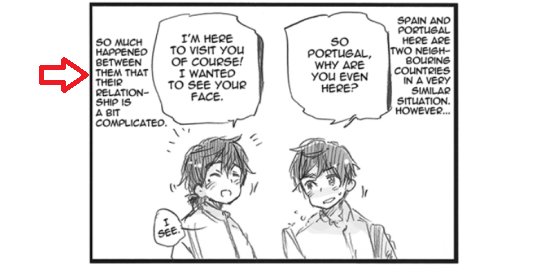
Ex: Spain and Portugal. (Chapters 77-79 of World Stars).
Both are noted to share a similar ancestry. As such,
Seychelles can’t tell which one is Portugal when she has a letter to deliver to
him.


Given the context in which the topic of their physical resemblance and relationship is discussed, if they were siblings, France would have attributed the reason for their likeness to this. He doesn’t.
Not once is a relation ever confirmed except for the fact that they’re neighbors.
Point is, it’s the similar ancestry that causes them to look alike.
+

+

Ex: Romania and the Italy Brothers [x].
While Romania may have inherited much of Rome’s culture, he’s
not related to the Italy brothers.


This brings me to my next point.
While cultural influence often affects the physical
and personality traits of nations, it doesn’t make them biologically related.
Ex: Seychelles was originally designed to have one thick
eyebrow and one thin one to represent French and English influence.

Ex: As an amalgamation of several cultures, America
resembles bits of Finland, France, and England.

Ex: France’s influence prevents America, Canada, and
Seychelles from inheriting England’s bushy eyebrows [x].

Ex: Young Canada inherits France’s hair due to his
influence. This is before England had assumed control over him.

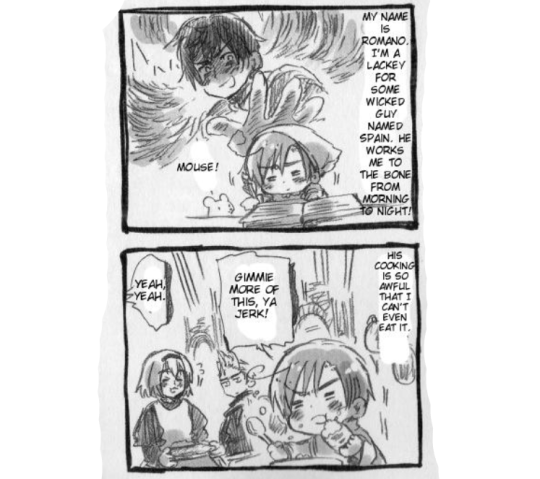
When a country is conquered and their conqueror is on the
same continent, the conquered personification lives with the conquering personification.
Ex: France, Holy Rome, and Chibitalia living in Rome’s house (panel used above).
Ex: Chibitalia and Hungary living in Holy Rome’s house. Despite the rough start, they become so close that they refer to each other as family.


Ex: Romano, Netherlands, and Belgium living in Spain’s house.
In modern times, we still see this occur, albeit it’s a bit
different.
The Chinese provinces +
Macau and Hong Kong (under a one country two systems principle) all
live in China’s household.


*Note – I made up the labels of house and household system
to better clarify and more easily distinguish between the two different living circumstances.
In canon, ‘House’ and ‘Household’ are terms used loosely and interchangeably in the translations.
The household system is separate from the house system in
that because the colonies are on separate continents, they’re part of a
household. In other words, they’re together and considered to be a unit despite
not living with the ruling nation.
Ex: England visits America, but America doesn’t live with
him in England.

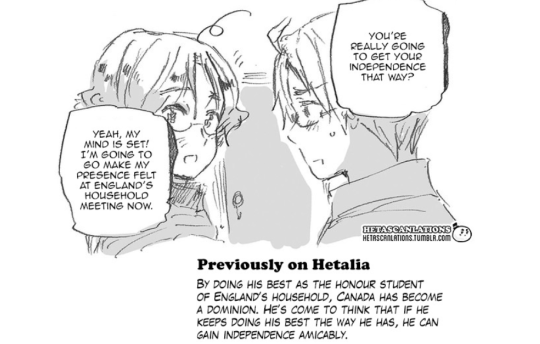
Ex: England hosts a household meeting, requiring the colonies to travel [x]. (America is already independent here, by the way. He’s not part of the household.)
Ex: Likewise, England has holiday houses in Hong Kong and
India, as alluded to in one of his character songs [x].
“
Curry, Chinese cuisine, my holiday houses’ meals.”
Ex: Hong Kong, who used to live with China and referred to him
in a more intimate way [x], changed after he became an English colony.
When he becomes Chinese territory again, he refers to China
as teacher/ Mr., seeing him more as a mentor.


What I want to stress here is how fluid interpersonal relationships
between nations are in Hetalia. They’ve lived for centuries; how they view and
interact with each other changes with time. Their relationships – aside from
biological relations – aren’t as static as human patterns of organization.

*on the phone*
America: Happy Father’s Day!
England: Wow, I’m impressed! This was really thoughtful of
you.
America: Dang, wrong number…I meant to call France.
England: *calls France*

The comic gag is that it’s attributed to French and English influence.


 Ellawritesficssometimes