image
image

This post will use
Adlerian theory to examine England’s personality. What I’ll elaborate on is how
he suffers from both an inferiority and superiority complex.

 What’s an Inferiority Complex? 

image

An inferiority complex
is a “condition that develops when a person is unable to compensate for normal
inferiority.” These individuals typically possess poor opinions of themselves
and feel helpless/ unable to cope with the demands of life.

In other words, these
individuals cannot accept that it’s a given that other people will be better
than them, either in a given task or life in general. If they come second to
someone, they take it personally and neurotically believe that it’s reflective
of their self-worth.

There are three
potential sources in childhood that can lead to the development of an
inferiority complex. For the purposes of this post, we only need to know about
neglect, which England experienced.

Neglect in childhood – from this psychological framework – entails
the child being met with an indifferent/ hostile attitude by their parents/
parent figures. As such, the children can develop feelings of worthlessness,
anger, and view others with distrust.

image

England’s Inferiority Complex: 

France and England’s
older brothers – Scotland, Wales, and Northern Ireland – step in as England’s
parent figures.

Ex: Since England’s
older brothers would hex and degrade him any time he got near, this satisfies
the indifferent and hostile attitude requirement.

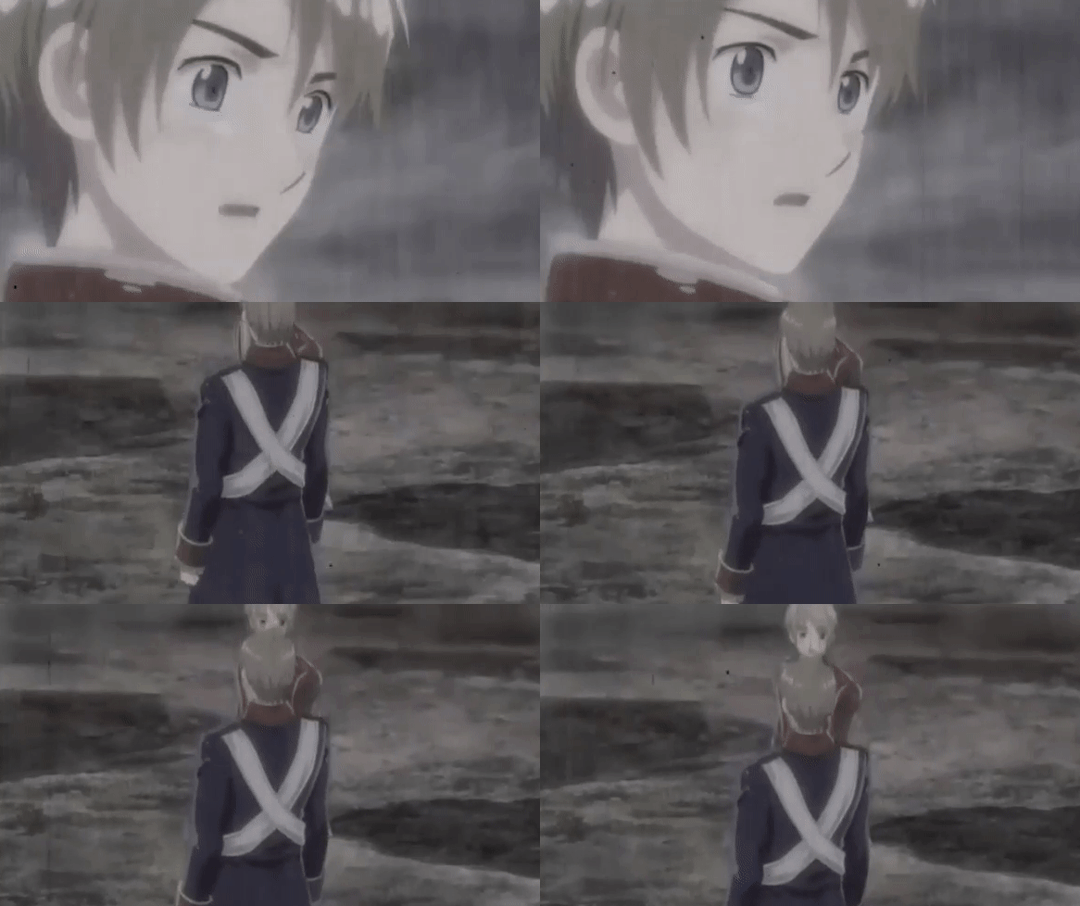
The cycle continues when England, having developed a poor sense of self-worth from the above rejection by his siblings, doubts whether he’ll be able to act as a proper older brother figure to America.

Notice how he cries as
he recalls these unpleasant memories from his childhood. Initially, he doesn’t
even want America to refer to him as onii-chan, but rather, just “England.”

image
image

Likewise, France’s
constant insults toward England, while intended to be teasing, is taken to
heart by the latter. He truly believes France when he says that he’s
“unrefined”, as in being behind on fashion trends.

image

Ex: France mocks
England’s hair for being outdated and ‘unrefined.’

image
image
image

Ex: England’s later
shown to be depressed over France’s comments and becomes insecure about his hairstyle and his failed attempts to change it.

image
image

Ex: England’s worry over
being unrefined is overcompensated for when he spies on France to get ahead of
fashion trends.

This way, his early-bird
conformity prevents him from being subjected to France’s comments. While he may
deny it, England does care about France’s opinion of him. He’s not as confident
as he tries to play himself off.

image
image

Ex: England undermines
France by vowing to have the latter become his vassal.

image

The feelings of
worthlessness that England attained is most seen in how self-deprecating he is.
Overall, he’s an extremely critical person, of both others and himself.

Ex: He’s recently noted
to have become more critical of himself than others.

image
image
image
image

The helplessness that
England experiences stems from his loneliness. He turns to the world of fantasy
(his magical friends) and fiction because it’s a more ideal and less painful
world.

image

The reason for this is
that he’s said to have trouble expressing himself. He often rubs people the
wrong way and isolates himself as a result. The irony is that England knows
that others misunderstand him, but doesn’t do anything about it. Instead, he makes self-deprecating jokes about himself [x].

What’s a Superiority Complex?: 

image

A superiority complex is
a “condition that develops when a person overcompensates for normal
inferiority.” These individuals can be vain, boastful, self-centered, and tend
to degrade others.

England’s Superiority Complex:

image

From England’s
inferiority complex, we know that he grew insecure about being weak and
unrefined.

In return, he
overcompensated by striving to be the best, most powerful nation.

Ex: England boasts about
his empire.

image
image

Even more interesting is
that after America surpasses him as a stronger world power, England attempts to
gain back this strength through physical training.

image

What’s important is that
he feels slighted by his inferiority and engages in a vain attempt to secure
his status once more, albeit failing.

As mentioned, England is
a very critical person.

Ex: He leaves scathing remarks on America’s movies.

image
image

Ex: He picks apart at everything America says during world meetings – most
of it is ridiculous anyway.

image
image

Ex: He and France have consistently insulted and bickered with each other
for centuries.

image

Point is, the insults
and criticisms are reflective of his own insecurities. Insecure people will
often degrade others in order to feel better about themselves.

In conclusion, while
England may be a bitter and pessimistic person, especially in the years
following the American Revolution [x], it’s imperative to realize that he’s just as
critical of himself.

The best thing about his
character is his uncertainty. He flips from being kind and sweet when he’s
feeling secure of himself to rude and bitter when he’s insecure. Lately,
however, this critical nature has become increasingly internalized…

image
image

While you’re right in that I’m manga-centric, there is actually a direct strip reference that mentions the Norman Conquest over England. What we learn is that France acted as England’s chef during this time [x]. 

image

Tonight, I’ll explore England’s childhood inferiority and how this also led him to develop a superiority complex in which he played himself off to be overly confident, despite lacking such certainty. 

Post coming up tonight!

image
image
image

Note: This is an example and reference post. By no means does this cover every case or detail in the manga. 

PART 1

America:  

Fear of Criticism–

Ex: In earlier strips, he’s
depicted to be reluctant to show England his movies.

image
image

This changes as he later
warms up to showing England his latest movies, only to have it be brutally
ripped apart, again. He’s gotten so used to being criticized by England that he’s normalized it all together.

image
image

Perhaps because of these
criticisms, on top of how poorly his movies are rated, is what caused him to
begin “laughing off the negative as something positive.”

image

Fear of Being Challenged

He likes to be the #1 at
everything. 

image

While it’s not made explicit, it’s clear that others’ opinions
threaten him.

Ex: He claims to want to hear
alternative opinions but later refuses to accept them.

image
image

Ex: He crushes bundled
spoons, likely as a form of intimidation, to prevent other nations from
disagreeing with his world defense plan.

image
image

Fear of Being Alone–

Due to England’s long absences,
he grew lonely.

image

This translates into adulthood,
where he pesters other nations into hanging out with him.

Ex: He breaks into Japan’s
house + desperately tries to convince himself that at least Japan likes him,
despite all other nations ‘hating’ him.

image
image

Discontentment with his
weight–

Ex: He doesn’t like being
called fat.

image

Ex: He refuses to acknowledge
the ‘number’ on his scale and instead convinces himself that it’s broken.

image
image

Austria:

Fear of Being Plain–

Ex: He doesn’t need to wear glasses
but feels simple without them [x].

image
image

Canada: 

Fear of Being Ignored/
Forgotten–

image

Canada was neglected in his
childhood and consequently developed low self-esteem and self-worth.

Ex: He mistakenly believed that
the then colonizing England was looking at
him as a person
and not as a resource when they first meet. If anything,
this fleshes out how young Canada wasn’t accustomed to being valued on a
personal level. As such, he doesn’t value himself later on in life.

image
image

Ex: He at one point believed
that America was disinterested in him.

image

Ex: He was once too shy to communicate
with America directly, so he used England as a mouthpiece.

image

Ex: He cries when Seychelles
remembers that he’s a member of the G8 .

image
image

Discontentment with Looks–

Ex: He doesn’t think he’s
good looking.

image

England:

Fear of being weak + inferior–

Ex: After being conquered
several times over, young England aspired to become strong himself.

image

Ex: He longs for the golden days of his empire [x].

Ex: He especially feels
inferior when America surpasses him in manufacturing during the Second Industrial
Revolution.

image
image

Ex: In “England’s Plan to Be
the Strongest”, England trains to become stronger – an implicit acknowledgment
that he’s lost power.

image

Low self-esteem–

Ex: As a child, he took France’s teasing
insults to heart and believed that he was “unrefined.”

image

Ex: While he’s critical of
others, he’s just as critical of himself. He’s self-deprecating.

image
image

Fear of Being Alone–

As the “Black Sheep of
Europe, he was constantly isolated from other countries.

image

Ex: The American Revolution.

image

ENGLAND: You’re still hung up
on those rubbish conspiracy theories, aren’t you?

AMERICA: Duh, they’re
interesting! There’s so much about the world that science can’t explain.

ENGLAND: Like us and why we exist?

AMERICA: Like…us…?

ENGLAND: I regret ever saying
anything.

AMERICA: 

image
image

To begin with, I want to emphasize how important it is to
recognize that Hetalia is not a series that believes in permanent grudges. Regardless of
the betrayals that occur in the manga, the grudges that the nations bear rarely
if ever remain.

This doesn’t go to say that grudges can’t last for a long
time, because they do and for good reasons. What I’m getting at here is that
while the nations are cultural personifications – representing their citizens,
not just the government – they’re also people just like you and me.

How the nations associate
with each other is influenced by their political relations. On the other hand,
to say that, because of these rocky political relations, the nations in
question inevitably hate each other is a shallow way of understanding things.

Their pasts together extend beyond their present situation. They’ve
lived for several lifetimes and have their own memories and experiences; there are
other factors to take into account that influence how they view each other on a personal level. To view and associate are two
very different things that are wrongfully equated together in the fandom.

I say this because you’ll see moments where enemy nations
drop their political masks and treat each other as friends.

Ex: After being stranded on Seychelles during WW2, Italy invites
France to his side of the island and asks not to pick a fight. Italy still
fondly refers to France as Big Brother, a title that originated from their
childhood spent together in Rome’s house.

image
image

Ex: When he occupies Rome, rather than treating the Italy
brothers with hostility, America politely asks them to make him authentic Italian
cuisine.

image
image

Ex: Italy excitedly greets Austria after his annexation,
despite having recently fought him in WW1.

image

What this post will explore is how grudges held by the nations
subside with time.

That said, let’s go over some examples.

America and England: 

Of course, I’ll get the most obvious one out of the way
first. America’s declaration of independence was experienced as a personal betrayal to England.

image
image

Ex: He’s noted to have had a stormy temper in the decades
following America’s independence. [x]

Ex: While it’s not explicitly stated, it’s alluded that
England is talking about America when he claims to have suffered from 100 years
of heartbreak.

image

Of more importance is that aside from their volatile political
relations, America still demands to see England when he hears that the latter’s
fallen ill as a result of the war.

Notice how distressed and panicked America is here. He even
tries to force his way into the house, despite being barred entry by
Canada. Again, the personal triumphs over the political.

image

As mentioned, with time, a lot of this anger and resentment disappears.

Ex: England takes the leap and attends America’s centennial
celebration.

image

Ex: The two are now able to tease each other void of any
spite.

image

Belgium and Netherlands:

There’s a rocky period in their relationship after Netherlands attempted to unify them into one Kingdom. Belgium declares her
independence instead.

image

We learn from his bunny how upsetting this “fight” was for
him. He copes by constantly keeping busy.

image

China and Japan:

This one is definitely the most difficult betrayal to
digest. It’s easily the most brutal scene depicted in the manga.

Japan stabs an unsuspecting China in the back during WW2.
What I want to place particular emphasis on is the fact that even though China
knew that their political relations were tense, he still personally trusted Japan, even as the katana was pulled out.

image
image

Additionally, notice how Japan’s face goes blank before he
stabs China. To me, this appears that he’s emotionally removed himself from the
situation.

image
image
image

In the aftermath of this betrayal, we see China drunkenly
crying as he realizes how war has changed Japan. Russia’s response to this is
crucial. 

Nations don’t remain as enemies
forever.

It’s the good memories that last.

image

Even though China developed a grudge against Japan, it doesn’t
last.

Ex: In a more recent strip, China attempts to strengthen his
diplomatic ties with Japan.

image

Following the abolition of their empire, Lithuania falls
under Russian control. As Lithuania’s forcefully dragged away, Poland doesn’t
answer Lithuania’s pleas for help and instead laughs at his facial expression.

image

Because of all the fond moments they shared together,
Lithuania resents Poland for this, but he doesn’t hate him. 

image
image

If he did, then he
wouldn’t have warned Poland of Russia’s plan to invade him in WW2.

image

All in all, the point to take away from this is that while
hatred exists in the manga, it doesn’t persist. Political relations may influence
the nations, but in no way does it define them in whole.

image