It depends on their position within the global economy.
As such, a nation’s health depends on their political and economic situation. They catch colds during economic recessions.
The Great Depression strips are a good source for this, as each negative number assigned to a nation has a differential impact on their health. Since America was a manufacturing powerhouse at the time, his stock market crash affected them all.
Ex: Japan obtains a cough, meanwhile Poland runs a high fever.
In modern strips, we’re also provided with the fact that Austria will slip into a high fever and eventually collapse if Germany even so much as catches a cold.
“A reliable country that likes to approach things with a sober seriousness. He approves of and supports lots of Germany’s ideas so he may look like one of the helper countries, but in reality the level of his dependency is pretty high. So high that when Germany catches a little cold, Austria goes straight to high fever and eventually collapses, and so he doesn’t have much of a choice than to take good care of himself.”
As for how serious it can get? Spain almost died from an economic recession.
Now that I’ve gone over some of the factors that cause a nation
to age [x], I think it would be useful to go through each one separately. This
post will focus on how political autonomy and independence allows a nation to
reach adulthood.
Not only that, but what you’ll also see is that they go
through growth spurts right before gaining independence; their status as an
adult is solidified once this independence is gained. In other words, it’s the resistance that first sparks the aging.
It’s also important to mention that
chronologically-speaking, nations will still consider themselves to be older
than others, regardless if one of them became an adult first. There are late bloomers
like the Italy brothers and quick bloomers like America. The best comparison I
can think of is that anything to do with gaining independence is akin to the pubescent
period for a personification.
That said, let’s go through some examples.
America:
In the following three panels, we see America go through three
developmental changes. In the first stage, he holds a more compliant attitude
towards England and helps him in the French-Indian War. Notice the tag of “Young
America” attached to him.
This compliance begins to wane as America was heavily taxed and financially drained by England following his involvement in the war. Notice how he’s a slightly
older child here.
Then, when America begins fighting for his independence, he’s clearly gone through another growth spurt.
We also see in the years leading up to his independence – as he becomes even more economically and politically sufficient – that he grows pre-emptively.
Lastly, there’s the imagery that Kumajiro uses with dolls to
represent England’s relationship with America and Canada. America is the rowdy
Baby Bear; put another way, it’s like a teenager fighting for freedom from
their parent. Once that freedom is gained, only then will they become an adult.
Canada:
Canada’s growth occurred at a much slower rate than America. He wasn’t an economic powerhouse like the latter.
While he remained as a young child, America appears to be in his pre-teen
phase.
In the years following America’s independence, Canada ages,
but he still has the lanky and awkward appearance of a teenager. He hadn’t yet
gained his autonomy yet, the missing factor to the age equation.
Here’s Canada after the Battle of Waterloo.
Pay attention to the roundness of his face.
And here’s him during the war of 1812 [right], vs how he
looks in present strips [left]. There’s a notable difference in age.
Likewise, we also know that when Canada upgrades to the semi-dependent
status of a Dominion, the autonomy is enough to allow him to reach adulthood.
Italy:
We know that Italy is around the age of a pre-teen during the
Austrian War of Succession. He’s not quite a teenager, or at least not an older
one given how short he is in comparison to Austria.
During the Battle of Custoza [whilst raging his third war of
independence], there’s a considerable increase in age. Once again, we see an
example of a nation pre-emptively growing right before they attain independence.
Once Italian Unification is complete, there’s no doubt that
Italy has become an adult.
Romano:
Romano’s path to adulthood occurred in the exact same manner
and timespan as Veneziano’s did.
He’s around the same age as Veneziano during the Austrian
War of Succession.
He’s noted to have stereotypical teenager behaviour in the
years leading up to his independence from Spain.
Before independence, he appears to be in his late teen
years.
Once unification occurs in the panel I provided above, he’s also clearly an adult.
With all that in mind, it’s important to mention that chronological age is how the nations organize themselves
in terms of perceiving their elders. I know this may come across as obvious,
but it still needs to be said.
Despite becoming an adult later than America did, Romano
still sees himself as older than America and even takes it upon himself to give
him political advice.
Misconception: He’s
weak
Reality: Far from
it. The man’s been through a lot, emotionally especially.
Ex: During a heated
argument with America, he’s able to close the door on him. It’s hinted that
Canada may have super strength, but he dismisses this.
Ex: He’s more
than capable of standing up from himself if necessary. Even a pushover has their limits.
Admittedly, he does excuse a lot of Cuba’s hostile behaviour
towards him. It’s only because Cuba mistakes him as America, though.
Ex: Canada’s
emotional insecurity can easily be seen as a strength. It takes a lot out of a
person to remain so generous and friendly, despite being historically ignored and
neglected by those close to you.
Misconception: He
and America hate each other.
Reality: While
they may have had some extremely rough times together, they’ve done more than
enough to make up for this.
Covering the progress of their relationship in more detail
will require a whole series of posts, but these are the basics.
Despite growing up together, they argued a lot following
America’s independence. Britain acted as the most prominent wedge between them. For some time before, they also couldn’t see eye-to-eye due to profound age differences.
Canada held resentment towards America for being selfish,
reckless, and too imposing.
Ex: America
actually pushed for Canada to gain his independence. This didn’t occur until quite a while later, obviously.
Ex: When Canada
does get his independence, they reconcile for the better…after having another argument of course. Siblings will be siblings.
Although, as you’ll
see soon, they still argue over the same things. Canada’s main tooth to pick
with America is his egotism and boisterousness.
Ex: America knows
little about Canada’s pop culture, meanwhile Canada knows everything about his.
Nonetheless, the two are still extremely close…
Ex: America helps
Canada figure out his identity. Canada’s multiculturalism [in the strips only,
of course] is inspired by America’s own diversity of cultures and ethnicities.
As such, Canada suddenly finds South Korea and China staying
at his place. The East Coast of Canada, especially Vancouver, is where many
East Asians immigrate to.
Ex: America is
jealous of Canada’s natural ability to get along with everyone.
Ex: The two co-host an online cooking show together. Yes, it’s called “America’s Cooking Channel, but Canada is on there enough times to deserve the title of a co-host.
Misconception:
France is his father.
Reality: France temporarily
acted as a big brother figure to Canada before England took hold of his
jurisdiction. As such, this would explain why Canada inherited France’s hair. It’s
mere influence. They’re not blood-related.
We’ve already see with Hong Kong how one nation’s influence can impact the
physical/ personality traits of another.
Ex: England’s
influence on Hong Kong’s personality. England also cursed Hong Kong to have
thick eyebrows like him.
Ex: Seychelles was originally supposed to have one
thick eyebrow and one thin one to represent French and English influences on
her nation’s culture.
Misconception: Canada’s invisible for no reason.
Reality: There’s
a real historical reason for this. Being a dominion, Canada was often
overshadowed by Britain.
For instance, in WW1, other than the occasional Canadian Red
Ensign flag – which also had a Union Jack on it – Canadian troops fought under
the Union Jack. In return, Britain absorbed much of the credit for the feats
accomplished by Canadian soldiers.
Ex: America thinks that Canada hides in Britain’s shadow. He holds back from saying this out loud.
Later, Canada’s shown to recognize this on his own.
Ex: Canada wanted
to sign a treaty with America, however he was too scared to talk to America
directly. He was worried that America wouldn’t be able to see him.
Bonus Facts:
He cried when Seychelles remembered him as being part of the
G8.
He served in the French army at Waterloo.
Maple syrup is his fuel.
He smoked marijuana.
He once yelled at America for three hours straight, pointing
out his faults. America cried afterwards. Predictably, this was quickly fixed with
a burger.
He aged at a much slower rate than America.
We already know from
chapter 1 of World Stars that the nations let their bosses order them around.
As such, they often have no choice over what they’re commanded to do.
I always use this
example, but it’s still important to point out that Germany’s sense of duty overrode
his personal unwillingness to annex Austria.
The control that
national leaders have over their personifications is pervasive. While Finland
is joking in part, he still alludes to the possibility of Germany’s boss [Hitler]
being more than capable of imprisoning Germany should he disobey orders.
In that regard, the
nations are just like regular citizens. They may cast votes…
…and hold meetings to
discuss world issues, but for the most part, they have little to no control
over what happens in their government. They recognize that there’s corruption
present, but don’t seem to be able to do much about it.
That doesn’t mean to say
that they have no agency, either. They’re not complete puppets in that they
have a mind of their own. It rarely happens, but some nations have in fact
resisted or gone against their boss’s wishes.
Either way, boss control
over personifications has historically been all-encompassing. While in present
times it’s not as extreme as what we saw during both world wars, the control is
still there. For example, England’s boss has control over his sweets and alcohol
intake.
Point is, there’s an
evident and wide power differential between a personification and their leader.
If that’s the case, what
happens to a personification when they’re captured?
The answer is nothing,
as Finland implies in this line of dialogue. More importantly, this strip takes
place in the present [2010].
The only material that
we have to work with on the subject can be found in
the instances where the nations are taken as prisoners of war.
Even when they are
rescued, it’s the personifications who do the liberating, not other human
soldiers. As you’ll see, when a nation is taken as a POW, they’re treated just
like any other soldier; no special treatment or protection is offered to them.
Let’s go over some
examples:
Russia:
As I’ve stated before,
Russia isn’t exempt from being exposed to the brutal conditions that his
soldiers had to endure.
The war-time conditions
are so bad that Russia even thanks Germany when he’s taken as a POW. He claims
that Germany is heaven compared to what he was used to dealing with.
Further, Russia’s bosses
are notorious for their brutal treatment of him. They clearly didn’t give a
damn about Russia given that they tortured him when they were bored.
That said,
I don’t think they would care all that much when news of Russia’s capture
reached them. Again, we don’t see any rescue attempts depicted.
There’s also the fact
that Russia was once given the order to stop a tank with his own body. What’s
crazy is that he actually obeyed this.
Germany:
When taken as a prisoner
of war, Germany claims that the torture there is nothing compared to what he
has to experience back home on a daily basis.
Italy:
Italy seems perfectly
comfortable upon being captured by Germany in WW1, citing that he doesn’t want to leave
as it would mean fighting again.
Usually it’s Germany who
rescues Italy when he gets into trouble on the battlefield. Of course, these strips take place during WW2.
However, in this case, Germany didn’t have to rescue Italy
from the Allies. He was so useless that they mailed him back.
England:
We also see that it’s
America who rescues England when he’s taken as a POW by the Italy brothers and
Germany.
In sum, when captured, it seems that the nations aren’t given any
special treatment or priority by their bosses. Instead, they’re treated just
like any other citizen. It would follow, then, that this type of treatment
would also carry into the present given the time in which Finland’s statement
was made.
I’m crying. They literally threw a wrench in his plan.
All right, so there’s
a few things to unpack here.
My understanding of it
is that America’s artificial creation of Santa by Coca-Cola actually created a real-life
need for a Santa personification.
Since the legend formulated
in America made out Santa to live in the North Pole, that’s why Finland assumed
responsibility for ensuring the delivery of presents on Christmas. He’s noted
to “answer America’s expectations.”
It’s also important to
note that before capitalism globalized the American version of Santa, each
nation experienced their Christmas differently:
Further, Santa in the
strips is used more as a metonymy. There’s multiple Santas – The term Santa is
used to refer to the whole collective of Santas, which just so happens to
include Finland. So in a way, yes, I would consider him as Santa’s helper
despite being one himself.
“Well, Santas born in Finland are used to the cold. We can even walk around with short sleeves in the Canadian winter!”
Ex: Finland frets
during Christmas 09’ when he loses three Santas.
What’s even more odd
is that the economic recessions in the American economy (the sub-prime mortgage
crisis of 2008 in this case) caused the Santas to undergo job cuts.
As for the travelling,
that’s a bit more open-ended.
Given that we see the Axis using a magic flying
sleigh without any problems, I would guess that their ability to fly across
borders is made to be even easier than their typical travelling abilities. I say this
only because Finland in the 2010 Christmas event isn’t able to transport to nations
far away from Europe (i.e Seychelles and Cuba).
They owe their
existence to them.
Ex: France lays out the rule that as long as the nation
possesses a stable government and a large enough citizenry to identify with
said national identity, the respective personification will remain and continue
to be immortal.
This rule is further confirmed in World Stars, where France
explicitly admits that he exists because of his citizens.
They openly interact with one another + humans know of their existence.
A common misconception that people often make is that the
nations’ identities are a secret kept from the public and that only their bosses
know about them. That simply isn’t true.
In fact, while some humans are shown to be perplexed by the
nations’ immortality, their overall existence is known to the public.
Ex: France introduces himself to Lisa, Jeanne d’Arc’s
reincarnate.
Ex: Italy flirts with his own citizens.
Interestingly, Italy’s also admitted to getting tired of
seeing the same faces of his citizens every day – a consequence of his
immortality. However, he does add to this and claims that seeing
these same faces can also be refreshing.
Point is, on top of their being no knowledge barrier of
their existence, the personifications openly interact with their citizens.
The Nations are Citizens Themselves.
Ex: Romano has his own passport.
Ex: Russia isn’t exempt from civilian duties, such as manual labor.
He’s forced to build a waterway alongside his people under
impoverished conditions.
He fought alongside his people in both world wars (as well
as any other personification), and endured the same notoriously terrible living
conditions that his soldiers were exposed to.
Ex: Coinciding with the last example, the nations serve in
their military. Here, America is tasked with tightening security among his
troops after Germany and Prussia successfully infiltrated them.
Population Demographics Affect the Nation’s Personality Traits, Behaviours, Habits, and Physiology:
Given that this is a series predicated on stereotypes, this
isn’t all that surprising.
Ex: China has a video game addiction resulting from this
becoming a rising problem among Chinese youth.
Ex: Germany strictly adheres to the directions of his GPS.
Hima drew this from a news story of a Bavarian who caused an accident by
following GPS directions.
Ex: Post WW1, several Lithuanians immigrated to America to
outsource their labor so that they could send money back home. As such,
Lithuania lived with America during this time.
The same thing happened with Romano. He went to live with America
during the first Industrial Revolution –a direct effect of his own people
migrating there for work.
Ex: As a result of his shifting cuisine (i.e. Indian and
Chinese influences), England is beginning to learn how to cook.
Ex: A nation’s obesity rate likewise impacts the weight of
the personification.
🐰
To celebrate April Fools’, here are some of the best pranks
pulled in the manga
🐇 🎉
Poland sends Russia a “scary” chainmail
letter threatening to make Warsaw his capital.
America annually prank calls England.
France thinks that Spain is joking with him when he’s
offered a bottle of olive oil to chug.
Spain wasn’t joking.
To get China to leave, Hong Kong lies and tells him that
there’s a new monster for him to collect. It’s really just a mailman.
People often find it perplexing that America can’t see ghosts
or magical creatures, and assert that this is done for seemingly no reason. It’s
quite the contrary. There’s an underlying rule in the manga that’s been used
and consistently drawn on:
That is, whether it’s ghosts, aliens, or magical creatures,
the nation’s ability to see/ believe in them depends on if their citizens
strongly believe in them. In other words, superstitions of the supernatural and
unknown need to be part of the nation’s popular belief system if the respective
personification is also able to believe in them.
I say believe mostly
because as you’ll see soon, sometimes a nation will see an unknown being, and
yet not recognize or acknowledge its existence. For the most part,
however, the nation simply won’t be able to see the being.
The reason listed that explains why America can’t see and
believe in ghosts is because 23% of his people either believe in their
existence or have had an encounter with them. Again, this ability is predicated
around citizen belief.
I can’t attest for the exact figures of this statistic. Point is, this is what Hima cited, and it is thus included into the reasoning
behind America’s skepticism of the supernatural. Of course, this rule doesn’t
mean that these beings don’t exist. It just affects whether the nation will be
able to see them.
Notably, this approximate statistic has since changed. [I’ll
get back to this in a moment.]
Likewise, because Americans strongly believe in the existence
of UFOs, America can see and interact with Tony.
Meanwhile, although England can see Tony, since his people
don’t believe in extra-terrestrial life as strongly, he’s skeptical of the
alien and doesn’t truly believe in it. [x]
Quickly, it’s important to go over some supernatural ground
rules specifically pertaining to America.
On Halloween, the one day of the year where Americans
temporarily, albeit strongly, believe in the existence of the supernatural,
America’s able to see ghosts and other unknown creatures.
England is noted to be able to make anyone who visits his
country see ghosts/spirits; America is the only exception to
this rule. [x]
When accused of seeing illusions by America, England claims that
America can’t see the unicorn because he’s too impure.
Funny, considering that England gives America a
unicorn to celebrate his bicentennial despite knowing full well that the latter can’t see it….yet.
What I’m about to present indicates a considerable shift
in America’s “ghost and monster culture”, whereby it’s strongly hinted that he’ll
soon be able to see ghosts, spirits, and any other magical creatures rather than
just aliens.
Please note that ghost and monster culture are terms that
Hima’s coined in describing a nation’s folklore and superstitional culture.
It’s not like this shift is impossible either. We’ve already
seen with Japan how he’s able to forget and subsequently re-remember the existence of
youkai spirits as a result of his own people forgetting about and later
believing in them again.
For example, in the Meiji era, Japan lost his ability to see
them with respect to his people forgetting about their existence. On the other
hand, because England’s monster culture remained prevalent, he was able to see the spirits (i.e the Tengu and Kappa).
However, later in WW2, when Japan and Italy are taking a
bath in a hot spring, we learn that Japan’s regained his ability to see his
nation’s magical creatures.
The same thing happens with America.
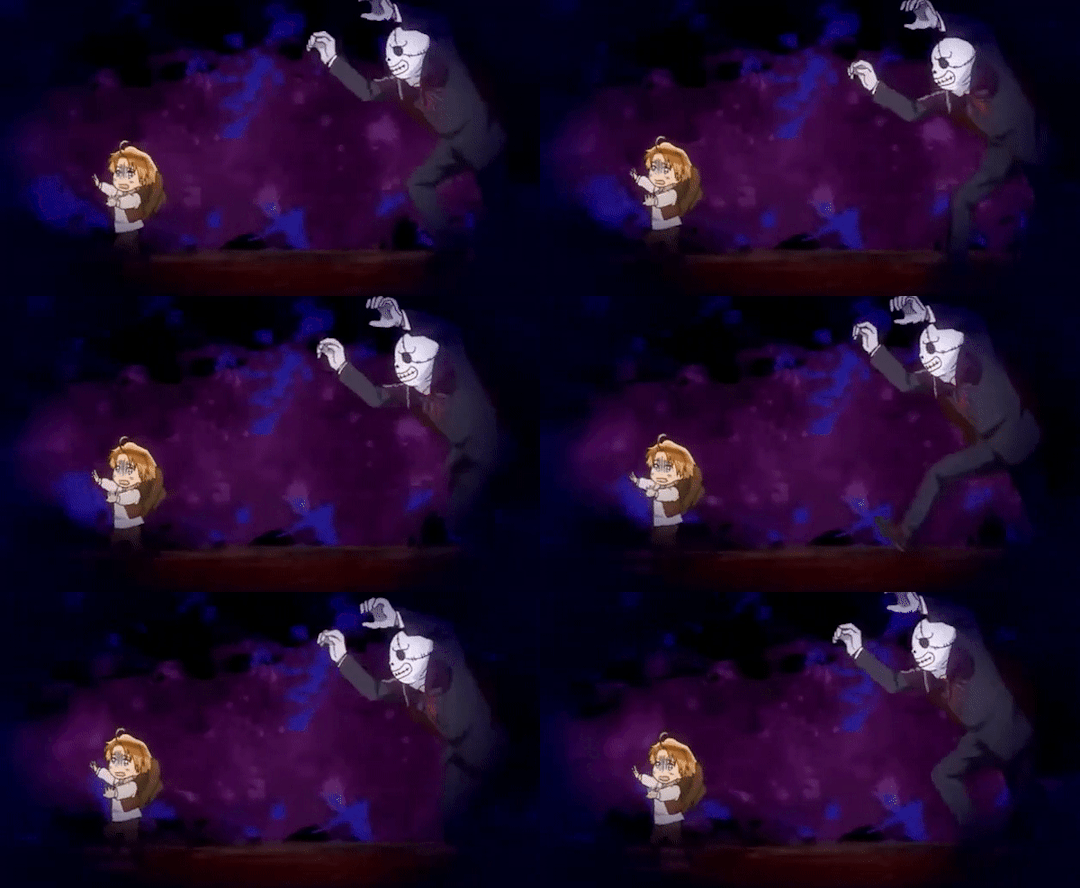
While he initially can’t see and doesn’t believe in ghosts,
he’s still terrified of them.
The fact that he doesn’t believe in them becomes woefully
obvious when a ghost literally taps America on the shoulder and introduces
himself. America doesn’t notice the ghost and instead seems to attribute the poke
on the shoulder to the false feeling of being touched or watched given that he’s
watching a horror movie while this all happens.
It’s only until World Stars where we begin to see a possible
shift in America’s ghost culture.
America visits England in Chapter 290. What I want to place
particular emphasis on is that America admits to his increasing interest in
fantasy movies. If we follow the rule from above, this would mean that his citizens
have taken up an interest in the genre/ supernatural belief, and this interest
is thus reflected in America’s own interests. Movies genres are a reflection of popular culture, after all.
This scene in particular substantiates this claim.
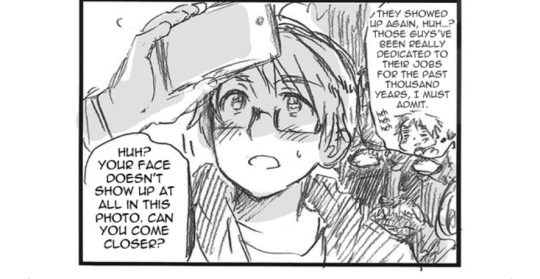
The two take a tour of a haunted citadel. America mistakes ghosts
for current staff members. [They had worked there when they were alive.]
He takes a picture of the ghosts, only to realize that they
don’t show up in the photo. More importantly is the fact that America was actually able
to see the ghosts.
Even if America wasn’t able to make the connection and
realize what they were, it would seem that his newfound interest in fantasy means
that his ghost and monster culture are shifting.
If that’s the case, then we could very well see an America
that’s able to see supernatural creatures in future strips.
Me: It’s just the doctor’s office, don’t be scared.





 Ellawritesficssometimes