When you join a fandom
and have a ton of content to catch up on


Misconception: He’s
an anxious person without a backbone.
Reality: He’s an
anxious person with an exceptionally strong backbone.
Lithuania used to be a world superpower. While he’s quiet
and introverted – like the other two Baltic countries – the fierce warrior
aspect of his personality hasn’t quite left him.
The most common piece of information that is used to
characterize him is that he “tends to think too much, which gets him depressed
and a stomach ache,” [x].
Ex: In his volume
3 character note, he’s described as a “serious young man with a strong body.”

Ex: In Italy’s
Chest Test series, Italy is surprised at how tough and muscular Lithuania is [x].

Ex: He loves
martial arts [x].

Ex: During the
Battle of Tannenberg, we learn from Finland that Lithuania is a “sharp” person.
In other words, he’s not someone to be underestimated on the
battlefield.
Prussia does exactly this, and it doesn’t turn out very well for
him. He actually hides from Poland and Lithuania after the battle, although he later
becomes a lackey to Poland.


Misconception: He’s
a sweet, pushover type.
Reality: He’s a
sweet, pushover type that has admirable moments of defiance. Lithuania isn’t only
defined by the above [partial] misconception. Even though he’s often bossed around and
later plays servitude to Russia, he’s still able to exercise his own agency.
Ex: The common
mistake is to only conceive him as someone who is introverted and good-natured.
He’s also a big brother type [x].
Ex: In addition,
he’s also noted to be bossed around frequently in Volume 5 – keep in mind that this
strip occurs during the Soviet Era.

Nonetheless, Lithuania’s seriousness and “strong perseverance”
is something that has consistently prevailed in him, no matter how dire the
circumstance.
Ex: Despite being pressured, Lithuania refused to convert to
Catholicism and holds defiance toward Prussia over this [x].

Ex: In strips that presumably take place during the Soviet Era
– as the setting is in Russia’s house – Lithuania’s old defiance for Prussia is
still alive and well. He gives him a “cold stare” and asks Prussia to leave him
alone [x].

Despite admitting to not liking him, Lithuania’s still civil
toward Prussia and gives him advice on living in Russia’s house [x].

Ex: It was
Lithuania who rallied the other Baltics to declare their independence from the USSR [x].

Misconception: He and Poland don’t have good relations
anymore.
Reality: He has some issues with Poland, stemming from their
past, but for the most part the two of them still share a good relationship in
the present.

Ex: Lithuania pulled a lot of the weight during their
union.

Ex: The fact that Poland laughed in his face as Russia
dragged him away during their forced separation didn’t sit well with Lithuania.
He holds clear bitter feelings about it [x].


Ex: On the other hand, Lithuania still cares about Poland
and tries to warn the latter of Russia’s intentions to partition him once again
in WW2.

Ex: While Lithuania is “dragged” around by Poland, he’s stated to still “enjoy himself” as this happens. My understanding
of this is that even though Lithuania does a lot of things for Poland, he doesn’t
mind the company [x].

On a similar note, in the World Academy AU, Lithuania is too
busy to attend the Choral Club’s meetings because he’s doing favors for Poland [x].
While he may be a pushover, I don’t think Lithuania would be doing this if he
didn’t care about Poland.


Misconception: He hates Russia.
Reality: He doesn’t have great relations with Russia, but he’s
civil.
Obviously, they’re not ‘friends-friends’ due to their past
together; however, it’s not pure hatred either.
Ex: He received many
scars during his time spent under Russian control.

Ex: He’s noted to be rehabilitating with Poland in the
post-Soviet era.

Ex: It’s alluded that Lithuania may suffer from PTSD. As he
recalls declaring his independence, he also remembers that Russia used to
squeeze his shoulders – a metaphor for political pressure. Without realizing it,
he begins squeezing Estonia’s and Latvia’s shoulders. It’s hard enough to cause
them pain [x].

Ex: Upon gaining independence, he was eager to get rid of
any belongings that were associated with Russia [x].

Ex: When asked if he considered Russia a friend, Lithuania
doesn’t “want anything in particular” and yet realizes that it’s probably
better to placate Russia. Of course, this is to be expected. The transition
toward a healthier relationship with Russia will take a long time for the ex-Soviet
countries to achieve. There’s also the fact that Russia’s sanity is unpredictable.

On the other hand, they still attend events together, so it’s
not as if the possibility of friendship – or at least acquaintanceship – isn’t
something on the horizon [x].

Bonus Facts:
Following WW1, Lithuania lived with America. This is done to
represent the Lithuanians who out-sourced themselves during this time.
Lithuania is later taken back by Russia once the Great
Depression hits [x].

America’s pets were very fond of Lithuania.

He has a crush on Belarus. On their first date, which predictably
didn’t last all that long (three minutes!), Belarus breaks his fingers [x].

In sum, as sweet, meek, and good-natured as Lithuania is, he’s definitely not someone to be underestimated. He’s an amazing, well-fleshed out character that is far more than the nervous wreck he’s commonly portrayed as.


Any strip that revolves around independence or revolution is
phenomenal in my opinion.
America – Fighting for independence from England [x].


The Baltics – Declaring independence from the USSR [x].

France – The fear of other European nations in response to
the French Revolution [x].


Italy– Fighting for independence from Austria [x].

Russia – Bloody Sunday [x]


+ the 1917 Revolution [x]


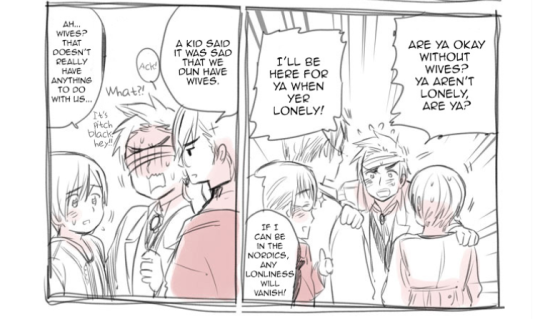
The fact that he’s always putting others first before himself. [x]
Ex: A little girl asks him if he’s lonely due to never having had a “wife” [partner].
His first thought is to ask the other Nordics if they’re lonely. He also offers them his support.



To understand Russia’s brutal and violent side, it’s
important to step into his mindset, warped as it is. I go into this in greater
detail in another post [x], but to put it briefly here…
During his childhood, Russia experienced severe repression
and violence. As such, he wrongly learned to equate violence as both a show of
love and a solution to his problems. Not only that, but this violence continued
into his adulthood.

Ex: Russia considers General Winter and anyone he meets to be his friend. The key point to keep in mind here is that while General Winter
protects Russia, he also attacks him every year.


Ex: Russia naïvely refers to the other Allied powers are his
friends. Meanwhile, Lithuania has a more realistic view, stating that nations
operate on principles of self-interest.


Russia becomes saddened after hearing this.

Ex: Russia’s bosses are so notoriously cruel that they
torture him when they’re bored.

They once asked him to stop a tank with his own body.

Again, I’m not justifying any of what I’m about to show. I’m
providing an explanation and in doing so, I’m shedding light on how Russia’s
warped sense of mentality makes him incapable of differentiating between right
and wrong. In other words, he’s not able to possess any morals, despite often
having good intentions.
This amorality and confusion of what true friendship, or
rather, what a healthy relationship with another person entails ,are what caused
nations in the USSR a lot of pain, suffering, and fear.
What I don’t see a lot of people mention is that these nations
are fully aware of the fact that Russia is incapable of making these distinctions.
While they may be scarred and still fearful of Russia in present times, not all
of them hold this against him. There’s meaning and reason behind this abuse,
foul and irrational as the reasoning may seem to a normal person.
That said, let’s tie this back to the strips.
Nations under Russian control became servants to Russia.
They were indoctrinated into saying what Russia wanted to
hear. There was no tolerance for dissent.

Similarly, while Russia represented them at world
conferences, the controlled nations would either stay home or act as servants
during these meetings.

Just like Russia was forced to build a waterway in impoverished
conditions, Latvia was tasked with building an entire railway on his own.


Notice how Russia pushes down on Latvia’s head when he protests to this.

Prussia is noted to have worked unprofitable jobs during his
time spent in the USSR. [x]
Lithuania received many scars on his back. This can be both
as a result of violent historical events marking themselves on his body and
Russia physically causing these marks. It’s left open-ended.

The trauma of Russia’s abuse is enough to have him experience
flashbacks.
Ex: Lithuania recalls declaring independence from the USSR. As
he imagines this, he remembers Russia squeezing his shoulders. Still immersed
in the memory, Lithuania begins squeezing Latvia’s and Estonia’s shoulders
without realizing it. He squeezes hard enough to cause them both pain.


In a volume 2 character note, Lithuania is said to be rehabilitating
from his time spent in the USSR.

I’ve said this before, but Russia pushing down on Latvia’s
head is likely a metaphor for political repression. Latvia’s growth was stunted
in the process.

What is of more relevance here is how ignorant Russia is to
Latvia’s suffering. He doesn’t connect Latvia’s trembling to feelings of fear
[of him].
To get Latvia to stop trembling, Russia’s solution is to
snap Latvia’s neck. You can’t honestly tell me that this is the rationality of
a sane person. This isn’t calculated pain; it’s irrational.

The imposition of Russian culture was so strong that Belarus
once forgot her own language.

The tension and fear are still there, but most of it has to do with the fact that
Russia’s personality is still unstable and unpredictable. He perceived the USSR
as an opportunity to keep and make new friends.
You can imagine how hard Russia took this separation,
childish and unrealistic as his conception of reality is. He was all alone
again.
Latvia is still scared of Russia and is not keen to visit him
on New Years when invited.

Estonia also remains fearful of Russia but is not afraid to
stand up to him if needed.
Ex: Estonia confronts Russia when he believes that the
latter hacked his blog.

Ex: Estonia has no problem hanging up on Russia during the
2010 Christmas event.

Prussia holds a strong resentment toward Russia. The hatred
is so deep that he’ll puke if Russia even so much as lays a finger on him.

With all that in mind, I’d like to end this by pointing out
that while history may have divided the nations [personifications], they don’t only let this effect how they interact
with each other in the present. They may still resent and be fearful of him; however, it doesn’t stop most of them from making peace and acting as if they’re a unit again.
This is seen in the 2011 Halloween event, where most of the
ex-Soviet nations coordinated their costumes together. Perhaps this is one
stride closer to obtaining the true friendship that Russia had originally
sought in them.


Sure thing! This could easily be a massive essay, but I’ll try to sum things up as briefly as I can. Post on the Soviet Union coming up tonight!

From what I
understand, yes.
Russia (the
personification) represented the USSR at world meetings.
Ex: The Baltics either stayed at Russia’s house or
acted as servants when Russia attended world meetings on their behalf. [x]

Ex: Bulgaria stopped attending the World Academy while he was under Turkish rule and didn’t come back until he was independent
again. [x]

The same
thing occurred with Romania too.


Friend 1: Guys, don’t go all FBI on me here, but I just got
a new boyfriend/girlfriend.
*You and Friend 2 look at each other like you’re in the
office*
Friend 1: I mean it! No stalking allowed!
You and Friend 2:

Misconception: Latvia’s physical body is young
and small for “no reason.”
I couldn’t
object anymore to this. While it’s not explicitly stated why Latvia is like this,
there are written rules and examples in the manga that provide a suitable
explanation. This is aside from the fact that Latvian people are among some of
the tallest in the world.
Since I
already have a theory on this, I’ll merely put a quick summary here:
For one
thing, we know that a nation’s health is predicated on their political and
economic situation. That is, if their economy is doing bad, or they’re experiencing
political instability, then they’ll develop a cold.
Likewise,
we know from the case examples of America, Canada, Italy, and Romano that
gaining independence causes the nations to age.
A strong
economy, a stable political situation, and political sovereignty are solid
factors in determining the age and size of full-blown nations – not micronations,
who are often anomalies to these rules.
That said,
because Latvia has historically experienced constant political repression and
subordination and lacks a strong economy, his physical body hasn’t aged as much
in comparison to the other nations.

Ex: Russia
pushing down on Latvia’s head is a metaphor for the political repression the
latter experienced at the hands of the former.

Further,
what differentiates Lithuania and Estonia in modern times is that both of them
are doing better off economically than Latvia is, who primarily relies on
agriculture. You also need to account for how Lithuania at one time was a
European superpower.
Ex: Estonia’s obsessed with money, and is good at managing economics.
Even then,
because of the political repression Estonia also experienced, he’s only a little bit
older than Latvia at 17.


Misconception: Because Latvia’s scared of
Russia and is physically weak, he’s just weak.
Latvia’s actually
a genius.
Ex: He
built an entire railroad by himself.

Ex: He
plays solo chess.

Misconception: His physical age means that he
has the mentality of a child
[He’s 15.]
While
Latvia does have a bit of a blabber-mouth –which gets him into trouble with
Russia, admittedly – that’s more of a character quirk than it has to do with his
maturity.
Ex: Latvia
has adopted a mentoring role when it comes to dealing with Sealand.

[He also
drinks a lot of alcohol.]
Misconception: He’s not scared of Russia
anymore
I’ve seen a
tendency for people to get angry when authors characterize the Baltics as being
afraid of Russia. Honestly, it’s accurate, especially given how terrifying their
past in the Soviet Union was and the extent to which they’re still traumatized
by it. (i.e. both Lithuania and Latvia are shown to escape from
reality, and maybe Estonia
too with his mochi-inspired dream + other dream fantasies).
The problem would be if you only depict
them this way, and don’t reveal the other aspects of their characters.


In other
words, “Stop making the Baltics weak!!!! They’re not scared of Russia!” is just
as bad as only showing them cowering
in the face of Russia.
Also remember that there was resistance and political
revolts on their part too. Either way, both depictions are biased,
one-dimensional, and don’t give the complexities of their personalities the
credit they deserve…


Keep in mind that the rules I’ve come up with here are not
canon. They’re simply just me compiling examples that form a consistent logic.
Overall, I’ve noticed two principle factors that causes the
nations to mature. There are other sub-principles that fall in tandem with
these categories.
1) They need a strong and autonomous economy, which
usually entails having a large population – If the nation is being taxed as a
colony, then they’re not economically autonomous.
2) They need to achieve political autonomy and
sovereignty (independence) – This includes a self-functioning and officially recognized
government.
Let’s go over a few examples.
At a young age, due to an early economic boom, we know that
America gained super strength. However, because his economy and legislatures
were authoritatively controlled by England, he grew weak for some time.
Now, notice how under England’s overbearing rule America’s
economy is strained. Not only that, but he looks considerably younger.

Then, look at him after he begins fighting for his
independence; there’s a notable increase in age between these two panels.

We also see this same growth spurt in volume 3, where
America ages exponentially right before he revolutionizes.

With control over his politics and economy, America was then
able to become an adult.
Admittedly, in the “Cleaning out the Storage” strip, America
admits that he feels like he’s becoming an “old geezer.”
Lithuania responds by telling him that he’s merely “becoming
an adult.”
Put into context, I interpret this as America maturing
mentally, as opposed to physically. From the example above, we know just how
dramatically he aged.
Likewise, what you’ll see in a moment is that America was considered
to be an adult well before the 1930s (around the time when the outsourcing
strips take place).

Canada is another good example of this autonomous economy/politics
requirement.
For one thing, he ages far slower than America, remaining as
a young child while the latter grew up at a faster rate. This is likely owed to
America’s larger economy.
That said, this proves the strong role that the total
strength of an economy overall plays
in the nations’ aging process. America and Canada were both under England’s
rule and were subjected to taxes, but because America’s economy [and
population] was larger, he matured more quickly.

The political autonomy rule is realized once Canada becomes
a Dominion (1867). While it’s not complete independence from Britain, it was
enough for Canada to physically mature from a teen to an adult.

This is a more tentative example, but I’ve noticed that the
nations possibly could have aged as a result of a changed structure in their
governments.
Before constitutional monarchies or people’s republics, the
government was strictly run by the church and later monarchs, who ruled by
absolute divine right. Basically, the people had no say in their governments.
I mention this because in this strip here, we know that
Austria, France, and Russia are about 17-18 years old during the Seven Years’
war.

We know now that France is 26 and Austria is just a little
younger than Prussia, who’s 20↑
. We still don’t have a confirmed age for Russia
yet.
Nonetheless, the difference between now and then is that
democratic governments today are supposed to derive their power from their people (corruption
and tricky nuances aside, it’s the structure not the pragmatics that matters
here).
Starting in the late 18th century, this new era
of politics and the subsequent provision of constitutional rights might have
lent to stronger senses of national identities, thus causing the nations to
adapt and age in response.
We also know from France that the nations exist and therefore get
their power from their people.

With the following rules above applied, this explains why
Latvia remains so fragile, small, and young despite existing for far longer
than some of the other nations who are physically
older than him.

Latvia hasn’t historically experienced consistent political
independence and autonomy, and has been subjected to foreign control for much
of his existence.
His economy is also considerably poor. He lags behind in
industrial developments and remains largely dependent on agriculture.

So, before anyone says that Hima characterizes a nation’s
age for seemingly no reason, try applying these rules. I guarantee you that you’ll
find some sort of economic or political justification.
 Ellawritesficssometimes