As mentioned, the colony system in the manga doesn’t have the colonizing nation live with their colony 100% of the time. Instead, the colonizer visits the colony in the latter’s home.
Ex: England visits America at his home. Long gaps of time pass between each visit.
Ex: In his character song “Absolutely Invincible British Gentleman”, England mentions that he has holiday homes – presumably in India and Hong Kong given the lyrics.
“Curry, Chinese cuisine, my holiday houses’ meals.” [x].
What you’ll see is that the word “home” is also used generically to refer to a piece of land/ territory/ settlement. It’s just like how nations will refer to their entire country as their house.
(e.g.,“My house [country] has the best food!”)
Another example would be Finland and Sweden’s colonization of America. They make a settlement [home] in America, only to have it taken from them by Holland. In this case, the strip is making a reference to New Sweden, otherwise known as Delaware [x].
Misconception: He’s
Iceland’s father.
Reality: He
raised Iceland and acts as an older brother figure/ mentor.
Ex: He supportively
encourages Iceland to participate in their activities. In this case, they’re
designing a Nordic-inspired hotel.
Ex: He also gave young Iceland diplomatic advice.
Misconception: He’s a playboy that treats Norway like a
loose end
Reality: Denmark treasures Norway as his best friend. As the
leader of the Nordics, he’ll selflessly put others first before himself.
Ex: When Denmark realizes that Norway is struggling under
his rule, he breaks down crying.
Ex: Denmark gets distressed when he’s forcefully separated from
Norway by a British Naval Blockade. He’s more worried about Norway.
Ex: He doesn’t want to let Norway down and look “uncool.”
Because of this, he heads into a battle with Sweden that he knows he’s going to lose.
Notice how he still tries to set an example for Norway.
Misconception: Norway is indifferent toward Denmark.
Reality: While Norway may enjoy teasing Denmark and often gets
irritated with him, he too reciprocates this deep-set affection. The two share
a strong bond.
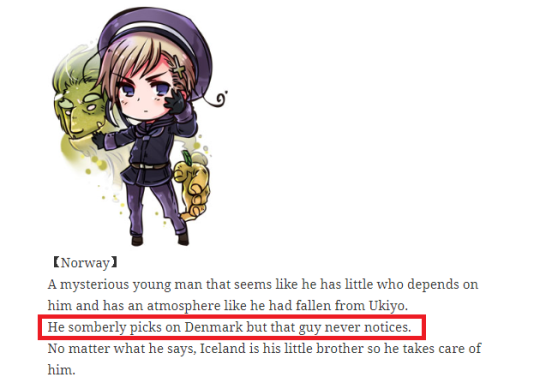
Ex: Norway’s hobby is gently poking Denmark. Denmark doesn’t
even notice Norway’s comments.
Ex: Norway expresses concern before Denmark charges into a
doomed battle against Sweden. Denmark refers to him as a “worry wart.”
Ex: Despite how poor he is under Denmark’s rule, Norway
recognizes that Denmark’s trying his best.
Again, Denmark may annoy Norway, but the two care strongly
for each other.
The running gag between the two of them is Denmark being
overly affectionate and Norway’s cheeky reactions to this affection.
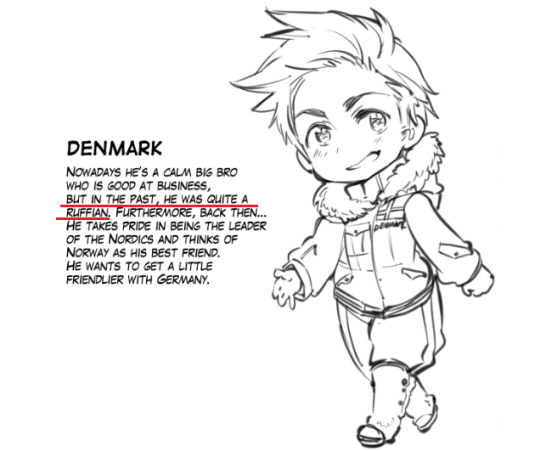
Misconception: He has a hot temper.
Reality:
He had a hot temper.
Due to recent statistics, Denmark is the happiest of the Nordics – his people are rated to be among the happiest in the world. [x]
Misconception: He and Sweden hate each other.
Reality: They hated each other.
Aside from friendly teasing here and there, the two get along really well.
Or, my personal favourite: Denmark and Finland mocking
Sweden.
Bonus facts:
He has a good relationship with Germany, mostly stemming
from their economic ties.
He once watched Hans Christian Andersen water grass with his
own tears.
He’s one of the few nations who can get the Netherlands to
sell him goods at a cheaper price.
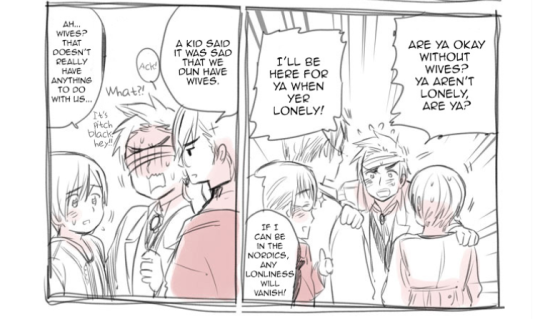
The fact that he’s always putting others first before himself. [x]
Ex: A little girl asks him if he’s lonely due to never having had a “wife” [partner].
His first thought is to ask the other Nordics if they’re lonely. He also offers them his support.
The nations are two-fold representations. By that I mean
that they have a literal body and a figurative body.
Bear with me, things get a bit tricky, but I’ll break it
down to the best of my ability.
Basically, the figurative body is what influences the nation’s
physical body.
The figurative body
is composed of two parts.
1) There’s the geography of the nation. The landmass is sometimes referred to as their body or house,
despite the real physical one that they possess.
The geography can influence both the physical appearance and
personality of the personification.
Ex: Since Sealand’s geographic body is small, so is his physical
one.
Ex: Iceland’s contrasting volcanic and freezing temperatures respectively
causes him to have a hot and cold side.
2) There’s the personality
of a nation. The personality of a nation (not to be confused with the
personification’s personality) is defined in terms of culture in the manga [x]
If the culture is well-developed
and thriving, then the personification will also thrive and be able to grow; to
age. However, if the culture is repressed, then the personification’s growth
will also be stunted.
The reason I’m outlining this is essentially to show how
geography/climate and historical events are reflected in the personifications’
appearances and personalities. Information on the impact that this has on their
health can be found here [x][x]
What this post will focus on, however, is why some nations
have scars and either suffer from or are affected with other physical symptoms.
Let’s go over some examples.
Ancient Rome:
Before dying, Rome was noted to have many wounds and scars –
a physical reflection of the turmoil his people suffered from.
Lithuania:
We know from his time spent in the USSR that Lithuania acquired
several scars on his back. The military repression of several revolts and the
banning of diverse cultural practices in favor of an atheist state very likely
had a role in causing these scars to appear.
Latvia:
Latvia’s case is similar to Lithuania’s. While we don’t know
if he has any scars, we know that Russia pushing down onto his head ultimately
stunted his growth. How I interpret this is that it’s a metaphor for political repression.
Put another way, Russian control stunted Latvia’s growth,
which, in turn, was reflected in the personification’s physical body.
China:
It’s hinted that China gained scars after being betrayed by
Japan in WW2. It’s both a literal and symbolic stab to the back.
Germany:
Each time America engages in reckless financial activities,
a new wrinkle develops on Germany’s forehead.
Finland:
Estonia’s quest to become a Nordic causes Finland’s back to
be itchy whenever he’s talked about.
Bonus cases that aren’t so clear…
Russia:
When he’s not wearing a scarf, Russia is shown to be wearing
bandages around his neck.
Netherlands:
An unknown event caused him to develop a scar on his
forehead.
Misconception: Finland has a sweet, child-like appearance, so he must be weak.
Reality:
Finland’s a warrior, and is noted to possess immense strength and resilience.
Ex: He’s so
cold-resistant that General Winter has no effect on him. They even get along.
Ex: He’s
visibly disappointed when Sweden calls off a battle during one of the Polish-Swedish
wars. Not to mention that he was excited about engaging in the fight.
Ex: His
patience isn’t endless. It’s said that if you poke him ten times, he’ll forgive
you, but once you pester him enough, he’ll get you back ten times harder.
[There’s a slight difference in the translation, but it’s basically the same thing.]
Misconception: Like Iceland, Finland’s one of the tamer Nordics.
Reality:
Finland’s actually quite strange.
Ex: He loves
nature and enjoys being covered in grass.
Misconception: He’s Sweden’s wife = Sufin is canon.
Reality: He
is not Sweden’s wife. Sufin is not canon.
Sweden calls Finland his
wife, but Finland does not accept the label.
The two do share a close
relationship though, enough for Finland to refer to Sweden as “Swe.”
Although, Finland is often
just as perplexed by Sweden as the other nations are.
Misconception: He’s a jittery, nervous, and shy person as a result of being overshadowed
by the other Nordics.
Reality: He’s
soft-spoken, and quiet-voiced, but is far from quiet. In fact, he can be a very
talkative and bubbly character at times. Nonetheless, he is said to be
overshadowed by the other Nordics.
Ex: Finland
jokes with Germany about his boss, despite the fact that the humour goes right over Germany’s head.
Ex: Finland’s
noted to be a particularly nagging person.
Bonus Facts:
He lightly teases Iceland and
once asked the latter to call him Big Brother.
He’s offered to act as a
father figure to America.
He loves saunas, sweets, and
alcohol. Bonus if it’s all combined together.
He’s had the hardest time out
of all the Nordics, likely stemming from the fact that he’s historically been
an underling to other nations.
All right, so there’s
a few things to unpack here.
My understanding of it
is that America’s artificial creation of Santa by Coca-Cola actually created a real-life
need for a Santa personification.
Since the legend formulated
in America made out Santa to live in the North Pole, that’s why Finland assumed
responsibility for ensuring the delivery of presents on Christmas. He’s noted
to “answer America’s expectations.”
It’s also important to
note that before capitalism globalized the American version of Santa, each
nation experienced their Christmas differently:
Further, Santa in the
strips is used more as a metonymy. There’s multiple Santas – The term Santa is
used to refer to the whole collective of Santas, which just so happens to
include Finland. So in a way, yes, I would consider him as Santa’s helper
despite being one himself.
“Well, Santas born in Finland are used to the cold. We can even walk around with short sleeves in the Canadian winter!”
Ex: Finland frets
during Christmas 09’ when he loses three Santas.
What’s even more odd
is that the economic recessions in the American economy (the sub-prime mortgage
crisis of 2008 in this case) caused the Santas to undergo job cuts.
As for the travelling,
that’s a bit more open-ended.
Given that we see the Axis using a magic flying
sleigh without any problems, I would guess that their ability to fly across
borders is made to be even easier than their typical travelling abilities. I say this
only because Finland in the 2010 Christmas event isn’t able to transport to nations
far away from Europe (i.e Seychelles and Cuba).
I love him too. He’s a giant sweetheart, quirky, uniquely strange and mysterious, and not to mention a total badass.
Post on Finland coming up tonight!
Misconception: He’s
emotionless.
Reality: He’s
expressive through non-expressiveness.
Ex: A smile for
him isn’t expressed as obviously as it is for some of the other characters.
Still, that doesn’t negate the fact that he has feelings. I mean really now.
Misconception: He’s
humourless.
Reality: He has
an implicitly “evil” and “mischievous” side. In other words, he’s often
playful, albeit subtly.
Ex: He’s the one
to come up with France’s punishment after the 2007 April Fools’ Event. This entails
getting France to praise everything about England’s culture for a whole day.
Ex: When at war
with each other, he was glad to have a legitimate reason to punch Denmark.
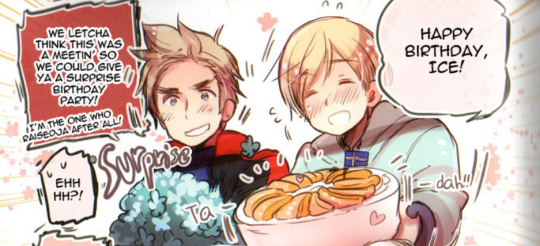
Ex: He goes along
with the Nordics’ plan to host a secret birthday party for Iceland.
Again, the
humour is subtle as he wordlessly teases Iceland and makes light out of the
latter’s confusion over them meeting outside.
Misconception: He’s
intimidating inside and out.
Reality: His
external appearance is intimidating, but he’s tender and sweet on the inside.
Ex: During the
stereotypical café arc, Sweden’s customer is initially terrified of him.
Nonetheless, Sweden gives away the meal for free.
Ex: He acts as a
parent to Sealand.
Ex: Ladonia
refers to him [and the other Nordics] as an Uncle.
Ex: He’s good at sewing + uses this skill to adjust smaller clothes for Finland.
Misconception:
SuFin is canon.
Reality: Sweden
has confirmed feelings for Finland, but Finland doesn’t reciprocate.
In a lost 2007 blog post, Hima confirmed that Sweden has
homosexual feelings for Finland and only acts this way towards Finland. [That’s
literally what the translation says].
Ex: Finland has
repeatedly denied being Sweden’s “wife.”
Nonetheless, the two do share a close relationship, enough for Finland to refer to Sweden as “Swe.”
Ex: The two spend
their New Years’ Eve together in 2009.
Ex: This one-sidedness
is seen as early as when they were first colonizing America. Finland spots
America in the wild, and Sweden proposes the option of them having kids.
Bonus facts:
It’s left unclear as to whether Sweden can see magical
creatures.
He and Denmark used to hate each other, but have recently
calmed down in their temperaments. Of course, this is to be expected from their present welfare
and collectively-oriented nations.
Regardless, the two still tease each other in
the present time.
[Denmark and Finland are imitating Sweden here.]
All in all, a somewhat mysterious, yet thoroughly entertaining character.
I just want to point out that these characterization posts aren’t analyses or theories. I’m simply presenting canon material.
It’s unfortunate and a bit tedious, but I have to play catch up for others by clarifying common misconceptions. Only then will I be able to get into the really deep and long theories that I have in store for later 😉















 Ellawritesficssometimes