While Finland does note that his and other nations’ physical strength [and physiology] in comparison to humans isn’t all that different, General Winter specifically doesn’t have an effect on him.

Pretty wild if you ask me.


While Finland does note that his and other nations’ physical strength [and physiology] in comparison to humans isn’t all that different, General Winter specifically doesn’t have an effect on him.
Pretty wild if you ask me.


I get asked
about this a lot, so I thought I would clarify a few things…
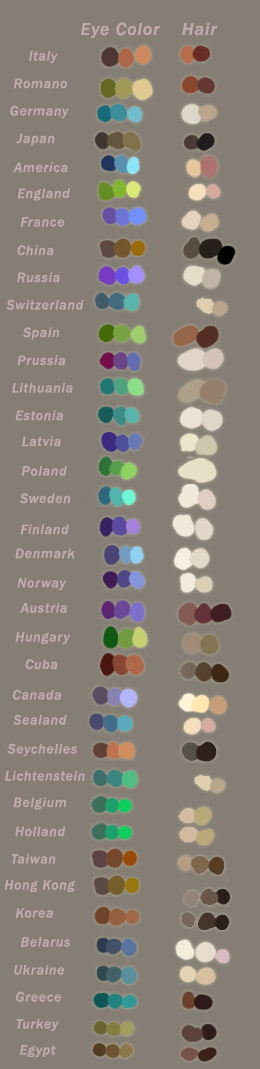
“Why do the nations’ eye colors keep changing?”
Hima
directly answers this question on his blog by stating that there’s “sufficient
freedom” regarding the eye colors of the nations. This would include sometimes
adding light brownish or greenish tints.

Although,
this obviously doesn’t explain why Sweden and Finland have solid brown eyes (and darker hair) in the first episode of
the anime. Regardless, that’s an animation inconsistency, not a canon one.

Likewise,
if you’re wondering why eye colors go from blue to violet to green, as seen
with the Nordics, there’s actually a justified reason for this.
Hima
provided a chart years ago revealing the different range of hues/mixes that each
nation’s eye and hair colors can assume.
“I tried to put every character’s hair and eye color in order. Being that this is something like an approximation, they do things like change in illustrations. But it’s like this, and I hope it’s good and easily understandable.”


That said,
there isn’t really one correct eye color for the nations, nor is there one
correct hair color; it’ll always differ slightly.
Make sense
now?

You can find the chart here:


Iceland, huh? For such a minor character, he’s perhaps one
of my favourites, mainly because his personality is so interesting and, well,
relatable.
Let’s get some clarifications out of the way first: Norway is Iceland’s older brother. They’re
related.
After having an excavation done on his land, Iceland finds
out that he has no strictly Icelandic indigenous people. Instead, it was
Norwegians who had first settled there before travelling elsewhere.


Now, this is important in establishing a tentative ground
principle in understanding the family trees in the series. I’ve found a pair of
relatively consistent rules too: It seems that nations are biologically related
when…
1) There is one dominant nationality of sibling #1’s people living on the other
sibling’s land – Ex: in this case, it would be early Norwegians initially
settling on Iceland.
And/ Or
2) The
nations of the siblings are typically next to one another – Ex: America and
Canada, Netherlands and Belgium, Germany and Prussia, &
Russia, Belarus, and Ukraine.
I know it’s messy, but remember that these rules are exceptive
and only apply when Hima explicitly makes them siblings. You can have
nations, like Spain and Portugal, who look alike due to similar ancestral
influences on their histories and cultures, and yet, they’re only listed as
neighbors with no biological
relation.
It’s important that I make this distinction only because the
Nordics all refer to each other as brothers in an affectionate way, despite us
knowing that they’re not actually related. Again, the only ones who are
confirmed to be related are Norway and Iceland.
There’s also the presence of brother figures in the series. Regarding Iceland, he sees the other Nordics as older brothers.

What’s
sad is that he didn’t get to meet most of the Nordics until the 18th
century.

While Denmark may have raised him…

…right from birth Iceland sensed that Norway was his older
brother.


Now for Iceland’s personality.
Predicating from his childhood and geographic isolation,
Iceland is unsociable. The irony is that he also feels lonely.

No one really knows anything about him, and he’s often the
odd man out.


Despite this alleged unsociability, Iceland still worries
about making friends.

Arguably,
Iceland is closest with Norway, who likes to “stick” into the former’s business.

While Iceland may snap at Norway and the other Nordics, he
secretly appreciates their concern – especially Norway’s. He doesn’t hate any
of them.


In fact, this somewhat erratic moodiness is actually part of
Iceland’s personality.
His contrasting warm (volcanoes, hot springs) and freezing
climate gives way to a polarizing temperament. As such, he’s noted to have a
hot and cool side.

This unpredictability in mood, metaphorically understood in
terms of how you never know when a volcano will explode, is seen in Iceland
right from birth.

His cool side relates more to his unsociability and shyness.
What’s more, his hot side doesn’t always have to do with his
temper or irritability. It can also mean the playfulness and mischievousness of
a young child.

Another fun fact is that Iceland is able to see Norway’s
magical creatures, albeit refusing to acknowledge this ability.


All in all, akin to his climate and geography, Iceland isn’t
static and is therefore far from your typical stock character. He has a
profoundly rich and complex personality stemming from a childhood filled with
neglect, isolation, and loneliness; the problem for him now is whether he’ll be
able to reconcile all this and open himself up to others more.


I’m still not too sure about this one, but since this is
also another thing that’s been heavily requested, I have no problem explaining
what little I do understand from it. That is, if there is even any thing to
make sense of…
We’ve seen that the nations can transport or travel across
borders in a short period of time. The first thing I’ve noticed about this
ability is that it requires some sort of connection. In the “We’re Shipwrecked”
strip, since China has villas – China towns – all over the world, he’s able to
use them as a method of transport, travelling as far as the island of
Seychelles.


In the Christmas 2011 Event, this idea of connection comes
up again as Russia proposes to Japan that they build a bridge in order to
connect their houses, making it easier to travel.

However, there are times when transporting is difficult for
the nations. In my opinion, I think distance is the key factor here. For
example, we see that Italy travels to Germany by crossing over through
Switzerland on foot.


In the 2010 Christmas Event, we also see Finland travelling
to Sweden’s and Germany’s houses without any difficulties. On the other hand,
when asked to interview Seychelles and Greece, Finland either mails or texts
them.

For Seychelles, Finland states that “her land is a bit far.”
You also likely have to factor in the obstacles of water (or mountain ranges,
deserts etc.) in travelling, as not all countries are connected by land, or if
they are, it’s not always flat and easy to travel across.

It seems that distance and connections between landmasses is
what allows and/or inhibits the nations to travel on foot, as opposed to more standard
means.
You’ve
got your fresh-meat, ripe for conquering


AU Finished! 10/10




















 Ellawritesficssometimes