It’s more like it’s a recurring joke that others call him out for this and he denies it.


It’s more like it’s a recurring joke that others call him out for this and he denies it.
Q: If
the UN has a personification does that mean the EU also has a personification
or is it not significant enough to have one? Another question is that why do
you think certain countries haven’t been given a personification in the hetalia
series, countries like aph Indonesia and Hawaii, is there a reason for this or
is it just a creative choice by the creator?
A: The EU does not have a personification.
There’s no real reason for this. It doesn’t have anything to do with
significance.
As for creating other characters, Hima typically cites that he
wants to travel to the country in question before he personifies them.
Q: How
much does France like anime?
A: A
significant amount considering that it’s so popular among his people.
Characteristics of the population are often reflected in the personification’s
attitude, behaviour, habits, and overall personality.
Ex: He’s
involved in a debate over anime voice actors with Japan, Taiwan, Vietnam, and Thailand.


Q: Any
theory of why France has some perverted tendencies? I know that he just likes
to show affection to others, but sometimes it goes too far.
Q: Why does France strip people, like that’s a pretty recurring
theme from the napoleon strips he was shown to have the thing stripping people from their clothes
and during the Christmas event of 2007 he stripped a bunch of nations naked.
A: It
did go too far. The old characterization of France is pretty awful. However,
the sexualized humour of it is not what people think. It’s honestly just bizarre,
but it does have a logic to it.
France’s stripping of people doesn’t have to do with a French
stereotype of sexuality from my understanding. It’s a historical representation
of how France picked and reaped at leftover territories after European conflicts…
a scavenger if you will. A good idiom in relation to this would be stripping something to the bone.
Just like France stripped Austria for winnings after the War of
Austrian Succession, this was likewise translated into how he interacted with
other nations – by stripping them. [x]


Hopefully, this makes sense, yes?
Q: Do
you think that England has some “big brother” trauma?
A: 100% he does.
Ex: England tears up when he’s faced with the prospect of
becoming America’s guardian. At first, he actually hesitated in accepting the ‘big
brother’ label because of how poorly he was treated by his own older brothers. [x]

The bad memories of his older brothers’ treatment of him that England doesn’t even accept the label of ‘big brother’ at first when he assumes responsibility for America.


Also…

Q: Are
the nations’ homes and/or things provided by the state or they work and earn
money themselves to pay for their own stuff?
A: It’s not clear whether the state provides anything for them.
All we know is that the nations work for their bosses and that the wealth of
the country is reflected in how much money the nation has (e.g., GDP).
Ex: France’s wallet is empty as a result of his economy’s poor performance. [x]

The personification is a physiological embodiment of their nation. Each city/ landmark is reflected in one part of their body.
That’s why, when France ‘rubs’ Italy’s chest during an economic recession, he’s looking for territory to leech money off.

Do you see what I mean by bizarre logic?


What this post will explore is the impact of England’s
parenting style on America. There is no good and bad here. All I aim to do is
give reason and meaning to the problematic behaviour and relationships that are
depicted in the series. The characterization is done for a specific purpose;
what I seek to do is bring several parallels to light to prove this.
One of psychologist Karen Horney’s theories explored how
problematic parent-child relationships often result in the child developing
neuroses (mental health complications), such as anxiety or depression.
However, rather than assert all the blame on the parent, she
went on to explain how parents who have been reared in an environment void of
love, care, and affection are typically incapable of raising their kids in any other
manner.
Put another way, parents pass on their neuroses to their
children. You can’t expect someone to consistently provide the care, warmth, and love that
they’ve never experienced and learned themselves. On the other end of the
spectrum, these problematic parent-child-relationships and parenting techniques
are learned and repeated through generation-to-generation. It’s a cyclical
process, that, unless consciously recognized, results in all sorts of emotional
trauma.
Of course, this doesn’t mean that the parents can’t provide this warmth or affection.

What Horney believed to be the Basic Evil of these problematic parenting styles is Parental Indifference, which can also
include a hostile or rejecting attitude of the parents toward the child. This
parental indifference can cause the child to develop feelings of Basic Anxiety or Basic Hostility – both of which, if not attended to, can lead to mental
health issues.
For the purposes of this post, I only need to focus on Basic
Anxiety. Basic Anxiety occurs when the child develops feelings of loneliness
and helplessness in a world that they perceive to be hostile and dangerous.
That said, what I’ll now analyze is how England’s own
upbringing and resulting mental health issues from it were passed down to
America.
Let’s tie this back to the strips.
England’s isolated upbringing as the Black Sheep of Europe
leads him to unconsciously replicate this isolation in how he raises America.

Since he grew up alone, he doesn’t see a problem in leaving America for long
periods of time. He even admits to America that this is what he had to go
through as a child.
Thing is, while this is normal to England, it’s obviously
an abnormal parenting practice.

The point to stress here is that England is repeating
the problematic parenting styles of his older brothers, who played no part in
raising him. They would send him hexes or drive him away with arrows if he
got too close for their liking.

The parallels of loneliness and helplessness are quite
clear.
Ex: England feels
isolated in Europe, often a result of his hostile attitude toward other nations.

Ex: He feels
helpless when he realizes that everyone has turned against him during the
American Revolution.


The loneliness is most prevalent when England pokes into
America’s business, wanting to bridge the gap in their relationship, but being
too prideful and hostile to get anywhere with this.
Ex: He visits
America to “check up” on Lithuania, who was living with America at the time.

America also fears being alone and experiences feelings of
helplessness. This childhood fear still persists.

Ex: America pokes
his nose into other nations’ business to the detriment of damaging his
relationships with them. As such, he fears being alone and desperately clings
on to the few he’s able to maintain a good relationship with (e.g., Japan).


Both feel a compulsion to be the #1 at everything. As I’ll
get into in a moment, this likely stems from low feelings of self-worth and
poor self-esteem. What you’ll also see is that England especially hates coming second
to America.
Ex: England training to become physically stronger.
The
strip this is taken from is titled “England’s plan to be the strongest.”
Hmmm…

Ex: America mass producing and becoming a dominant economic power.

His dethronement of England in becoming the world’s #1
industrial power is not taken well by the latter.

Constantly being ostracized and insulted by other nations
has had a devastating impact on how England views himself.

America also struggles with self-esteem issues, although it
mostly has to do with his weight.
Ex: He refuses to
accept the number on the scale and claims that it’s broken.

Both cope with the stresses and difficulties of daily life
by hiding in their imaginations.
Ex: America’s
go-to safety mechanism is imagining superheroes to solve his problems.

Notice how England calls out how unrealistic America’s
reality is.

Of course, this is hypocritical given that England escapes
into the world of fantasy and magic when he’s feeling lonely or stressed.

Overall, what I find interesting and would highly recommend that
others look into is how similar England and America experience themselves and
their problems. Personality-wise, they couldn’t be any more different;
mentally, however, they’re quite alike.


Of course. How might I
forget that people depict him as cold and emotionless when in actuality…
…he’s a gigantic
sweetheart in his own awkward way.
France tells Germany out
of the blue to meet with him secretly and to dress inconspicuously.
Germany does this, no
questions asked.


Italy gains weight when
his country’s obesity rate rises.
Germany pulls up data to
prove that it’s okay if “handsome Italian men” have some stomach fat.

America doesn’t believe
the large reading on his bathroom scale and calls Germany for ‘electrical help.’
Once again, Germany
comes, no questions asked.

He also helps America
train harder to shed off some extra weight (it’s actually just muscle, but
America doesn’t realize this).

He loves his dogs.

He loves baking and
graciously shares this passion with others.

It’s somewhat similar, but Russia sends [political] pressure
in the form of hearts. Since he grew up under repressive rule himself and considers
anyone to be his friend regardless if they abuse him or he abuses them, force
is the only way he knows how to communicate with others.


Similarly, to end the hyphen dispute between Czechia and Slovakia, he squeezes them together in a hug.


In previous posts [x] [x], I’ve laid out the rules that explain what
affects a nations’ health. This post, however, will elaborate in more detail to
show the different ways in which they can be affected and why that is.
For one thing, we know that the personification’s health is
predicated on their economic and political situation. That is, if they are
suffering from political issues (either domestic or international) or are
experiencing an economic recession, they will fall ill.


That said, let’s go through the symptoms they can experience.
Ex: Several nations develop fevers or colds in reaction to
the Great Depression.


Ex: Austria will develop a high fever and eventually collapse if
Germany acquires a cold [from an economic slump].

“A reliable country that likes to approach things with a sober seriousness.
He approves of and supports lots of Germany’s ideas so he may look like one of the helper countries, but in reality the level of his dependency is pretty high.
So high that when Germany catches a little cold, Austria goes straight to high fever and eventually collapses, and so he doesn’t have much of a choice than to take good care of himself.”
Ex: England develops a cold after the American Revolution.

Ex: The aftermath of the Napoleonic Wars.

Ex: Spain nearly dies during an economic recession before
Romano starts helping him recover with imports.
This symptom in particular is depicted more as a consequence
of war (which includes separate battles/attacks) or civil strife. You’ll often
see the most devastated nations coughing up blood in panels where Hima
introduces different sides of the conflict.
Ex: Prussia, Spain, and Italy during the Napoleonic Wars.

Ex: Prussia during the American Revolution.

Ex: China during WW2 after being betrayed by Japan.

Ex: The disunity in the Holy Roman empire causes Holy Rome
to fall ill and cough up blood. His political situation isn’t stable, which, in
turn, is reflected in his poor health.


Bonus case:
The nations cough up blood and get sick during conflicts,
but are nonetheless able to heal from these wounds with time as their country’s
situation stabilizes.
But, what if a personification never healed emotionally from
a conflict and keep reliving it over and over again?

Wouldn’t that explain why England coughs up blood and falls
ill every year during the fourth of July? The event is still fresh in his mind,
and regardless if it’s over and done with, his body reacts as if it’s still
happening.



I think it goes unsaid that how the nations relate to one
another is not only based on their present political relations.
In other words, while they may not be on good terms with
each other, these relations don’t define their relationship in whole. There are
times where nations get along, and there are times where they will fight
frequently and ‘hate’ each other. Point is, the hate doesn’t typically last.
While current relations do cause tensions, their pasts have
the most impact on how they view one another. It would therefore be shallow to
say that if nation A and nation B grew up together, only to go to war centuries
later, that they would unequivocally hate each other and be unable to reconcile.
Relationships don’t work like that, and this is especially the case for
immortals who have lived several lifetimes.
I’ve stressed this in other posts before, but the nations
don’t represent their government. They represent their people – they’re cultural,
not political representations. The irony is that they’re forced to serve their government, which may or may
not represent their peoples’ best interest. [x] [x]
It is for this reason that even in times of war, nations on
opposing sides are shown to be getting along with each other when they’re not
on the battlefield.
Ex: America’s occupation of Rome. He doesn’t treat the Italy
brothers as enemies, but rather friends.


Ex: England, Russia, and Germany share their military
rations with each other.


While humans from other nations may bear present grudges
towards each other, this doesn’t always reflect itself in the personification.
It’s important to remember that they’re people themselves, and have had more experiences
that influence their outlook on life.
That said, what this post will set out to demonstrate is
that nations rumoured to canonically hate each other don’t actually. The hatred
isn’t deep-set or genuine. It’s more like a rivalry between someone who constantly
gets on your nerves…someone who you routinely get into arguments with and can
never see eye-to-eye. On the other hand, old war grudges have been shown to heal with time.
Although, some take far longer than
others.
With all that in mind, let’s go over some of the most common
characters that are mistakenly depicted to be in hate-hate relationships. And
yes, while this is intended to be ship neutral, all of these examples can be
used to counter bashes against your ship.
While they may have been on thin ice with each other in the Cold
War, their history runs far deeper than that. Unfortunately, we get very
minimal insight into American-Imperial Russia relations. The strips only depict
Russia’s participation in the American Revolution.
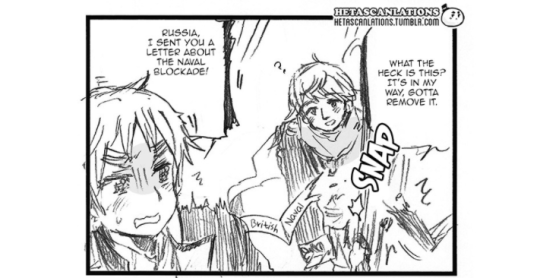

Either way, the two countries don’t hate each other,
regardless of how tense their political relations were and still are. They even
acknowledge this tension as they spend time with each other in the present.
Russia in particular admits to how much America gets on his nerves.


Japan’s betrayal in WW2 caused China to develop a strong
grudge towards him.

Nonetheless, in recent strips, we do see China attempting to
reconcile with Japan through diplomacy.


The two are noted to fight like cats and dogs. Each nation
depicts each other in a negative historical light. They may have resented each
other, and still do from time to time. However, it’s not true, long-lasting hatred.

Ex: Hungary’s somewhat smug reaction to Romania and Bulgaria fighting with
each other.
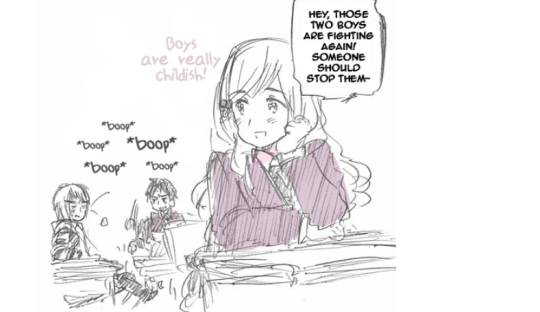
Regardless, they’re still capable of getting along.

The two bicker every time they see each other.

Comic gags
aside, the two still care for each other and are mentioned to be making some grounds
in their relationship.

Ex: Turkey’s form of bullying Greece is taking him to a
bathhouse and massaging him.

Switzerland yells at Japan to be more assertive and voice
his opinion. It has nothing to do with hatred. If anything, it’s an aggressive form of encouragement.


Romano suffers from an inferiority complex in comparison to
Veneziano, who received most of their grandfather’s attention. As such, he is
often very hostile to Veneziano, referring to him as “stupid little brother”,
or something similar to that depending on his mood.

However, this is only done to Veneziano’s face. When he’s
not around, Romano’s been shown on several occasions to look out for Veneziano.

Short story short, the two have been able to reconcile their
rocky relations in the years following the Revolution. England’s bitter and
scathing nature towards America has softened considerably over the years.
It’s said that England once suffered from one hundred years
of heartbreak, presumably a hint to the American Revolution.[x]
Ex: England still goes to America’s centennial celebrations, despite
how sick it makes him.

He also offers to fix a crack in the first liberty bell he
gave to America, and gives him another one for his bicentennial.

Ex: The two are close enough to make fun of each other’s
politics.

Canada doesn’t hate America. Instead, he hates America’s
egocentrism and often calls him out for this.

While these two are notorious for fighting, having their own
designated preserve to quarrel in…

…they can get along with each other just as well too.
Ex: France used to be England’s cook.

Ex: England proudly calls on France’s cooking skills again
when he opens a butler café.

Ex: A summary of how their relationship’s progressed.

The two don’t get along with each other.

However, that doesn’t stop them from spending Christmas together as ‘family.’ Prussia, of course, initially [teasingly] refuses to accept Austria and Hungary as guests.

…

Albeit the fact that it’s one sided, Prussia’s hatred of
Russia is deep. It’s probably one of the only case examples where it’s not a
matter of two nations simply not getting along.
Ex: Prussia will cough up blood if Russia touches him.
Either that, or he will lose four eyelashes.

With all that in mind, long-lasting hatred between nations
is rare in canon. Similarly, while current political relations may have an
influence on how nations interact with each other, the influence of the past –
on a personal level – is much greater.

All right, yeah. While this isn’t a novel theory or anything, I still think it’s important to point out that very few nations actually hate each other. Yes, there are periods where they do, but it’s not a deep-set hatred. I can only think of one example where it’s true hatred, and it’s only one-sided.
This isn’t strictly intended for ships, but it can certainly be used as a reference if you want to prove that the relationship dynamic is possible. I’ll touch on this later, but I want to reiterate again that the nations are cultural, not political representations.
Post coming up tonight.


I want to begin by pointing out that I’m simply presenting
canon information. That is, what we’ve seen
about religion in the strips.
Just because one nation follows the dominant religion of their
people doesn’t necessarily mean that they don’t hold their own beliefs or can’t
engage in the religious practices of other groups amongst their citizenry – all
I’m saying is that the latter point hasn’t been demonstrated in the series.
It’s also important to mention that the nations are
stereotypical personifications – they’re not characterized for specificity.
With all that in mind, religion in Hetalia encompasses a
generalized population rule. Similar to how they’re affected by the demographic
statistics of their citizens (e.g., their weight, income, behavioural habits),
the nations have also historically abided by the most dominant religion in
their country.
Since the Church used to be the Head of State, they would
have also been the respective personification’s boss.
Ex: We saw this with England, who spent some time on the run
from a Bishop who ordered him to cut his hair.

Ex: Prussia first emerged as a Catholic religious order.

As a reflection of his people and their beliefs, he was
therefore extremely religious.

Ex: There’s also Knights Templar, who likewise represented
a Catholic religious order.

The Polish-Swedish wars are a good example of how the
different religious orientations of the two countries are reflected in their personifications.


As mentioned above, the nations only follow a religion if it’s
prevalent within their population.
Ex: During the year 1000 [the Christian Millennium Apocalypse),
France and England truly believed that the world was going to end.
France feared going to hell. Because he thought they were both
going to die anyway, England fulfilled France’s last wish and pretended to be
conquered by him (ironic, considering that the Norman Conquest wasn’t that far
in the future).

Meanwhile, Hungary who had just converted to Christianity
that year, hadn’t yet acquired the religious beliefs that would have also made
her fearful of the so-called apocalypse.

Ex: There’s also this beautiful gem of a scene where Iceland’s
converted to Christianity. Note again how this happens only because his people
are being converted.


Ex: Despite being a secular state in modern times, France
still believes in God. This is seen in his encounter with Lisa, Jeanne d’Arc’s
reincarnate.

Ex: Ancient Rome ties up God so that he’s able to leave Heaven and visit Veneziano.


Ex: God visits Hungary in her dreams and orders her to hit
France with her frying pan.

Ex: God visits Estonia in his dreams and fulfills his
fantasy to be surrounded by girls.

Of course, this wouldn’t be a religion-based post without mentioning the Vatican. While he doesn’t have an official design and appearance, Hima does say what his personality would be like should he ever become canon.


Misconception:
Greece and Turkey genuinely hate each other.
Reality: They say
they hate each other, but their actions tell another story. It’s more like
they’ll break out into arguments whenever they see each other, despite being
too prideful to admit that they actually care for one another.
The whole Greece wishing death upon Turkey gimmick is used for
exaggerated comedic purposes.

To be as transparent as possible, they do get on each
other’s nerves. A lot.

Ex: They’re often compared to cats and dogs.


Regardless…
This doesn’t stop Turkey from checking in on Greece. He did
play a part in raising him, after all.

Ex: They’re noted to be making advances in their
relationship, but still break out into arguments easily.


Ex: Greece offers to be stripped naked during the Christmas
2007 event to prevent Turkey from having his mask ripped off by France [don’t
ask].

That’s not the face of hatred – it’s far from it.

When Turkey enters, with his mask taken off nonetheless,
only then does Greece get hostile.

How I see it was that he had no problem
looking out for Turkey as long as Turkey wasn’t there to witness this and later
have something to gloat about.

Ex: Turkey’s form
of “bullying” is taking Greece to a bathhouse to bathe him and remedy his stiff
bones.


Misconception:
His slow and languid form of speech must mean that he’s unintelligent.
Reality: Greece
is incredibly intelligent. His culture’s philosophies and sciences had and
still have profound influence in how humankind organizes itself today. His
laziness, aside from the Greek stereotype, also stems in part from that fact
that he’s a night person.


“The whole problem started as he joined the Euro zone.Thanks to Greece, Germany had to mobilize all his resources, and he is now fully dependent on him.
Despite this situation, he’s mostly eating good food, sleeping, thinking about philosophy, and is generally happy like usually.”
Misconception: Because he’s so absorbed in his mind, he’s a
recluse.
Reality: He’s one of the most sexually active aph characters
out there.
Ex: He’s very natural and forthcoming about the topic of
sex.


Ex: It’s hinted that he once slept with Japan, although
Japan dismisses this as a dream.

Bonus Facts:
Still on the topic of Japan, Greece shares a very close and
wholesome friendship with him.
The two have undergone many cultural
exchanges.

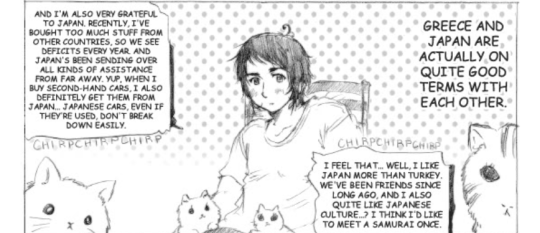
His hobby is excavating his mom’s ruins [Ancient Greece].


In an EU meeting, he once proposed to get rid of the concept
of debt.


 Ellawritesficssometimes