image
image

Keep in mind that the rules I’ve come up with here are not
canon. They’re simply just me compiling examples that form a consistent logic.

Overall, I’ve noticed two principle factors that causes the
nations to mature. There are other sub-principles that fall in tandem with
these categories.

1) They need a strong and autonomous economy, which
usually entails having a large population – If the nation is being taxed as a
colony, then they’re not economically autonomous.

2) They need to achieve political autonomy and
sovereignty (independence) – This includes a self-functioning and officially recognized
government.

Let’s go over a few examples.

America: 

At a young age, due to an early economic boom, we know that
America gained super strength. However, because his economy and legislatures
were authoritatively controlled by England, he grew weak for some time.

Now, notice how under England’s overbearing rule America’s
economy is strained. Not only that, but he looks considerably younger.

image

Then, look at him after he begins fighting for his
independence; there’s a notable increase in age between these two panels.

image

We also see this same growth spurt in volume 3, where
America ages exponentially right before he revolutionizes.

image

With control over his politics and economy, America was then
able to become an adult.

Admittedly, in the “Cleaning out the Storage” strip, America
admits that he feels like he’s becoming an “old geezer.”

Lithuania responds by telling him that he’s merely “becoming
an adult.”

Put into context, I interpret this as America maturing
mentally, as opposed to physically. From the example above, we know just how
dramatically he aged.

Likewise, what you’ll see in a moment is that America was considered
to be an adult well before the 1930s (around the time when the outsourcing
strips take place).

image

Canada: 

Canada is another good example of this autonomous economy/politics
requirement.

For one thing, he ages far slower than America, remaining as
a young child while the latter grew up at a faster rate. This is likely owed to
America’s larger economy.

That said, this proves the strong role that the total
strength of an economy overall plays
in the nations’ aging process. America and Canada were both under England’s
rule and were subjected to taxes, but because America’s economy [and
population] was larger, he matured more quickly.

image

The political autonomy rule is realized once Canada becomes
a Dominion (1867). While it’s not complete independence from Britain, it was
enough for Canada to physically mature from a teen to an adult.

image

Monarchies vs Constitutional Monarchies and Republics:

This is a more tentative example, but I’ve noticed that the
nations possibly could have aged as a result of a changed structure in their
governments.

Before constitutional monarchies or people’s republics, the
government was strictly run by the church and later monarchs, who ruled by
absolute divine right. Basically, the people had no say in their governments.

I mention this because in this strip here, we know that
Austria, France, and Russia are about 17-18 years old during the Seven Years’
war.

image

We know now that France is 26 and Austria is just a little
younger than Prussia, who’s 20↑

. We still don’t have a confirmed age for Russia
yet.

Nonetheless, the difference between now and then is that
democratic governments today are supposed to derive their power from their people (corruption
and tricky nuances aside, it’s the structure not the pragmatics that matters
here).

Starting in the late 18th century, this new era
of politics and the subsequent provision of constitutional rights might have
lent to stronger senses of national identities, thus causing the nations to
adapt and age in response.

We also know from France that the nations exist and therefore get
their power from their people.

image

Latvia:

With the following rules above applied, this explains why
Latvia remains so fragile, small, and young despite existing for far longer
than some of the other nations who are physically
older than him.

image

Latvia hasn’t historically experienced consistent political
independence and autonomy, and has been subjected to foreign control for much
of his existence.

His economy is also considerably poor. He lags behind in
industrial developments and remains largely dependent on agriculture.

image

So, before anyone says that Hima characterizes a nation’s
age for seemingly no reason, try applying these rules. I guarantee you that you’ll
find some sort of economic or political justification.

image

I’ve seen this question enough times where I think it’s
important to differentiate between a few things.

Misconception #1: That nations are a reflection of their governments.

This couldn’t be the more opposite. Countless times
throughout the series, the nations have been shown to do things against their
will. Right from the get-go, this rule is established in chapter 1 of World Stars.

image
image

The nations may not agree with their bosses, but they
nonetheless accept their fate, resign, and obligately listen and do what they’re
told–not that it makes it right, nor am I justifying it.

Likewise, the nations represent their people. Yes, they’re
political in the sense that they’re forced to work for their governments, but
it’s important to remember that they’re cultural and historical
personifications.  

They don’t represent the government. The nations represent
their people in whole; the government is only a small part of that.

image

In other words, likewise to the stereotypes they embody, the
nations are a symbol of their people’s cultural identity.

Think of it this way: when you identify yourself with a
national identity, is it predicated on the negative actions of your government?

No.

Then why apply the same faulty logic to the nations?

What the government does is not a reflection of that
nation’s culture. That said, it wouldn’t make sense to attribute the actions of
a political minority onto a cultural personification that represents the
majority. Not to mention that again, the nations are often forced to follow
their bosses’ orders.

Misconception #2:
Political Enemies = Personal Enemies

Remember that the nations themselves are people too.
Regardless of the wartime alliances they get involved in, they’re more often
than not able to transcend over them. While war may impact how they formally relate
to each other, it doesn’t impact the past that they’ve shared and experienced
together (spanning across decades, centuries, and sometimes even millennia).

So, while they may be enemies during war, when fighting
isn’t necessary, the nations will still interact and see each other as friends
above all else. Political relations between national leaders is more orientated
in the present, whereas due to long-established and developed relationships, the nations are more influenced by the past. However, that doesn’t mean that they hold grudges either. It just means that they have more to consider. 

image
image
image

Misconception #3: Tense Relations = Incompatibility

Like I said above, the nations are humans too. Yes, their
countries may not have had/have the best relations, but that doesn’t
automatically mean that the respective personifications won’t get along either.

The best example of this is how Russia and America interact
with each other, especially in modern
times. They may not be the best of friends, but they still share a considerably
familiar and comfortable relationship.

image
image
image

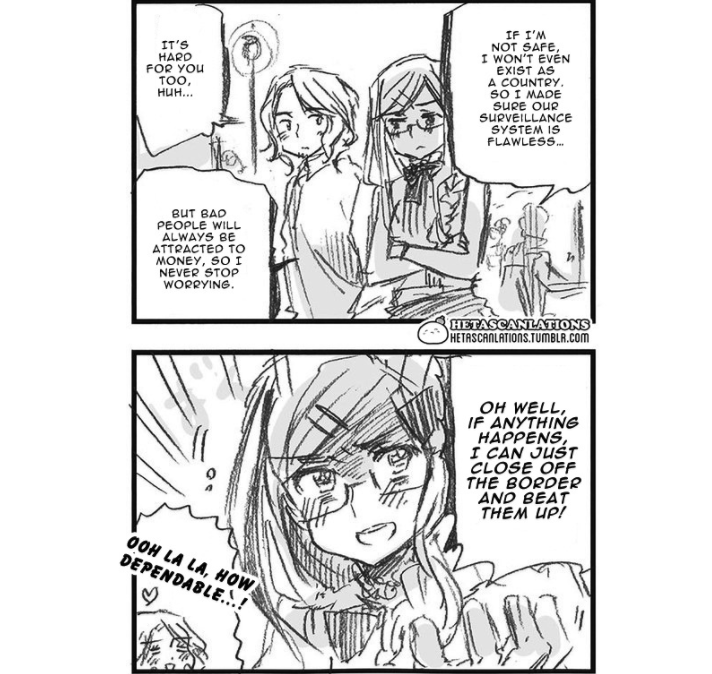
“What do you think of the new strip?”


I think it’s very
interesting, mainly because it confirms earlier conceptualizations of
nationhood!

Since Monaco isn’t a big
country and has a small population, they mainly rely on tourists to sustain
themselves.

image
image

However, because the
country is resort and luxury-based (i.e casinos, hotels), it doesn’t attract a
ton of people, as not many people can afford going there.

image

Instead, it attracts for
the most part richer classes, both good and bad. What Monaco and France are
discussing here with regards to public safety is that the corrupt rich people Monaco’s
attractions bring in threaten the possibility of other people wanting to visit
her country.

When she says that she
won’t exist if she’s not safe, she’s basically saying that she’s nothing
without people visiting her. Likewise, because she doesn’t have a large
population, her existence is heavily dependent on tourists.

So, it would follow that
Monaco needs to dispose of the dangerous classes by getting rid of them,
therefore upping her country’s safety and making it a more desirable place to
travel to.

This strip echoes what
we saw back in chapter 307, where France confirms that their nationhood derives
from their citizens.

image

In sum…

A nation is nothing
without their people. But, because Monaco is tourist-based, they comprise a big
part of her population, albeit temporarily.

She “doesn’t stop
worrying” because if corrupt tourists with money keep visiting her, it can act
as a disincentive for other tourists to visit.

There’s also an issue
with expensiveness that she has to tackle if she’s to attract more kinds of
people to her country.

image

Just a little question ! In your post about the magical capacities of nations, you said that England has the ability to show the fairies to anyone he wish… And for that you showed us the fantasy England comic strip. But in this one, he was sleeping and the faeries were surprised and afraid when they saw that someone else is able to see them. And Hima didn’t say that England has this power. So, for me, France can also see magical beings, no ?

This is an
excellent question, but to me, I felt like this strip was more open-ended in
how you interpreted it. That’s why I didn’t include France, as it wasn’t solidly
confirming anything.

Here’s the
full justification for it.

England’s
sleeping, surrounded by his fairie friends. Like you said, they get scared when
they hear France knocking on the door.

image

Judging by
France’s reaction here, this is the first time he’s seeing fairies.

Then, you
have England’s flustered reaction about France not knocking.

image

Taken together,
it seems like England letting his guard down by sleeping might have actually
activated his powers in allowing France to see the fairies. We’re only given
information about the fact that he has this ability when nations come to his house, not whether he can consciously
or unconsciously evoke and control it.

Of course,
with Hetalia, the one exception to the rule always seems to be Halloween. The
fairies/ ghosts have no problem showing themselves to skeptics then. 

Ex: France
encounters Napoleon’s ghost during the 2013-2014 Christmas Event.

image
image

America is far from dumb. I’ve
explained this many times before. But, if more examples are needed, I’m happy
to give them.

image

Despite being naïve and seemingly
simple-minded at times, the reality is that America is selective in his choice
to read the atmosphere. He’s also extremely intelligent.

Russia passive-aggressively gives
America a ticket to Siberia for his birthday. 

image

America later blows his nose with it.

image
image

America holds a vote regarding his proposal for a world defense plan. When he brings up the option of those disagreeing with him, he crushes bundled spoons as a form of intimidation.  

image

America was one of the busiest, most productive nations during the Second Industrial Revolution. 

image

He has an interest in archaeology and writes in his country’s newspapers.

image
image
image

There seems to be a lot of confusion and sometimes purposeful
misleading regarding what France means when he calls himself a “Big Brother.”

On one hand, you have people who have only watched the dub,
haven’t read a page of the manga, and worst of all, incorrectly declare that
France is related to all the nations who either call him big brother, or who he
claims to be the big brother of. There’s also people who know this is false,
but still use the misunderstanding as a way to immaturely elevate their own
ship and degrade shippers of the opposite kind.

To that, I say this: the dub is never canon. I totally get why
there’s a lot of misconceptions regarding the family tree, though. For example,
in the dub, Switzerland is referred to as France’s relative, meanwhile, in the
strip material, Switzerland is listed as France’s neighbor.

image

Again, don’t ever use the dub as a source. It’s like the
Wikipedia equivalent of canon material; it gives you a general idea, but in no
way is it totally correct. While I understand how limited the anime medium can
be in portraying all canon information, it’s still your responsibility to do
your research. 

That said, if you’ve read the manga, you would know that France
doesn’t have any siblings. That’s right. He’s not a big brother at all, but
rather, he’s listed as a big brother type. Likewise, he’s also referred to
himself as “the Big Brother of the world.”

image
image

In other words, because France is self-conscious of his age, he
opts to be a big brother mentor figure as opposed to identifying as an elder.
Although, admittedly, he has occasionally adopted a parental role. This is
especially the case with America, whom France expresses disdain at England for
raising so poorly.

image

Regardless, the following few strips demonstrate how France will
claim to be the big brother of literally anything.

Here, he deems himself to be the big brother of the reader. No,
I’m not kidding.

image

When he meets Lisa, Jeanne d’Arc’s reincarnate, he introduces
himself as “Big Brother France.”

image

The rest is pretty straightforward. Aside from the explicit
character description, there’s no possible way he would be related to them all
without it creating the need for other nations to be related to each other.

England:

image

Italy:

image

Germany:

image

Seychelles:

image

In sum, “Big Brother France” is not actually a big brother.

He’s a big brother figure.

image