Coming out of a difficult test like…


Fighting for petty reasons to their own
detriment despite also caring and holding a deep respect for each other [x].

“This just in! The French Revolution!
France is forced to wear unaristocratic clothing and dresses
like a commoner!”
England: Aw, pity. Alexa, play despacito.


What this post aims to do is capture England and France’s
relationship at its most basic core. Contrary to popular opinion, France and
England don’t hate each other. There is a discrepancy in what they say and what
they do and feel, and that’s a critical point to understand when examining
their dynamic. What best exemplifies this is a character note from Volume 1.
England is stated to have an “inseparable fight-friendship”
with France. In other words, the whole purpose of their relationship is
predicated on irony. The two ‘despise’ each other due to political ties and
personal disputes, while at the same time, they’ll also find themselves
inexplicably gravitating toward the other. Point is, even when they were
enemies, having grown up together, the two still hold a degree of familiarity that
has made them inseparable, regardless if they’re allies or enemies.
That said, I’ve organized their relationship into three main
themes. Let’s tie this back to the strips.
Of course, I have to begin with what they’re most known for:
fighting and bickering.
The two grew up as rivals and continue to be rivals in
adulthood. Remember that there’s a difference between being a rival and an
enemy. Historically, France and England bounced back and forth between being enemies
or not but always remained as rivals [x].


When they were younger, the comic gag was that France
desired to conquer England, whom he viewed as “uncute.”
While France did tease England for his hair and fashion, I
don’t think he realizes the extent that this has on England’s self-esteem.
England’s pride is too great to admit that France’s words affected how he
viewed himself, so it wasn’t exactly a topic that they brought up and discussed
openly [x].

Ex: England privately reflects on his lacking sense of refinement
after France mocks his sense of style.

Nonetheless, in the same strip, France still takes the time
to cut England’s hair, let alone compliment him, and reserves a matching clothing
piece for England to wear.


We also know that during the Norman Conquest, England became
a subordinate to France.
Ex: England isn’t willing to admit to young America that
France used to cook for him during this period [x].

Another example that illustrates their rivalry well is how
France sided against England in the Revolution [x] [x].


What I take away from this is the differentiation between
the influence that politics has in the present experience of relationships
between nations versus the accumulation of history and experiences that affect
their personal relationships.
That brings me to my next theme.
As mentioned, while England and France fight and bicker
frequently, enemies or not, they would still be considered to be each other’s
right-hand man. Their history together runs deep. The opposite’s presence is
something that has always been a constant in their life. It’s for this reason
that I believe they always find themselves drawn to the other in a variety of
circumstances.
Ex: In WW2 when he’s occupied by the Nazi regime, England
takes France into his home.

Ex: When he opens a maid café, England has no qualms in
proudly declaring the cook of the establishment to be French [x].

Ex: In Volume 6, we see France reprimanding and confronting
England on how poorly he raised America.

Lastly, it’s no question that France and England declaring
that they hate each other is a misnomer. The discrepancies in their words and
their actions speak enough volumes to this.
Ex: When they thought the world was going to end in the year
1000, England decides to grant France’s wish and pretends to be conquered by
the latter.

Ex: In the middle of a brawl, France compliments the
material of England’s outfit, and, in return, England offers France a 20%
discount for the same material [x].

Ex: France plans to sightsee in England and asks England for
any hotel recommendations. While verbally refusing to give France the
recommendations, England still emails them to France [x].

Ex: In the well-known “Dream United Kingdom” strip, France
proposes to England after the Suez Canal Crisis wreaked havoc on their
economies. The intention was to establish a union between the UK and France [x].

What’s always interested me is that even though England was
vehemently opposed to marrying France, his reason for not doing so wasn’t an
outright rejection. Instead, he claims that he didn’t want to marry France for
the lame reason of ameliorating their financial circumstances.
In sum, while France and England may be rivals and
extensively get on each other’s nerves, to only look at them in this light
would be to wrongly stereotype their relationship. The two have an interwoven
complex of friendship and rivalry; both components are necessary if their
dynamic is to be looked at in whole.


2) explain
fruk to the less enlightened pls
3) Hmmm…
Could you start a friendship series too? I think we all focus too much on the
potential romance between the pairings and not the meaningful bonds that they
share with one another. For instance, I would love if you could do a post on
Fruk’s friendship, a friendship that’s very underrated amongst the fandom. I
mean yes, they do fight like no other, but throughout the years they’ve really
formed a deep mutual respect, in their own way. Just, what are your top Fruk
friendship moments?
4) could
you talk a bit about france and england’s relationship pls? I love your
psychtalia things!
(Thank you!!!)
I’m going to cover Fruk from a friendship perspective, as I’ve promised before. I think it would be a good idea to go over certain relationships before looking at the easter eggs that slightly hint at romance.
Post coming up tonight!

Jesus Christ, you guys are super sweet. Thank you 😀
I would just like to point out that I’m going to be brief here. I’ve already covered this topic and don’t typically re-answer questions. I have a post directory and it’s your responsibility to read it along with the ask guidelines before you send in an ask! [x]

Anon 1: Any material that isn’t deleted is still canon, which includes the old characterizations, unfortunately.
What I can’t stress enough is the use of discretion in recognizing that the way the characters are portrayed is far different now. Years of material have consistently proven that Himaruya’s learned from his mistakes and has grown as a creator.
It’s just as wrong to hold on to previous characterizations as ‘evidence’ as it is to completely ignore and deny their existence.
Anon 2: It’s not a DNA/ deterministic behaviour type of thing. My understanding is that it stems from custom and tradition.
We’ve seen this before with America. How he behaves in world meetings goes against conventional norms.

Notice how Russia mentions that they’re [as in those nations who are older than America] are bound by tradition, (Together with Russia, Volume 5).

From what I can recall, there is one instance where a nation goes against their bosses’ wishes.
Occurs during the Anglo-Japanese Alliance Arc…
Japan claims that his boss “went on his own accord” in speaking to Russia and apologizes to England, who at the time didn’t have good relations with Russia [x].


Anon 3: That’s one thing about Hetalia that’s a bit confusing. Its rules are flimsy and there are several exceptions. Perhaps with France the matter was the question of the legitimacy of the government.
Anyways, we do know what happened to him in canon. He went to live with England after the Nazis occupied him (Volume 5, Liberté, Égalité, Fraternité and…)


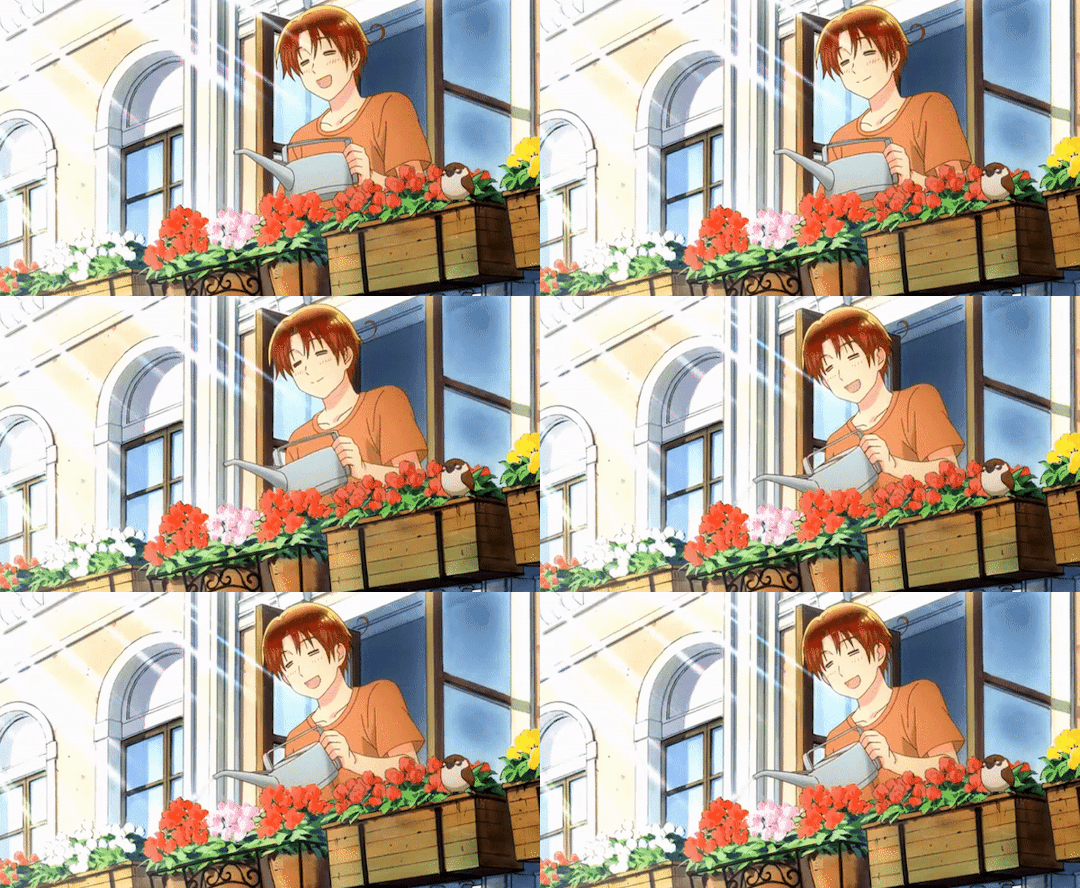
This post will explore how openly and inclusively concepts of
love and sexual attraction are depicted in the manga. While the nations don’t
have canonically assigned sexual orientations—of course, with the exception of Sweden—
it’s the fact that there is a representation of diversity within the series
that matters. Obviously, the term ‘Sexualities’ in the title is used very loosely
for lack of a better word.
In no way will these be all examples included in the manga, but this
should provide a good scope for understanding how Hetalia approaches human sexuality
and the capacity to love.

England is once described by France as being aroused by anything [x].

In the infamous Buon San Valentino strips, a series of
mishaps occur where Germany misinterprets his relationship with Italy to be a
romantic one and proposes to him (really???).
Regardless of the misunderstanding, what matters is that Germany was okay with
the idea of entering a same-sex relationship [x]. Not only that, but he had totally committed himself to it.


In a volume 2 character note, France is said to go for “guys
and girls of all types”, including non-humans “as long as they’re beautiful.”


In the 2007 April Fools’ event, we also learn that he may
have a preference for “macho men.”
Both are notorious for being girl-lovers, without a
question. It’s part of the Italian stereotype [x] [x].


On the other hand…
Italy admits to Germany in Buon San Valentino that his first
love was a guy, presumably referring to Holy Rome [x].

In a Volume 2 character note, it’s left open-ended on
whether Romano has a taste for men.


Bonus:
Spain quasi-proposes to Romano when gay marriage is legalized in his country [x].

Sweden remains as the only aph character to possess a canon
sexuality. He’s homosexual, but only feels this way toward Finland. It’s
one-sided, as Finland doesn’t reciprocate this sentiment [x].

Strips have suggested that Taiwan may be attracted to women.
In the Christmas 2011 event, she’s unable to concentrate due
to the exposure of other female nations’ cleavage.

In the Halloween 2013-2014 event, she checks out other
female nations.


Any time, and not quite!
France sides with his
people after the Revolution. The rule of thumb is that whoever is in power acts
as the personification’s boss.
In the case of the French
Revolution, there was a shift in government from the divine rule of the French
Monarchy to the alleged democratic rule of his people. (Didn’t really play out
that way, oops.)
You see France suffer
from the turmoil of the Revolution on the sidelines as his people overthrow the
government [x].

It’s only after the
people are in power, in the government more importantly, that he sides and celebrates
with them.
He later tries to convince other European nations with monarchies to let citizen-rule prevail. Instead, they perceive him as a threat; abolishing monarchies would be an end to the social order that had organized their lives for so long.


Russia is a clearer
example of how government changes are depicted.
He’s tasked with
quelling a protesting group of citizens during Bloody Sunday, despite evidently
not wanting to do it. Notice how he’s crying [x].
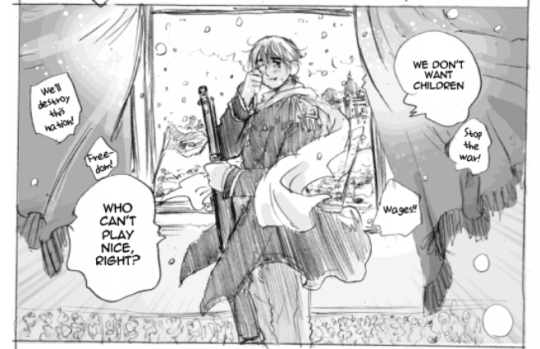
The process of changing governments
and respective boss changes is well demonstrated in chapter 61 of World Stars [x].


England: If you win, you better not rub it in, you hear me?
France: Who do you take me for? Of course I won’t!
*wins the World Cup*
France:

 Ellawritesficssometimes